Dramatic Cat-Eye Lashes: The Gradient, the Maps and the Anti-Droop Rule
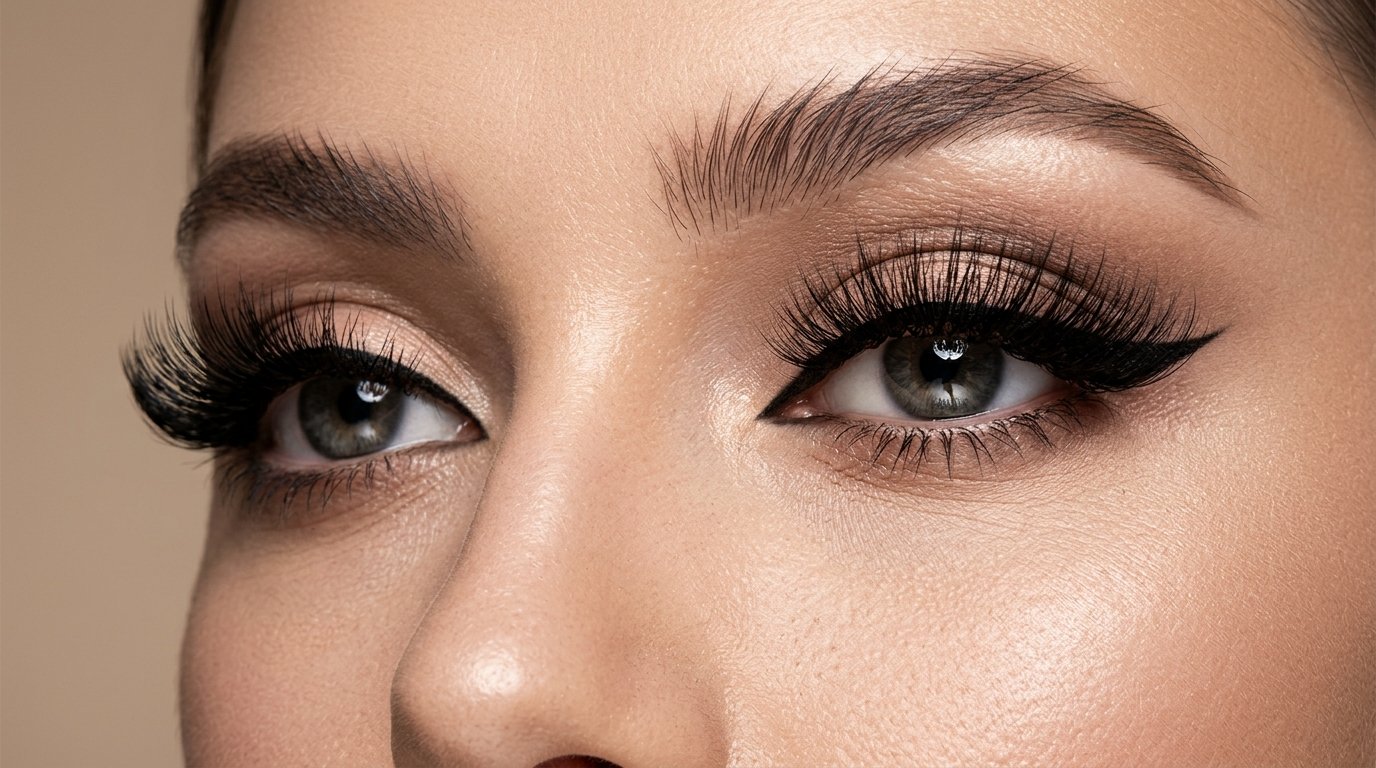
Dramatic cat-eye lashes are not a product. They are a shape: lash length that starts short at the inner corner, climbs steadily along the lash line, and peaks in the outer third of the eye.
That rising length is called the gradient, and it does the work eyeliner does with pigment. It pulls the eye outward, lifts the outer corner, and creates the elongated, feline line the style is named for.
Everything else is a dial. Three dials set the drama: the peak’s length, the climb’s steepness, and the curl’s strength at the peak. Turn one up and the same map goes from office soft to red carpet.
Quick answer: for extensions, ask for a cat eye map rising from 8 to 9mm at the inner corner to a 14 to 16mm peak placed just before the outer corner, in C or D curl. For strips, buy a flared style whose longest fibers sit at the outer end. The full maps, curls and fixes are below.
One correction runs through this page, because it decides whether the look lifts or droops. The longest lash does not go on the very last lash. It goes just before the corner, and the final segment steps down. Hold that thought; it gets its own section.
What Makes a Lash a Cat Eye?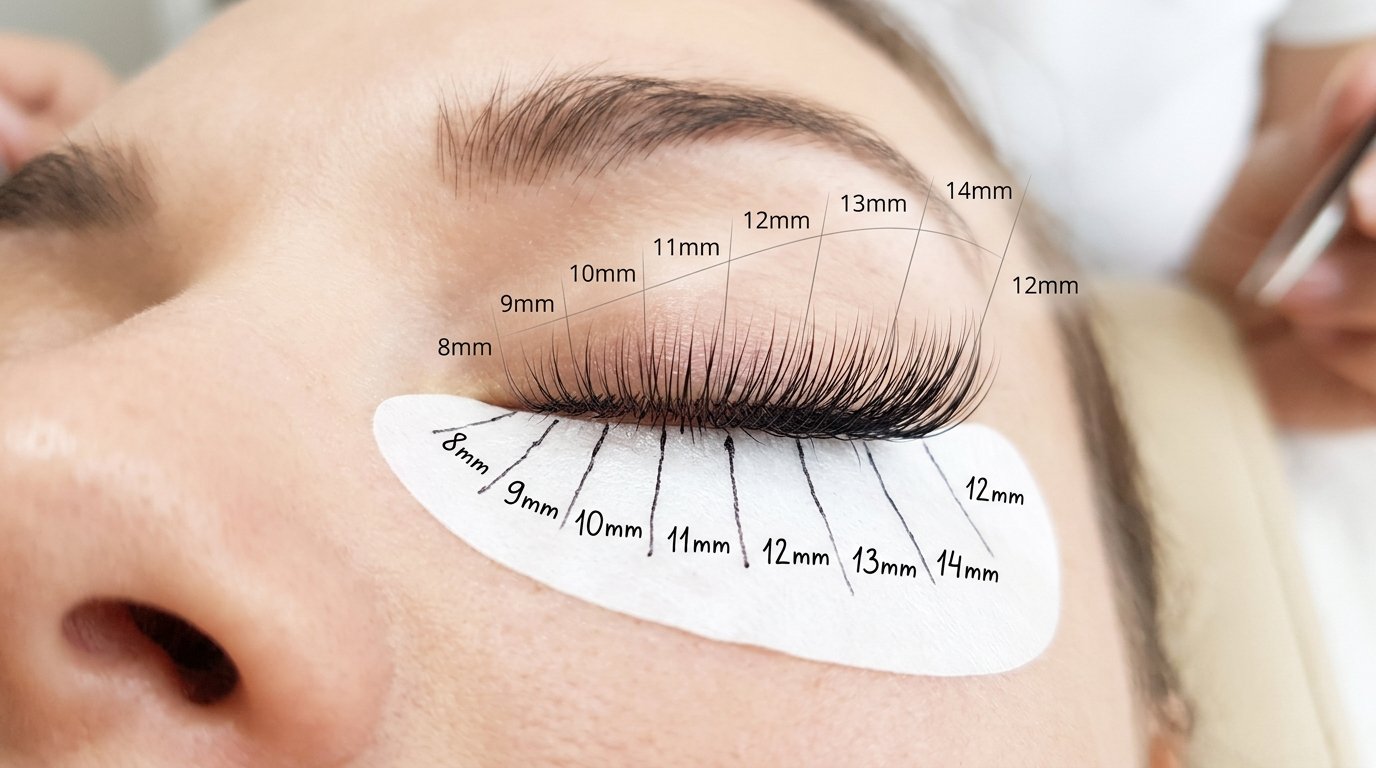
A cat eye is defined by where the length lives. In a natural or open eye map, length is distributed evenly or peaks at the center. In a cat eye map, the peak sits in the outer third, and every zone before it is shorter.
The effect is optical, and an Australian retailer’s style guide states the principle cleanly: the cat eye works through elongation and contrast, extending the lash line outward and slightly upward so the eye reads longer and more lifted. Fake Eyelashes’ winged and wispy guide builds its teaching on that pair.
Contrast is the second ingredient. A wispy cat eye mixes lengths deliberately, longer spikes inside a shorter base, so the line reads feathery rather than solid. A smooth cat eye keeps the gradient clean for a velvet finish. Both are cat eyes; the texture dial differs.
The Three Drama Dials
- Peak length: the longest zone. Classic sets peak at 14mm; volume sets at 16mm; the most aggressive published strand reaches 18mm at the outer corner
- Gradient steepness: how fast lengths climb. A gentle 8 to 14 climb reads elegant; a jumpy climb with spikes reads editorial
- Curl at the peak: C curl lifts softly, CC steps up, D is the drama curl. The peak wears the strongest curl in most published maps
Notice what is not a dial: thickness alone. A dense set with an even length line is a volume look, not a cat eye. Shape first, then volume.
The Anti-Droop Rule: Peak Before the Corner
Here is the rule, stated the way two independent sources state it. Place the longest length slightly before the very last outer corner, then taper the final segment down by 1 to 2mm.
The salon supplier guide behind the classic map teaches the same geometry from the technician’s side: keep the outer tip 1 to 2mm shorter than the peak to prevent drooping. Swaniya’s cat eye extensions guide pairs that rule with its zone method, dividing the lash line into 6 to 8 zones so the taper is planned, not improvised.
The mechanics are simple. The outermost natural lashes are the finest and weakest on the line and point downward on many eyes. Loading them with the longest, heaviest extension drags the corner down, and the eye reads sad instead of snatched.
The DIY mapping community found the identical fix independently: its soft wispy system is built on an anti-droop strategy, never letting the very last section be the heaviest. When a supplier manual and a home mapper agree, treat it as close to consensus as this topic gets.
Apply the rule in every format. Strips: choose styles whose flare peaks before the band’s end, or accept the end segment as the taper. Clusters: place your longest cluster one segment in from the corner. Extensions: say the words taper the tip to your technician.
The Four Maps, Compared
Published cat eye maps disagree with each other, and this page prints them as strands with sources instead of crowning one. Choose by the drama you want.
|
Map (strand) |
Lengths, Inner to Outer |
Curl Pairing |
Character |
|
Classic (salon supplier strand) |
8, 9, 10, 11, 12, 13, 14mm |
D at the outer zones; L or L plus named for straight lashes |
The textbook gradient: even climb, elegant peak, the safest salon ask |
|
Volume (lash tech post strand) |
8, 8, 10, 10, 12, 14, 16mm |
C curl fans in the published post |
A fuller base with a higher peak; the drama comes from density plus length |
|
Bold short (same tech post) |
9, 10, 11, 12, 14mm |
Posted as a bolder outer corner concept |
Fewer zones, faster climb; suits smaller eyes that cannot carry 16mm |
|
Wispy (tech post system) |
Base fans 10 to 15mm; spikes 13 to 16mm laid over |
CC or D base; D spikes, with 14mm the signature spike |
Texture is the drama: a soft base with deliberate longer spikes, spaced, not clumped |
A fifth strand prints with a warning. One explainer publishes inner 10 to 12mm in C, middle 12 to 14 in CC, outer 16 to 18 in D: the aggressive strand, starting long, ending longest, ignoring the taper. On strong natural lashes and large eyes it can look editorial. On everyone else it is the map most likely to droop.
The Two Layer Logic Inside Every Wispy Map
Wispy is not random. The posts describe two layers: a base layer of fans supplying soft fullness, kept shorter through the middle, and a texture layer of spikes, the longer closed fans that create the flicker. One soft build keeps fans at 8 to 13mm and runs all spikes at 14mm.
Diameters follow the layers in the explainer strand: 0.03 fans for the base, 0.05 spikes for the texture. The principle matters more than the numbers: the visible layer runs longer and slightly heavier; the layer underneath stays light so the set can carry it.
Curls by Job
Curl decides how much length you actually see. A long lash in a weak curl points outward and reads shorter; the same length in D curl stands up and announces itself.
|
Curl |
The Job It Does |
Best Use in a Cat Eye |
|
C |
Everyday lift, soft and forgiving |
Full sets for a wearable gradient; the base of the published volume map |
|
CC |
A step up in lift without full drama |
Mid zones and wispy bases; opens the eye while staying natural |
|
D |
The drama curl; strongest visible lift |
Peaks and spikes; the most popular choice for cat eye sets in the salon strand |
|
L and L plus |
Flat based lift for straight or downward growing natural lashes |
Outer corners that must stay visible; named in the salon guide for exactly this problem |
Mixing is normal practice in the published maps: C curl fans with D curl spikes is the tech post’s own suggestion for readers who want texture without a fully dramatic base. Ask for the mix by name and the set lands where you intended.
Cat Eye by Format: Strips, Clusters and Extensions
The gradient survives translation into every format. What changes is cost, wear time, skill and risk.
|
Format |
How the Cat Eye Is Built |
Wear |
Skill and Risk Notes |
|
Full strip lashes |
Buy the gradient ready made: flared styles carry the longest fibers at the outer end |
One day per application; pairs are reusable with care (a 5 to 10 uses strand on one published fox eye strip) |
Beginner friendly; the risks are glue sensitivity and a visible band, both manageable |
|
Half strip lashes |
The gradient applied only to the outer half; the inner half stays your own lashes |
One day per application |
The easiest drama in the set: less band to hide, less weight, and the blend point is the only skill |
|
Cluster lashes |
You build the gradient segment by segment under the lash line with bond and seal |
Several days per set in the product category’s terms |
Intermediate; removal must follow the product method so clusters slide off without pulling naturals |
|
Salon extensions |
A technician maps the gradient lash by lash: classic, hybrid or volume fans |
Weeks, with fills on the salon cycle, commonly every 2 to 3 weeks in salon guidance |
Professional application and removal only; the natural lash load rules live here |
Strip Specs That Actually Create the Shape
Shop by spec, not by the word dramatic on the box: flared or winged in the style name, fibers visibly lengthening toward one end, and a band you can work with. Cotton bands flex and trim easily; invisible bands disappear but show placement errors.
Published strip drama, printed as product claims: fluffy strips marketed at 18mm, a fox eye strip at 20mm with spiky fibers and D curl construction, and a flared statement strip at 25mm. Those are the lengths brands print; what they look like on your eye depends on your eye’s size, which is why the pick guides that show photos earn their place. Beauty Explained’s cat eye picks state the honest rule plainly: compare the shape in photos and fit, because no lash creates the strongest effect on every eye.
For a subtle cat eye, the social strand recommends 9 to 12mm with C curl character. Most faces live between 13 and 17 at the peak.
The Eyeliner Partnership
Lashes and liner are one gesture in this style. The gradient already draws the wing’s line; liner’s job shrinks to filling the band line and extending the flick a few millimeters past the corner, in the direction the peak points.
That is why this page sits beside the site’s eyeliner work. The grunge eyeliner looks guide covers the smudged, lived in version of the same eye, and its wing teaching transfers directly: the flick follows the lower lash line’s angle upward, never straight out.
For photo looks, let one feature lead. The shoots behind our balayage hair color ideas and our cherry cola brunette guide both let the eye lead and keep hair glossy rather than busy.
Cat Eye by Eye Shape
This section builds on the Australian style guide’s eye shape teaching, the best in the research set, with the map adjustment each shape needs.
Almond Eyes: The Native Shape
Almond eyes accept the pronounced wing without adjustment; the classic and volume maps run as published. Your only decision is drama level. Choosing a first map, start classic: it is the shape your eye already draws.
Round Eyes: Elongate, Do Not Widen
Round eyes gain from the cat eye’s outward pull, and the guide’s phrasing is exact: they can be elongated upward to carve out more lid space. Keep inner zones short (the 8 to 9mm start matters for you), let the gradient climb steadily, and avoid doll eye maps entirely, since a center peak widens what you are trying to lengthen.
Hooded Eyes: The Corner Must Peek
Hooded eyes benefit from a lifted outer corner that peeks when the eyes are open, in the guide’s words. Two adjustments make it real: favor curl over length (D curl at the peak shows above the fold; extra millimeters hide inside it), and consider the squirrel adjustment below when the fold is heaviest at the corner itself.
Downturned Eyes: Where Squirrel Beats Cat Eye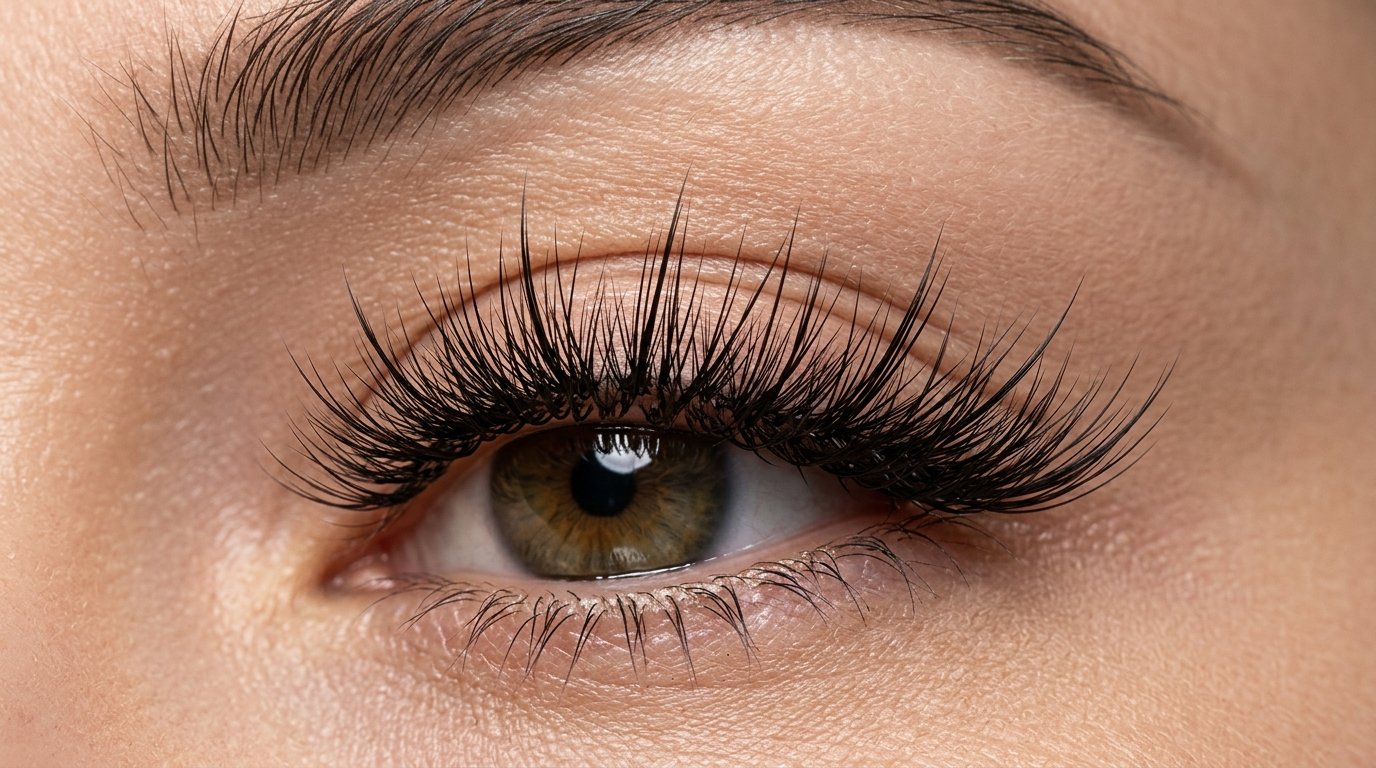
This is the honest exception. On downturned eyes, a classic cat eye’s peak at the corner can drag the eye further down, because the longest lash lands exactly where the eye already falls. The salon guide names the fix: a squirrel map, peak at the outer center rather than the corner, lifts instead. If your corners tilt down, ask for squirrel and borrow the cat eye’s curl and texture.
Monolid Eyes: Band and Curl Strategy
The user experience layer contributes a rare note here: spider and spiky designs open monolid eyes without overwhelming the line, and thin bands blend best. Favor wispy texture over dense volume, and let spikes do the elongation work that a heavy gradient cannot.
Small and Deep Set Eyes: Scale and Flutter
Small eyes scale the map, not the idea: the bold short strand (9 to 14mm) exists for you, because drama is a ratio, and a 14mm peak on a small eye out-dramas an 18mm peak on a large one. Deep set eyes, per the style guide, shine with a wispy, fluttery finish toward the outer edge.
Applying Strip and Cluster Cat Eyes
Application decides whether the gradient you bought is the gradient you wear.
- Measure and trim first. Hold the strip against your lash line. Trim excess from the outer end on most flared styles, in tiny cuts, checking between cuts; the inner corner length is calibrated and cutting it shifts the whole gradient
- Curl and mascara your own lashes lightly first if you use mascara under strips; it gives the band a shelf and blends the two lines
- Apply glue and wait for tack. A thin line along the band, then patience until it turns tacky; wet glue slides, tacky glue grips. Black glue hides the band line, per the user strand, at the cost of unforgiving placement
- Place center, then corners. Set the middle of the band on the lash line first, then press the inner corner, then seat the outer corner last, angled slightly upward to follow the gradient
- Pinch and press. Pinch the strip and your own lashes together along the line with tweezers or fingers so no gap shows when you blink
- For clusters, work from the outer segments inward under the lash line, longest cluster one segment in from the corner, stepping down in length as you move in, then seal as the product directs
Corner lifting has three usual causes: the strip was too long (trim), the glue went on too wet (wait for tack), or the band sat on skin oil (cleanse and dry the lid first).
At the Salon: What to Ask Your Lash Tech
Salon cat eyes fail in translation more than in technique. Clients say dramatic; technicians hear a map. Bring the map. The tech posts are literally formatted as screenshots to show a technician, and bringing one is normal practice now.
- Say the style and the map: cat eye, with the lengths written out (the classic or volume strand from the maps table is a complete sentence)
- Say the curl: D at the peak for drama, or C fans with D spikes for texture with a soft base
- Say the taper: longest length before the corner, final segment 1 to 2mm shorter. This sentence alone prevents the most common cat eye disappointment
- Say your eye shape concern: hooded, downturned or small, and ask whether squirrel serves you better. A good technician would rather adjust the map than rebuild the set
- Ask the load question: are these lengths and diameters safe for my natural lashes? The answer tells you how the salon thinks
The salon guide anchoring this page’s maps, Swaniya’s cat eye extensions guide, is written for technicians as much as clients, which is why its language works in the consultation: zones, peaks and tapers are shared vocabulary.
Wear, Removal and Natural Lash Safety
Extensions are applied one extension to one natural lash by a trained technician, with lengths and diameters matched to what your natural lash can carry. That matching, natural lash load, is why the diameter numbers exist: a fine natural lash under a heavy fan sheds early or breaks.
Glue rules apply in every format. Patch test new adhesives as the product directs, keep glue out of the eye itself, and stop using any product that causes persistent redness, swelling or itching, seeking care for symptoms that do not settle. Adhesives are chemicals used millimeters from the eye; treat them accordingly.
Removal is where damage actually happens. Strips release with warm water or makeup remover and patience, never a pull. Clusters come off with their system’s remover so the bond dissolves. Extensions are removed professionally with a gel or cream remover that breaks the bond; picking, pulling or oil soaking at home tears natural lashes out with the extensions.
Between sets, naturals recover: a break lets the lash cycle complete. The site’s rosemary water for hair guide (publishing soon) covers the herbal routine readers ask about for hair and scalp care, with the same honesty standard about what is proven.
Sleep and handling round out wear care: extensions last longest when they are kept dry for the first day per salon aftercare norms, brushed gently with a clean spoolie, and not rubbed. The best healthy habits for women system on this site (publishing soon) makes the matching point from the health side: sleep position and pillow friction are beauty variables, not just comfort ones.
Common Mistakes
|
Mistake |
What Actually Goes Wrong |
|
Putting the longest lash on the last lash |
The weakest natural lashes carry the heaviest load and the corner droops; the taper rule exists to prevent exactly this |
|
Judging drama by millimeters alone |
Drama is a ratio of peak to inner length and eye size; an 18mm peak on a small eye reads costume, not cat eye |
|
Copying a screenshot map without your eye shape |
Maps assume a standard eye; hooded and downturned eyes need the curl and squirrel adjustments or the map works against you |
|
Trimming strips from the inner end |
The calibrated short end is destroyed and the gradient starts too long, poking the inner corner all day |
|
Wearing mascara over volume extensions |
Mascara clumps fans shut and breaks the wispy texture the set was built for; salon strands advise against it on volume sets |
|
Removing extensions by pulling |
Natural lashes tear out with the bond; professional removal dissolves the bond instead |
|
Asking for dramatic with no map |
The word means a different map to every technician; the screenshot and the taper sentence are the fix |
Every mistake is one mistake: treating the cat eye as a product name instead of a geometry. The geometry is learnable in one page, which is the point of this one.
Key Takeaways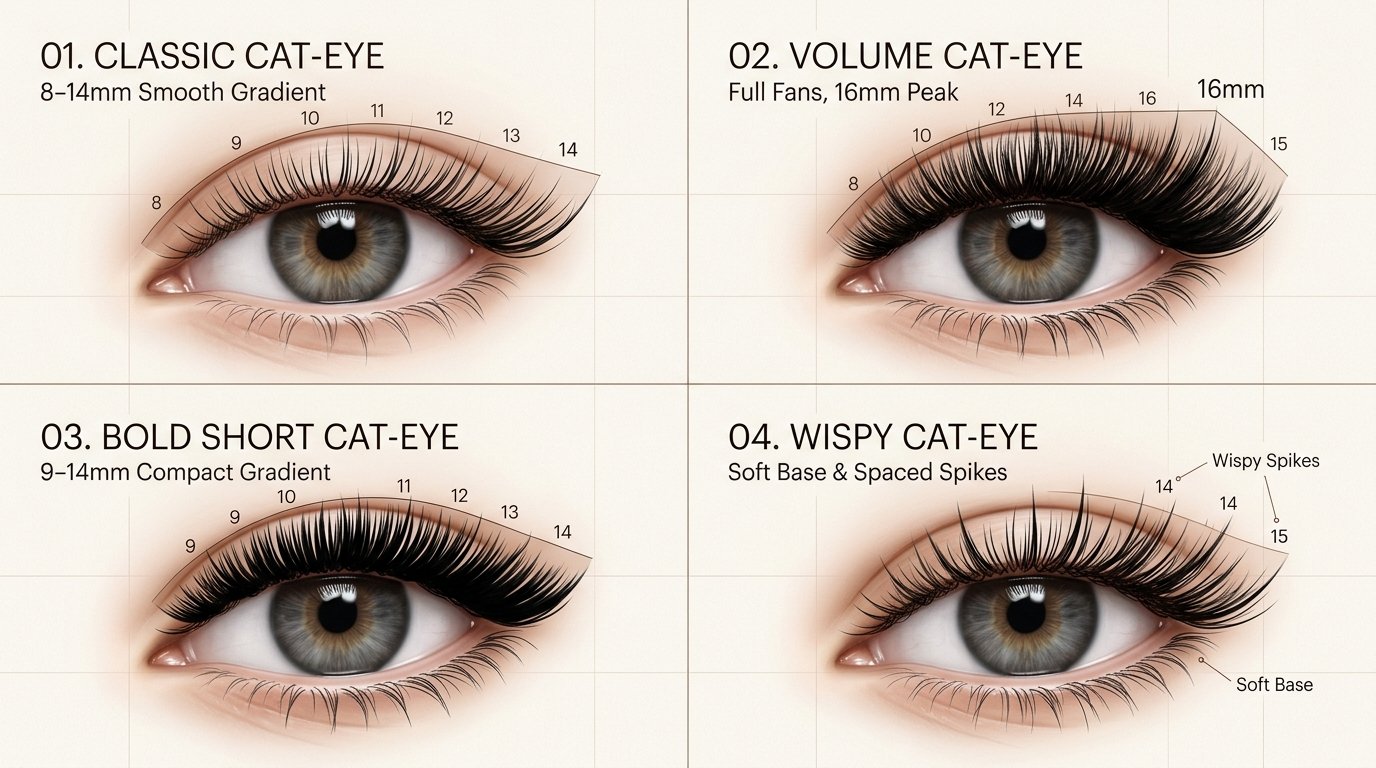
- A cat eye is a length gradient: short inner, peak in the outer third, and drama set by peak length, steepness and curl
- Peak before the corner, taper the tip 1 to 2mm. Two independent sources, one rule, zero droop
- Four published maps print as strands: classic 8 to 14, volume to 16, bold short to 14, wispy as fans plus spikes
- D is the drama curl; C and CC build wearable bases; L and L plus rescue straight or downward lashes
- Downturned eyes often need squirrel, not cat eye; hooded eyes need curl more than length
- Extensions are professional work at both ends: application and removal
Frequently Asked Questions
What are dramatic cat-eye lashes?
Lashes, in any format, whose lengths rise from short at the inner corner to a peak in the outer third, with the drama turned up: a longer peak (14 to 16mm in published extension maps), a steeper climb, and a strong curl such as D at the peak. The shape elongates the eye the way a wing of eyeliner does.
What makes a cat-eye lash different from a regular dramatic lash?
Placement of the length. A regular dramatic lash is dramatic everywhere: long, dense, or both, along the whole line. A cat eye concentrates its length and emphasis at the outer third, which is what creates the elongated, lifted line instead of an evenly glamorous one.
What is the difference between cat eye and fox eye lashes?
In product language, fox eye reads more elongated and straighter lined, the snatched extreme of the same family, while cat eye keeps a softer upward flick. Print it as a usage distinction, not a technical standard: sources use the terms loosely, and some products carry both names.
What lengths are used in a dramatic cat-eye lash map?
Strands, by map: classic 8 to 14mm, volume 8 to 16mm, bold short 9 to 14mm, wispy fans with spikes to 16mm, and one aggressive strand reaching 18mm at the outer corner. Inner corners sit at 8 to 9mm in the careful maps. Your technician scales the strand to your eye.
What curl is best for dramatic cat-eye extensions?
D curl at the peak is the salon strand’s most popular answer for cat eye sets, with CC for a softer result. C curl builds wearable bases and carries the published volume map. For straight or downward growing natural lashes, the guide names L or L plus, whose flat base keeps the outer corner visible.
What is a wispy cat-eye lash set?
A cat eye built in two layers: a shorter base of volume fans for soft fullness, and a texture layer of longer spikes laid over it at spaced intervals. The published system runs base fans around 10 to 15mm with spikes at 13 to 16mm in D curl, 14mm being the signature spike length.
What are spikes in a cat-eye lash set?
Spikes are closed or narrow fans left deliberately longer than the base layer around them, placed at planned intervals, concentrated from mid eye to the outer third in the cat eye version. They create the flickering, strip lash texture. Spaced and consistent reads wispy; clumped reads messy, in the tech post’s own warning.
How do I get a cat-eye effect with strip lashes?
Buy the gradient ready made: a flared or winged strip whose fibers lengthen toward the outer end. Measure it against your eye, trim any excess carefully, glue, wait for tack, place the center first, then seat the outer corner last with a slight upward angle. The application section walks the full sequence.
How do I get a cat-eye effect with cluster lashes?
Build the gradient yourself, segment by segment under the lash line: longest cluster one segment in from the outer corner, stepping down in length toward the inner eye, following the taper rule. Bond and seal per the product’s method, and remove with its remover so clusters slide off cleanly.
Are half lashes enough for a cat-eye effect?
Often, yes, and they are the easiest route to it. A half strip carries the flared outer section only, so the gradient, the lift and the drama all arrive with half the band to hide and half the weight. The blend point where strip meets your own lashes is the only skill to learn.
Why do my cat-eye lashes look droopy instead of lifted?
The classic cause is geometry: the longest, heaviest lash sits on the very last outer lashes, which are the finest on the line and often point down, so the corner gets dragged. The second cause is a weak curl at the peak. Both have fixes, and the first is the taper rule below.
What is the anti-droop taper rule?
Place the longest length just before the outer corner, and make the final segment 1 to 2mm shorter than the peak. The salon supplier guide teaches it as droop prevention; the DIY mapping community teaches the identical strategy. It is the closest thing to consensus this topic has.
Do cat-eye lashes suit hooded eyes?
Yes, with adjustments: favor curl over length, since a strong D curl at the peak stays visible above the fold while extra millimeters hide inside it, and keep the corner lifted so it peeks when the eye is open. If your fold is heaviest at the corner, ask about the squirrel adjustment.
Do cat-eye lashes suit round eyes?
Very well. Round eyes are elongated by the outward pull, and the style guide’s advice is to elongate upward, carving out lid space. Keep the inner zones genuinely short so the gradient has somewhere to climb from, and avoid doll eye maps, whose center peak widens round eyes further.
Do cat-eye lashes suit downturned eyes?
Carefully, and sometimes not in its classic form. A peak at the corner can drag a downturned eye further down. The salon guide’s answer is the squirrel map, peak at the outer center, which lifts instead. Borrow the cat eye’s curl and texture, move the peak, and the family serves you.
Do cat-eye lashes suit small eyes?
Yes, scaled. Drama is a ratio: the bold short map strand (9 to 14mm) was published for exactly this. A 14mm peak on a small eye reads more dramatic than an 18mm peak on a large eye, and it will not overwhelm your proportions or brush your brows.
Do cat-eye lashes suit monolid eyes?
Yes, with texture leading. The user experience record notes spiky and spider style designs open monolid eyes beautifully without overwhelming the line, and thin bands blend best. Choose wispy spikes over dense volume, and let the texture do the elongation.
Can beginners wear dramatic cat-eye lashes?
Start with the formats in order of forgiveness: half strips first, then full flared strips, then clusters once application feels easy. Extensions are beginner friendly as a client, since a technician does the work, but bring the map and the taper sentence from the salon section so the result matches the picture in your head.
How do I trim strip lashes for a cat-eye fit?
Measure the strip against your lash line first, then trim the excess in tiny cuts, checking between cuts. On most flared styles you trim from the outer end, but check the style’s shape first: if the flare’s longest point sits at the very end, trim minimally and accept a slightly longer wear, or choose a half strip instead.
Which end of a strip lash do you trim, and why?
Usually the outer end, because the inner end’s short fibers are calibrated to sit comfortably near the tear duct. Trimming the inner end shifts the whole gradient outward and leaves the inner corner too long, which pokes and lifts. The exception is a style whose drama peak must be preserved at all costs; then size down the style instead.
How long do cat-eye lash extensions last?
The set grows out with your natural lash cycle, and salon practice runs on fills every 2 to 3 weeks to replace shed lashes and keep the gradient’s shape, since losing outer lashes first quietly erases the cat eye. Without fills, a set fades unevenly over roughly a month or more.
How much do dramatic cat-eye extensions cost? (strand answer)
Printed honestly: this research returned no verified US salon price list, so no figure is stated as fact. Salon prices vary by city, technician and set type (classic, hybrid, volume), with fills charged separately on the 2 to 3 week cycle. Check local salon menus for current pricing rather than trusting any article’s number, including this one.
Are dramatic lashes heavy or uncomfortable?
Correctly fitted, they should feel like very little. Weight complaints trace to three causes: lengths beyond what the eye or natural lash carries well, a strip band that was never trimmed to fit, or glue placed on skin instead of the lash line. Persistent heaviness or pinching is a fitting problem to fix, not a price of drama.
Can I wear dramatic cat-eye lashes every day?
Strips and clusters, yes, with removal and clean lids nightly. Extensions are worn continuously by design, with the fill cycle as the commitment. The honest caution is about your natural lashes and your appetite: daily maximum drama flattens its own effect, and most wearers keep a softer map for daytime and the dramatic one for occasions.
Do dramatic lashes damage natural lashes?
Not by category; by load and removal. Extensions matched to your natural lash’s capacity and removed professionally are the safe pattern. Damage comes from loads beyond the natural lash’s capacity, picking and pulling at removal, and cluster bonds ripped off dry.
How do I remove strip lashes and clusters safely?
Strips: soften the glue with warm water or makeup remover, wait, then lift gently from the outer corner; never pull a dry strip. Clusters: use the system’s remover product so the bond dissolves and segments slide off. If anything resists, add remover and time, not force.
Why should extensions be removed professionally?
Because the adhesive bond is broken by a formulated remover, applied with the eyes closed and the product controlled, in salon practice. Home attempts substitute picking, pulling and oil soaking, which remove natural lashes along with the extensions. The removal appointment is part of the service, not an upsell.
Can I wear mascara with cat-eye strips or extensions?
With strips, mascara belongs under the strip, on your own lashes before application, to blend the lines. Over extensions, salon strands advise against it, especially on volume sets: mascara clumps the fans shut, erases the wispy texture, and its removal friction shortens the set’s life.
Can I wear cat-eye lashes with glasses?
Yes, with a clearance check: very long peaks can brush lenses. Favor curl over length (a D curl peak reads dramatic while standing away from the lens), and test strip length with your frames on before an event, not during it.
How do I stop the inner or outer corner from lifting?
Work the three causes: fit (trim the strip to your line), glue state (apply at tacky, not wet), and surface (cleanse and fully dry the lid so no oil breaks the bond). Press and hold each corner for a few seconds at application, and carry a mini glue for event day insurance.
What glue should I use for dramatic strip lashes? (types, not brands)
By type: brush on adhesives give control for beginners; tube glues suit experienced hands; latex free formulas exist for latex sensitive users; black glue hides the band line while clear glue forgives placement slips. Choose by your sensitivity and skill, patch test new formulas, and let dry down to tacky before placing.
Should I patch test lash glue?
Yes, with any new adhesive, as the product directs: a small amount at a discreet skin site, watched for reaction over the stated period. Adhesives are used millimeters from the eye, and sensitivity shows as redness, swelling or itching. A reaction means that formula is not for you, in any format.
What is the difference between cat eye and doll eye lash maps?
The peak’s address. Cat eye peaks in the outer third and elongates. Doll eye peaks at the center of the lash line, opening and rounding the eye, the choice for eyes that want to look bigger and wider. Same tools, opposite geometry, which is why naming the map matters more than naming the drama level.
What is a squirrel lash map, and when does it beat cat eye?
Squirrel places the peak at the outer center, a few lashes in from the corner, then steps down. It beats cat eye on downturned eyes, where a corner peak drags, and helps some hooded eyes whose fold is heaviest at the corner. The salon guide names it for exactly these adjustments.
How many lash lengths are in a typical cat-eye map?
The classic strand uses seven lengths (8 through 14mm); the volume strand uses six distinct lengths across seven zones; the bold short strand uses five. Technicians divide the line into 6 to 8 zones and assign a length to each, which is what makes the gradient smooth instead of stepped.
Can I ask my lash tech for a specific map?
Yes, and you should. Bringing screenshot maps is normal practice now; the tech posts are formatted for it. Bring the map, the curl and the taper sentence, and let the technician scale it to your natural lashes and eye shape.
What should I tell my lash tech to get a dramatic cat eye?
Four things: the style (cat eye), the map (classic or volume strand, lengths written out), the curl (D at the peak, or C fans with D spikes), and the taper (longest before the corner, tip 1 to 2mm shorter). That is a complete brief.
Do longer lashes always mean more drama?
No. Drama is the ratio between peak and inner lengths, read against your eye’s size, plus the curl’s visibility. A clean 8 to 14 gradient with a D peak out-dramas a flat 16mm line on most eyes. Length is one dial of three, and the least subtle one.
How do I make a dramatic cat eye softer for daytime?
Turn the dials down one notch each: peak at 13 to 14mm instead of 16, C or CC curl instead of D, smooth texture instead of spikes, or the same strip style worn as a half lash. The shape stays; the volume of its voice drops, which is all daytime asks.
Can mature eyes wear dramatic cat-eye lashes?
Yes, and the lift is often the point. Choose lighter fibers and shorter peaks so the set lifts rather than weighs, favor curl for visibility, and keep the gradient’s inner start soft. On mature lids, a well tapered cat eye reads as an eyelift in lash form, which is why the style persists across decades.
What if one eye looks different from the other?
First, know that asymmetry is normal; most faces have a slightly different eye on each side. Technicians map each eye individually for this reason. With strips, trim each side to its own eye rather than matching the pair to each other, and judge the result at arm’s length, where faces are actually seen.
Are dramatic cat-eye lashes guaranteed to suit my eye shape? (honesty FAQ: no)
No, and no honest page will promise it. Most eye shapes have a cat eye adjustment that flatters them, and one shape family, downturned eyes, is often better served by the squirrel cousin. Fit, curl and taper decide more than the style name does. Anyone guaranteeing a result from a lash map is selling the map, not fitting your eyes.
Conclusion
Dramatic cat-eye lashes reward the reader who learns one geometry. The gradient rises, the peak waits in the outer third, the tip tapers, and the curl does the announcing. Every format you buy or book is that sentence in different materials.
Choose your strand honestly: classic for elegance, volume for fullness, wispy for texture, squirrel when your corners ask for it. Bring the map, trim the strip to your own line, and let the taper rule protect the lift.
The maps and matching eye makeup keep growing across FashionGleem. Start with the shape; the drama takes care of itself.

Dilawar is a contributing writer at Fashiongleem.com, focusing on beauty, hairstyles, skincare, fashion accessories, and personal grooming. He creates informative, easy-to-follow articles that help readers explore new looks, understand popular beauty trends, and improve their everyday styling routines. His writing emphasizes practical advice, useful product information, and accessible fashion inspiration for modern readers.