Baby Mullet Haircut: The Soft First Cut, Done Safely
A baby mullet haircut is either the hairstyle your baby grew by accident or the soft little cut you choose on purpose, and this page serves both, because most families meet the first version before they ever consider the second.
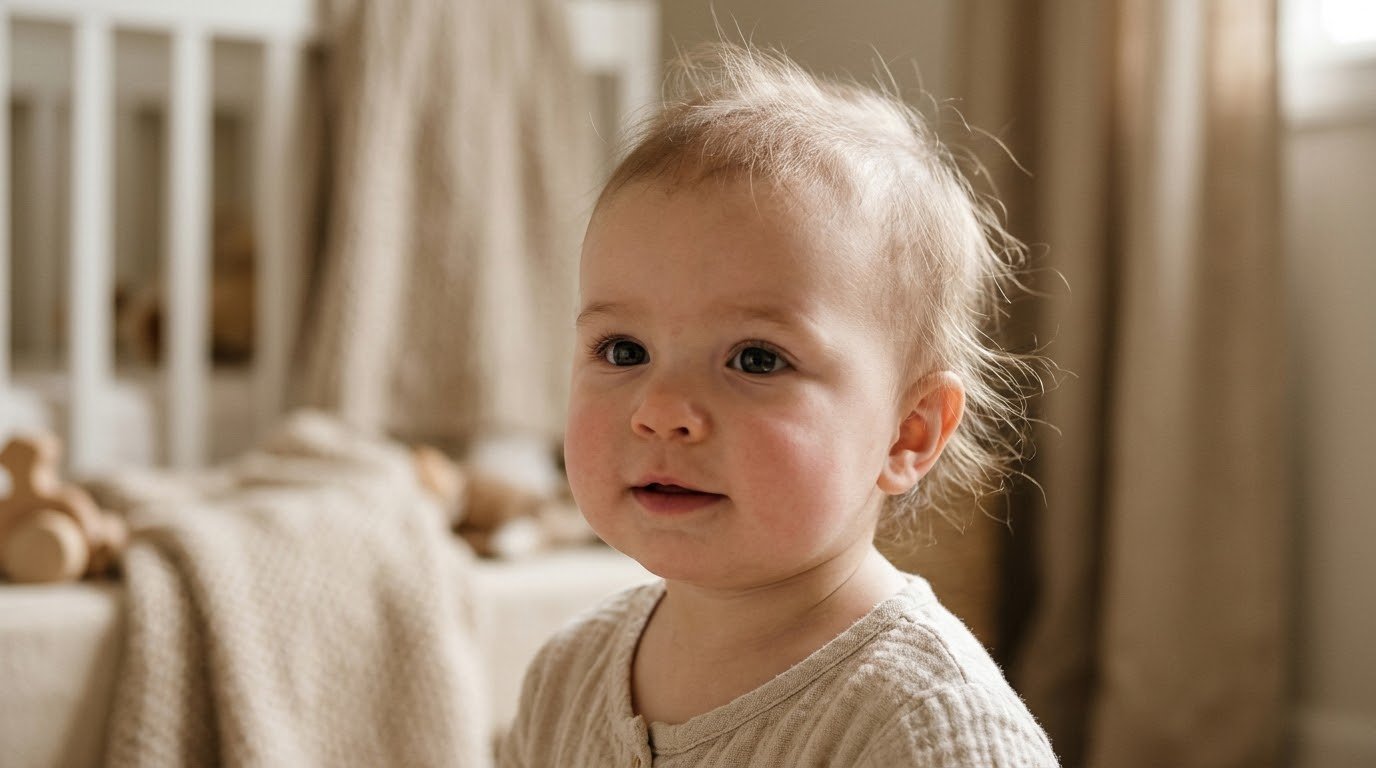
Newborn hair sheds unevenly. The top and sides thin or stall while the back keeps growing, and one morning the mirror shows a tiny mullet nobody ordered. That stage is normal, common, and temporary.
The intentional version simply shapes what is already there: a neat scissor cut front, soft sides, and a short back kept a little longer than the rest. Done gently, it is the lowest drama styled cut of the baby years.
What follows is written for parents, with the safety rules first and the style talk second, in the spirit of the wider hair library at FashionGleem. If a rule here ever conflicts with a gallery photo somewhere, the rule wins.
The Short Answer: Two Things Share One Name
The growth mullet arrives uninvited. Babies lose newborn hair in patches during the first months, growth rates differ around the head, and the nape usually wins the race. No cutting decision caused it and none is required by it.
The chosen mullet is a deliberate, softened shape: front and sides tidied with scissors, the back left roughly one to two inches longer in toddler guide terms, and every hard edge of the adult version removed.
Your first job is deciding which mullet you are dealing with. A parent shaping a growth stage needs permission and a tidy, not a full restyle. A parent choosing the cut needs the softening rules below.
Both jobs end the same way, with a baby whose hair is out of the eyes, whose back length looks intentional, and whose next grow out stage is already planned.
Why the Back Outgrows the Top
Newborn hair runs on its own schedule. Much of it enters a shedding phase in the first months, friction from sleeping rubs the back of the head, and regrowth starts at different times in different places.
The result is the classic uneven map: wispy or bare patches up top, a determined strip along the nape, and sides somewhere in between. One first haircut guide lists that back heavy shape as a standard sign that trim time is approaching.
Nothing about it signals a problem. It is the normal arithmetic of baby hair, and it resolves as the mature growth pattern establishes itself over the first couple of years.
Knowing this saves money and worry. The stage does not need fixing; it needs, at most, shaping, and only when the front starts bothering the baby or the back starts tangling.
Shape It, Grow It Out, or Cut It Off
Three honest options cover every family. The right one depends on what you actually like when you look at your baby, not on what a trend is doing this season.
|
Your goal |
The move |
What happens next |
|---|---|---|
|
Keep the charm, lose the scruff |
Shape it into a soft baby mullet |
Tidy every five to six weeks, back kept short |
|
Done with the look |
Grow it out into a layered toddler cut |
Awkward weeks, then length evens up |
|
Want it gone now |
Cut the back to match |
One even length, grows out as a classic toddler cut |
Shaping is the smallest intervention: the stylist evens the front, cleans around the ears, and trims the back to a deliberate short length. Ten minutes, and the accident looks like a decision.
Growing out asks for patience through a shaggy middle stage. Cutting it off is instant and tidy. Neither is a failure of the other, and you can change lanes at any appointment.
The Softening Rules: Translating the Adult Mullet
The grown up version lives in the house modern mullet guide, all contrast and attitude. A baby version keeps the silhouette and removes everything sharp, short, or styled about it.
Rule one: scissors first. A scissor cut is softer, quieter, and more forgiving on a moving head than clippers. Clippers are optional, guarded, and never the main tool for a first mullet.
Rule two: taper, never a skin fade. Galleries show faded toddler mullets, but those belong to older children. On a baby or young toddler, the sides blend gently with scissors or a long guard, and the scalp never shows.
Rule three: keep the back short. The toddler strands put the extra length at about one to two inches past the front. Longer backs tangle, mat during sleep, and turn a cute shape into daily work.
Rule four: no product styling. Whatever galleries suggest, a baby mullet is worn as it grows: washed, detangled, and left alone. Pomades and gels are for the adults in the permed hair mullet guide, not for under twos.
Readiness: The Signs That Gate the First Cut
There is no official age for a first haircut, and the sources refuse to invent one. Their ranges overlap rather than agree: many first cuts fall between about 8 months and 2 years, with some babies trimmed earlier and others not until age three.
Readiness is physical, not calendrical. The key sign is a baby who can sit up with steady head control, usually somewhere in the second half of the first year, because every safety technique assumes a head that mostly stays where it is put.
The practical triggers are just as clear: hair falling into the eyes, tangles forming at the nape, or a shape so uneven it bothers you in every photograph. Any one of them is a sufficient reason; none is an emergency.
Waiting is equally respectable. Wispy hair that stays out of the face can be left alone for months, and a later first cut is a calmer first cut for almost every child.
The readiness summary in the Mom Loves Best first haircut guide makes the same point parents hear from good salons: schedule around the child you have, fed, rested, and recently awake, not around a milestone chart.
The Session Playbook
Book the morning. Aim for 30 to 45 minutes after a meal, nowhere near nap time. A tired or hungry baby turns a ten minute trim into an endurance event for everyone holding still, which is nobody.
Budget 10 to 15 minutes of chair time. Tell the stylist the limit up front. A good kids stylist plans the cut in that window: front first while cooperation is freshest, back second, details only if the mood holds.
Bring the distraction kit. A favorite small toy, a snack for after, and a spare top for you both. Tiny hairs itch, and a fresh shirt ends the appointment happier than any styling could.
Expect imperfection and accept it. A first mullet on a moving baby is a shape, not a sculpture. The standard is safe, even enough, and kind, and any stylist chasing gallery precision on a one year old is optimizing the wrong thing.
Save the keepsake. Ask before the first snip if you want a lock of hair kept dry and aside. Salons do this daily, many with a certificate, and it is much harder to arrange afterward.
Tools and Safety, Without Negotiation
The tool kit is short and non negotiable: blunt tip or rounded tip safety scissors, a soft comb, a spray bottle for dampening, and a cape or towel. Everything sharp pointed stays in another room.
Never a razor on a baby. Not for the neckline, not for a cleanup, not in a professional’s hand or a parent’s. Baby scalps are soft, heads move without warning, and no aesthetic detail justifies the tool.
The technique that makes scissors safe is the fingers as guard method: a small section combed smooth, held between index and middle finger, cut beyond the fingers, so steel meets hair with your hand between blade and baby.
If clippers enter the picture at all, the toddler guide arithmetic is conservative: a No. 2 guard (6 mm) is the shortest sensible choice for little ones, No. 1 (3 mm) is too short, and quiet kids models exist precisely because the buzz startles babies.
The moment a child thrashes or twists, tools move away and the session pauses or ends. An unfinished haircut is a story; an injury is not. Every credible guide says some version of this, including the Expert Hairstylist baby boy haircuts guide.
What to Say at the Salon: The Baby Mullet Script
Stylists translate pictures imperfectly and words well. Walk in with the shape described in four short clauses, and show one photo as a backup, not as the specification.
The script: a soft baby mullet, scissor cut please. Keep the front neat and out of the eyes, sides blended softly with no fade, back left about an inch or two longer than the front, and the neckline left natural.
Add your constraints: ten to fifteen minutes of sitting at most, scissors only if clippers frighten your child, and a keepsake lock saved first if you want one.
Then say the sentence that licenses a good result: even and safe beats perfect. A stylist who hears that relaxes, works faster, and usually delivers a better baby haircut than one performing for a gallery.
The toddler gallery at Hairgleam toddler haircuts gallery shows the soft mini mullet this script produces: tidy front, gentle sides, and just enough nape length to read as a mullet at toddler scale.
Styles by Hair Type
|
Hair type |
Baby mullet version |
Tidy interval (guide strands) |
|---|---|---|
|
Straight, fine |
Soft mini mullet, feathered back |
About every 6 weeks |
|
Wavy |
Toddler mullet shape, scissor texture |
Every 5 to 6 weeks |
|
Curly |
Back kept in natural ringlets, front lifted clear |
Every 6 to 8 weeks |
|
Thick |
Back thinned by layering, never razor |
Every 5 to 6 weeks |
Straight and fine hair shows every snip, which argues for the softest version: minimal layering, a feathered back edge, and length judged dry, because fine hair springs up as it dries.
Wavy hair is the mullet’s home turf. The wave gives the back movement for free, scissor texture prevents a shelf like edge, and the shape forgives a wiggly appointment better than any other type.
Curly hair needs its length respected. One stylist guide cautions that wet curls stretch and the cut silhouette can shrink noticeably on drying, so lengths are set conservatively and checked dry. The ringlets at the back are the whole point; do not let anyone straighten the plan.
Thick hair needs weight managed with scissor layering through the back, so the shape lies down instead of puffing. The tool is patience, not thinning shears near a baby scalp and never a razor.
Girls, Boys, and the Same Soft Shape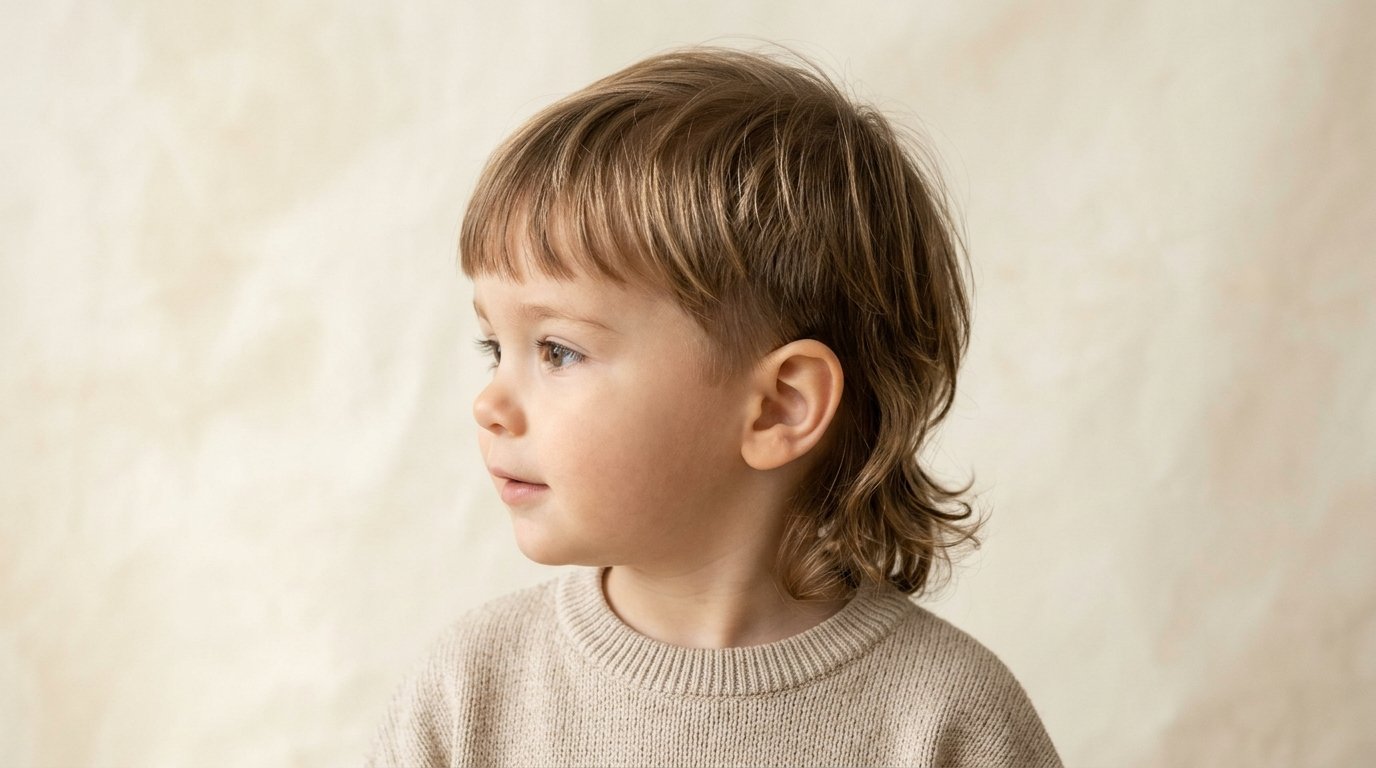
Nothing in the shape is gendered at this age. A baby girl mullet keeps the same neat front and short back, often with the front left slightly longer to sweep aside, and it grows toward the same layered toddler styles.
Parents of girls usually meet the growth mullet during a grow out from a first bob or while waiting for front length. Shaping the back buys tidiness without surrendering the length project.
The variations catalogued for older children, including the girls styles in the Modern Mullets kids hairstyles roundup, mostly wait for school age. Under three, the soft version is the version, for every child.
The Grow Out Path
A baby mullet’s best feature is its exit. Because the contrast is gentle, the shape relaxes into a layered toddler cut as the front and sides gain length, with no awkward cliff to survive.
The path runs in stages: the back stops being trimmed to mullet length, the front catches up over two or three tidy cycles, and one appointment quietly redefines the whole head as a shaggy layered cut.
From there the road forks by taste: keep growing toward a surfer toddler style, tidy into a classic short cut, or, for much later years, revisit the dramatic shapes in the house wolf cut guide when the wearer is old enough to choose them.
Parents who might want the back gone sooner should say so at the shaping appointment. A stylist who knows the exit can bias the lengths so the grow out takes weeks instead of months.
The Money and Time, Honestly Framed
Kids salons price first cuts as a service with ceremony: the chair, the certificate, the keepsake, and patience priced in. Prices vary too much by city and salon type to print a responsible figure here, and any exact number would be a guess dressed as data.
What can be said: a barbershop trim usually costs less than a specialist kids salon experience, and an at home tidy between appointments costs nothing but nerve. Choose by your child’s temperament, not by the photograph you hope to post.
Time is the real currency anyway. Ten minutes in the chair, a tidy every five to six weeks in the guide strands, and a minute of detangling after baths. A baby mullet that demands more than that has been cut too ambitious.
Mistakes That Undo a Good Baby Mullet
Booking at nap time. The single most common error, and the easiest to avoid. Every other problem on this list gets worse on a tired baby.
Asking for a fade on a toddler. The faded mullet photos are older children. Insisting on one under three trades the soft shape for harsh lines that grow out badly and date instantly.
Letting the back run long. Past a couple of inches the back tangles nightly, mats against car seats and pillows, and turns a low maintenance cut into a daily detangling negotiation.
Chasing symmetry on a moving head. Small unevenness is invisible in real life and in photographs. Repeated correction passes are how ten minutes becomes thirty and a calm baby becomes a former client.
Cutting at home with the wrong scissors. Kitchen shears and pointed craft scissors are the usual suspects. If a home tidy is happening, it happens with blunt tip safety scissors, tiny amounts, and the front only.
At Home Touch Ups: What Is and Is Not Yours to Do
Between appointments, parents can safely do exactly two things: lift the fringe a few millimeters when it reaches the eyes, and snip a single tangled tail at the nape. Both with safety scissors, a calm baby, and a hard stop at any protest.
Everything structural is salon work: the back length, the side blend, the overall balance. Home enthusiasm in those areas is how stylists earn their fix it appointment money, a category every kids salon quietly maintains.
An uneven home trim is not a disaster. Hair grows, the mullet shape is forgiving, and a professional tidy restores the lines in minutes. Bring honesty about what happened; stylists have seen worse before lunch.
The Myth That Will Not Die
Cutting a baby’s hair does not make it grow back thicker, faster, or straighter. The follicle under the scalp never learns what happened at the surface, and every credible source in this field says so plainly.
What cutting does is remove the fine tapered ends baby hair starts with. The blunter edge catches light evenly and feels fuller between your fingers, which is an appearance, not a growth change.
Decide about the mullet on looks, comfort, and upkeep, the honest criteria. A parent promised thicker hair by a haircut has been sold a story, and stories make poor reasons to put scissors near a baby.
Where FashionGleem Fits
The mullet family here runs from this softest member upward: the adult shapes in the modern and permed guides, the shaggy drama of the wolf cut, and the full hair style library for everything between.
This page owns the under three chapter: the growth stage, the softening rules, and the session that keeps a small person safe and mostly cheerful while scissors do quiet work.
When your child is older and asking for the bold versions by name, you will know exactly which rules to retire and which, like booking after breakfast, are for life.
Three Babies, Three Right Answers
The eight month old with a fringe problem. Her front hair reaches her eyes while the back is still wispy. She does not need a mullet at all yet; she needs a fringe lift and patience, and the shape can be chosen at the next visit.
The fourteen month old in full growth mullet. His back strip is long, his top is catching up, and the family loves the look in photos. He is the shaping candidate: ten minutes, scissors, back set to a deliberate short length, done.
The two and a half year old whose parents are finished. The back tangles daily and nobody enjoys the detangling. The right answer is the exit: back cut toward even, a layered toddler cut by the following appointment, no sentimentality required.
Same salon, same tools, three different plans. The difference was never the hair alone; it was what each family wanted the next three months to feel like.
Photographs: Getting the Picture You Imagined
Book the tidy three to five days before the photos, not the morning of. A fresh cut settles, any tiny unevenness stops catching your eye, and a bad mood on the day costs nothing.
On the day, the routine is water and fingers only: dampen, smooth the front aside, let the back fall where it grows. Product on baby hair photographs worse than it looks in the mirror, every time.
Bring the spare top to the shoot as well as the salon. The mullet’s back length makes a surprising number of neckline appearances on light colored outfits, and a clean shirt saves the retake.
And keep one unstyled photograph from the growth stage. Families consistently report that the accidental mullet picture, scruff and all, is the one that gets framed next to the polished first birthday shot.
Siblings, Twins, and Hand Me Down Haircuts
An older sibling’s mullet is a reference, not a template. Hair type, cowlicks, and growth speed differ between children of the same parents, sometimes dramatically, and the soft rules matter more than matching silhouettes.
For twins, book back to back appointments and cut the calmer child second if either is likely to learn fear from watching. Or cut the braver one first and let success be the demonstration. You know your children; the stylist will follow your call.
Matching outfits photograph beautifully with matching lengths, not identical cuts. Ask the stylist to equalize the back lengths and let each front follow its own growth pattern.
When the Mullet Meets Special Occasions
Christenings, weddings, and family portraits all create pressure to make the baby look a certain way on a certain day. The mullet handles this well precisely because its tidy version is its normal version.
Resist the special occasion upgrade: no first time fade, no new product experiment, no dramatically shorter back the week of the event. Familiar beats fancy at this age, in photographs and in person.
If the event involves hats, formal headwear, or a long car journey, expect the top to flatten and the back to tangle. Pack the small soft brush and accept the two minute refresh as part of the outfit.
The Second Haircut Is a Different Appointment
Everything gets easier. The child knows the chair, the stylist knows the head, and the shape from the first cut tells everyone what grew fast and what lagged, which is genuinely useful information.
Use it. If the back outran everything again, the mullet can be recommitted with confidence. If the front caught up, the second appointment is the natural moment to start the layered grow out.
Parents also relax, which children read instantly. The second cut is where the family routine forms: same salon, same time of morning, same snack afterward. Ritual is a styling tool at this age.
A Note for Grandparents and Other Stakeholders
First haircuts attract opinions the way christenings attract cameras. Someone will mourn the curls, someone will question the mullet, and someone will produce a photograph of a bowl cut from 1987 as evidence.
The parents’ call governs, and the soft mullet has one diplomatic superpower: it is reversible on a six week clock. Nothing about it is a commitment anyone needs to win an argument over.
If a grandparent wants a keepsake, offer them a second small lock from the back, cut by the stylist at the same appointment. It costs nothing, ends most negotiations, and spreads the milestone the way milestones prefer to be spread.
The Postcard Version
If this page shrinks to one card on the fridge, it reads: shape it softly, cut it safely, book it after breakfast, and let it grow out when it stops being fun. Everything else here is detail in service of those four instructions.
The baby will not remember the haircut. You will remember whether it was calm, and the photographs will show whether it was kind. Optimize for those two records and the style takes care of itself.
What Good Looks Like at Pickup Time
You will know the appointment worked before you see the back. The baby is unbothered, the front is clear of the eyes, and the whole head looks like itself, only tidier, which is precisely the brief.
Check the back in the mirror together: a short, even extra length, soft at the edges, nothing shaved, nothing sharp. If it looks like a smaller, gentler version of the shape you pictured, it is right.
One Last Reassurance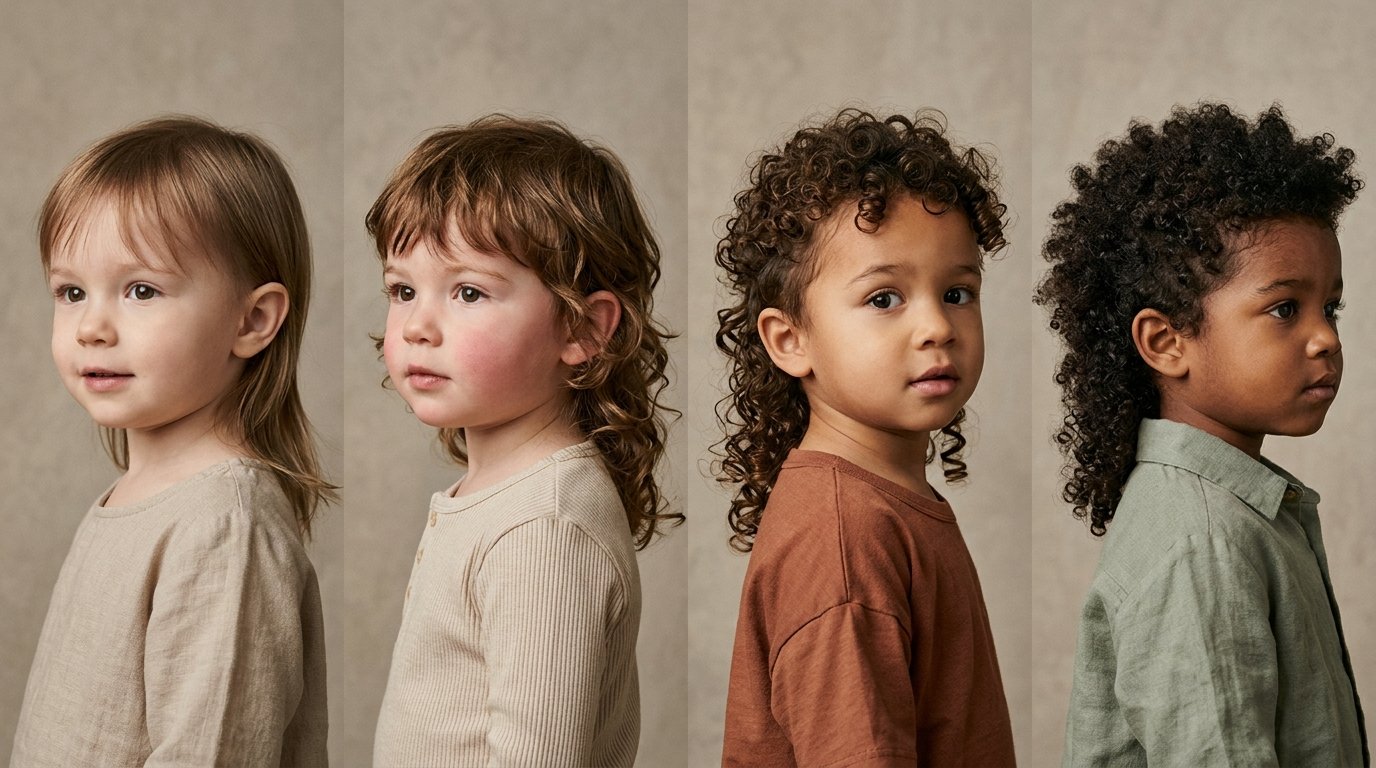
Somewhere tonight a parent is searching this exact phrase because a relative laughed at the back of their baby’s head. The record should show that the laugh is the tradition, the haircut is optional, and the baby, in every version of this story, is fine.
Frequently Asked Questions
1. What is a baby mullet haircut?
It is a short front with a longer back, softened. Neat scissor cut front and sides, a little extra length at the nape, and none of the adult version hard edges or styling.
2. Why is my baby hair longer at the back than the top?
Because baby hair grows unevenly. Newborn hair sheds in patches and growth starts at different rates around the head, so the back commonly outruns the top for a while.
3. Is the baby mullet growth stage normal?
Yes, it is a standard stage. Most babies pass through a back heavy phase in the first year or two.
It resolves as the mature growth pattern establishes itself.
4. What age can a baby get a mullet haircut?
When the child can sit steadily. There is no set age; readiness means sitting up with steady head control, and many first cuts happen somewhere between about 8 months and 2 years.
5. When should a baby have a first haircut at all?
When hair or comfort says so. Hair in the eyes, tangles at the nape, or a very uneven shape are the usual triggers.
There is no calendar date and no harm in waiting.
6. What are the signs a baby is ready for a first haircut?
Steady head, fed, and rested. Sitting up with good head control is the physical sign; a recent meal and a finished nap are the mood signs that make it work.
7. How long should the back of a baby mullet be?
About one to two inches longer. Toddler guide strands put the extra back length in that range.
Longer backs tangle and mat, so the baby version stays short.
8. Should a baby mullet have a fade?
Not a real fade, no. The baby version blends the sides softly with scissors or a long guard.
Faded mullets in galleries are older children, not toddlers.
9. Is a skin fade safe for a toddler?
Skin fades are not recommended for toddlers here. They are harsh, grow out badly, and sit outside the soft, safe approach every first cut source advises for this age.
10. Scissors or clippers for a baby mullet?
Scissors first, always. They are quieter, softer, and more forgiving on a moving baby.
Clippers are optional, quiet models only, and never the main tool for a first cut.
11. What clipper guard is safest for a toddler?
The No 2 guard, at 6 mm, is the floor in toddler guides. The No 1 guard, at 3 mm, is called too short for little ones.
Many parents skip clippers entirely and lose nothing.
12. What scissors are safe for cutting baby hair?
Blunt tip or rounded tip safety scissors. Purpose made for children, with no sharp point near a moving head.
Kitchen shears and craft scissors stay in the drawer.
13. Can I cut a baby mullet at home?
A small tidy, yes; the full shaping, carefully. Confident parents manage fringe lifts at home with safety scissors.
The back length and side blend are better left to a stylist.
14. How do I keep a baby still for a haircut?
Short, fed, and entertained. Book after food and sleep, bring a favorite toy, and accept a 10 to 15 minute limit.
If the mood collapses, pause or finish another day.
15. What if my baby is scared of clippers?
Switch to scissors and stop apologizing. The buzz and vibration startle many babies.
A scissor cut is silent, and a good stylist will happily change tools mid appointment.
16. How long does a baby haircut appointment take?
About 10 to 15 minutes of chair time. Tell the stylist the limit in advance.
First cuts are planned around a small child cooperation window, not adult appointment lengths.
17. When is the best time of day for a baby haircut?
Mid morning, after a meal. Roughly 30 to 45 minutes after eating, and nowhere near nap time.
A tired or hungry baby is the main cause of difficult first cuts.
18. How often does a baby mullet need a trim?
About every five to six weeks in guide strands. Mostly the front needs tidying while the back keeps its shape.
Curly versions often stretch to six to eight weeks.
19. Does a baby mullet grow out nicely?
Yes, that is its best feature. The gentle contrast relaxes into a layered toddler cut as the front catches up, usually over two or three tidy cycles.
20. What does a baby mullet grow into?
A shaggy layered toddler cut. From there families keep growing toward a surfer style, tidy into a classic short cut, or simply keep the soft mullet longer.
21. Does cutting baby hair make it grow back thicker?
No, that is a myth. Cutting does not change follicles or growth.
It removes fine tapered ends, so the hair looks and feels fuller, which is an appearance, not growth.
22. Why does baby hair fall out in patches?
Because newborn hair sheds on a schedule of its own. Much of it enters a resting and shedding phase in the first months, unevenly, and friction from sleeping adds patches at the back.
23. Can a baby girl have a mullet haircut?
Yes, the shape is for every baby. Girls versions keep the same soft front and short back, sometimes with a slightly longer sweeping front, and grow out identically.
24. What is a soft mini mullet for toddlers?
It is the gentlest named version. A soft mini mullet keeps the front and sides neat with just enough nape length to flick, suited to toddlers roughly two to four in gallery strands.
25. What is a toddler mullet fade?
It is the older toddler version with blended sides. Short top, softly faded or tapered sides, and one to two inches of back.
Under three, choose the scissor softened version instead.
26. Does a baby mullet suit curly hair?
Beautifully, with length respected. Curls give the back natural movement.
Lengths should be set conservatively because wet curls stretch and shrink back on drying.
27. How is a curly baby mullet cut differently?
It is checked dry and cut gently. Curly hair is usually assessed in its natural state, with small amounts taken and the dry silhouette confirmed before more comes off.
28. Does a baby mullet work on fine thin hair?
Yes, in its softest form. Fine hair shows every snip, so minimal layering and a feathered back edge work best.
Length judged dry avoids a too short surprise.
29. What should I tell the stylist to get a baby mullet?
Use the four part script. Soft baby mullet, scissor cut, front neat and out of the eyes, sides blended with no fade, back an inch or two longer, neckline natural.
30. Should a first haircut be at a salon or at home?
A kids salon for the first shaped cut. Specialists are set up for short windows and wiggly clients.
Home is fine for tiny fringe tidies between visits.
31. How do I save a lock of hair from the first cut?
Ask before the first snip. Stylists set a dry lock aside on request, and many salons add a first haircut certificate.
Keep the lock in an envelope or keepsake box.
32. What if the home trim comes out uneven?
Book a fix it tidy. The mullet shape is forgiving and a stylist can restore the lines in minutes.
Do not keep correcting at home; that is how small errors grow.
33. Can a baby mullet fix hair falling in the eyes?
Yes, that is its main practical job. Clearing the fringe while keeping the back length is exactly the baby mullet bargain: comfort now, style intact.
34. Do babies need styling products for a mullet?
No. A baby mullet is worn as it grows: washed, detangled, left alone.
Styling products in galleries are aimed at older children and adults, not babies.
35. How do I stop the back of a toddler mullet tangling?
Detangle gently after baths. A soft brush or fingers with a little water through the nape prevents mats from car seats and sleep.
Snip only a hopeless tangle, carefully.
36. Is a baby mullet appropriate for photos and events?
Very; it photographs as intentional. A shaped mullet reads deliberate in pictures, unlike the scruffy growth stage.
Book the tidy a few days before the event, not the morning of.
37. What is the difference between a baby mullet and a kids mullet?
Age and edges. A kids mullet uses fades, longer backs, and styling on a child who sits still and chooses it.
The baby version softens all three for under threes.
38. When should a baby mullet be grown out or cut off?
When you stop liking it, or it stops being easy. If the back tangles daily or the shape needs constant work, grow it out or cut it even at the next appointment.
39. Can a cowlick ruin a baby mullet?
Rarely; a good stylist cuts around it. Cowlicks decide where the top falls.
Soft, longer fronts usually cooperate with the swirl instead of fighting it.
40. How much does a baby first haircut cost?
It varies too much to state honestly. Specialist kids salons charge for the ceremony and patience; barbershop trims usually cost less.
Ask locally rather than trusting any printed figure.
41. What should I bring to a baby first haircut appointment?
The distraction kit. A favorite small toy, a snack for afterward, a spare top, and your keepsake request ready.
Plus a baby who has eaten and slept.
42. Does a baby mullet need a shaped neckline?
No, natural is the baby rule. A shaped neckline needs stillness and close tools for a detail nobody sees on a toddler.
It can arrive with later, older cuts.
Conclusion
A baby mullet haircut is the rare trend a baby can arrive with by accident and leave with on purpose: shape it softly, cut it safely, keep the back short and the front clear, and let it grow out gracefully when its season ends.
When your child is older and choosing the bold versions, the mullet family will be waiting, and so will the breakfast before the appointment.

Dilawar is a contributing writer at Fashiongleem.com, focusing on beauty, hairstyles, skincare, fashion accessories, and personal grooming. He creates informative, easy-to-follow articles that help readers explore new looks, understand popular beauty trends, and improve their everyday styling routines. His writing emphasizes practical advice, useful product information, and accessible fashion inspiration for modern readers.