The Blue Serum: What We Actually Know About Copper Peptides in Skincare
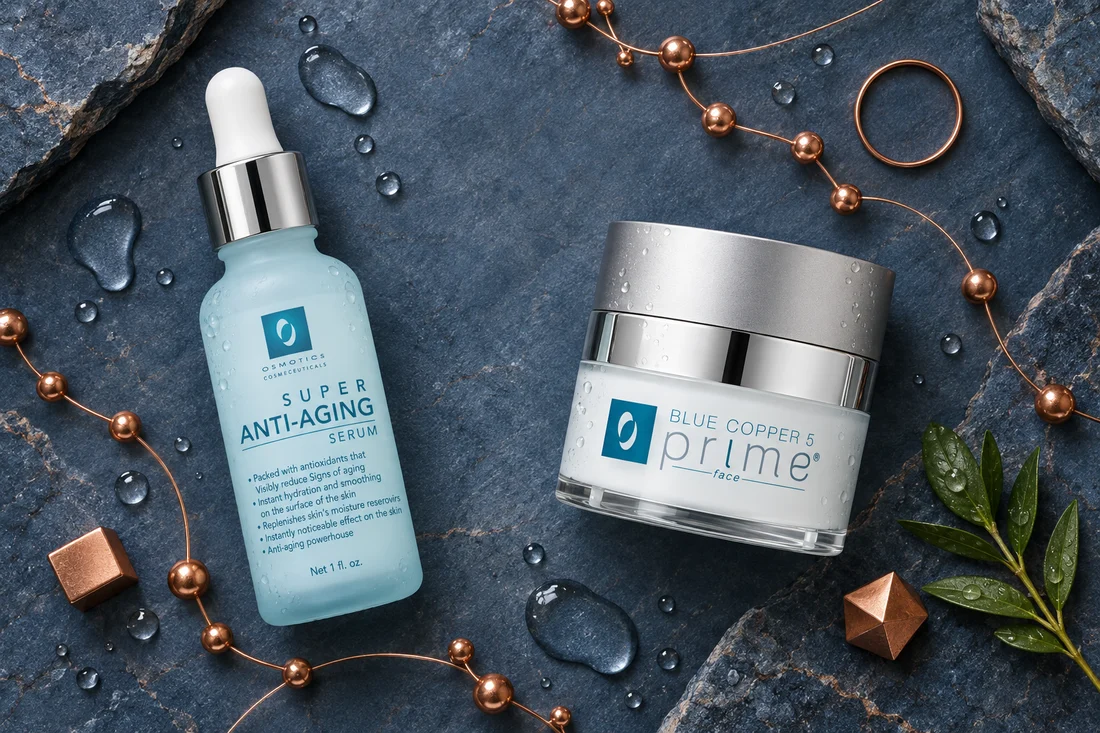
The first thing most people notice about a copper peptide serum is the colour. It is a soft, slightly unexpected blue, closer to a swimming pool than to the milky whites and golden oils that crowd most bathroom shelves. That colour comes straight from the copper, and it has become something of a calling card. On social media, a dropper of blue liquid now signals a certain kind of skincare enthusiast: curious, ingredient-literate and happy to read the small print.
The molecule behind the colour is GHK-Cu, a complex made of a tiny peptide (three amino acids: glycine, histidine and lysine) bound to a copper ion. GHK was first described in the early 1970s, when researchers isolated it from human plasma, and the copper-bound form has been studied in various laboratory settings since. In cosmetics, it turns up in serums, creams and eye products, usually somewhere in the middle of the ingredients list.
It is worth knowing that the same molecule exists in two quite different worlds. On the beauty side, it is an ingredient in finished, cosmetic-grade formulas made for skin. On the laboratory side, a listing for GHK-CU from a research supplier describes a freeze-dried powder sold for research use only, with batch testing and analytical data rather than skincare promises. Those are not interchangeable products, and the gap between them is the whole story of this article.
The research world has its own supporting cast, too. Companies such as Direct Bac Water sell bacteriostatic water, a sterile water with a small amount of preservative that laboratories keep on hand. For a skincare reader, that is a useful reminder that much of the vocabulary now circulating online (vials, lyophilised powders, purity by HPLC) belongs to a setting with its own rules, training and paperwork, none of which applies to a serum on a bathroom shelf.
So what does the evidence say about copper peptides in skincare? The honest answer is: something interesting, but less than the hype suggests.
Where the Research Is Strong, and Where It Is Thin
The Preclinical Picture
Much of the excitement around GHK-Cu comes from preclinical work, meaning studies in cell cultures and animal models. In these settings, researchers have looked at how the complex interacts with fibroblasts (the cells that produce collagen and other structural proteins), how it relates to the extracellular matrix and how it behaves in models of wound repair. Some studies have also examined changes in gene expression.
This work is genuinely interesting to scientists. It is also exactly the kind of evidence that tends to be overstated in marketing. A result in a dish of cells is a starting point for a question, not an answer about what happens on a human face. Skin is a formidable barrier, concentrations in cell studies may bear little relation to what reaches living tissue from a cream, and many promising preclinical findings never translate.
The Human Studies
There are some small studies in people using cosmetic formulations containing copper peptides, generally looking at the appearance of fine lines, firmness or skin texture over a period of weeks. They are worth knowing about, but they come with familiar limits: modest numbers of participants, short durations, varied formulations and, in some cases, funding or involvement from companies with a commercial interest. Few have been replicated at scale.
That does not make copper peptides worthless. It means they sit in the category of ingredients with plausible, early-stage support rather than the deep, consistent evidence base that, say, sunscreen or retinoids enjoy. If a brand tells you otherwise, it is getting ahead of the science.
Why the Distinction Matters
Skincare marketing likes a confident verb. Copper peptides “rebuild”, “repair”, “regenerate”. The research, read carefully, uses much more cautious language: associated with, observed in, studied in relation to. Keeping that distinction in mind is not cynicism. It is respect for what researchers have actually found, and it protects you from paying a premium for certainty that does not yet exist.
A Short History of a Small Molecule
The story usually begins with Loren Pickart, the American researcher who identified GHK in human plasma in the early 1970s and went on to study its copper-binding behaviour. Over the following decades the molecule moved from academic papers into wound-care research and, eventually, into cosmetics, where it was given the label-friendly name copper tripeptide-1.
For a long time it remained a specialist ingredient, found in a handful of niche serums and talked about mainly by skincare obsessives on forums. Its wider breakthrough came later, as social platforms rewarded ingredient explainers and a new generation of brands built whole product lines around single, named actives. Prices dropped, formulas improved, and the blue serum went from curiosity to mainstream shelf.
It is worth pausing on how long that journey took. Decades of work have produced a lot of laboratory data and a reasonable track record in cosmetics, yet the large, independent human trials that would settle the bigger claims are still largely missing. That is not unusual. Plenty of familiar skincare ingredients have followed the same arc, from lab bench to bathroom shelf, without ever acquiring the evidence base of the classics. Knowing the history helps you calibrate your expectations: the molecule has earned its place in the conversation, not a starring role in every routine.
The Copper Peptide Aesthetic
How a Blue Bottle Became a Trend
Part of the appeal is simply visual. In a market crowded with near-identical clear serums, a blue one is memorable. It photographs well, it looks clinical without looking cold, and it hints at something mineral and slightly old-fashioned. Copper, after all, has been associated with health and craft for centuries, from cookware to jewellery.
The rise of ingredient-led skincare helped, too. Over the past decade, shoppers have learned to talk about niacinamide, retinal and azelaic acid with the fluency once reserved for perfume notes. Copper peptides fit neatly into that culture: a named molecule with a backstory and a scientific-sounding mechanism, ready for a ten-step explainer video.
The “Skinimalist” Counterpoint
There is a counter-trend worth mentioning. Many dermatologists and cosmetic chemists have spent the past few years urging people to simplify: a gentle cleanser, a moisturiser, daily sun protection and perhaps one well-chosen active. In that framework, copper peptides are an optional extra rather than a cornerstone. Whether they earn a place depends on your budget, your skin’s tolerance and your curiosity, not on any obligation to keep up.
Questions People Ask
Can Copper Peptides Be Combined With Other Actives?
This is one of the most debated questions in online skincare circles. Some brands advise keeping copper peptide products separate from strong acids or certain forms of vitamin C, on the theory that they may interact; others say their formulations are designed to coexist. Evidence on real-world interactions in finished products is limited. The practical answer is to follow the guidance printed by the maker of the specific product you own and, if you have sensitive skin or a skin condition, to ask a dermatologist or pharmacist.
Is the Colour a Sign of Strength?
Not necessarily. The blue tint indicates that copper is present, but the depth of colour depends on concentration, the rest of the formula and the packaging. A deeper blue is not a reliable guide to effectiveness, and a pale formula is not automatically weaker.
What About Irritation?
Copper peptides have a long history of use in cosmetics, and cosmetic products sold in the UK and EU must have a safety assessment before they reach the market. Like any ingredient, they can irritate some people. Most brands suggest a patch test for any new skincare product, and copper peptide formulas are no exception. Anything beyond ordinary cosmetic use is a question for a qualified professional.
Reading a Copper Peptide Label
Where It Sits in the Ingredients List
Look for names such as “copper tripeptide-1” in the ingredients list (the INCI name used on cosmetic labels). Its position gives a rough sense of concentration relative to the rest of the formula, though many actives are effective at low levels and the list alone will not tell you much about performance.
Packaging and Stability
Peptides can be sensitive to light, air and heat, so opaque or airless packaging is a good sign. Check the period-after-opening symbol and the batch code, and store the product as directed. A serum that changes colour dramatically or smells off has probably passed its prime, whatever the date says.
Claims Worth Questioning
Be cautious of copper peptide products promising medical outcomes, comparing themselves to clinic treatments or citing “studies” without naming them. Cosmetic products are allowed to make claims about appearance, not to promise treatment of disease. A brand that blurs that line is telling you something about its approach.
The Bigger Trend: Beauty Borrowing From the Lab
Copper peptides are part of a broader moment in which beauty borrows heavily from the language of science. Peptides, growth factors, exosomes and “bio-identical” ingredients are now everyday marketing words. Some of these ingredients have a decent evidence base, some are promising, and some are mostly branding. The shopper’s job is to tell them apart.
The healthiest approach is curiosity without credulity. Enjoy the ritual, enjoy the blue bottle if it makes you happy, and treat bold claims as an invitation to ask more questions. Keep a clear line between finished cosmetic products, which are made and assessed for skin, and laboratory materials, which belong to research settings with their own rules.
The Verdict
Copper peptides are not a miracle, and they are not a fad with nothing behind it. They are a cosmetic ingredient with an intriguing scientific background, some early human data and a large body of preclinical research that has not yet been fully translated into the kind of evidence dermatologists rely on.
If you like the way a copper peptide serum feels on your skin and it fits your budget, there is no reason not to enjoy it. Just read the box the way a scientist would: slowly, sceptically and with an eye for what has really been measured.

Sam Kuran is a content writer at FashionGleem, covering beauty, skincare, haircare, makeup, and fashion trends. Sam focuses on creating informative, easy-to-understand articles that help readers explore beauty products, improve their personal care routines, and make confident style choices. With an emphasis on practical tips, reliable sources, and people-first content, Sam aims to make beauty and fashion information accessible, useful, and enjoyable for everyday readers.