Sunscreen Powder: The Reapply Layer, Not the Base Layer
Sunscreen powder is the second sunscreen, not the first: a mineral powder brushed over a lotion or cream base to reapply SPF during the day without disturbing makeup.
That order matters because of one number: SPF is tested at 2 mg per square centimeter of skin, and a brush almost never deposits that much.
Used in its real job, powder is genuinely useful: midday touch-ups over foundation, shine control for oily skin, and quick coverage for the scalp part and hairline.
Product facts and prices here were checked in November 2026 against manufacturer pages, retailer listings and the guides named, and every price prints as a dated strand.
This page is general information only, following American Academy of Dermatology and FDA framing for sun protection. It is not personal medical advice, and no powder here is promised to protect any reader.
The Short Answer: What Sunscreen Powder Is For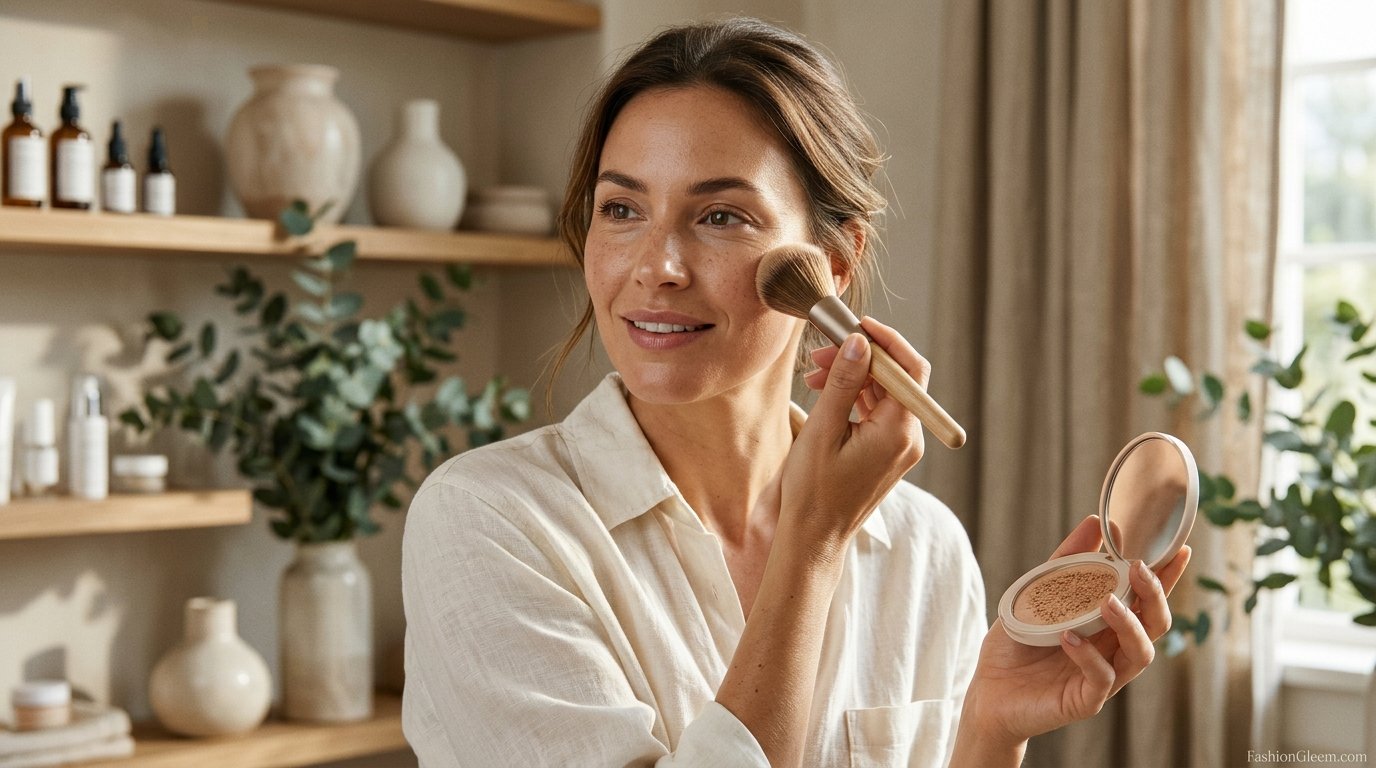
Quick answer: apply a broad spectrum lotion or cream sunscreen in the morning, then use sunscreen powder on the clock to top up over makeup, control shine, and cover the spots lotions miss.
Cleveland Clinic dermatologist Christine Poblete-Lopez, MD, states the consensus plainly in the Cleveland Clinic explainer on powder sunscreen: powder belongs as a touch-up after an initial application of traditional sunscreen.
The Wall Street Journal dermatologist panel says the same in fewer words: powder cannot be used by itself; start with a lotion or cream in the morning, then reapply with powder.
|
Layer |
Product |
Job |
Clock |
|---|---|---|---|
|
Base layer |
Broad spectrum lotion or cream, SPF 30 or higher |
The measured morning protection everything else maintains |
Once, applied generously before going out |
|
Top-up layer |
Sunscreen powder, brush-on, loose or pressed |
Reapplying over makeup, shine control, scalp and hairline |
Every two hours outdoors, sooner after sweat or swimming |
|
Heavy exposure |
Water resistant lotion or cream again |
Beach, swimming, hiking and heavy sweating days |
Reapply the base itself, not just the powder |
Read every labelled SPF below with that table in mind: the number is a tested claim at the standard dose, and the dose section next explains why a dusting cannot cash it.
The Dose Problem: Why Powder Cannot Be Your Only Sunscreen
SPF Is Tested at 2 mg per Square Centimeter
SPF values are measured under FDA and international test protocols with the product applied at 2 mg per square centimeter of skin. That is the dose behind every number printed on a sunscreen label.
For a lotion, guides translate that dose into about a quarter teaspoon for the face. Powder has no honest household equivalent, which is the first warning sign.
The FDA sunscreen guidance explains what SPF and broad spectrum mean on a label, and why products below broad spectrum SPF 15 must carry a skin cancer and skin aging alert.
What the Amount Studies Found
A 2009 study in Photodermatology, Photoimmunology and Photomedicine tested sunscreen at 2, 1.5, 1.0 and 0.5 mg per square centimeter and found protection fell significantly as the amount dropped.
A DGK multicenter study in Skin Pharmacology and Physiology (2007) points the same way: below the tested dose, the protection a user actually gets is a fraction of the label claim.
Dermatologist Leslie Baumann, MD, quoted in a secondary strand, does the powder arithmetic: a face of roughly 600 square centimeters would need about 1.2 g of powder at the test dose.
The same strand puts a typical powder application at roughly 0.085 g, about fourteen times less. Those figures print here as attributed expert math, not as a measurement made for this page.
What Dermatologists Say, in Their Own Words
Dr. Poblete-Lopez warns that powder is probably not going to be used in sufficient quantities to give the level of protection skin really needs, and that it rubs off easily.
Her positioning is the category rule: powder goes on as the last layer, over a real base, with fragrance and preservatives a caution for sensitive skin.
The practical test is visibility: if you cannot see the layer, it is nowhere near the tested dose. A visible, even layer over a morning base is the honest way to use this format.
The Base Plus Top-Up System: How Powder Fits a Morning Routine
The system has two layers and one clock: a generous lotion or cream base in the morning, powder top-ups every two hours outdoors, and the base itself reapplied for swimming or heavy sweat.
The morning sequence belongs to a routine, not a product page. Our skincare routine for beginners sets out the order, with sunscreen as the final step before makeup.
On FashionGleem, the morning routine for glowing skin covers the same AM ground from the glow side: cleanse, treat, moisturize, then SPF, then makeup, in that order.
Where makeup carries its own SPF claim, the same dose rule applies. Our skincare foundation guide explains why a skin-first base sits over a real sunscreen, never instead of one.
- Morning: lotion or cream base, broad spectrum SPF 30 or higher, applied generously and left to set before makeup.
- Midday: blot oil, then powder in several slow passes over the face, ears, hairline and neck.
- Outdoors all day: powder on the two hour clock, and lotion again after swimming, sweating hard or towel drying.
- Evening: remove everything with your normal cleanse; sunscreen and makeup left on overnight help nobody.
That is the whole system. Everything after this section is about choosing a powder well for the top-up job, and using it properly.
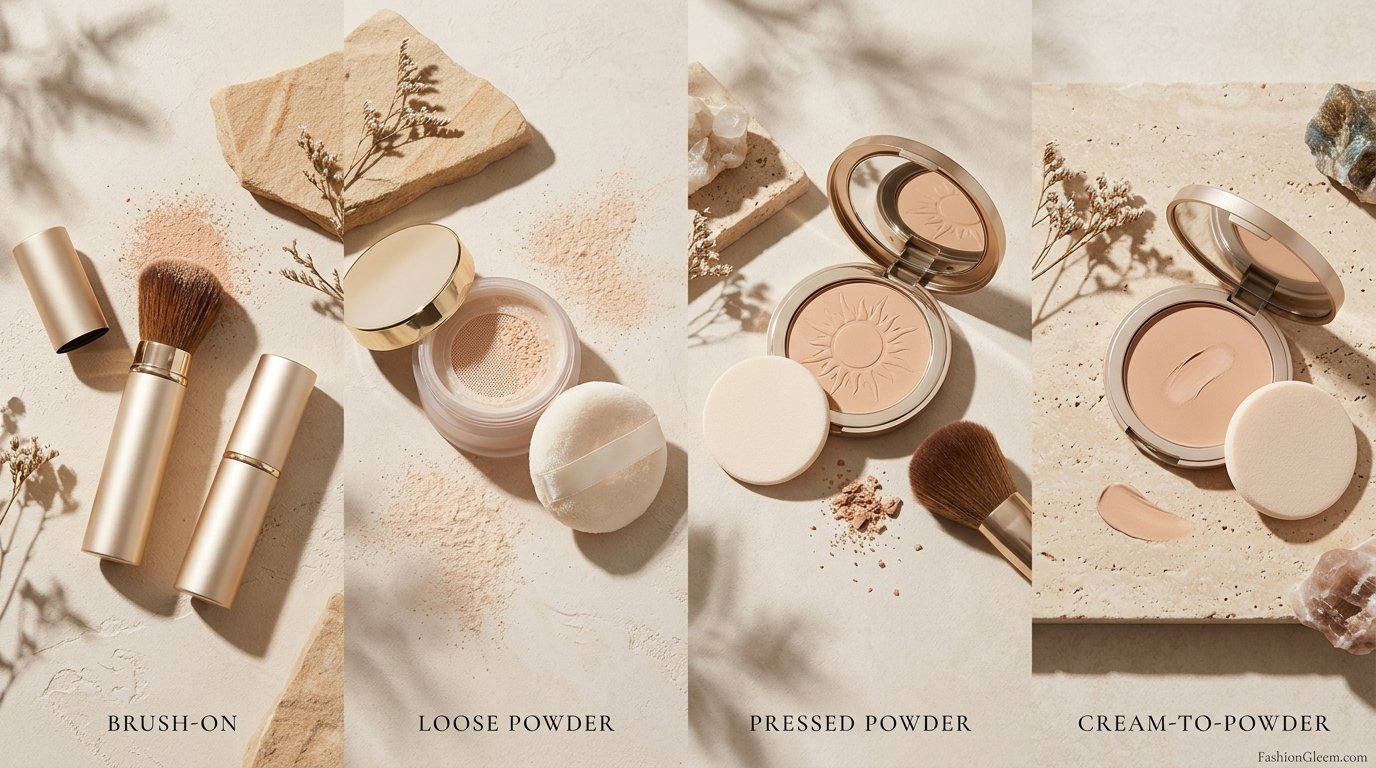
Formats Compared: Brush-On, Loose, Pressed and Cream-to-Powder
Format decides how much powder lands, how the product travels, and how much dust you breathe. On a dose-limited category, format is a protection question, not packaging trivia.
|
Format |
Deposit |
Portability |
Mess and dust |
Best job |
|---|---|---|---|---|
|
Brush-on self-dispensing tube |
Light to moderate; depends on priming and passes |
Best; made for handbags |
Low mess; least loose dust |
Reapplying over makeup anywhere |
|
Loose powder with puff |
Heavier; press-on control |
Vanity product; travels badly |
Most dust; highest inhalation care needed |
Heavier top-ups at home, nose and hairline detail |
|
Pressed powder compact |
Moderate and visible |
Good; mirror compacts exist |
Low dust |
Coverage-led touch-ups that behave like makeup |
|
Cream-to-powder compact |
Most visible coverage |
Bulkiest |
Minimal dust |
Makeup touch-ups where coverage matters most |
Brush-on wins the bag and loses when its dispenser will not prime or feed. A clogged brush deposits even less powder, which quietly worsens the dose problem.
Loose powder gives the user control and a heavier deposit, at the cost of mess and airborne dust. Pressed and cream-to-powder compacts behave most like makeup and are the easiest to apply visibly.
The Product Field: Powders Compared by Criteria
No ratings, scores or stars appear in this table, by rule. Each product is described by format, labelled SPF, shades, weight and dated US price strands, so you can choose by the criteria that fit your skin and budget.
The base-layer rule prints inside the buying decision, not below it: every product here is a top-up over a morning lotion or cream base, whatever its label claims.
|
Product |
Format and labelled SPF |
Shades |
Weight |
US price strands, checked Nov 2026 |
Cost per gram |
|---|---|---|---|---|---|
|
Colorescience Sunforgettable Brush-On Shield |
Brush-on; SPF 50, PA++++ (brand claim) |
Four shades plus Glow and Bronze |
6 g (0.21 oz) |
$69 on the Colorescience Brush-On Shield product page; about $35 to $57 in US retail listings |
About $11.50 per gram at $69 |
|
Supergoop! (Re)setting 100% Mineral Powder |
Brush, twist-lock flow; SPF 35, PA+++ (guide strands) |
Four shades plus translucent |
About 4 g; check the unit |
$35 in guide strands (Nov 2026); see the Supergoop (Re)setting Mineral Powder page |
About $8 to $9 per gram |
|
Brush On Block Mineral Powder |
Refillable brush; SPF 30, SPF 50 version in guide strands |
Translucent (SPF 50 strand) |
Check the unit |
$46 for SPF 50; $28 to $36 for SPF 30 (guide strands) |
Mid field; refills lower it |
|
Jane Iredale Powder-Me SPF 30 |
Oversized refillable brush; SPF 30 |
Four shades |
Check the unit |
$56 in guide strands (Nov 2026) |
Premium; face and scalp positioning |
|
Hawaiian Tropic Mineral Powder Brush |
Brush, magnetic head; SPF 30 |
Four shades |
Check the unit |
$14 guide; $13.42 Amazon; $16.99 Target, unmerged |
Lowest in the field per gram |
|
iS Clinical PerfecTint Powder |
Brush, tinted pods; SPF 40 |
Five shades (guide strands) |
Pod format |
$82 in guide strands (Nov 2026) |
The splurge tinted option |
|
Ciele Filter & Protect |
Loose powder with puff; SPF 30+ (brand styling) |
Three shades |
Check the unit |
$38 in guide strands (Nov 2026) |
Best loose powder strand in the guides |
|
Avene Mineral Tinted Compact |
Pressed cream-to-powder; SPF 50 |
Two shades |
Compact |
$44 in guide strands (Nov 2026) |
Coverage-led; not strictly a powder |
The Two Leaders by Criteria: Colorescience and Supergoop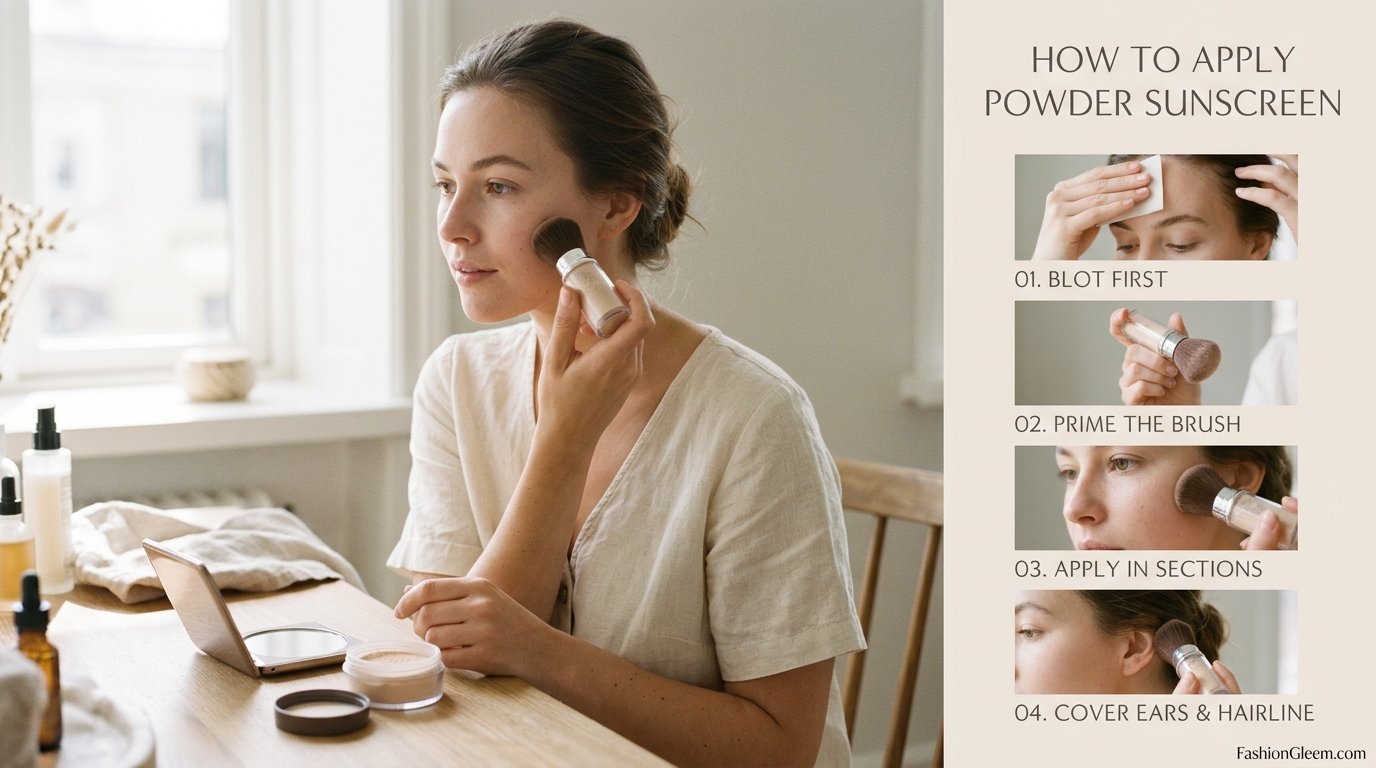
The Colorescience strand is the maximal label: SPF 50 and PA++++ brand claims, 22.5 percent zinc oxide plus 22.5 percent titanium dioxide in label strands, and an 80 minute water resistance claim on the label.
Guide strands also describe a Skin Cancer Foundation Active recommendation for the brush; the Skin Cancer Foundation sunscreen guidance explains what its Seal of Recommendation program means.
The Supergoop strand is the setting powder that is also a labelled sunscreen: SPF 35, zinc oxide based, a twist-lock brush testers praise, and refill cartridges.
Oily skin testers favour it; the same strands warn it can cling to dry patches. Neither product is crowned here: shade match, skin type and budget decide between two honestly different tools.
The Budget Tier: Hawaiian Tropic, Derma E and Mineral Fusion
Hawaiian Tropic holds the lowest price strands in the field, with four shades, a 40 minute water resistance strand, and a magnetic brush head that makes cleaning realistic. Its caveats print too: a tropical fragrance, and cast reports on deeper tones.
Derma E appears as the lead pick in one face-specific guide, translucent and matte with pore-blurring positioning. Mineral Fusion is the Wall Street Journal nice-price pick, with a matte but not overwhelming finish strand.
Prices for Derma E and Mineral Fusion were not verified in November 2026, so this page prints none for them rather than borrow a number.
Tinted and Coverage-Led Options
Tinted brushes and compacts do two jobs at once: top-up plus visible coverage. The PerfecTint strand adds light coverage and redness softening; the Avene compact is coverage first, powder second.
Tint also carries a protection argument, covered next: iron oxides in tinted formulas contribute visible light protection, which matters most for pigmentation-prone skin.
The ISDIN Version Trap: Read the Drug Facts Panel
The ISDIN Mineral Brush prints here as a conflict, not a pick. US roundup strands, Byrdie among them, describe it as an SPF 50 mineral powder recommended by named dermatologists for oily skin.
The Beauty Gypsy guide states the opposite for the unit it examined: the international version carries SPF 50+, while the US version it checked carried no SPF rating at all, despite similar packaging.
Both strands may be true of different units, which is the lesson. Before buying any powder, read the Drug Facts panel on the exact version in front of you; another market’s SPF claim is not your label.
- Drug Facts panel present: it is a labelled sunscreen in this market version. No panel, no SPF claim you can rely on.
- Broad spectrum and SPF: the AAD floor is broad spectrum SPF 30 or higher for any sunscreen layer.
- Water resistance minutes: 40 or 80 if claimed; still not a beach-day primary.
- Shade list: check your tone against the actual range, not the marketing photo.
- Net weight in grams: the number that turns a price into a cost per gram.
Tinted or Translucent: Shade, Cast and Iron Oxides
Translucent sounds universal and often is not. Mineral particles sit on the skin surface, and a translucent powder can still leave a grey or chalky cast on medium to deep skin tones.
Tinted shades are the category’s fix: they look more natural on deeper tones and usually contain iron oxides, the pigments that also contribute protection against visible light.
Dermatologist Kseniya Kobets, MD, quoted by the Wall Street Journal, calls that visible light contribution helpful for melasma, hyperpigmentation and discoloration. That is general information, not treatment advice.
Shade ranges remain a category flaw: many brands offer one translucent shade or three to five tints. Treat the range as a first-class criterion, the way the clean girl makeup look depends on a base that matches.
Our best foundation for oily skin guide works the same seam: a base that fights your skin tone or type will be abandoned, and an abandoned sunscreen protects nobody.
How to Apply Powder Sunscreen Properly
Technique cannot repeal the dose problem, but it decides whether a top-up is a real layer or a gesture. The guides agree on the sequence.
- Blot first. Oil breakthrough makes powder grab and cake over makeup, so blot the T-zone before the brush comes out.
- Prime the brush. Activate the flow on the back of your hand until powder visibly coats the bristles; an unprimed brush applies almost nothing.
- Work in sections. Forehead, cheeks, nose and chin, in slow circular passes, then repeat the circuit rather than dusting once.
- Cover the missed zones. Ears, hairline, the front and sides of the neck, and the backs of the hands are where bases thin out first.
- Use the scalp part deliberately. Powder along the part and hairline tops up without greasy hair; a hat still beats any top-up for long exposure.
- Reset the clock. Outdoors, the next top-up is due in two hours, sooner after swimming, heavy sweating or towel drying.
For the lotion technique underneath all this, the AAD guide to applying sunscreen sets out amounts and timing for the base layer, including applying before going outdoors.
Beginners can pair this page with our makeup tutorial for beginners, which keeps the makeup side simple enough for a top-up layer to sit on.
Skin Types: Oily, Dry, Sensitive and Acne Prone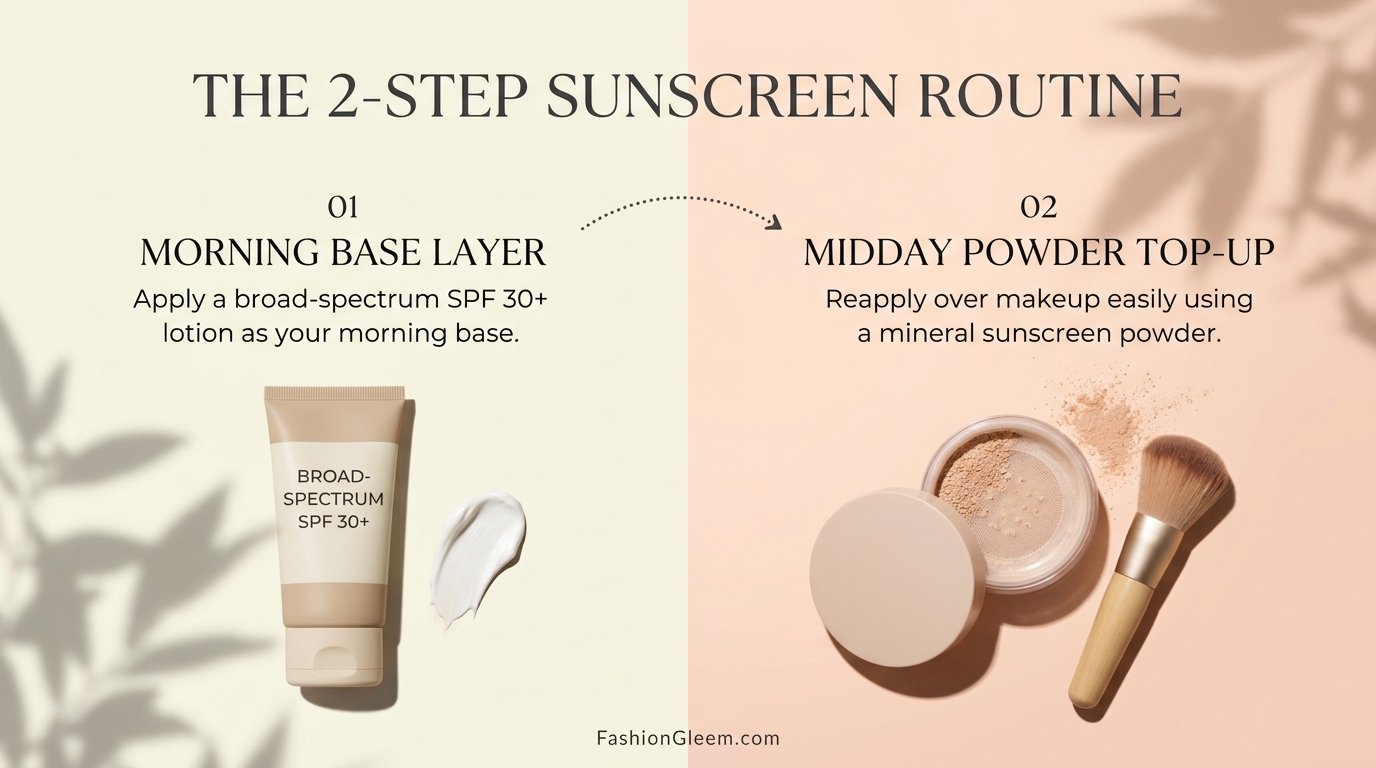
Oily and combination skin is the category’s happiest case: silica and mineral powders absorb oil, cut shine and top up in one pass. Dermatologist Hadley King, MD, quoted in NBC Select strands, calls powder lightweight and easy to reapply, especially over makeup.
Dry skin is the caution case. Powders cling to dry patches and emphasize texture; moisturize well, keep the morning base creamy, and use powder sparingly. Hydrating ingredient strands exist, but they soften the problem rather than solve it.
Sensitive skin readers get one warning: Dr. Poblete-Lopez notes fragrance or preservatives can bother sensitive skin, rosacea or eczema, so the ingredient list matters more than the brand.
Acne prone readers often choose powders for the dry, oil-absorbing finish, and some products carry noncomedogenic label claims. Those are per-product claims, not a category guarantee, and breakouts remain possible with any product left on skin.
Safety Strands: Inhalation, Nanoparticles and the FDA Paper Trail
The inhalation question prints here as positions, not a verdict, because that is what the sources support. No alarmism, and no dismissal either.
The Environmental Working Group advises against spray and loose powder sunscreens containing zinc oxide or titanium dioxide, citing inhalation concerns, especially with nanoparticles. That is EWG’s position, printed as theirs.
A 2019 review of the inorganic filters by Schneider and colleagues separates the routes: on skin, the reviewed evidence is reassuring, matching the FDA position that these particles do not significantly penetrate intact skin.
The same literature flags inhalation as the route needing study, largely on animal and occupational data. Mitigations follow from the strands: apply in a ventilated spot, avoid breathing in while dusting, and prefer pressed or brush formats if loose dust worries you.
The FDA paper trail is dated strands, never one present-tense claim. A 2011 FDA list placed powders among dosage forms not eligible for the monograph, as later summaries carry it.
The FDA’s 2019 proposed rule then treated powders as a possible dosage form while stating the agency had insufficient evidence that sunscreen powders are generally recognized as safe and effective, and requested more data.
Re-verified for this article in November 2026, the current FDA sunscreen guidance consumer page explains SPF, broad spectrum and label warnings and does not list powder among the forms it discusses, so this page claims nothing further in the present tense.
The honest summary stands: powders are sold legally in the US with Drug Facts labels, while their monograph status carries a long, unresolved paper trail. The American Academy of Dermatology guide to selecting a sunscreen remains the steadier buying frame: broad spectrum, SPF 30 or higher, water resistance when you sweat or swim.
Cost Per Gram: What Brush-On Sunscreen Really Costs
Nobody in the ranking field runs this arithmetic, and it changes choices. Brushes hold 0.15 to 0.21 oz; you are paying for an applicator system plus a few grams of powder.
The leading brush holds 6 g. At the $69 manufacturer strand checked in November 2026, that is roughly $11.50 per gram, against lotions delivering 50 to 100 g for a fraction of the per-gram price.
The budget brush flips the intuition only partly: at the $13.42 to $16.99 strands, it costs far less per tube and still several dollars per gram. Refillable systems are how the per-gram cost falls over time.
None of this argues against buying one. It argues for buying with open eyes: the powder earns its price as a habit tool you will actually carry, not as economical protection.
Brush Care, Expiry and Storage
A brush-on dispenser fails quietly: makeup, oil and old powder cake in the bristles, flow turns uneven, and the little powder you applied becomes less.
Clean the brush head exactly as the brand directs, and never submerge a built-in dispenser unless the brand says it is safe. Removable or magnetic heads are a genuine feature difference.
Powders carry expiration dates like other sunscreens. Follow the printed date, store the tube away from heat and humidity, and keep it in the bag you carry indoors rather than a glovebox baking through summer.
Travel is the format’s honest advantage: no liquid, no leak, carry-on friendly, provided the tube at home was not already cooked or clogged.
Powder vs Spray vs Stick: Choosing a Reapplication Method
|
Method |
Dose honesty |
Over makeup |
Best case |
|---|---|---|---|
|
Powder |
Low dose, but visible where it landed |
Best; controls shine as it tops up |
Oily skin, matte makeup, scalp and hairline |
|
SPF setting spray |
Hardest to dose visibly; one mist is never the labelled amount |
Good for dewy finishes |
Dry skin and dewy makeup, with the same base rule |
|
Sunscreen stick |
Moderate; several passes needed |
Can drag on makeup |
Ears, nose, under eyes, targeted zones |
|
Lotion or cream |
The only method that reliably reaches test dose |
Disturbs makeup |
The morning base, beach and swim days, full reapplications |
The seam rule never changes: whichever top-up you choose, the morning base underneath is doing the heavy lifting, a point the Cleveland Clinic explainer on powder sunscreen makes as firmly as this page does.
A powder you carry beats a lotion left at home, and a lotion day beats a powder day whenever exposure is serious.
Frequently Asked Questions
Does powder sunscreen actually work?
It works as a layer, with a hard limit. The mineral filters, usually zinc oxide and titanium dioxide, are real UV filters. The limit is dose: SPF is tested at 2 mg per square centimeter, and almost nobody brushes on that much. The verdict across dermatologist sources: a touch-up format over a lotion base, not a replacement.
Can powder sunscreen replace my regular sunscreen?
No. Cleveland Clinic, the Wall Street Journal panel and the leading guides agree: start with a generous broad spectrum lotion or cream, then use powder to maintain it. Powder alone, at realistic amounts, should not be expected to deliver its labelled SPF.
Why can powder not deliver its labelled SPF in normal use?
Because of the testing standard. SPF is measured at 2 mg per square centimeter, and amount studies show protection falls steeply below that dose. Dermatologist Leslie Baumann, in an attributed strand, puts a face needing about 1.2 g of powder, against a typical application near 0.085 g.
How much powder sunscreen should I apply?
More than feels natural: several slow overlapping passes until there is a visible, even layer, then still treat it as a top-up over a base. No honest household measure converts passes into the 2 mg test dose, which is why the base layer matters.
How often should I reapply powder sunscreen?
On the sunscreen clock: every two hours outdoors, and sooner after swimming, heavy sweating or towel drying, per the label. Indoors, the guides use strategic top-ups before going outside again, rather than a rigid desk alarm.
Is powder sunscreen mineral or chemical?
Overwhelmingly mineral in the current US market, built on zinc oxide and titanium dioxide, often combined; one leader’s label strand lists 22.5 percent of each. Mineral particles sit on the skin surface, which also explains the recurring tint and white cast questions.
What SPF should I look for in a powder sunscreen?
The AAD floor: broad spectrum, SPF 30 or higher. Powders here carry label claims from SPF 30 to SPF 50. Read the number as a tested claim at the standard dose, not what a light dusting delivers; a higher claim does not repeal the dose problem.
What does broad spectrum mean on a powder sunscreen?
It means the product passed the US broad spectrum test covering UVA and UVB, the same Drug Facts standard as a lotion. Some powders also print PA ratings, the Asian UVA system; one leading brush lists PA++++ on its own site. Read both on the exact version you are buying.
Can I apply powder sunscreen over makeup?
Yes, that is the format’s main job. Let makeup settle, blot excess oil, prime the brush until powder coats the bristles, then make several slow overlapping passes. Over makeup is where the dose limit matters least, because the morning base underneath is doing the heavy lifting.
Can I wear powder sunscreen under makeup or on bare skin?
You can, and some products are marketed for under, over or alone. On bare skin it works as a light mineral layer and shine control. Neither position changes the rule: it is a layer in a system whose foundation is a properly applied lotion or cream sunscreen.
Which is better for oily skin, powder sunscreen or lotion?
They do different jobs. A lotion base gives the measurable morning protection; powder is the better midday tool because silica and mineral powders absorb oil and cut shine while topping up. Dermatologist Hadley King, in NBC Select strands, calls powder lightweight and easy to reapply over makeup.
Does powder sunscreen work for dry skin?
Worse, usually. Powders cling to dry patches and emphasize texture, a caveat repeated across the guides. Dry skin readers should moisturize well, keep the morning base creamy, and use powder sparingly as a top-up rather than a heavy layer.
Does powder sunscreen leave a white cast on deeper skin tones?
Translucent mineral powders can leave a grey cast on medium to deep skin. Tinted shades are the fix: they look more natural on deeper tones and usually contain iron oxides. Shade ranges are still narrow, which this page treats as a real buying criterion.
Why do tinted powder sunscreens help with melasma and pigmentation?
Because of iron oxides, which contribute protection against visible light as well as UV. Dermatologist Kseniya Kobets, quoted by the Wall Street Journal, calls that helpful for melasma and discoloration. This is general information, not treatment advice.
Is powder sunscreen safe to breathe in?
The category’s open question, printed as positions. The Environmental Working Group advises against spray and loose powder sunscreens with zinc oxide or titanium dioxide over inhalation concerns. The 2019 review literature separates skin, where evidence is reassuring, from inhalation, flagged for further study. Apply ventilated and avoid breathing in.
Are nanoparticles in powder sunscreen dangerous on skin?
The skin and lung routes are different questions. Review literature reports these nanoparticles do not penetrate beyond the outer skin layer in healthy intact skin, and the FDA treats both filters as benchmark actives. The caution concerns inhaling airborne particles, not powder on skin.
What is the FDA’s position on powder sunscreen as a dosage form?
Unsettled, printed as dated strands. A 2011 FDA list placed powders among forms not eligible for the monograph. The 2019 proposed rule treated powders as a possible form with insufficient evidence of being generally recognized as safe and effective. The current FDA consumer page, checked November 2026, does not list powder among the forms it discusses.
Is the ISDIN Mineral Brush an SPF 50 sunscreen in the US?
Check the exact version, because the strands conflict. US roundups describe it as SPF 50. The Beauty Gypsy guide states the international version carries SPF 50+ while the US version it examined carried no SPF rating at all. Read the Drug Facts panel on your unit.
Brush-on, loose or pressed: which powder format is best?
Criteria, not a crown. Brush-on wins on portability and reapplication over makeup, and loses when dispensers will not prime. Loose powder gives control and a heavier deposit, and loses on mess and dust. Pressed compacts give the most visible coverage. Match the format to the job.
What is the difference between powder sunscreen and an SPF setting powder?
Often nothing but the label, and the label is what matters. A powder sold as a sunscreen carries a Drug Facts panel and an SPF tested under the sunscreen standard. A cosmetic setting powder mentioning SPF without Drug Facts is a makeup claim. One leading product is deliberately both.
Does powder sunscreen expire or lose potency?
Yes, it carries an expiration date, and mineral powders have a failure mode of their own: dispensers clog, brushes cake with oil and old powder, and flow turns uneven long before the date if never cleaned. Follow the printed date; store away from heat.
How do I clean a brush-on sunscreen applicator?
As the manufacturer directs, and never submerge a built-in dispenser unless the brand says it is safe. Buildup in the bristles changes how evenly powder dispenses, which quietly worsens the dose problem. Removable or magnetic heads are a genuine feature difference.
Can I use powder sunscreen on my scalp and hair part?
Yes, and it is one of the format’s best uses: powder along the part and hairline tops up protection without the greasy hair a lotion causes, a use the Wall Street Journal and Reader’s Digest strands both describe. A hat beats any top-up for extended exposure, and bald or thinning scalps should get a conventional base first.
Can children use powder sunscreen?
Carefully, as a top-up, not a strategy. Guides pair a powder for quick reapplications with a heavy duty cream for intense sun. Loose powder adds the inhalation wrinkle for small children, and no powder should be a child’s only beach protection. Follow age directions and the lotion-first rule.
Is powder sunscreen water resistant?
Some carry water resistance claims of 40 or 80 minutes, tested label claims like any sunscreen’s. They do not make powder the right primary product for swimming or a beach day, where the guides keep lotion or cream in charge.
Can powder sunscreen cause breakouts or irritation?
It can, like any product left on skin. Cleveland Clinic’s dermatologist warns that fragrance or preservatives can bother sensitive skin, rosacea or eczema, and advises reading the ingredient list. Noncomedogenic wording is a per-product label claim, not a category guarantee.
Why is brush-on sunscreen so expensive compared with lotion?
The arithmetic is uncomfortable. You are paying for the applicator system and a small amount of product: the leading brush holds about 6 g. At the $69 manufacturer strand checked in November 2026, that is roughly $11.50 per gram, against lotions delivering 50 to 100 g for a fraction of that.
How much does powder sunscreen cost?
As dated strands, never a single price. Checked November 2026: the leading SPF 50 brush lists at $69 at its manufacturer, with US retail listings from about $35 to $57. A leading setting powder appears at $35 in guide strands, a refillable SPF 50 brush at $46, and the budget brush at $14, $13.42 and $16.99.
Supergoop or Colorescience: which powder should I choose?
By criteria. One strand: SPF 50 claim, PA++++, 22.5 percent zinc oxide plus 22.5 percent titanium dioxide, 80 minute water resistance claim, four shades, the field’s highest price, a dispenser some testers find stubborn. The other: SPF 35, a setting powder build, a twist-lock brush testers praise, refills, and a formula that can cling to dry patches.
What is the best budget powder sunscreen?
The strand consensus points at the Hawaiian Tropic mineral brush: the lowest US price strands in November 2026, four shades, a 40 minute water resistance strand, and a magnetic brush head testers like. Its caveats: a tropical fragrance, and possible cast on deeper tones. Derma E and Mineral Fusion are the other budget strands.
Can powder sunscreen help with melasma?
Only as part of a tinted routine, as general information. The mechanism strand is iron oxides contributing visible light protection, which dermatologists here describe as helpful for melasma. The powder is not a treatment, the morning base matters most, and anyone managing melasma should work with a dermatologist.
Does powder sunscreen protect against blue light and pollution?
Some brands claim it, and those claims print here as brand claims about their own formulas. The independently grounded part is narrower: mineral filters block UV, and iron oxides contribute visible light protection. Marketing language about pollution or infrared protection is not upgraded into established fact on this page.
What is the Skin Cancer Foundation seal on some powders?
The Skin Cancer Foundation runs a Seal of Recommendation program for products meeting its criteria. Guide strands describe one leading brush as recommended for Active use. Treat the seal as a label fact, verified on the Foundation’s own site, not as proof a powder replaces a lotion base.
Should I use powder sunscreen at the beach or while swimming?
Not as your primary protection. Even powders with water resistance claims are the wrong main defense for swimming, heavy sweating or a full beach day. Use a water resistant lotion or cream as the base, reapply it after swimming, and let powder handle dry touch-ups afterwards.
Can powder sunscreen be my only sunscreen if I am indoors most of the day?
The honest answer is about exposure, not the clock. Incidental exposure, the commute, a lunch walk, a bright window seat, is still exposure, and a light powder layer beats nothing. But calling it your sunscreen implies labelled protection the dose problem does not support. A quick morning base plus top-ups is the recommended routine.
How do I stop powder sunscreen from looking cakey over makeup?
Blot first, use less per pass and more passes, and match the shade. Oil breakthrough makes powder grab and cake; blotting first is the fix the guides repeat. Tinted shades cake less visibly than a mismatched translucent on deeper skin. Powder over flaking skin will always show.
Powder sunscreen or SPF setting spray for touch-ups?
Both beat not reapplying; the guides split by finish. Powder controls shine and you can see where it went, suiting oily skin and matte makeup. Sprays suit drier skin and dewier finishes but are harder to dose visibly. The same base layer rule sits underneath either way.
Can men use powder sunscreen?
Yes. Translucent strands are marketed as invisible, the format is popular for scalp coverage and shine control without a made-up look, and nothing in the mineral formulas is gendered. The same rules apply: lotion base in the morning, powder for top-ups.
How should I store powder sunscreen in a hot car or bag?
Heat degrades it, and a handbag in a hot car is the worst storage in the category. Powders avoid liquid leak risk, their travel advantage, but the expiration date assumes reasonable storage. Keep it in the bag you carry indoors, not the glovebox.
Does powder sunscreen need to be removed at night?
Yes. It is a mineral layer sitting on skin, with makeup and the day on top of it. Normal evening cleansing removes it. Leaving any sunscreen and makeup on overnight is a routine failure, not a powder specific danger, and the cleansing order belongs to your evening routine.
What should I check on the label before buying a powder sunscreen?
Five things: the Drug Facts panel, so it is a labelled sunscreen in this market version; broad spectrum and the SPF claim; water resistance minutes if claimed; the shade list against your skin tone; and the net weight in grams, for cost per gram. That checklist catches the version trap and the casting translucent.
Is powder sunscreen worth it?
Worth it as a habit tool, not as protection math. Dermatologist Mona Foad, quoted by the Wall Street Journal, notes that a product people find easy to use gets used consistently, and consistency is a major factor in sun protection. If a brush in your bag is the difference between reapplying and not, it earns its price.
Conclusion
Sunscreen powder earns its place in a bag the moment its job is stated honestly: it is the reapply layer, the tool that keeps a morning base topped up over makeup, through shine, and along the scalp part.
Choose yours by criteria, not crowns: the format your day needs, a shade your skin tone can wear, a Drug Facts panel on the exact version, and a cost per gram you accept with open eyes.
Then use it on the clock, over a real base, and let the base itself handle the beach. Start tomorrow morning with the lotion, and let the powder do the job it is actually good at.

Dilawar is a contributing writer at Fashiongleem.com, focusing on beauty, hairstyles, skincare, fashion accessories, and personal grooming. He creates informative, easy-to-follow articles that help readers explore new looks, understand popular beauty trends, and improve their everyday styling routines. His writing emphasizes practical advice, useful product information, and accessible fashion inspiration for modern readers.