Skincare Foundation: The Hybrid Base Decoded, From Skin Tints to Serum Foundations
Skincare foundation is the category where makeup stopped pretending to be separate from skincare. Every major base launch now leads with an ingredient list, and the reader’s real question is which of those ingredients actually do anything.
Most pages answer with a shopping list. Roundups rank fifteen bottles, repeat each brand’s claims, and never explain why one hybrid earns its price while another is ordinary foundation wearing a serum costume.
This page decodes the category instead. A format spectrum first, then an ingredient honesty test, then the SPF reality check, and only then the chooser paths that match a format to your skin.
The honesty rules are stated up front. Prices print only as dated strands from pages actually checked, label terms get graded rather than repeated, and no foundation on this page is allowed to replace a routine.
It also grades the words printed on the bottle. Non-comedogenic and dermatologist tested appear throughout this category, and each time they appear here, the unregulated status of the term travels with it.
Skincare Foundation in One Answer: Coverage With a Skincare Layer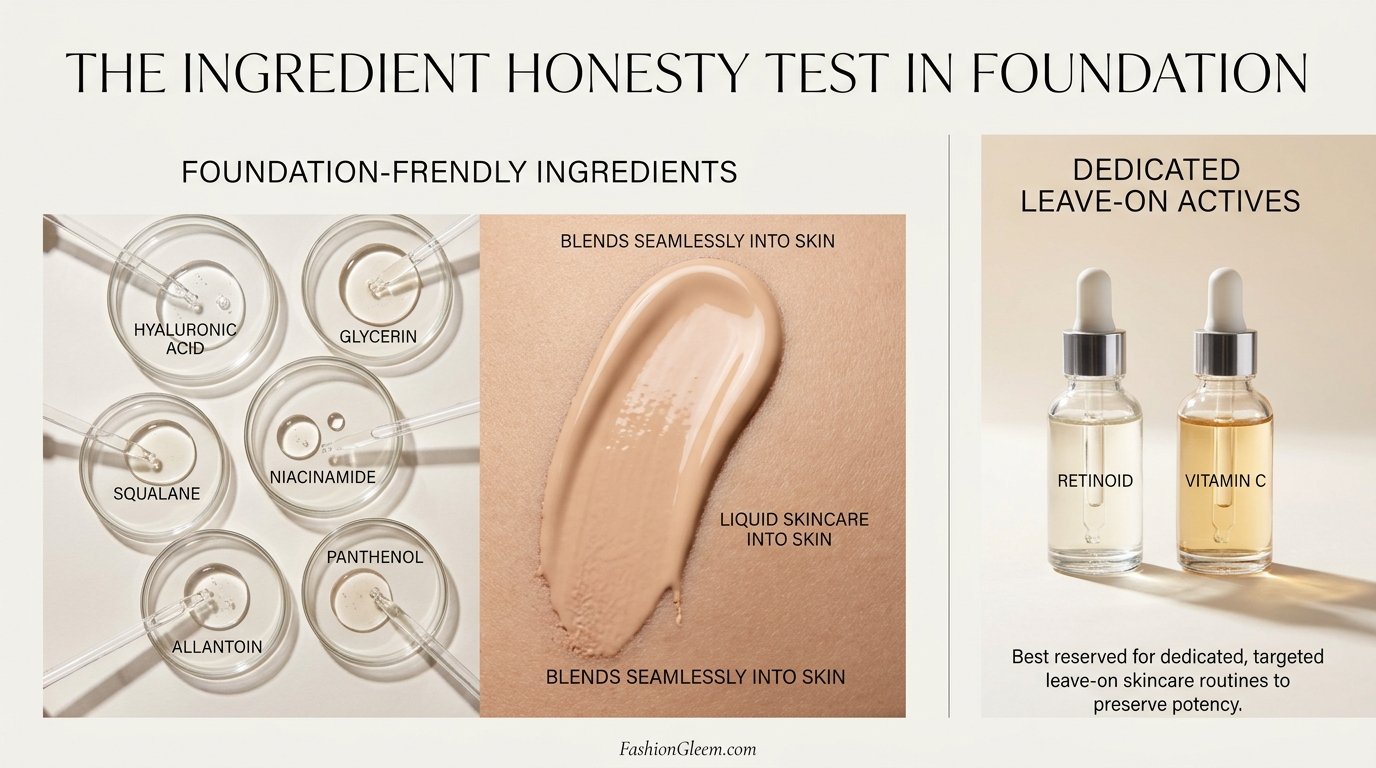
The one answer: a base that pairs pigment with surface skincare. Coverage evens the skin tone while humectants, emollients and barrier friendly ingredients make the wear itself kinder than a traditional matte foundation.
The category is a spectrum, not a single product. At one end sit tinted moisturizers that are skincare with a whisper of pigment; at the other, full foundations where skincare plays a supporting role.
The strongest competitor frames the limit honestly: the Women’s Concepts skincare foundation guide argues that foundation is built to sit on top of skin rather than sink in, so what a hybrid can deliver is capped by design.
That cap is the key to the whole category. A skincare foundation can support a routine and make daily coverage more comfortable. It cannot do the work of the serums and treatments it imitates.
If You Meant the Foundation of a Skincare Routine
A quick disambiguation, because the phrase carries two meanings. If you searched for the foundation of a skincare routine, meaning the base steps everything else builds on, this short box is yours.
The routine foundation is three steps. A gentle cleanser, a moisturizer matched to your skin type, and a broad spectrum SPF 30 or higher sunscreen every morning. Treatments and extras layer on top of that base.
The two meanings meet at one point. A solid routine underneath is exactly what makes the makeup version of a skincare foundation sit better, pill less and need less coverage in the first place.
The Format Spectrum: Six Bases by Coverage and Skincare Load
Place any product name on this spectrum before judging its claims. Coverage rises left to right while the skincare share falls, and most disappointment comes from buying one end while expecting the other.
|
Format |
Coverage |
Skincare load |
Finish |
Best suited to |
|---|---|---|---|---|
|
Tinted moisturizer |
Sheerest |
Highest, it is moisturizer first |
Dewy, fresh |
Dry and normal skin, minimal days |
|
Skin tint |
Sheer |
High |
Natural, skin like |
Normal to combination, no makeup look |
|
Tinted serum |
Sheer to light |
High, serum texture |
Luminous |
Dry skin wanting a glow with care |
|
Serum foundation |
Light to medium, buildable |
Medium, actives in a true base |
Natural to satin |
Most skin types, daily wear |
|
CC cream |
Medium, color correcting |
Medium |
Satin, correcting |
Redness and uneven tone |
|
Full skincare foundation |
Medium to full |
Lowest, skincare as support |
Matte to satin |
Oily skin, events, long days |
The roundups confirm the ordering: the Good Gosh Beauty skin care foundation roundup sorts its picks across the same tint to foundation range, and the QueenCompares serum foundation comparison builds its whole comparison inside the serum foundation band alone.
Magazine fields sort the same way: the Women’s Weekly Singapore foundation roundup lists its ten picks with coverage and key ingredients side by side, which is the spectrum logic applied one product at a time.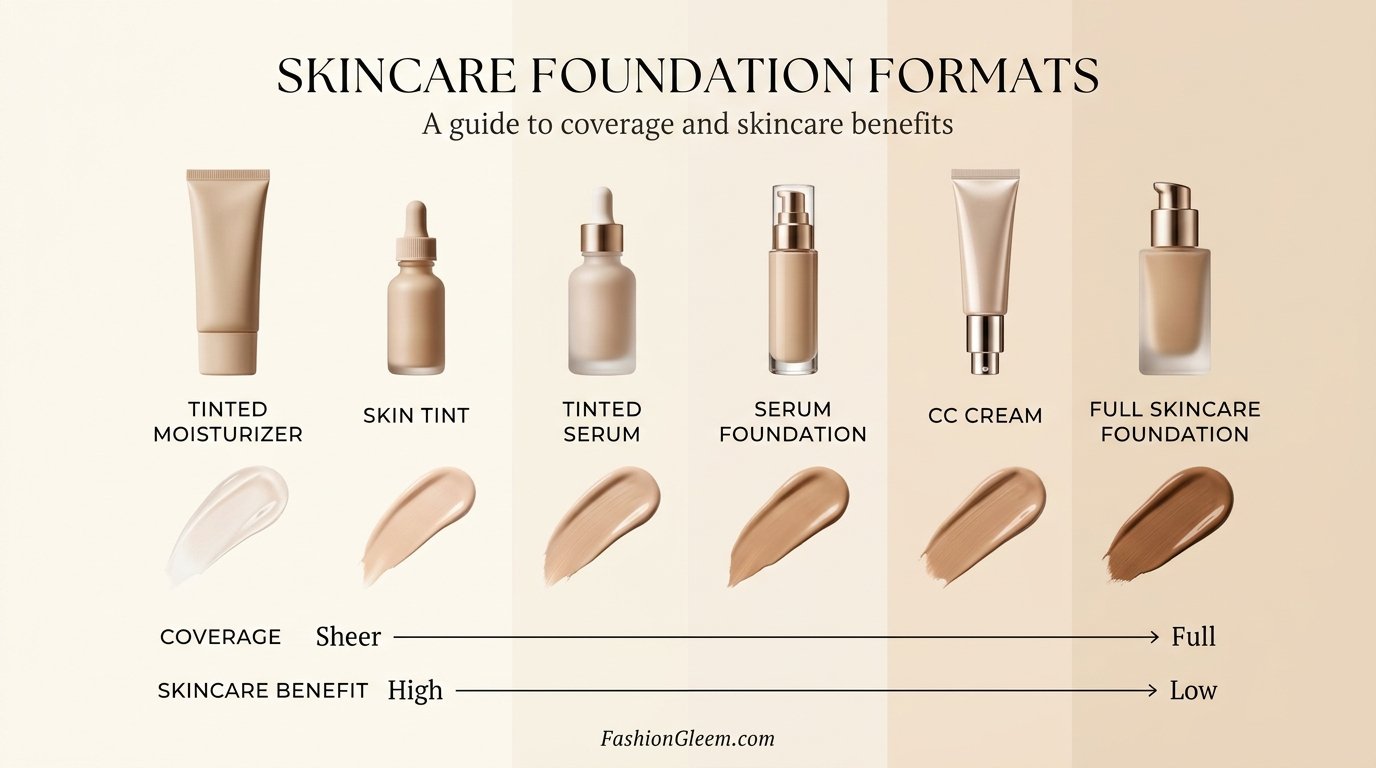
Against a regular foundation, the trade is consistent:
|
Point of comparison |
Regular foundation |
Skincare foundation |
|---|---|---|
|
Primary job |
Coverage and finish |
Coverage plus surface care |
|
Ingredient story |
Pigment, film formers, finish agents |
Adds humectants, emollients, barrier support |
|
Coverage ceiling |
Full |
Usually light to medium, buildable |
|
Wear character |
Longest hold, can feel dry |
More comfortable, may fade sooner |
|
Label discipline |
Finish claims dominate |
Ingredient claims need grading |
|
Best day |
Events, photography, long wear |
Daily wear, dry or sensitive skin days |
The Ingredient Honesty Test: What Works on the Surface
A foundation lives on the surface of skin for hours, then gets washed off. Ingredients that work exactly there, on contact and by feel, are the honest core of any hybrid formula.
Surface actors grade highest. Hyaluronic acid and glycerin pull water to the surface, squalane and dimethicone smooth and soften, niacinamide supports tone and barrier, and allantoin and panthenol calm the feel of wear.
Penetration dependent actives grade lower here. Retinoids and many vitamin C derivatives need to reach living skin layers over time, and a pigmented layer removed nightly is a poor delivery vehicle for them.
The top competitor prints the same grading: the Women’s Concepts skincare foundation guide names weak label passengers such as tocopherol at token levels and retinyl palmitate, ingredients whose presence reads better than it performs.
The Percentage Test: Published Numbers Versus Active Levels
One brand publishes its number: the L’Oreal Paris product page for its hyaluronic tinted serum markets its tinted serum as the first with 1% hyaluronic acid and states that figure on its own product page, where any reader can check it.
The contrast case publishes none: the Sephora listing for the ILIA True Skin Serum Foundation claims active levels of niacinamide and allantoin for its serum foundation, highlights niacinamide in the ingredient story, and never states a percentage anywhere on the page.
Neither wording proves the other product weaker. The lesson is narrower and more useful: a printed percentage can be compared and questioned, while an unquantified claim can only be believed.
Check the ingredient list position yourself. On any INCI list, ingredients appear in descending order down to the 1% line, so a hero ingredient named near the end is present in homeopathic company.
The practice has a name in the trade: fairy dusting. A fashionable active is sprinkled at a level too low to perform, purely so the front of the bottle can claim it, and position checking is how a reader catches it.
Percentages cut through the dust. Where a brand prints one, comparison becomes arithmetic; where it refuses to, the refusal itself is data, and it usually means the number would not help the story.
What a Foundation Cannot Replace
It cannot replace your serum. A treatment serum is dosed, layered under moisturizer and left to work around the clock; a foundation is diluted by pigment and removed at night.
It cannot replace your moisturizer either. Dry skin still needs its cream underneath, because the humectants in a tint carry a wear day, not a barrier repair program.
It cannot fix the skin it covers. Coverage hides redness and uneven tone for a day; the causes belong to the routine, to time and sometimes to a dermatologist, and no pigment layer changes that division of labor.
Leave on actives belong in leave on skincare. The same logic runs through our retinol body lotion guide, where the active sits in a product designed to stay on skin, which is the opposite of a base you cleanse away.
The SPF Reality Check: Foundation SPF Is a Bonus, Never the Plan
This is the block the roundups skip, and it is the most important one on the page. An SPF number on a foundation bottle describes a laboratory test, not your morning face.
SPF is tested at a thickness makeup never reaches. The standard test applies 2 milligrams per square centimeter; dermatologist Patricia Lucey, quoted in the Prevent Cancer Foundation explainer on makeup SPF, explains that real foundation wear is a fraction of that layer.
The shortfall is steep. At typical application amounts, an SPF 30 foundation may deliver an effective protection closer to SPF 5 to 10, because protection falls fast as the layer thins.
The American Academy of Dermatology figure makes it vivid. Reaching a foundation’s labeled SPF would take roughly seven times the amount people normally wear, a quantity no finish could survive, as Advanced Dermatology’s myth roundup reports.
SPF values do not add across layers. An SPF 15 moisturizer under an SPF 30 foundation is not SPF 45; layering improves thickness and coverage evenness, not arithmetic, as the Prevent Cancer Foundation explainer on makeup SPF states plainly.
The correct order is sunscreen first, as its own step: the bareMinerals guide to SPF in makeup gives the same guidance, a dedicated broad spectrum SPF 30 or higher sunscreen as the last skincare step, with makeup over it as a bonus layer.
So the separate sunscreen step is never optional under these products. Any routine that treats foundation SPF as permission to skip sunscreen is trading real protection for a label number, whatever a product roundup suggests.
One exception class deserves its own grading. Foundations built on salicylic acid, such as the acne lines the Women’s Concepts skincare foundation guide lists at 0.5%, carry a drug ingredient, and the claims section below grades them as drugs, not cosmetics.
Reapplication exposes the same gap outdoors. Sunscreen needs renewing about every two hours in the sun, and no one rebuilds a finished face on that schedule, so the durable protection has to live in the layer underneath.
Choosing by Skin Type: Five Paths Through the Spectrum
Skin type chooses the format before brand or price enter the decision. The chooser table compresses the five paths; the subsections that follow carry the reasoning and the traps.
|
Skin type |
Format to start from |
Finish |
Seek |
Avoid |
|---|---|---|---|---|
|
Dry |
Tinted serum or serum foundation |
Dewy, luminous |
Hyaluronic acid, glycerin, squalane |
Matte powders, alcohol heavy formulas |
|
Oily and combination |
Serum foundation or full skincare foundation |
Satin to soft matte |
Niacinamide, oil free bases |
Heavy oils, very dewy tints |
|
Acne prone |
Serum foundation, carefully checked |
Natural to satin |
Short ingredient lists, salicylic exception graded |
Fragrance, known personal triggers |
|
Mature |
Skin tint or serum foundation |
Luminous, flexible |
Glycerin, peptides as support, flexible film |
Thick matte layers that settle |
|
Sensitive and reactive |
Mineral leaning tint or serum foundation |
Natural |
Allantoin, panthenol, fragrance free |
Fragrance, drying alcohol, long lists |
Read the table by your worst skin day, not your best. A format that survives flaking, oil breakthrough or a reactive morning is the format that earns daily wear; the rest is special occasion logic.
Dry Skin: Serums and Tints That Carry Water
Dry skin wants the left half of the spectrum. Tinted serums and serum foundations bring the humectants with them, sit over moisturizer without clinging, and fade softly instead of cracking into flakes.
The drugstore strand proves the format: the L’Oreal Paris product page for its hyaluronic tinted serum positions its 1% hyaluronic acid tinted serum for sheer to light coverage, the exact shape dry skin asks for, at a price printed in the value section below.
Oily and Combination Skin: Satin Finishes and Thin Layers
Oily skin wants the right half, applied thin. Serum foundations with satin or soft matte finishes hold better, and two thin layers outlast one thick one, which separates and pools by midday.
Niacinamide is the seek ingredient here. It is a surface friendly active associated with oil balance and tone, and unlike the penetration dependent actives, its job in a base is realistic.
Acne Prone Skin: Labels Graded, Not Trusted
Two label terms on acne marketed bases need grading first. Non-comedogenic has no FDA definition and no standard test behind it, and dermatologist tested can mean a single dermatologist reviewed or tried the product; neither phrase is a certification.
With that grading attached, the terms still sort shelves. They signal a formula built with pore concerns in mind, but your own patch test and trigger history outrank any front of pack wording.
The salicylic exception is a different object. A foundation with 0.5% salicylic acid is making a drug claim and is regulated as one, so judge it by treatment standards, not by hybrid marketing.
Mature Skin: Flexible Films Over Thick Coverage
Mature skin is a texture problem before a coverage problem. Heavy matte layers settle into fine lines and announce them; flexible luminous films move with the skin and blur instead of packing.
Skin tints and light serum foundations win here. They even tone without building a crust, and the tested picks in the Woman and Home serum foundation test repeatedly land on serum formats for the over 40 wearers in their panel.
Sensitive and Reactive Skin: Short Lists and Patch Tests
Sensitive skin shops the ingredient list, not the claims. Fragrance free formulas, short lists and calming surface ingredients such as allantoin and panthenol lower the odds of a reactive day.
Patch test behind the jaw for two days. A hybrid base covers the whole face for hours, so the test area should match the exposure, and a product that stings on application is telling you its answer early.
Shade and Undertone Matching
Undertone decides whether a shade reads as skin or as paint. Warm, cool, neutral and olive are the four working categories, and the foundation shade that matches your neck in daylight is the honest test.
Two home tests sort most readers. Silver versus gold jewelry flattery and the wrist vein check are imperfect but useful, and they agree often enough to start a shade range search in the right family.
Ranges vary wildly across this category. Some mineral leaning lines offer a handful of shades while prestige serum foundations run to forty, and a narrow range is a real cost whatever the formula quality.
Grade self adjusting claims skeptically. Color changing and one shade fits all formulas flex within a narrow band at best; the Good Gosh Beauty skin care foundation roundup promotes a best self adjusting pick, and its own trade off notes admit depth limits at both ends.
Olive undertones are the category’s blind spot. Green leaning skin sits between warm and cool, most ranges serve it badly, and a shade that reads gray or orange in turns is usually an undertone miss, not a depth miss.
Oxidation explains the orange surprise. Some formulas darken as their pigments and oils meet air and skin, so judge a swatch after fifteen minutes of wear, not at the counter, and not under store lighting.
Match to the neck or chest, not the back of the hand. Faces run redder and hands run darker than the jawline you are actually blending into, which is why counter matches so often fail at home.
Application Over a Skincare Routine
The routine order is fixed and short. Cleanser, treatment steps, moisturizer, sunscreen, then foundation, with each layer given its moment to settle before the next one lands on top of it.
- Cleanse gently and pat dry, because a damp but not wet face takes moisturizer evenly and gives the base a stable start.
- Apply treatments and moisturizer, then wait one to two minutes until the surface feels set rather than slick to the touch.
- Apply sunscreen generously, about two finger lengths for the face, and let it set for several minutes before any pigment touches it.
- Apply the skincare foundation in thin layers, building coverage only where needed instead of coating the whole face at full strength.
- Set selectively: powder only where shine breaks through, so the skincare finish the product promised survives the day.
Fingers, Brush or Sponge: Matching the Tool to the Format
Serum textures reward warmth and speed. Fingers press tinted serums and skin tints into skin before they set, and the thinnest formats in the spectrum generally look most like skin applied this way.
Brushes build where coverage is the point. Serum foundations and fuller hybrids buff up a level with a dense brush, at the cost of some of the skincare finish the formula promised.
A damp sponge is the forgiving middle. It sheers out excess, presses product around texture instead of over it, and rescues an application that went on too thick, which beginners and textured skin both appreciate.
Why Foundations Pill, and How to Stop It
Pilling is a layering physics problem, not a defective product. Tiny rolled beads form when a new layer drags an unset layer beneath it, and the usual suspects are named below in order.
Base clashes come first. A silicone heavy sunscreen under a water based foundation, or the reverse, can refuse to marry, and matching base families is the fastest single fix most wearers ever make.
Too much product comes second. Thick moisturizer, thick sunscreen and thick foundation in sequence guarantee surplus that has nowhere to go, and thinner layers solve what new purchases often cannot.
No wait time comes third. Brushing pigment over sunscreen that has not set is the classic morning rush error, and the several minute pause in the steps above exists precisely for this failure.
The finish layers pair carefully too. Blush sits over the hybrid base once it sets, and our jelly blush guide covers the gel blush timing that keeps color from disturbing the base beneath it.
A full face built on hybrids stays in family: our best vegan mascara guide pairs the base with lashes at the affordable end, which suits a category whose whole pitch is fewer, better layers.
Wear, Setting and Removal
Wear time follows the spectrum. Tints fade gracefully across a workday, serum foundations hold longer with selective setting, and full skincare foundations trade some comfort for the longest hold of the set.
Touch up by pressing, not adding. A fingertip or sponge pressed over a faded patch redistributes what remains, while a fresh full layer over eight hour skin is how cakey afternoons are manufactured.
Setting powder and setting spray do different jobs. Powder absorbs shine and locks oily zones; spray melts powder back into a skin like finish. Most hybrid wearers need one of them, in one zone, not both everywhere.
Removal is part of the product’s skincare promise. Long wear and SPF bearing formulas need a proper cleanse at night, and a cleansing balm or double cleanse lifts what a splash of water leaves behind.
Sleeping in a hybrid base cancels its pitch. The ingredients were the selling point, but overnight wear means clogged pores and pillow transfer, and no surface active justifies skipping the cleanse.
Replace bottles on schedule. Serum droppers and pumps meet fingers and air daily, formulas separate and oxidize across months, and a base that smells off or pours unevenly has already given its verdict.
Certification claims sort at the shelf too: our cruelty free makeup brands guide lets a reader check which hybrid brands carry verified cruelty free status instead of a bunny drawn by the marketing team.
Clean claims get the same treatment: our clean cosmetics guide separates regulated terms from atmosphere words, the same grading habit this page applies to non-comedogenic and dermatologist tested.
What the Two Verified Prices Actually Show
Only two US prices print on this page, each with its source and date attached. No national average exists in the sources checked for this article, so none is printed, and the two strands are never blended into a range.
The prestige strand: the Sephora listing for the ILIA True Skin Serum Foundation lists its serum foundation at $56.00, crawled on 2026-11-20, medium coverage with the unquantified active levels claim the honesty test examined above.
The drugstore strand: the L’Oreal Paris product page for its hyaluronic tinted serum lists its tinted serum at $20.99, crawled on 2026-11-20, with the published 1% hyaluronic acid figure the prestige listing declines to match.
The lesson is about information, not just money. The cheaper product publishes more verifiable detail than the expensive one, which is why this page grades labels before it ever grades price tags.
Editorial enthusiasm is not a price check: the Who What Wear skincare foundation roundup assembles a prestige led set of fifteen hybrids with strong photography and no visible testing method, a reminder that glow in a roundup is a styling outcome as much as a formula one.
Frequently Asked Questions
1. What is a skincare foundation?
A base that pairs pigment with surface skincare in one formula. Humectants, emollients and barrier friendly ingredients ride along with the coverage, so the wear itself is kinder than a traditional foundation, within the limits of a product removed nightly.
2. What is the difference between a skincare foundation and a regular foundation?
Coverage philosophy and ingredient load. A regular foundation is pigment and finish alone, while a skincare foundation adds humectants and barrier ingredients and usually trades maximum coverage and wear for comfort on skin.
3. Is a serum foundation the same as a skin tint?
No, they sit at different points on the spectrum. A skin tint is sheer and skincare led, while a serum foundation carries more pigment, builds to medium coverage and behaves like a true base.
4. Where does a tinted moisturizer fit among skincare foundations?
At the sheerest, most skincare led end. A tinted moisturizer is moisturizer first with a whisper of pigment, the lightest coverage in the family and the natural starting point for dry or minimal makeup days.
5. What is the difference between BB cream, CC cream and skincare foundation?
They correct in different directions. BB creams blend light coverage with skincare extras, CC creams add color correction for redness and uneven tone, and a skincare foundation is the broader family both belong to.
6. Do skincare foundations actually do anything for skin?
Yes, within a clear ceiling. Surface ingredients hydrate, smooth and calm the feel of wear, and coverage improves appearance immediately, but a layer removed nightly cannot deliver what leave on treatments do over time.
7. Which skincare ingredients are worth having in a foundation?
The surface actors: hyaluronic acid, glycerin, squalane, niacinamide, allantoin and panthenol. They hydrate, soften and support the barrier exactly where a foundation sits, which is why they grade above actives that need penetration.
8. Is niacinamide in foundation effective, or just marketing?
It is one of the more realistic hybrid ingredients. Niacinamide works at the surface on tone and barrier support, so its role in a base is plausible, though an unquantified claim still cannot be compared against a published percentage.
9. What does 1% hyaluronic acid on a label actually tell me?
It tells you the dose, which almost no label does. A printed percentage can be compared across products and judged against known use levels, turning a marketing claim into a checkable fact.
10. What does “active levels” of an ingredient mean?
It is a brand phrase, not a measurement. It claims a meaningful amount without stating one, and the ILIA listing examined on this page uses it for niacinamide and allantoin while publishing no percentage anywhere.
11. Are there ingredients in foundations that are mostly label decoration?
Yes, and the field names them. Token levels of tocopherol and penetration dependent retinyl palmitate appear on labels for story value, present in amounts or forms a foundation cannot realistically deliver on.
12. Can a foundation replace my serum?
No, and the attempt usually disappoints. A serum is dosed and left to work under moisturizer around the clock, while a foundation dilutes its actives in pigment and is cleansed off at night.
13. Can a foundation replace my moisturizer?
No, not for skin that needs one. A tint can carry a dry day in mild weather, but barrier support comes from the cream underneath, and skipping it shows up as clinging and flaking by afternoon.
14. Does foundation need to penetrate skin to work?
No, and the honest formulas are designed that way. Foundation is formulated to sit on top of skin, so its best ingredients are the ones whose job happens on the surface.
15. Is the SPF in foundation enough sun protection on its own?
No, not on its own. Foundation is applied far below the tested thickness, so its labeled SPF overstates real protection, and dermatologists treat it as a bonus layer over a dedicated sunscreen.
16. How much foundation would I need to wear to get the labeled SPF?
Roughly seven times the amount people normally wear. That is the American Academy of Dermatology figure carried by dermatologist commentary, and no wearable finish survives that quantity, which is the point.
17. Should sunscreen go under or over skincare foundation?
Under, always. Sunscreen is the last skincare step, given several minutes to set, and foundation goes over it as a bonus layer rather than a replacement for it.
18. Do SPF values add up when I layer moisturizer, sunscreen and foundation?
No, SPF does not add across layers. An SPF 15 moisturizer under an SPF 30 foundation is not SPF 45; layering helps thickness and evenness of coverage, not the arithmetic.
19. Is mineral SPF in foundation better than chemical SPF?
Neither wins inside a foundation. Both types face the same thickness problem at makeup application amounts, so the choice matters far less than wearing a dedicated sunscreen underneath at full measure.
20. How often would foundation SPF need reapplying outdoors?
On the sunscreen schedule, about every two hours outdoors. Foundation alone cannot hold that cadence without disturbing the makeup, which is another reason the protection layer belongs underneath.
21. What is the best skincare foundation format for dry skin?
A tinted serum or a serum foundation with a dewy finish. Humectant rich formulas sit over moisturizer without clinging to flakes, and the sheer end of the spectrum fades softly instead of cracking.
22. What is the best format for oily skin?
A serum foundation or full skincare foundation with a satin to soft matte finish. Thin layers hold best, and niacinamide is the seek ingredient for oil balance at the surface.
23. What should acne-prone skin look for in a foundation?
Short, fragrance free ingredient lists and a personal patch test. Treat non-comedogenic as a marketing signal rather than a guarantee, and grade any salicylic acid formula as a drug product, not a cosmetic hybrid.
24. Does non-comedogenic on a label guarantee no breakouts?
No, it cannot guarantee that. Non-comedogenic has no FDA definition and no standard test behind it in the US, so the phrase prints on this page only with that grading attached.
25. What does “dermatologist tested” actually mean?
Less than it sounds. The term is unregulated and can mean a single dermatologist reviewed or tried the product; it is not a certification, a trial result or an endorsement standard.
26. What is the best format for mature skin and fine lines?
A skin tint or light serum foundation with a flexible, luminous film. Heavy matte layers settle into fine lines and announce them, while flexible films move with skin and blur instead of packing.
27. What should sensitive or reactive skin avoid in a foundation?
Fragrance, drying alcohol and very long ingredient lists. Sensitive skin does better with short, fragrance free formulas and calming surface ingredients such as allantoin and panthenol, patch tested behind the jaw first.
28. Can I wear skincare foundation every day?
Yes, for most skin, with nightly removal as the condition. Daily wear is the category’s design case, and the routine underneath, plus a proper cleanse at night, is what makes it sustainable.
29. Can skincare foundation help with redness?
It can cover redness, and CC formats are built to correct it. Coverage and color correction mask the appearance, while persistent redness itself belongs to the skincare routine and, when it flares, a dermatologist.
30. How do I find my foundation undertone?
Start with the jewelry and vein tests, then confirm with a jawline swatch in daylight. Gold flattering suggests warm, silver suggests cool, disagreement suggests neutral, and the daylight swatch settles what the tests cannot.
31. Why does my foundation turn orange during the day?
Usually oxidation, sometimes a warm undertone mismatch. Pigments and oils darken as they meet air and skin, so judge a shade after fifteen minutes of wear rather than at the counter.
32. Do self-adjusting or color-changing foundations really match everyone?
No, and the honest sellers admit the limits. Flexible shade formulas adjust within a narrow band around a base tone, and the roundup promoting a self adjusting pick concedes depth limits at both ends.
33. Should I match foundation to my neck, chest or face?
To the neck and jawline, checked against the chest. Faces run redder and hands run darker than the line you blend into, which is why counter matches on the hand so often fail at home.
34. What order do skincare and foundation go on in?
Cleanser, treatments, moisturizer, sunscreen, then foundation. Each layer gets a short settle time, sunscreen goes on generously and sets for several minutes, and pigment is always the last thing to land.
35. How long should I wait between moisturizer, sunscreen and foundation?
One to two minutes after moisturizer, and several minutes after sunscreen. The pause lets each layer set so the next one glides instead of dragging, which is also the main defense against pilling.
36. Why does my foundation pill over my skincare?
Because an unset layer underneath gets dragged into beads. Silicone and water base clashes, too many thick layers and no wait time are the three usual causes, in that order.
37. How do I stop foundation from pilling?
Match base families, thin every layer and restore the waits. Pair water with water or silicone with silicone, cut surplus product, and let sunscreen set fully before pigment touches it.
38. How long does a skincare foundation usually last on skin?
By format, from a graceful tint fade to a full workday. Skin tints soften across hours, serum foundations hold longer with selective setting, and full skincare foundations trade some comfort for the longest wear.
39. How do I remove a long-wear skincare foundation properly?
With a real cleanse, not a splash. A cleansing balm or double cleanse lifts long wear and SPF bearing formulas fully, because residue left overnight works against everything the product promised.
40. How often should I replace a bottle of foundation?
When it smells off, separates or pours unevenly, and on schedule before that. Droppers and pumps meet air and fingers daily, so most bases earn replacement within six to twelve months of opening.
41. What is a fair price for a skincare foundation?
Only dated strands can answer honestly. A prestige serum foundation checked today lists at $56.00 and a drugstore tinted serum at $20.99, both crawled on 2026-11-20, and no averaged figure is printed.
42. Can a foundation legally claim to treat acne or change my skin?
No, and the law draws the line clearly. Claiming to treat acne or change skin structure is a drug claim under the US cosmetic versus drug distinction, which is why salicylic acid foundations are regulated as drugs.
Conclusion
Skincare foundation earns its name only when the label survives the honesty test. A format placed on the spectrum, ingredients graded by where they work, and SPF treated as a bonus: that is the whole method.
The routine underneath still does the heavy lifting. Sunscreen as its own step, moisturizer matched to your skin, and treatments left on overnight will always outwork anything suspended in pigment and cleansed away.
Start with one honest bottle. Match the format to your skin type, check the ingredient list before the marketing, and let a single well chosen hybrid replace three half believed ones.
The wider site keeps the same grading standard: the FashionGleem home page gathers the makeup and care guides this page draws on, each one built to be checked the way this category was.

Dilawar is a contributing writer at Fashiongleem.com, focusing on beauty, hairstyles, skincare, fashion accessories, and personal grooming. He creates informative, easy-to-follow articles that help readers explore new looks, understand popular beauty trends, and improve their everyday styling routines. His writing emphasizes practical advice, useful product information, and accessible fashion inspiration for modern readers.