

Beauty Routine at Home: The Secret to Glowing Skin & Hair 2026
A beauty routine at home sounds simple, yet most people quietly sabotage it with too many products, the wrong order, or no plan at all. What if the secret to better skin and hair is not a longer shelf of bottles, but a smarter system you can finish in minutes?
Dermatologists keep repeating the same message: consistency beats complexity. Below, you will find every step, schedule, and shortcut you need to build a routine that fits your skin, your budget, and your life.
Table of Contents
What Is a Beauty Routine at Home?

A beauty routine at home is a repeatable set of skin, hair, and body care habits you perform in your own space. It usually includes cleansing, moisturizing, sun protection, hair care, and a few weekly treatments.
The goal is not to copy a salon. The goal is to keep your skin barrier healthy, your hair strong, and your confidence steady using products and habits you can actually afford and maintain.
The Core Parts of a Home Beauty Routine
Most routines are built from five parts. You can start with the first two and add the rest later.
- Skincare for face and neck
- Hair and scalp care
- Body, hand, and foot care
- Makeup or grooming, if you use it
- Lifestyle habits such as sleep, food, and water
Why a Beauty Routine at Home Works So Well
Your skin responds to small, repeated actions. Washing, moisturizing, and protecting from the sun every single day does more than a luxury facial once a month.
Doing it at home also gives you control. You choose the ingredients, you see changes sooner, and you spend far less than you would on regular salon visits.
Benefits You Can Expect
- Better hydration and a smoother skin texture
- Fewer breakouts when you cleanse consistently
- Healthier hair with less breakage
- Lower monthly beauty spending
- A calmer evening and a more confident morning
How Long Before You See Results
Skin renews itself on a slow cycle, so patience matters. Dermatologists often suggest giving a new product around four to six weeks before you judge it.
Hydration and softness can show up within days. Texture, dark spots, and acne usually need weeks of steady use.
Know Your Skin Type Before You Start
Every good beauty routine at home begins with one question: what does your skin actually need? Guessing leads to irritation, wasted money, and confusing results.
Wash your face, wait an hour without applying anything, and look at your skin in natural light. What you see tells you most of what you need to know.
Oily Skin
Oily skin looks shiny within an hour, especially across the forehead, nose, and chin. It often comes with enlarged pores and frequent breakouts.
Choose a gentle gel cleanser and a lightweight, oil-free moisturizer. Skipping moisturizer is a common mistake because dehydrated skin can produce even more oil.
Dry Skin
Dry skin feels tight after washing and may look flaky or dull. It often struggles in cold weather and heated indoor air.
Look for creamy cleansers and moisturizers with ceramides, glycerin, or hyaluronic acid. Apply moisturizer while your skin is still slightly damp.
Combination Skin
Combination skin is oily in the T-zone and normal or dry on the cheeks. It can be tricky because one product rarely fits both areas.
Use a balanced cleanser and a light gel cream. You can spot treat the oily zone and add extra moisture to the dry areas.
Sensitive Skin
Sensitive skin reacts quickly with redness, stinging, or itching. Fragrance, harsh scrubs, and strong acids are common triggers.
Keep your routine short and fragrance-free. Patch test every new product on your inner forearm or behind your ear before using it on your face.
Normal Skin
Normal skin feels comfortable, rarely breaks out, and does not swing between oily and dry. Your job is to protect it.
A mild cleanser, a simple moisturizer, and daily sunscreen are enough for most people with this skin type.
Morning Beauty Routine at Home
Think of your morning routine as protection. Your skin faces sunlight, pollution, and makeup during the day, so the morning is about defense.
A strong morning routine takes five minutes. Here is the order that works for almost everyone.
Step 1: Cleanse Gently
Even if your face feels clean, it collects oil and sweat overnight. A mild, fragrance-free cleanser removes that buildup better than water alone.
Massage it in for about thirty seconds, rinse with lukewarm water, and pat dry. Hot water strips natural oils and can leave skin tight.
Step 2: Apply an Antioxidant Serum
A vitamin C serum is a popular morning choice. A Mayo Clinic dermatologist has noted that vitamin C helps defend against environmental stress and supports collagen production.
Vitamin C products can lose strength as they oxidize, so buy small bottles and store them away from heat and light.
Step 3: Moisturize
Moisturizer locks in water and supports your skin barrier. In the morning, a lightweight lotion or gel cream layers best under sunscreen and makeup.
Look for ingredients such as ceramides, hyaluronic acid, glycerin, and niacinamide. Use a pea-sized amount for the face and a little extra for the neck.
Step 4: Protect With Sunscreen
Sunscreen is the single most important step in a morning beauty routine at home. The American Academy of Dermatology recommends a broad-spectrum, water-resistant sunscreen with SPF 30 or higher.
Apply it every morning, even on cloudy days and when you stay indoors near windows. Reapply every two hours when you are outside.
Step 5: Optional Extras
Eye cream, lip balm, and a hydrating mist are nice additions. They are optional, and your skin will not suffer if you skip them on rushed days.
Add one new product at a time so you can spot any reaction.
Night Beauty Routine at Home
If the morning is about protection, the night is about repair. Your skin renews itself while you sleep, so this is the best time for treatment products.
A night routine also removes makeup, sunscreen, and pollution that build up through the day.
Step 1: Remove Makeup and Sunscreen
Start with a cleansing balm, micellar water, or cleansing oil if you wear makeup or water-resistant sunscreen. This melts away what a regular cleanser may leave behind.
Never sleep in your makeup. It clogs pores and can irritate your eyes.
Step 2: Cleanse Again
Follow with your regular gentle cleanser. This is often called double cleansing, and it is helpful on days you wear makeup or sunscreen.
On bare-skin days, one cleanse is enough.
Step 3: Use a Treatment Product
This is where actives live. Depending on your goals, you might use a retinoid, salicylic acid, azelaic acid, or a gentle exfoliating acid.
Introduce them slowly, two or three nights per week at first. Using too many strong actives together is the fastest way to damage your skin barrier.
Step 4: Moisturize Richly
A thicker night cream or balm helps skin recover while you sleep. A Mayo Clinic dermatologist suggests a moisturizer with ceramides, which are building blocks that keep skin intact and hold in moisture.
If your skin is very dry, seal everything with a thin layer of a bland ointment on the driest areas.
Step 5: Care for Lips and Hands
Apply lip balm and hand cream before bed. These areas lose moisture quickly and rarely get the attention they deserve.
Small steps like these make a visible difference within a week.
Skincare Routine at Home: The Right Order of Products
Order matters because each product has a job. A simple rule helps: apply products from thinnest to thickest texture.
The American Academy of Dermatology points to a clear sequence when you use several products. Cleanse first, treat second, moisturize third, and finish with sunscreen in the daytime.
Daily Order at a Glance
| Time | Step 1 | Step 2 | Step 3 | Step 4 |
|---|---|---|---|---|
| Morning | Gentle cleanser | Vitamin C or antioxidant serum | Lightweight moisturizer | Broad-spectrum SPF 30+ |
| Night | Makeup remover if needed | Gentle cleanser | Treatment such as retinoid or acid | Richer moisturizer |
How Many Products Do You Really Need
Most people do well with four: a cleanser, a moisturizer, a sunscreen, and one targeted treatment. That is a complete skincare routine at home.
Extra steps like toners, essences, and eye creams can be fun, but experts say they rarely change results in a major way.
How Long to Wait Between Layers
Give each layer about thirty to sixty seconds to settle. You do not need to stand at the mirror with a timer.
Wait a little longer after strong actives, and always apply sunscreen last in the morning, before makeup.
Weekly Beauty Routine at Home
Weekly treatments are the bonus layer. They polish your skin and hair without overloading your daily routine.
Keep them gentle and limited. More is not better when it comes to exfoliation and masks.
Exfoliation Once or Twice a Week
Exfoliation removes dead cells that make skin look dull and feel rough. Chemical exfoliants such as lactic acid, glycolic acid, or salicylic acid are usually gentler than gritty scrubs.
Start once a week and watch how your skin responds. Stop if you notice stinging, redness, or peeling.
Face Masks for Your Skin Goal
Masks give your skin a concentrated boost for ten to fifteen minutes. Choose one based on what your skin needs that week, not on what looks trendy.
- Clay masks help absorb excess oil on oily and combination skin
- Hydrating gel or cream masks help dry and dull skin
- Soothing masks with oat or centella help sensitive skin
- Sheet masks give a quick hydration boost before an event
Hair Treatments and Scalp Care
Once a week, add a deep conditioner or a hair mask to the lengths of your hair. If your scalp feels heavy or flaky, use a gentle scalp scrub or a clarifying shampoo.
Avoid applying heavy masks directly to the scalp unless the product is made for it.
Hands, Feet, and Nails
A weekly hand and foot session keeps rough patches under control. Soak, gently file calluses, moisturize, and wear cotton socks for an overnight treat.
Push back cuticles softly rather than cutting them to reduce the risk of infection.
DIY Face Masks at Home: What Works and What to Avoid

Kitchen ingredients are tempting, and some are genuinely helpful. Others can burn, sting, or leave you with a damaged skin barrier.
The safest approach is to choose simple, gentle ingredients and always patch test first.
Gentle Ingredients Worth Trying
- Plain yogurt for a mild, cooling mask
- Honey for light moisture on most skin types
- Mashed banana or avocado for dry skin
- Colloidal oatmeal for calming irritated skin
- Cucumber slices for a refreshing, soothing feel
A Simple Honey and Oat Mask
Mix one tablespoon of finely ground oats with one tablespoon of honey and a teaspoon of warm water. Spread it over clean skin and leave it for ten minutes.
Rinse with lukewarm water and follow with moisturizer. It is gentle enough for most skin types.
Ingredients to Avoid
Lemon juice, baking soda, vinegar, and toothpaste are popular online hacks. They can throw off your skin’s natural pH and cause irritation or burns.
If a homemade mask stings or burns, rinse it off right away. Your skin should feel comfortable, not punished.
At-Home Facial Steps You Can Follow in 30 Minutes
You can create a calming facial without any special equipment. The American Academy of Dermatology keeps the core of healthy skin care simple, so steaming, masks, and massage are best treated as optional extras.
Do this once every one to two weeks when you want a little extra care.
The Facial Step by Step
- Remove makeup and cleanse thoroughly.
- Exfoliate gently if your skin tolerates it.
- Apply a mask suited to your skin type.
- Massage in a serum using upward strokes for two to three minutes.
- Seal with moisturizer.
- Finish with sunscreen if it is daytime.
Face Massage and Facial Tools
Massage boosts relaxation and helps products absorb comfortably. Clean fingers work beautifully, and tools like a gua sha stone or facial roller are fine if you enjoy them.
Use light pressure, never drag the skin, and clean any tool after every use.
When to Skip an At-Home Facial
If you have eczema, rosacea, an active skin infection, or a sunburn, skip masks, steam, and extra exfoliation. Stick to a basic cleanse and moisturize routine until your skin settles.
When in doubt, ask a dermatologist before adding something new.
Hair Care Routine at Home
Healthy hair starts at the scalp. A thoughtful hair care routine at home keeps strands strong, shiny, and easier to style.
The right routine depends on your hair type, texture, and how often you use heat or color.
How Often Should You Wash Your Hair
There is no single rule. Oily scalps may need washing every one to two days, while dry or curly hair often does better with two or three washes per week.
Let your scalp guide you. If it feels itchy or greasy, wash. If it feels tight, wait another day.
Shampoo, Conditioner, and Technique
Focus shampoo on the scalp and let the suds rinse through the lengths. Apply conditioner from mid-length to the ends, since that is where hair is driest.
Rinse with lukewarm water and finish with a cooler rinse if you like extra shine.
Drying and Styling Without Damage
Blot hair with a microfiber towel or cotton tee instead of rubbing. Rough towel drying causes frizz and breakage.
Use a heat protectant before any hot tool, and keep the temperature as low as your hair type allows.
Hair Care by Hair Type
| Hair type | Main need | Helpful habit |
|---|---|---|
| Straight | Oil control and shine | Wash more often, light conditioner |
| Wavy | Frizz control | Scrunch with a curl cream |
| Curly | Moisture | Deep condition weekly, detangle wet |
| Coily | Moisture and length retention | Layer leave-in and sealing oil |
| Fine | Volume without weight | Lightweight formulas, root lift |
Trims and Scalp Health
Regular trims every six to eight weeks keep split ends from traveling up the hair shaft. A gentle scalp massage while shampooing helps remove buildup.
If you notice sudden thinning, flaking that will not clear, or a sore scalp, see a dermatologist.
Beauty Routine at Home for Men
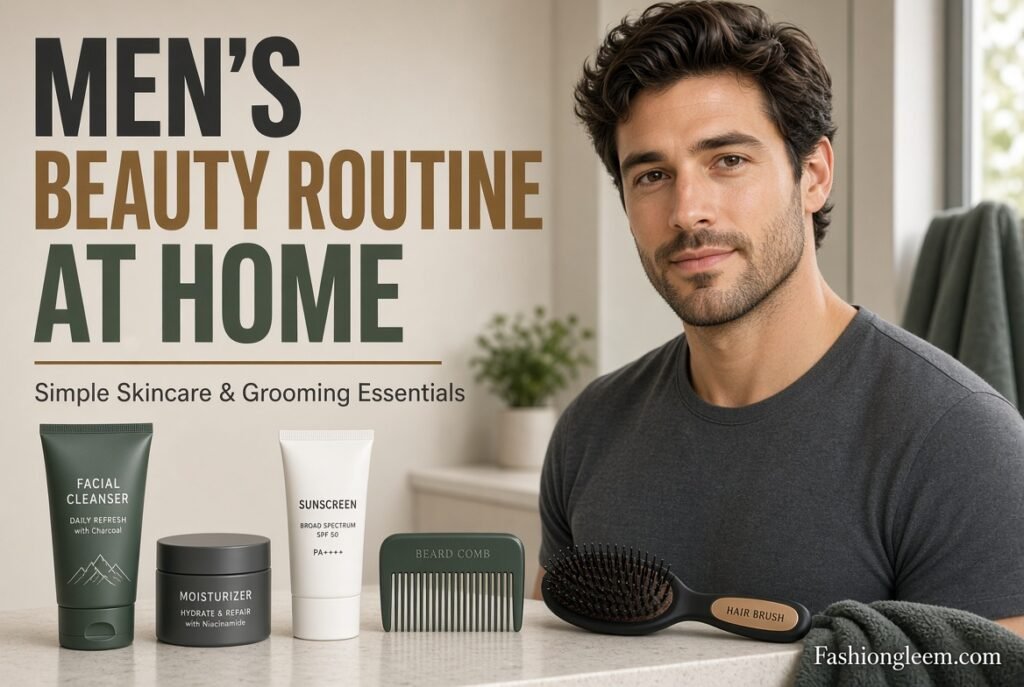
Men’s grooming does not need to be complicated. A simple routine of cleanser, moisturizer, sunscreen, and a good haircut can transform how you look and feel.
Shaving, beard care, and scalp care add a few extra steps, but the basics stay the same.
Skin Basics for Men
Wash your face morning and night, moisturize after shaving, and use sunscreen daily. Men often get more sun exposure on the neck, ears, and scalp, so do not skip those areas.
If you shave, use a sharp blade, a soothing shave cream, and go with the direction of hair growth to reduce razor bumps.
Choosing a Haircut That Fits Your Routine
The right cut makes hair care easier. Short styles like a buzz cut fade need almost no styling, while medium length hairstyles for men give you room to experiment with texture.
If you like volume and movement, layered haircuts for men work well with a simple wash-and-style routine.
Styling Curly and Textured Hair
Curly hair needs moisture and a gentle hand. A leave-in conditioner and a defined cut, such as a curly burst fade, keep curls neat and easy to manage.
For a sharper everyday look, a mid fade haircut or a low taper fade textured crop grows out gracefully between barber visits.
Buzz Cut Maintenance at Home
Buzz cuts are the easiest to maintain, but the guard number changes how often you need a touch-up. Shorter lengths like a 4 guard buzz cut look neat for a shorter time, while longer lengths like a 6 guard buzz cut grow out more forgivingly.
Moisturize your scalp and apply sunscreen to it, because a short cut leaves skin exposed.
Natural Beauty Routine at Home
A natural beauty routine at home focuses on gentle, simple ingredients and healthy habits. Natural does not automatically mean safer, so it is worth reading labels and patch testing.
The best natural routines combine a few clean products with strong lifestyle basics.
Natural Ingredients With Real Benefits
- Aloe vera gel for soothing sun-exposed or irritated skin
- Jojoba or squalane oil for lightweight moisture
- Shea butter for very dry skin and cracked heels
- Green tea extract as a gentle antioxidant
- Rosewater as a light, refreshing mist
Natural Habits That Matter More Than Products
Drinking enough water, eating a balanced diet with fruits and vegetables, and sleeping well show up on your skin. No cream can fully replace these habits.
Moving your body regularly also supports circulation and helps manage stress, which can trigger breakouts.
Be Careful With Essential Oils
Essential oils are strong and can cause allergic reactions or sun sensitivity. Dilute them properly, avoid them near the eyes, and skip them completely if your skin is sensitive.
If a product relies on a long list of fragrant oils, think twice before putting it on your face.
Budget Beauty Routine at Home
You do not need expensive products to get great results. Many drugstore brands use the same core ingredients as luxury lines.
Spend your money where it counts and save where it does not.
Where to Spend and Where to Save
| Product | Spend or save | Why |
|---|---|---|
| Sunscreen | Spend a little more | You will wear it daily, so it should feel pleasant |
| Cleanser | Save | It stays on skin for seconds |
| Moisturizer | Save | Simple formulas work well |
| Retinoid | Mid-range | Consistency matters more than price |
| Masks | Save or DIY | They are occasional extras |
Smart Ways to Cut Costs
- Buy a core set of four products and ignore the rest
- Use samples to test new items before buying full sizes
- Look for fragrance-free basics, which are often cheaper
- Use up products before opening new ones
- Replace sheet masks with a homemade oat mask
Build a Starter Kit Under a Small Budget
A cleanser, a moisturizer, a sunscreen, and a lip balm cover the essentials. Add a gentle exfoliating acid or a retinoid later when you are ready.
Body Care Routine at Home
Your face gets most of the attention, but the skin on your body deserves care too. A short body routine keeps skin soft, smooth, and comfortable.
You can fit it into the time you already spend in the shower.
Showering Without Drying Out Your Skin
Long, hot showers strip natural oils. Keep showers to about ten minutes with warm water, and use a gentle, fragrance-free body wash.
Pat your skin dry and apply body lotion within a few minutes while it is still damp.
Body Exfoliation and Smoother Skin
Exfoliate rough areas such as elbows, knees, and heels once or twice a week. A soft washcloth or a lotion with lactic acid or urea works well.
For bumpy upper arms, gentle chemical exfoliation is usually kinder than harsh scrubbing.
Body Sunscreen and Shaving
Do not forget sunscreen on your neck, chest, hands, and arms. These areas show age and sun damage early.
If you shave, use a clean razor, a shaving cream, and a soothing lotion afterward to prevent irritation.
Lip, Hand, and Nail Care at Home
Small details make a routine feel complete. Lips, hands, and nails are exposed to wind, water, and sanitizer all day.
A few minutes each week keeps them looking cared for.
Lip Care
Apply a hydrating lip balm with SPF in the morning and a thicker balm at night. Avoid picking at dry skin, because it slows healing.
If your lips stay chapped, check for irritating ingredients like strong mint, menthol, or fragrance.
Hand Care
Wash hands with a gentle soap and moisturize afterward. Keep a small tube of hand cream near your sink and your desk.
At night, apply a richer cream and wear cotton gloves for deeper repair.
Nail Care and At-Home Manicure
File nails in one direction to avoid splitting. Apply cuticle oil, shape the nails, and finish with a clear base coat or polish.
Give nails breaks from polish occasionally and never rip off gel or acrylic, because it can thin the nail plate.
Makeup Routine at Home
Makeup is optional, and a good skincare base makes any product look better. A light, fresh routine often looks more flattering than a heavy one.
Here is a quick approach for a polished everyday look.
A Five-Minute Natural Makeup Routine
- Apply moisturizer and sunscreen and let them settle.
- Dab tinted moisturizer or skin tint where you need coverage.
- Conceal under the eyes and around the nose.
- Add cream blush to the cheeks with your fingertips.
- Brush brows, curl lashes, and add mascara.
- Finish with lip balm or a tinted lip product.
Keep Your Tools Clean
Wash makeup brushes and sponges every week or two. Dirty tools hold oil and bacteria that can trigger breakouts.
Replace mascara every three months, since old formulas can irritate the eyes.
Always Remove Makeup at Night
Removing makeup is the bridge between a day routine and a night routine. A cleansing balm or micellar water followed by a gentle cleanser does the job.
Skipping this step is one of the most common causes of dull, congested skin.
Beauty Sleep and Lifestyle Habits
No product beats good habits. Sleep, food, stress, and movement shape the way your skin and hair look every day.
Treat these as part of your beauty routine at home, not as separate topics.
Sleep Your Way to Better Skin
Aim for seven or more hours of sleep when you can. A cool, dark, quiet room helps, and so does keeping screens away from the bed.
A clean pillowcase, changed every week or so, reduces oil and bacteria against your face.
Food and Hydration
A balanced diet with vegetables, fruit, whole grains, healthy fats, and enough protein supports your skin and hair. Drinking water helps your body function well, although it will not replace moisturizer.
If you suspect a food trigger for breakouts, talk with a doctor or dietitian before cutting out entire food groups.
Stress and Self-Care
Stress can worsen acne, hair shedding, and sensitivity. Even ten minutes of stretching, a walk, or quiet breathing before bed makes a difference.
Treat your evening routine as a small ritual rather than a chore. That mindset makes consistency far easier.
Beauty Routine at Home for Different Skin Types
Skin types respond differently to the same products. This table gives you a quick reference to start with.
| Skin type | Cleanser | Moisturizer | Helpful extras |
|---|---|---|---|
| Oily | Gel or foaming | Oil-free gel | Salicylic acid, niacinamide |
| Dry | Cream or milk | Rich cream with ceramides | Hyaluronic acid, gentle oils |
| Combination | Balanced gel | Light gel cream | Spot treatments, clay on T-zone |
| Sensitive | Fragrance-free creamy | Bland, soothing cream | Colloidal oatmeal, panthenol |
| Acne-prone | Gentle gel | Non-comedogenic lotion | Benzoyl peroxide, azelaic acid |
| Mature | Hydrating cleanser | Rich cream | Retinoid, vitamin C, peptides |
Beauty Routine for Acne-Prone Skin
Keep it simple and gentle. Wash twice a day, use a non-comedogenic moisturizer, and apply a targeted treatment such as benzoyl peroxide or salicylic acid.
Do not pick or scrub aggressively. If acne is painful, deep, or leaving marks, a dermatologist can offer prescription options that work faster.
Beauty Routine for Dry and Mature Skin
Dry and mature skin benefits from richer moisturizers, a nightly retinoid, and daily sunscreen. Add hydrating serums with hyaluronic acid for extra plumpness.
Be gentle with exfoliation, as thin, dry skin irritates easily.
Essential Beauty Products Checklist
You can build a complete beauty routine at home with a short shopping list. This checklist separates must-haves from nice-to-haves.
Must-Have Products
- Gentle cleanser
- Moisturizer for your skin type
- Broad-spectrum sunscreen SPF 30 or higher
- Shampoo and conditioner for your hair type
- Lip balm and hand cream
Nice-to-Have Products
- Vitamin C serum for mornings
- Retinoid or gentle exfoliating acid for nights
- Hair mask or leave-in conditioner
- Cleansing balm for makeup removal
- Face mask for weekly use
Tools Worth Having
A soft washcloth, a microfiber hair towel, a clean set of makeup brushes, and a nail file cover most needs. Fancy devices are fun but never required.
Common Beauty Routine Mistakes to Avoid
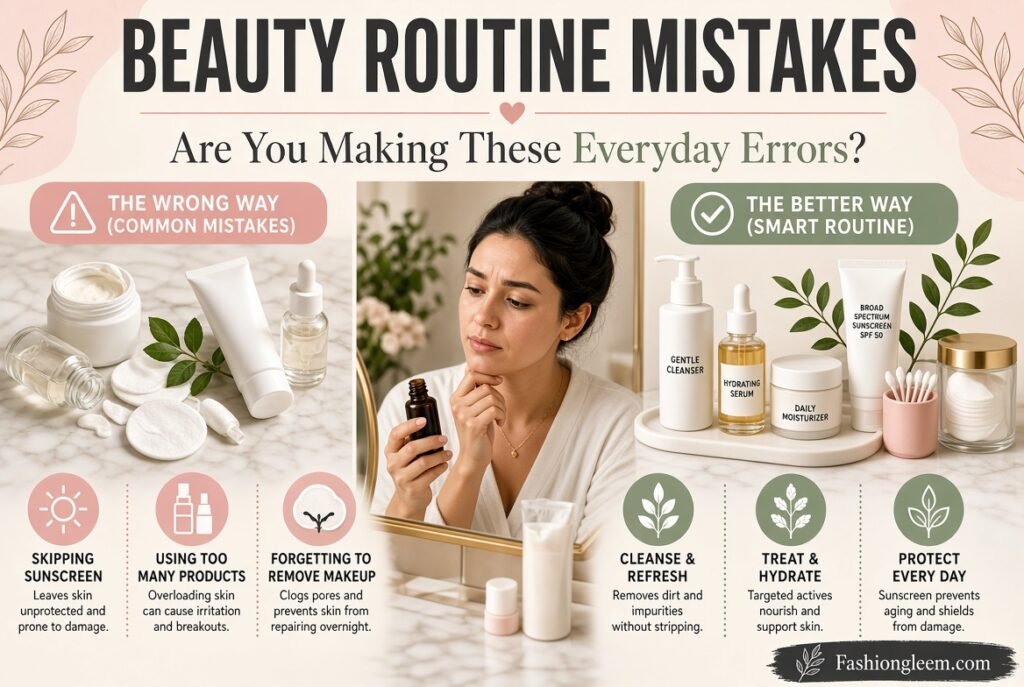
Even a good routine can backfire when small errors pile up. Check yourself against this list.
Using Too Many Actives at Once
Combining retinoids, acids, and vitamin C on the same night can overwhelm your skin barrier. Redness, stinging, and peeling are signs you did too much.
Introduce one active at a time and give it several weeks.
Skipping Sunscreen
Without sunscreen, other steps lose much of their value. Sun exposure is a leading cause of visible aging and a major risk factor for skin cancer.
Make sunscreen the one step you never skip.
Washing Too Often or Too Harshly
Washing more than twice a day, except after heavy sweating, can strip your skin and trigger more oil. Scrubbing hard does not clean better, it just irritates.
Gentle, consistent care wins every time.
Ignoring Patch Tests
A patch test takes a minute and can save you days of irritation. Apply a small amount to your inner arm or behind the ear, and wait twenty-four hours.
Following Every Trend
Viral products and twelve-step routines look exciting, but your skin does not care about trends. Choose products based on ingredients and your own results.
How to Build a Beauty Routine at Home You Will Actually Follow
The best routine is the one you repeat. Start small, link it to existing habits, and expand only when the basics feel automatic.
Here is a simple weekly plan to copy and adjust.
A Sample Weekly Schedule
| Day | Morning | Evening |
|---|---|---|
| Monday | Cleanse, moisturize, SPF | Cleanse, retinoid, moisturize |
| Tuesday | Cleanse, moisturize, SPF | Cleanse, moisturize |
| Wednesday | Cleanse, vitamin C, moisturize, SPF | Cleanse, exfoliating acid, moisturize |
| Thursday | Cleanse, moisturize, SPF | Cleanse, moisturize |
| Friday | Cleanse, vitamin C, moisturize, SPF | Cleanse, retinoid, moisturize |
| Saturday | Cleanse, moisturize, SPF | Face mask, hair mask |
| Sunday | Cleanse, moisturize, SPF | Hand and foot care, early sleep |
Habit-Building Tips
- Keep products where you can see them
- Pair your routine with brushing your teeth
- Use a calendar or reminder for weekly treatments
- Take progress photos once a month in the same light
- Forgive missed days and simply continue
How to Adjust With the Seasons
In winter, switch to richer moisturizers and cut back on exfoliation. In summer, choose lighter textures and reapply sunscreen more often.
Travel, stress, or hormonal shifts may also call for a temporary change. Your routine should flex with your life.
When to See a Dermatologist
A home routine can handle everyday needs, but it cannot replace medical care. Some signs are your cue to book an appointment.
- Acne that is deep, painful, or scarring
- A mole that changes shape, color, or size
- Persistent rashes, itching, or burning
- Sudden hair loss or patchy thinning
- Skin that does not improve after consistent care
A board-certified dermatologist can diagnose the problem and suggest treatments that products from a store cannot match.
Also Read:
- Popular Layered Haircuts For Men
- 4 Guard Buzz Cut
- 5 Guard Buzz Cut
- 6 Guard Buzz Cut
- 8 Guard Buzz Cut
- 10 Guard Buzz Cut Styles
- 12 Guard Buzz Cut
- 16 Guard Buzz Cut
- Buzz Cut Fade
- Modern Mullet
- Permed Mullet Variations
- Asian Mullet Hairstyle
- Mohawk Mullet Variations
- Medium Length Hairstyles For Men
- The Quiff Hairstyle
- Burst Fade Comb Over
- Burst Fade Slick Back
- Burst Fade Taper
- Burst Fade Mohawk
- Curly Burst Fade Haircut
- Mid Fade Haircuts
- Low Taper Fade Buzz Cut
- Low Taper Fade Middle Part
- Low Taper Fade Textured Crop Haircut
- Low Taper Fade Fluffy Hair
Frequently Asked Questions (FAQs)
What is a good beauty routine at home?
A good beauty routine at home includes cleansing, moisturizing, and sunscreen every day. Add hair care and one or two weekly treatments as you build the habit.
What are the basic steps of a beauty routine at home?
The basics are cleanse, treat if needed, moisturize, and protect with sunscreen in the daytime. Hair washing, lip care, and hand care complete the routine.
How long should a daily beauty routine take?
Most people need about five minutes in the morning and ten minutes at night. Weekly masks and hair treatments add another twenty to thirty minutes.
What is the correct order for a skincare routine at home?
Apply products from thinnest to thickest. Cleanse first, then serums or treatments, then moisturizer, and sunscreen last in the morning.
Do I really need a night routine?
Yes, because your skin repairs itself while you sleep. Cleansing removes dirt and makeup, and moisturizer or treatments support that repair.
Is sunscreen necessary every day?
Yes, daily sunscreen is one of the most effective ways to protect your skin. Use a broad-spectrum, water-resistant formula with SPF 30 or higher.
How often should I exfoliate at home?
Once or twice a week is enough for most skin types. Sensitive or dry skin may need even less.
Can I use a vitamin C serum and a retinoid together?
Many people use vitamin C in the morning and a retinoid at night to avoid irritation. Introduce them slowly and stop if your skin becomes red or sore.
Are homemade face masks safe?
Gentle ingredients like oats, honey, and yogurt are usually safe for most people. Avoid lemon juice, baking soda, and vinegar, and always patch test first.
How do I choose products for my skin type?
Identify whether your skin is oily, dry, combination, sensitive, or normal. Then choose gentle formulas made for that type and add new products one at a time.
How long does it take to see results from a new routine?
Hydration improves within days, while texture and breakouts may take four to six weeks. Dark spots and fine lines can take longer.
What is the best hair care routine at home?
Wash according to your scalp and hair type, condition the lengths, and use a heat protectant before styling. Add a weekly mask and trim every six to eight weeks.
Can I follow a beauty routine at home on a tight budget?
Yes, a cleanser, moisturizer, and sunscreen from the drugstore cover the essentials. Spend a little more on sunscreen you enjoy wearing daily.
Do men need a beauty routine at home?
Men benefit from the same basics of cleansing, moisturizing, and sunscreen. Add shaving care and scalp care when needed.
When should I see a dermatologist?
See one for painful acne, changing moles, persistent rashes, or sudden hair loss. A professional can offer treatments that home products cannot.
Is a beauty routine at home better than salon treatments?
They serve different purposes. A steady home routine handles daily care, while salon or medical treatments are useful for specific goals.
Conclusion
A beauty routine at home does not need to be expensive or complicated. Cleanse gently, moisturize, protect with sunscreen, and care for your hair and body with simple, steady habits.
Start with the basics and add one new step at a time. Patch test new products, listen to your skin, and adjust with the seasons.
Remember that consistency matters more than perfection. Missed days are normal, and the routine you can maintain is always better than a perfect plan you abandon.
Use the schedules and tables above as your starting point, and build a beauty routine at home that feels like a small daily reward. If your skin or hair needs more than home care can offer, a dermatologist is always the right next step.
