

How to Apply Eyeliner for Hooded Eyes: Draw for the Open Eye
How to apply eyeliner for hooded eyes starts with one change of habit: stop designing the line on a closed, stretched lid, and start mapping it on the open eye you actually show the world.
A hooded eye has a crease that exists but is covered by a fold of skin when the eye is open, so liner placed the standard way gets hidden, stamped onto the hood, or cut at the outer corner.
The fix is placement before product: identify your fold type, choose the method that fits it, then pick a format by job. No liner survives a line drawn in the wrong place.
Technique advice here is attributed to named artists and publications as strands. Where artists disagree, on wing angle, waterline, shimmer and line coverage, the disagreement prints in full instead of being merged.
This page owns hooded eye liner technique only. The full beginner routine lives in our makeup tutorial for beginners; mature makeup broadly lives elsewhere on this site.
The Short Answer: Five Rules That Fix Hooded Eyeliner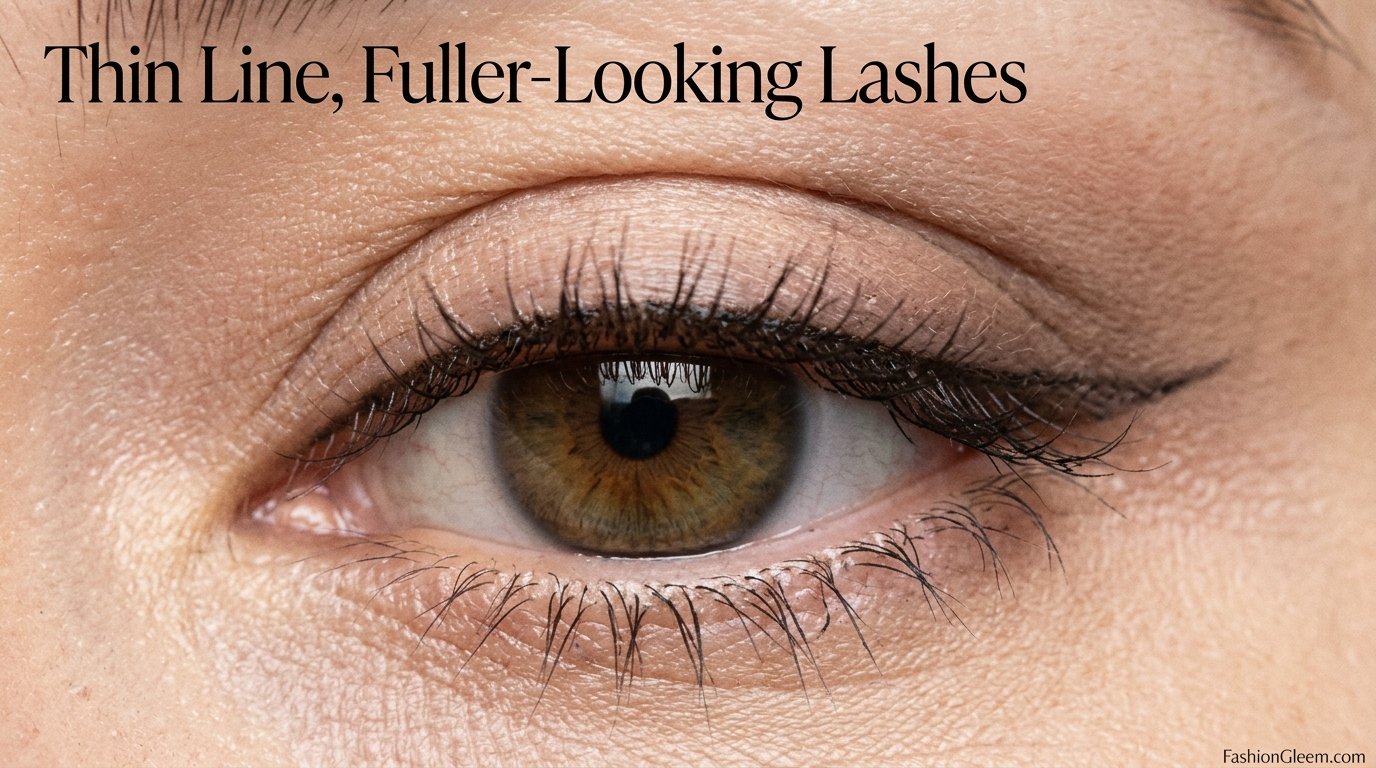
Quick answer: map with eyes open and brows relaxed, tightline or keep the line hairline thin, let the lower lash line set the wing direction, cross the fold on purpose, and set for the friction zone.
Rule 1: Map With Eyes Open, Brows Relaxed, Mirror at Eye Level
Every placement decision, endpoint, angle and thickness, is judged looking straight ahead. Lower your gaze only to connect marks already placed.
Rule 2: Tightline or Hairline Thin, Never Thick at the Inner Third
Definition belongs in the lash roots or in a line too thin to spend lid space. Thickness, when you want it, belongs at the outer third where the open eye can display it.
Rule 3: Let the Lower Lash Line Set the Wing Direction
Extend the direction of your lower lash line past the outer corner as the starting angle. It is a guide tied to your eye, not a universal number.
Rule 4: Cross the Fold on Purpose: Batwing, Straight Wing or No Wing
A wing that ignores the fold gets cut by the fold. Choose a shape that steps over it, runs straight under it, or skips the wing for a smoky edge.
Rule 5: Set for the Friction Zone, Then Judge From the Front
The outer corner is where skin touches skin with every blink, so it fades first. Prep and setting protect it, and the finished look is judged from the front, never in a magnifying mirror.
First, the Mirror Check: Are Your Eyes Hooded, Deep-Set or Monolid?
Look straight ahead with relaxed brows. If skin from below the brow covers your crease and hides part or all of the mobile lid while your eyes are open, your eyes are hooded.
The All About Vision hooded eyes explainer describes the same check: hooded eyelids are a normal variation, and skin below the brow nearing the lash line is the giveaway.
Hooded vs Deep-Set vs Monolid vs Downturned: The Distinction Table
|
Eye type |
What you see in the mirror |
Liner logic that follows |
|---|---|---|
|
Hooded |
Crease exists but a fold covers it when open |
Map on the open eye; tightline, batwing or straight wing |
|
Deep-set |
Eyes sit back under a strong brow bone; lid often still shows |
Shadow and depth are the issue, not drape; standard lines often survive |
|
Monolid |
No visible crease to hide; a smooth lid surface |
Gradient built up from the lash line; no fold to cross |
|
Downturned |
Outer corners sit lower than inner corners |
Short straight or puppy direction; a lifted flick fights the eye |
|
Partially hooded |
The fold covers the outer lid but not the inner lid |
Outer-third methods first; inner lid can carry a normal thin line |
Partial Hooding, and Hooding That Deepens With Age
Many readers are partially hooded, most often at the outer third, which is exactly where wings live. Outer-third methods solve more hooded liner problems than any product swap.
Hooding also deepens with age as skin loses elasticity, a point artist Laura Geller makes in the HELLO! artist roundup on hooded eyeliner. A method that worked at thirty may need the mature adjustments in the variations section at fifty.
One boundary, stated once: hooded eyes are anatomy, not a condition. Terms such as dermatochalasis and ptosis, and procedures such as blepharoplasty, are outside a makeup guide; if a fold blocks your vision, ask an eye clinician, not a liner tutorial.
Why Standard Eyeliner Fails on Hooded Eyes
The Fold Covers the Line
A line drawn on a closed, smooth lid sits elsewhere once the eye opens. The brow zone drapes over the crease, the mobile lid slides under it, and the line is not visible anymore.
Transfer: The Stamp on the Hood
Wet or slow-drying liner meets the hood with every blink. The fold presses on the fresh line and lifts a copy onto the skin above: the stamp readers find in their crease by mid-morning.
The Outer Corner Friction Zone
The MakeupTutorials.com hooded eyeliner guide names the outer corner friction zone: skin touches skin there constantly, so wings degrade there first. Plan for that zone instead of blaming the product.
The methods below are direct answers to these three failures: tightlining avoids the covered zone, the batwing crosses the fold, and the longevity stack defends the friction zone.
Prep: Blot, Prime and Set Before Any Liner
Start with a dry lid. Blot away skincare and oil, and keep rich eye cream off the lid itself before makeup; oil undoes liner all day.
Lay down a thin base: eyeshadow primer, or concealer set with translucent powder, or a matte neutral shadow. It gives liner a drier surface and slows oil migration.
Educator Jessica Kohn, in the HELLO! roundup, recommends setting powder before and after liner. Test that strand first if transfer is your main complaint.
Keep the base thin and fully set before liner touches it. A thick, tacky base grabs the pen unevenly and makes a thin line harder, not easier.
The Six Methods, Sequenced From Forgiving to Graphic
Learn these in ladder order, not all at once: tightlining and the thin line first, smoky second, mini wing third, batwing fourth, floating liner last.
|
Rung |
Method |
What it teaches |
|---|---|---|
|
1 |
Tightlining |
Lash root placement and eyes-open checking |
|
2 |
Thin lash line, outer third first |
Line control without spending lid space |
|
3 |
Smoky smudged liner |
Forgiveness; edges that survive softening |
|
4 |
Mini wing and straight wing |
Endpoint mapping on a small scale |
|
5 |
Batwing |
Crossing the fold with a deliberate step |
|
6 |
Floating liner |
Graphic placement above the crease |
Method 1: Tightlining, Definition Without Spending Lid Space
Tightlining places pigment in the upper lash roots so no pale skin shows between the lashes. The eye gains definition and lashes look fuller, while the lid keeps all its visible space.
Work in dots or short presses with a waterproof gel pencil, or gel on a small flat brush, filling the roots section by section. Look slightly down, keep the tip at the roots, and stop if the eye waters.
Whether tightlining means the roots or the upper waterline itself is a genuine field disagreement, covered below. The lash root version gives most of the effect with the least irritation.
Method 2: The Thin Lash Line and the Outer-Third Line
Draw the line as thin as the applicator allows, hugging the lashes, thinnest at the inner third. A thick stripe spends the narrow visible zone and makes the eye look smaller.
The outer-third line is the beginner workhorse: start where definition changes the eye most, and extend inward only while the line stays hairline fine.
MakeupTutorials.com illustrates the contrast as roughly a 1 mm line against a 3 mm line. On a hooded lid, that is the difference between definition and a lid full of liner.
Method 3: The Batwing, Step by Step With Eyes Open
The batwing is a wing drawn on the open eye so it reads as a normal flick from the front, though its closed-eye shape has a notch where it crosses the fold. HELLO! and MECCA credit artist Katie Jane Hughes with popularizing it.
- Mark the endpoint first, looking straight ahead: a dot where the wing should end, following your lower lash line direction.
- Draw the lower edge from the outer corner out to the dot, still looking ahead with brows relaxed.
- Draw the upper edge back from the dot toward the lash line, crossing the fold where the fold actually sits.
- Lower your gaze only now, and connect the step the fold creates; fill only what the open eye needs.
- Keep the notch. Do not smooth the step into a thick triangle; that rebuilds the heavy shape the method exists to avoid.
- Tightline or add the thin lash line, then clean the lower edge with a cotton bud or a flat concealer brush.
The MECCA Memo winged eyeliner guide sketches with pencil or shadow first before committing with liquid. Sketching first is the learner version of every wing here.
Judge the result open and from the front. The closed-eye hook is the compensation working as intended, not a mistake.
Method 4: Straight-Out and Puppy Wings for Downturned Corners
When the outer corner drops or the fold hangs low, a lifted flick fights the eye. A shorter wing running straight out, or only slightly up, reads better and survives the fold.
Puppy liner follows the natural lash direction slightly downward for a softer, rounder look. Creator Smitha Deepak teaches a hooded eye puppy tutorial as a strand; treat it as a style goal, not a failed wing.
Both options share the batwing rule: map the endpoint on the open eye first, then draw. Direction changes; the discipline does not.
Method 5: Smoky Smudged Liner, the Forgiving Option
Apply pencil or gel at the lash roots, smudge immediately with a small brush, then press matching dark eyeshadow over it to set. The edge is diffusion, so small transfer matters far less.
This is the no-wing permission several artists grant hooded eyes: a smoky lash line plus tightlining gives a complete evening look with no crisp edge to cut.
Smoky liner is also the training format for wings. Stamp the shape in shadow first, check it open, and trace with gel or liquid only once the shape is right.
Method 6: Floating Liner Above the Crease, the Advanced Option
Floating liner sits above the natural crease, on skin that stays visible, so the fold cannot hide it. It reads as graphic makeup, deliberately.
Place it with the eye open, following the crease at a distance your fold allows, and keep the rest of the eye quiet. It is the last rung, not a starting point.
Choose Your Method by Fold Type: The Decision Table
|
Fold type |
First method |
Fallback |
Avoid first |
|---|---|---|---|
|
Full hood, little lid visible |
Tightlining plus outer-third line |
Batwing with a short wing |
Thick full line drawn closed |
|
Partial or outer hood |
Thin line plus mini wing |
Batwing at the outer corner |
Long dramatic flicks |
|
Downturned hooded |
Straight-out wing |
Puppy liner or smoky line |
Lifted flick from almond eye tutorials |
|
Mature, textured hood |
Gel pencil or shadow first, short strokes |
Smoky liner set with shadow |
Dragging liquid across textured skin |
|
Deep-set, often confused |
Standard thin line, checked open |
Outer-third emphasis |
Hooded methods on a fold you lack |
Work one variation at a time. Changing method, format and colour together makes it impossible to tell what fixed the failure.
Formats by Job: Gel, Liquid, Felt Tip, Pencil and Shadow
Choose format by the job in front of you, not by reputation. Dry-down speed and forgiveness matter more on a hooded lid than pigment intensity, because the fold touches everything.
|
Format |
Best job on hooded eyes |
Dry down and transfer |
Forgiveness |
Removal |
|---|---|---|---|---|
|
Felt or brush tip liquid pen |
Thinnest, sharpest wing edge |
Fast dry down helps transfer most |
Low; errors are crisp |
Needs a remover that dissolves film |
|
Gel pot with angled brush |
Tightlining and controlled wings |
Sets firmly once dry |
Medium; stamp and adjust |
Soak-off removal |
|
Gel pencil |
All-round lash line and smoky base |
Sets after a short working time |
High; smudges before it sets |
Moderate |
|
Regular pencil, kohl |
Smoky looks and beginner sketching |
Highest transfer risk unless set with shadow |
Highest |
Easiest |
|
Eyeshadow with angled brush |
Sketching wings and soft lines |
Powder, so no wet transfer; wears shorter |
Highest; fully erasable |
Easiest |
Product names recur across artist content as dated strands: Stila, Shiseido, NYX, Urban Decay, Bobbi Brown, Laura Mercier, Ilia, Victoria Beckham. Recurrence is not a ranking; this page prints no ratings and no prices, because both move.
If cruelty free formulas matter to you, our best cruelty free makeup guide covers the wider routine; the format logic applies whatever the brand.
Where Artists Disagree: Angle, Waterline, Shimmer and the Full Line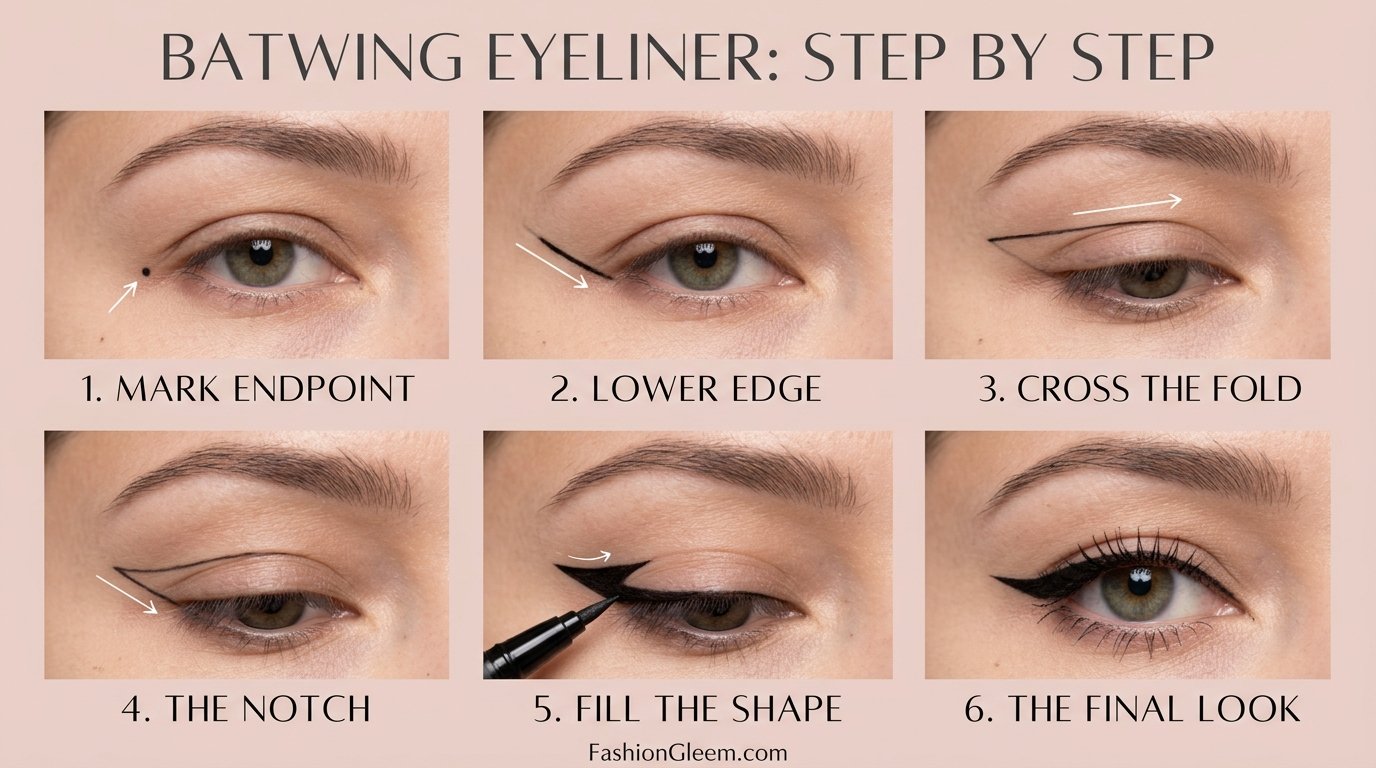
Honest tutorials conflict. Four disagreements run through this research; each strand is attributed, and none is merged into a fake consensus.
|
Question |
Strand one |
Strand two |
Working approach |
|---|---|---|---|
|
Wing angle |
Follow the lower lash line upward, often described at roughly 30 to 45 degrees (majority tutorial strand) |
Go straight out or slightly down for puppy and downturned looks (Deepak strands); C-shape toward the temple (Dominique social strand) |
Start from your lower lash line; change direction only when your corner shape asks for it |
|
Tightlining target |
Pigment in the lash roots, worked under the lashes (Hammer, in HELLO!) |
Pigment dotted on the upper waterline itself (many tutorial strands) |
Roots first; waterline only if your eyes tolerate it |
|
Finish on the hood |
Matte on the hood, because shimmer emphasizes texture and the fold (common artist strand) |
A small shimmer accent at the inner corner or centre lid opens the eye (other artist strands) |
Matte across the hood; shimmer as a small placed accent, not a wash |
|
Line coverage |
Outer two-thirds only, kept away from the inner corner (Kohn, in HELLO!) |
A hairline carried through the full lash line (other tutorial strands) |
Begin at the outer third; extend inward only at hairline weight |
The Who What Wear winged eyeliner guide adds the rule both camps share: artist Amalie Russell warns never to stretch the lid, because released skin moves the wing. On disagreements, experiment; on that rule, the field is settled.
Variations: Mature Lids, Asymmetry, Glasses and Colour
Mature and Textured Hooded Lids
Use the same eyes-open map with gentler mechanics: gel pencil or shadow first, short strokes without stretching, and brown or soft black for a less harsh edge.
Keep wings shorter and straighter, and lean on tightlining for definition. Our makeup tutorial for mature skin owns mature makeup broadly; this page adjusts only the liner layer for a deepening fold.
One Eye More Hooded Than the Other
Treat the eyes as related, not identical. Map each wing to its own fold, keep endpoints at matching heights from the front, and let the more hooded side take the batwing step while the other takes a small flick.
Fix the smaller error with a cotton bud or concealer edge. Thickening both sides in turn is how wings grow all morning.
The Glasses Check
Frames change which part of the wing shows. Tightlining plus a slightly stronger outer third usually reads at conversational distance; very thick liner can crowd small frames.
Always do the final check with glasses on, from the front. A wing that clears the fold can still hide behind a frame line.
Colour and Finish Choices
Brown is the most recommended softer alternative to black, with navy, plum and deep grey as soft definition strands. Colour never fixes placement; a thick brown line disappears like a black one.
Our clean girl makeup guide shows how little liner a fresh look needs. For shimmer questions, our satin eyeshadow palette guide explains finishes; keep shimmer off the hood itself, per the disagreement table.
The Longevity Stack: Prep, Set and Honest Limits
Longevity is a stack, not a product claim. Each layer removes one cause of failure; skipping cheap layers and buying a costlier liner solves the wrong problem.
|
Layer |
Action |
Failure it answers |
|---|---|---|
|
Blot and prime |
Dry lid, thin primer or set concealer base |
Oil breaking the formula down |
|
Thin application |
Hairline line, fast-setting format |
Wet liner stamping the hood |
|
Dry-down pause |
Let liner set before shadow |
Transfer in the first minutes |
|
Set the pencil |
Press matching shadow over pencil or gel |
Smudging through the day |
|
Friction zone plan |
Smoky or tightlined base under the wing |
Outer corner fading first |
|
Touch-up tool |
Carry a cotton bud, not extra liner |
Edge cleanup without thickening |
No honest source here promises zero transfer on a deep fold in humidity. The stack extends wear and makes fading read as softening, not failure.
Failure Diagnosis: Symptom, Cause, Fix
|
Symptom |
Likely cause |
Fix to try first |
|---|---|---|
|
Line vanishes when you open your eyes |
Line drawn inside the fold on a closed lid |
Remap on the open eye; move definition to the roots |
|
Stamp or copy of the line in the crease |
Wet liner met the hood; slow dry down |
Thinner line, faster format, dry-down pause, set base |
|
Wing looks broken or hooked from the front |
Wing drawn closed, then cut by the fold |
Batwing mapping with the notch kept |
|
Wings uneven every time |
Filling one wing fully before mapping the other |
Dot both endpoints first; compare from the front |
|
Eyes look smaller with liner on |
Thick full line spending the visible lid |
Outer-third line, hairline inner, tightline instead |
|
Outer corner smudges by midday |
Friction zone wear plus lid oil |
Longevity stack; smoky base under the corner |
Gentle Removal: Soak, Do Not Scrub
Soak, do not scrub. Hold a remover-soaked pad over the closed eye until waterproof film dissolves, then wipe gently. Micellar water handles pencil, shadow and lighter gels.
Fold skin traps residue along the lash line, so make a gentle second pass there. Remove mascara properly too; our best drugstore mascara and best mascara for volume pages cover mascara choice, and leftover mascara is often misread as liner transfer.
Harsh rubbing is especially poor practice on mature or sensitive lids. If a formula needs force, change the remover before the liner.
Mistakes That Ruin Hooded Eyeliner
- Drawing the whole look with eyes closed, then judging it open for the first time.
- Stretching the lid flat to draw, so the wing distorts the moment the skin is released.
- A thick line across the full lash line, spending the visible lid and closing the eye down.
- Smoothing out the batwing notch into a heavy triangle that recreates the original problem.
- Judging symmetry in a magnifying mirror instead of from the front at conversational distance.
- Buying a new liner before fixing placement, when the failure was geometry, not formula.
- Skipping the dry-down pause, then blinking the wet line straight onto the hood.
- Removing waterproof liner by rubbing, which punishes the thinnest skin on the face.
Curl lashes and add mascara so straight lashes do not shadow the lid. A softer shade from our best brown mascara page pairs well with brown liner days.
For special occasions, our peach blush makeup guide shows how blush balances a stronger eye. Keep the liner method; change only the intensity.
Frequently Asked Questions
How do you apply eyeliner for hooded eyes step by step?
Prep and set the lid, look straight ahead with eyes open and brows relaxed, mark the wing endpoint first, draw the lower edge toward it following the lower lash line, map the upper edge back, lower the gaze only to connect the fold step, then tightline or add a hairline line from the outer third inward.
Why does my eyeliner disappear when I open my eyes?
Because the surface changes. A line drawn on a closed lid sits inside the fold; when the eye opens, brow zone skin drapes over the crease and covers the mobile lid. The fix is placement mapped on the open eye, not a thicker line.
What is batwing eyeliner and how do you draw it?
A batwing is drawn with the eyes open so it reads as a normal flick from the front, while its closed-eye shape carries a notch where it crosses the fold. Mark the endpoint looking ahead, draw to it, draw back across the fold, and keep the notch.
Should you apply eyeliner with hooded eyes open or closed?
Open, for every placement decision. Drawing on a closed or stretched lid produces a shape that distorts when the face relaxes, a warning repeated by artists including Amalie Russell. Lower the gaze only briefly to connect marks already placed.
What is tightlining and is it the same as lining the waterline?
Tightlining places pigment in the upper lash roots so no skin shows between lashes; the waterline is the inner rim itself. Sources use the terms loosely, and this page prints that disagreement. Both give definition without spending lid space.
What eyeliner format works best for hooded eyes, gel, liquid, pencil or pen?
By job, not by crown. Fast-setting liquid and tip pens draw the thinnest wing and dry quickly, which helps transfer. Gel is the forgiving all-rounder and the usual tightlining choice. Pencil is the smoky format but transfers most unless set with shadow.
How do you stop eyeliner transferring onto your hood?
Reduce oil, wet contact time and thickness. Prime or set the lid, choose a fast dry-down format, let liner set before blinking hard, keep the line thin, and set pencil with shadow. No method honestly promises zero transfer in humidity.
What angle should a wing be for hooded eyes?
The majority strand follows the lower lash line upward past the outer corner, often described at roughly 30 to 45 degrees. It is not universal: puppy and downturned methods go straighter or down, and C-shape strands aim toward the temple.
Should eyeliner be thin or thick on hooded eyes?
Thin at the lash base, especially the inner third. A thick stripe spends the narrow visible lid and can make the eye look smaller and heavier. Thickness belongs at the outer third and inside the wing fill, where the open eye can display it.
Do hooded eyes need primer before eyeliner?
For longevity, the field says yes in practice. Primer, or concealer set with powder, gives liner a drier surface and slows oil migration. Skipping primer while buying a costlier liner solves the wrong problem; primer is prep, not a promise.
How do you do eyeliner for hooded eyes over 50 or with mature lids?
Keep the eyes-open map and soften the mechanics: gel pencil or shadow first instead of dragging liquid over textured skin, short strokes without stretching, brown or softer black, tightlining for definition, and a shorter, straighter wing.
What is the difference between hooded, deep-set and monolid eyes for eyeliner?
Hooded eyes have a crease covered by a fold when open. Deep-set eyes sit back under a prominent brow bone and often still show lid and crease. Monolids have no visible crease, so gradient from the lash line is the method.
Can hooded eyes wear winged eyeliner at all?
Yes, with a wing designed for the fold. Ranked by forgiveness: a mini flick, a straight-out wing, a batwing that steps over the fold, and a smoky wing that needs no crisp edge. No credible artist source here says hooded eyes cannot wear wings.
What is floating eyeliner and should beginners try it?
A line placed above the natural crease so it stays visible over the fold. It is a graphic, advanced look, not an everyday starting point. Learn tightlining and the thin line first, the batwing second, and floating liner only when you want a deliberately visible creative line.
How do you do a smoky or smudged eyeliner look on hooded eyes?
Apply pencil or gel at the lash roots, smudge immediately with a small brush, then press matching dark eyeshadow over it to set. The smoky method trades a crisp edge for diffusion, which is why small transfer or asymmetry matters less.
Should you line the inner corner and full lash line on hooded eyes?
Artist strands often say no, or only at hairline weight. Jessica Kohn advises the outer two-thirds because a full heavy line can close the eye down. Start at the outer third and extend inward only while the line stays hairline thin.
What is puppy eyeliner and does it suit hooded eyes?
Puppy liner extends the outer corner slightly downward or straight, following the natural lash direction, for a softer and rounder look instead of a lifted flick. It suits downturned corners and soft looks, and conflicts with lift advice elsewhere; it is a style choice with a different goal, not a failed wing.
How do you make eyeliner wings even on both hooded eyes?
Map both endpoints before filling either wing, compare looking straight ahead, and build in short strokes. Eyes and folds are naturally asymmetric. Fix the smaller error with a cotton bud or concealer edge rather than thickening both sides in turn.
Is waterproof eyeliner necessary for hooded eyes?
It is the field baseline recommendation, because fold contact plus lid oil breaks regular formulas faster, but waterproof is a label claim, not magic. Long-wear and fast-setting matter as much. Waterproof also needs soak-off removal.
Can you use eyeshadow as eyeliner on hooded eyes?
Yes, and several artists recommend it as the training format. An angled brush stamps shadow at the lash line and sketches the wing with erasable edges before liquid is committed. Shadow alone wears softer and shorter, so it is a sketch and smoky tool first.
Should you use matte or shimmer near the hood?
The strands disagree, unmerged. Matte is the common recommendation on the hood itself because shimmer can emphasize texture and the fold, especially on mature lids. Other artists place a small shimmer accent at the inner corner or centre lid. Placement, not finish alone, is the distinction.
How do you apply eyeliner for hooded eyes with downturned corners?
Do not copy the lifted flick blindly. A shorter wing going straight out or only slightly up, stopping before the fold drops, usually reads better. Tightlining adds shape without forcing the corner upward against its natural direction.
What do you do if only one eye is hooded or more hooded?
Treat the eyes as related, not identical. Map each wing to its own fold while keeping endpoints at matching heights from the front. The more hooded side may need the batwing step while the other takes a small conventional flick. The goal is balance at conversational distance.
How long should a wing be on hooded eyes?
Shorter than social media drama suggests. A long flick has more fold to cross and more chance to distort. Shorter, slightly upward wings tend to work better for everyday wear, as the Vieve strand notes. Length is a style dial to turn after the short version works.
Do you put eyeliner on the lower lash line for hooded eyes?
It can balance the eye, especially a soft outer-third smudge, but it is optional. Lower liner that is too heavy can drag the eye down. The beginner default is upper definition first, then a light outer lower touch only if the eye looks unfinished.
What colour eyeliner suits hooded eyes?
Black gives the strongest definition and the harshest edge. Brown is the most recommended softer alternative, with navy, plum and deep grey as soft definition strands. Colour does not fix placement. Choose colour after the shape works.
How do you clean up a messy wing without starting over?
Use a cotton bud lightly dampened with micellar water for small corrections, or a flat brush with a little concealer to sharpen the lower edge. Remove and redraw when the endpoint itself is wrong; concealer cannot move a wing that starts in the wrong place.
Should you stretch your eyelid to apply eyeliner?
No, according to the strongest artist strands. Pulling skin tight changes the eye shape, and the wing will not sit the same when released. Work with relaxed skin and short strokes, lifting the lash area only enough to tightline the roots.
How do you tightline without poking your eye or making it water?
Use a waterproof gel pencil or gel on a small brush, work in dots or short presses between the lash roots, and stop if the eye waters. Keep the tip at the roots rather than deep on the rim, and build in sections.
Can hooded eyes wear false lashes with eyeliner?
Yes, and lashes can help by creating a visible dark base, but they do not replace placement. Curl and mascara matter because straight lashes can shadow the lid. Treat lashes as an optional finishing step, not the technique itself.
How do you remove waterproof eyeliner from hooded or sensitive eyes?
Soak, do not scrub. Hold a remover-soaked pad over the closed eye to dissolve the film, then wipe gently; micellar water handles lighter formats. Fold skin traps residue, so make a gentle second pass along the lash line.
What is the easiest eyeliner look for a hooded eye beginner?
Tightlining plus a thin outer-third line in gel pencil or shadow, with no wing on day one. It teaches lash root placement and eyes-open checking without batwing geometry. Add a mini flick after the base line looks right on three separate days.
Why does my wing look like a hook or hockey stick when I close my eyes?
That is often the batwing working as intended. The step is the compensation that lets the open-eye wing read straight across the fold. Judge the wing open and from the front; closed-eye prettiness is the wrong test for this eye shape.
Does brow shaping change eyeliner for hooded eyes?
It changes the visible canvas. Filling sparse brow areas and brushing hair up, without overfilling the lower edge, preserves space below the brow. Brows stay a short supporting note here; brow shaping has its own guides and is not rebuilt on this page.
Can you wear coloured or graphic eyeliner with hooded eyes?
Yes, by placing colour where the open eye shows it: a thin coloured lash line, a coloured batwing, or floating liner above the crease. Learn the shape in black or brown first, because colour makes errors more visible.
What products do makeup artists mention most for hooded eyes?
As dated strands only, names recurring across this research include Stila Stay All Day, Shiseido MicroLiner Ink, NYX Epic Ink, Urban Decay 24/7, Bobbi Brown Long Wear Gel, Laura Mercier Caviar Tightline, Ilia Clean Line Gel and Victoria Beckham Satin Kajal. Recurrence is not a ranking.
Is eyeliner different for hooded eyes and hooded Asian eyes discussions online?
Online discussions sometimes group different lid structures together, which creates poor advice. A hooded eye has a covered crease; a monolid has no visible crease; many eyes combine features. Use your own mirror check rather than a label based on ethnicity.
Do hooded eyes need surgery or is makeup enough?
Outside the scope of a makeup guide. Hooded eyes are a normal anatomical variation, not a condition this page treats. If a fold blocks vision or the lid margin covers the pupil, that is a question for an eye clinician, not a liner tutorial.
How do you make eyeliner last all day on oily hooded lids?
Run the full longevity stack: blot and prime, set the base, choose a thin fast-setting formula, set pencil with shadow, keep rich eye cream off the mobile lid, and carry a cotton bud for cleanup. The outer corner may still fade first.
Should you set eyeliner with powder or eyeshadow?
Setting with matching eyeshadow is the artist method for pencil and gel, because it locks and softens at once. Translucent powder is the prep and light set step. Powder over dried liquid is usually unnecessary.
What mirror and lighting are best for applying eyeliner on hooded eyes?
A mirror at eye level, face straight ahead, in even front lighting. Looking down into a low mirror or up into downlights changes the fold you see. Front light shows the symmetry the world will see.
How do you adapt eyeliner for hooded eyes when wearing glasses?
Definition must survive a frame and lens distance: tightlining and a slightly stronger outer third usually read better than a hairline alone, while very thick liner can crowd small frames. Check the finished look with glasses on, from the front.
Conclusion
Learning how to apply eyeliner for hooded eyes is mostly learning to trust the open eye: map on it, choose the method your fold asks for, and let placement do the work products cannot.
If you want the sequence beside your mirror, the optional batwing practice checklist prints the endpoint mapping and ladder steps on one page. The methods above stand complete without it.
Build the rest of the look around the line: our makeup tutorial for beginners covers the full routine in order, and the mascara and blush pages linked here finish what the liner starts.
Start with tightlining this week, add the mini wing when the base line behaves, and judge every attempt from the front, in honest light.

Dilawar is a contributing writer at Fashiongleem.com, focusing on beauty, hairstyles, skincare, fashion accessories, and personal grooming. He creates informative, easy-to-follow articles that help readers explore new looks, understand popular beauty trends, and improve their everyday styling routines. His writing emphasizes practical advice, useful product information, and accessible fashion inspiration for modern readers.