

Dry Brushing Routine: Steps, Real Benefits and Honest Limits
Dry brushing routine searches usually want two things at once: the exact steps, and an honest answer about whether the famous claims are true. This page gives both, in that order of importance.
The routine itself is short. On completely dry skin before your shower, you sweep a firm natural bristle brush over the body in long strokes toward the heart, starting at the feet. Three to five minutes later you shower and moisturize.
The claims need sorting, because they are not all equal. Exfoliation is real and dermatologist endorsed. Cellulite removal and body detox are not supported by evidence, whatever the marketing says. Everything between those poles gets its verdict below.
What Dry Brushing Actually Is
Dry brushing is mechanical exfoliation performed on dry skin. The American Academy of Dermatology places brushes in the mechanical exfoliation family: tools that physically lift dead cells off the surface with friction.
That classification matters because it sets honest expectations. A surface tool produces surface effects: smoothness, softness, a brief flush, better product absorption. Claims about fat, toxins, or deep tissue start where the bristles stop.
The practice is not new. In Ayurveda it is called garshana, a daily self care ritual traditionally said to clear ama, a traditional concept of built up toxin. That framing is a belief tradition, worth knowing and worth labeling correctly.
Modern wellness adopted the ritual and amplified the claims. Cleveland Clinic’s dermatologist reviewed guide walks the middle line well: some claims hold up, dermatologist Shilpi Khetarpal notes, and definitely not all of them do.
The Claims Audit: What Holds Up and What Does Not
Read this table before any product page. Each famous claim gets a verdict and the named source behind it, so you can check the reasoning instead of trusting adjectives.
|
Claim |
Verdict |
What the Evidence Says |
|---|---|---|
|
Exfoliates dead skin |
Supported |
Mechanical action lifts surface cells; Cleveland Clinic calls it excellent for rough, dry skin |
|
Smoother, softer skin |
Supported |
The direct result of removing the dull top layer |
|
Brighter, radiant look |
Temporary effect |
Fresh surface plus a circulation flush; fades as the flush fades |
|
Boosts circulation |
Supported, temporary |
Local blood flow rises where you brush; skin turns slightly pink |
|
Helps moisturizer work better |
Supported |
Exfoliated skin absorbs lotion and oil more evenly afterward |
|
Supports lymph flow |
Limited evidence |
Clinics describe lymph flow promotion; independent reviews find meaningful drainage unproven |
|
Detoxifies the body |
Unsupported |
The liver and kidneys detoxify; no strong clinical evidence ties brushing to toxin removal |
|
Reduces cellulite |
No proof |
Dr. Khetarpal: no proof, not supported by scientific evidence; Mayo Clinic agrees |
|
Fades stretch marks, firms skin |
No evidence |
Both live in the deeper dermis, beyond a bristle’s reach |
|
Helps weight loss |
No |
No mechanism and no measurement support it |
The cellulite row deserves one extra sentence, because it sells the most brushes. What people read as reduction is temporary plumping from increased blood flow, Dr. Khetarpal explains. The dimpling structure underneath is unchanged.
The lymph row deserves the same care. Manual lymphatic drainage is a specific clinical technique used for conditions like lymphedema. A home brush routine is a gentler, simpler thing, and evidence reviews note a brush stroke is unlikely to replicate the clinical method.
None of this makes the routine pointless. It makes it correctly sized: a pleasant, cheap exfoliation ritual with a real glow effect. Bought for that, it satisfies. Bought for cellulite or detox, it can only disappoint.
Choosing Your Brush
The brush is the routine’s only equipment, and the choice has three parts: bristle material, stiffness, and handle. Price matters least; budget and premium brushes share the same working parts.
|
Bristle |
Feel |
Best For |
|---|---|---|
|
Sisal (plant fiber) |
Firm, crisp |
Normal skin, the standard recommendation |
|
Boar bristle |
Firm but flexible |
Beginners, normal to slightly sensitive skin |
|
Cactus / tampico fiber |
Firm |
Resilient skin, experienced brushers |
|
Synthetic |
Varies, can be sharp |
Only if soft; wellness guides warn stiff synthetics can scratch |
|
Plain dry washcloth |
Very gentle |
Very sensitive skin (Dr. Khetarpal’s suggested substitute) |
Stiffness follows a ladder rule: start one step softer than you think you need. Beginners who begin with the firmest brush usually quit in week one with irritated skin and a drawer ornament.
The handle decides whether your back gets brushed at all. A long handle, detachable on some models, reaches the full back solo. A small palm brush gives better pressure control on legs and arms. Many people end up owning one of each.
Skip the face question for now: body brushes are not face tools. Facial skin is thinner and more reactive. If you keep a face routine, it lives in the skincare routine for beginners and its gentler methods, not in this brush kit.
The Routine, Step by Step
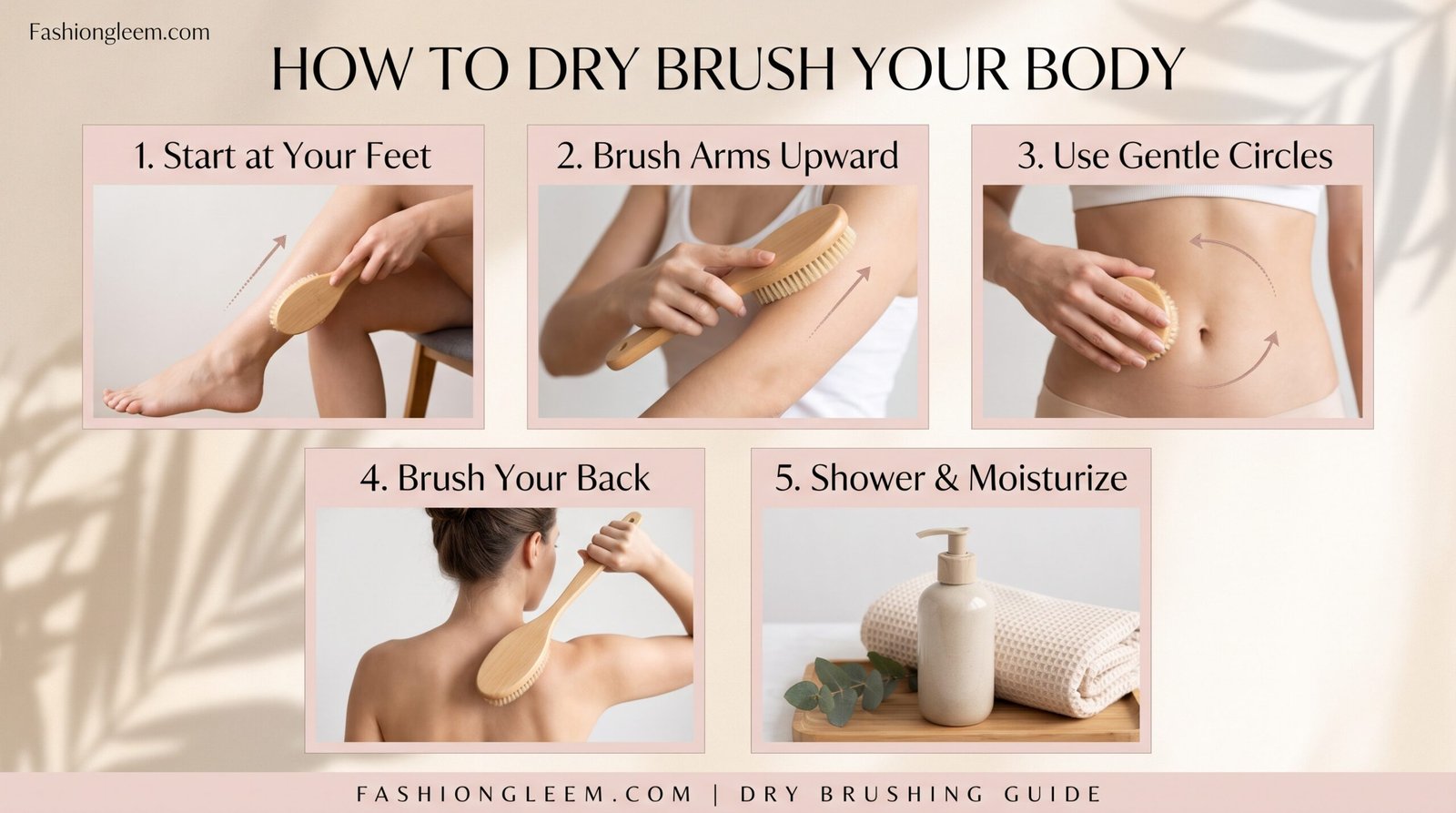
The sequence below follows the dermatologist guided versions, including goop’s dermatologist guided routine, which quotes specific numbers worth stealing. Total time: three to five minutes. Skin should end slightly pink, never red and raw.
1. Start dry, before the shower. No lotion, no oil, no damp skin. Dry friction is the whole mechanism. Morning suits most people because the ritual is invigorating; evening before a bath works too.
2. Feet and legs first. Begin at the soles and tops of the feet. Brush up the ankles and calves in long strokes, then knees to thighs. Every stroke moves toward the heart, which on legs simply means upward.
3. Use two to three strokes per section. That count comes from the dermatologist quoted in goop’s dermatologist guided routine. Other guides say three to five. Either way, this is a sweep, not a scrub: pass, lift, move on.
4. Hands and arms next. Start at the hands and brush up the forearms and upper arms toward the shoulders. Keep pressure light to moderate, and lighten further on the inner arm, where skin is thin.
5. Stomach in gentle circles. Use small circular strokes, conventionally clockwise, with the lightest pressure of the body zones so far. Guides explain the direction as following digestion; treat it as a harmless convention and keep the touch gentle.
6. Back, upward, with the long handle. Brush from the lower back upward toward the shoulders in long strokes. One dermatologist guided version adds brushing inward toward the spine first. This is the zone the long handle exists for.
7. Chest and neck last, lightest of all. These areas have the thinnest skin on the route. Brush down from the neck toward the chest, feather light, or skip entirely while you are learning your pressure.
8. Shower, then moisturize on damp skin. The shower rinses away everything the bristles loosened. Then apply body lotion or oil while skin is still slightly damp to seal in hydration, the aftercare step dermatologist guidance consistently includes.
Two pressure checks keep the routine honest. The bristles should move the skin slightly without dragging or scratching. And the pinkness test rules: slightly pink means done; lingering redness means the settings were wrong.
The Stroke Map by Body Part
Print this table mentally once and the routine runs itself. Zone, stroke, and pressure are the three facts per area.
|
Body Zone |
Stroke |
Direction |
Pressure |
|---|---|---|---|
|
Feet and ankles |
Long sweeps |
Upward |
Moderate (soles can take more) |
|
Calves and shins |
Long sweeps |
Up toward knees |
Light to moderate |
|
Thighs |
Long sweeps |
Up toward hips |
Moderate; light on inner thigh |
|
Hands and arms |
Long sweeps |
Up toward shoulders |
Light to moderate; lightest inside |
|
Stomach |
Small circles |
Clockwise (convention) |
Light |
|
Back |
Long sweeps |
Up toward shoulders |
Moderate |
|
Chest |
Short, gentle sweeps |
Inward and down |
Very light |
|
Neck |
Short, gentle sweeps |
Down toward chest |
Very light, or skip |
Direction has one logic everywhere: toward the heart. Up the limbs, down the neck, inward on the chest. Learn the logic once and no chart is needed again.
One zone is deliberately missing: the face. It is not a body brushing zone. Delicate facial exfoliation belongs with facial methods, the way the Korean skincare 10 step routine treats the face as its own careful system.
How Often: The Frequency Matrix
Here is the part most guides fake. Published advice genuinely conflicts: wellness guides commonly say two to three times a week, spa sources say three to five, and Cleveland Clinic describes a daily technique. No evidence based universal schedule exists.
The tiebreaker is the American Academy of Dermatology’s principle: exfoliation frequency depends on skin type and method, and more aggressive exfoliation should happen less often. Applied honestly, that principle produces this matrix.
|
Skin Type |
Brush |
Start At |
Working Range |
|---|---|---|---|
|
Sensitive |
Soft boar or washcloth |
Once a week |
1 to 2 times a week |
|
Dry |
Soft to medium |
Once or twice a week |
2 times a week, moisturize well |
|
Normal |
Medium sisal or boar |
Twice a week |
2 to 3 times a week |
|
Resilient |
Firm sisal or tampico |
Twice a week |
3 times a week, daily only if skin stays calm |
Three governors override any row. Lasting redness means cut back, whatever the table says. A dated warning still circulates, a 2015 interview in which a dermatologist cautioned against very frequent exfoliation; treat it as one expert’s older opinion pointing the same way as the AAD principle.
And daily deserves its plain framing: some people brush daily with a soft brush and thrive, but nothing in the evidence says daily is necessary. Two or three good sessions beat seven irritated ones.
Two Weekly Schedules That Work
Abstract frequency becomes easy when it lands on a calendar. Both schedules leave rest days, because exfoliation is a stimulus and skin answers stimuli between sessions, not during them.
The Beginner Schedule (Weeks 1 to 3)
- Monday: full routine, soft brush, lightest pressure, about three minutes
- Wednesday: rest day, moisturizer only
- Friday: full routine again, same settings
- Weekend: one optional session only if skin stayed completely calm
The Regular Schedule (After Week 3)
- Monday: dry brush, shower, moisturize
- Tuesday: optional body scrub day is unnecessary; rest or normal shower
- Wednesday: dry brush session two
- Thursday: rest
- Friday or Saturday: dry brush session three
- Hair removal and self tanner days: keep separate from brush days where possible
Notice what the schedules never do: stack methods. Brush day and scrub day are the same day only in routines that end in irritation. The best skincare routine for glowing skin makes the same sequencing point for the face: one exfoliation method per slot.
Aftercare and the Order of Everything
The routine’s slot in a wider body care week matters as much as its steps. The canonical order is fixed: brush, shower, moisturize. Everything else arranges itself around those three.
Self tanner belongs on its own day. Exfoliating before tanning is standard prep, and brushing the day before application is the gentler sequence. Brushing a developed tan strips it in patches.
Hair removal also separates. Brushing freshly shaved or waxed skin stings and inflames. Brush the day before shaving instead, which also lifts hairs and can mean a closer shave with fewer trapped hairs afterward.
Body scrubs and exfoliating gloves are substitutes, not partners. All three are mechanical exfoliation. Choose per session, and let the weekly schedule above assign each method its day if you rotate them.
Where does the ritual sit in the day? Many fold it into their beauty routine at home as the pre bath spa step. Others stack it onto the morning shower the way a glow up routine stacks small daily upgrades: five minutes, visible payoff, done.
Dry Brushing vs Other Exfoliation Methods

One honest comparison table prevents the commonest error, which is doing all of these in the same week at full strength.
|
Method |
Type |
When |
Strength |
Best For |
|---|---|---|---|---|
|
Dry brush |
Mechanical |
Dry skin, before shower |
Medium, adjustable by pressure |
Whole body ritual, glow, routine building |
|
Body scrub |
Mechanical |
In shower, wet skin |
Medium to strong |
Occasional deep polish, pre tan prep |
|
Exfoliating gloves |
Mechanical |
In shower |
Medium |
Convenience, legs |
|
AHA/BHA body lotion |
Chemical |
After shower, dry skin |
Gentle to medium, cumulative |
Bumpy texture, keratosis pilaris support |
|
Dry washcloth |
Mechanical |
Dry skin |
Very gentle |
Sensitive skin starter |
Chemical exfoliants deserve a respectful line: for bumpy conditions like keratosis pilaris, ingredient based lotions often do the heavy lifting, with brushing as surface support. The methods are teammates across a week, not rivals in a single session.
Who Should Skip It, and Where
The safety list is short, specific, and non negotiable. Cleveland Clinic states the core rule plainly: never brush broken skin, including cuts, scrapes, lesions, sores, and burns, sunburn included.
- Skip the area entirely: broken or infected skin, active eczema or psoriasis flares, sunburn, fresh tattoos, irritated or inflamed patches
- Brush around, never over: raised moles, warts, and raised bumps; prominent varicose veins
- Stop immediately if: redness, swelling, or inflammation appears during a session
- Ask your own clinician first: pregnancy questions, especially about abdominal brushing, and any diagnosed skin condition under treatment
Sensitive skin is a settings problem, not a ban. Softer brush, lighter hand, once a week, and a forearm patch test first. Dr. Khetarpal’s own fallback for very sensitive skin is disarmingly simple: a plain dry washcloth.
Facial skin stays out of the routine altogether. Readers building a gentle face plan will find the layered approach in the beauty routine at home more suitable than any bristle near the face.
Brush Care, Cleaning, and Replacement
A dirty brush redeposits oil and bacteria onto freshly exfoliated skin, which can look exactly like the breakouts people blame on the routine. Care takes two minutes and prevents the irony.
- After each use: shake or tap out the debris, and store the brush dry, bristles ventilated
- Weekly-ish: wash bristles with gentle soap and water, rinse, and dry fully before storing; avoid soaking wooden handles longer than needed
- Never share a brush; it is a personal exfoliation tool
- Replace when bristles soften, splay, or shed noticeably; product guidance commonly puts brush life around six to twelve months, read as approximate
Storage location matters more than any product: a brush kept damp in a steamy shower ages fast and grows what you least want on skin. A dry shelf near the shower beats a wet caddy inside it.
Mistakes Gallery
Every failure below is a settings error, not a mystery. Each one is fixable in a single sentence.
- Scrubbing instead of sweeping. Hard pressure adds irritation, not benefit. Lighten until the skin barely moves.
- Daily from day one. Frequency is earned by calm skin over weeks. Start at once or twice weekly.
- Brushing wet skin. Water kills the friction that does the work. Dry skin only, before the shower.
- Face with a body brush. Body bristles are built for limbs. The face is out of bounds.
- Stacking a scrub on top. Two mechanical methods in one session is the classic route to a raw week.
- Skipping the moisturizer. Brushing adds no hydration. Lotion or oil on damp skin completes the routine.
- Buying it for cellulite or detox. The audit table above is the antidote. Buy it for smooth skin and a good five minutes.
More Skin and Body Care Guides

This routine plugs into the wider skincare cluster naturally. The skincare routine for beginners sets the overall order this body ritual complements, and the best skincare routine for glowing skin builds the glow goal from the face side.
For ingredient led care, the turmeric face mask shows the mask tradition, while the full skincare guides gather every routine, order guide, and skin type plan in one place.
Frequently Asked Questions
What is a dry brushing routine?
A short pre shower ritual: on completely dry skin, you sweep a firm natural bristle brush over the body in long strokes toward the heart, starting at the feet, then shower and moisturize. A session runs about three to five minutes. The AAD classifies the brush as a mechanical exfoliation tool, its one firmly established function.
How do you dry brush step by step?
Start on dry skin before the shower. Brush the feet and legs upward in long strokes, two to three strokes per section. Then the arms from hands to shoulders. Circle the stomach gently clockwise, brush the back upward with a long handle, and use the lightest pressure on chest and neck. Shower, then moisturize on slightly damp skin.
Why do you brush toward the heart?
The convention comes from the lymphatic framing of the practice: lymph fluid ultimately returns toward the chest, so strokes are directed inward and upward to follow that flow, and upward strokes also match how a massage therapist would work a limb. Whatever one thinks of the drainage claim itself, the direction rule gives the routine a consistent, easy to remember structure. On the legs and arms toward the heart simply means upward; on the neck it means downward toward the chest.
How often should you dry brush?
Published guidance conflicts, honestly: wellness guides often say two to three times a week, spa sources three to five, and Cleveland Clinic describes a daily technique without proving daily is necessary. The AAD principle governs: frequency follows skin type and method strength. Beginners and sensitive skin start once or twice a week and increase only while skin stays calm.
Can you dry brush every day?
Some people do, softly, and Cleveland Clinic’s guide describes a daily technique. But no evidence based daily schedule exists, and daily brushing raises irritation risk on the neck, chest, and inner arms. The practical governor is your own skin: lasting redness or next day rawness means the frequency is too high for you, whatever a guide promised.
What are the proven benefits of dry brushing?
The defensible list: mechanical exfoliation leaving skin smoother, a temporary local circulation boost with a brief flush and plumper look, better absorption of moisturizer applied afterward, and the invigorating ritual value many people enjoy. Cleveland Clinic’s dermatologist reviewed overview supports the exfoliation and circulation description. Everything beyond that list should be read as claim, not conclusion.
Does dry brushing reduce cellulite?
No proof supports it. Cleveland Clinic dermatologist Shilpi Khetarpal, MD, states there is no proof dry brushing reduces cellulite or its appearance, and Mayo Clinic lists dry brushing among approaches that do not work as cellulite treatments. The smoothing seen right after brushing is temporary plumping from increased blood flow, which Dr. Khetarpal identifies as the belief’s likely source.
Does dry brushing detox the body?
No strong clinical evidence says so. The liver and kidneys perform detoxification; brushing skin has not been shown to remove toxins from the body. The detox language descends from the Ayurvedic framing, where the practice, called garshana, is traditionally said to clear ama, a traditional toxin concept. That is a belief framing to report respectfully, not a physiological finding.
Does dry brushing help lymphatic drainage?
Evidence is limited and the big claims overreach. Manual lymphatic drainage is a specific clinical technique for conditions like lymphedema, and even its research results conflict. A simple brush stroke is unlikely to replicate it. Movement, muscle contraction, and breathing move lymph day to day. Brushing toward the heart follows the convention; meaningful change from brushing is unproven.
Does dry brushing help circulation?
Temporarily and locally, yes, in the modest sense that friction and massage-like pressure increase blood flow to the skin being brushed, producing warmth and a pink flush. That is the effect behind the guidance that skin looking slightly pink means the section is done. It is a surface effect measured in minutes, not a cardiovascular intervention, and guides that promise an energy surge are describing how invigorating the ritual feels, which many people do report.
How long should a dry brushing session take?
About three to five minutes for the full body, according to the dermatologist quoted in goop’s guide, who suggests two to three strokes per section. Longer sessions usually mean more pressure or more passes, and both raise irritation without adding benefit. If a routine regularly runs past ten minutes, it has probably become scrubbing rather than brushing.
How hard should you press when dry brushing?
Light to moderate pressure, always. The bristles should move the skin slightly without dragging, scratching, or leaving marks that linger. Slight pinkness is the working endpoint; redness that stays, stinging, or rawness means the pressure or frequency is too high. Thin skinned areas, the neck, chest, stomach, and inner arms and thighs, get the lightest touch of all.
What kind of brush is best for dry brushing?
A brush with firm but not sharp natural bristles: sisal is the common recommendation, with boar and cactus (tampico) fibers also widely used. A long handle, detachable on some models, makes the back reachable. Beginners and sensitive skin should start softer. Wellness guides often advise against very stiff synthetic bristles, with one guide claiming they can create micro tears; that specific claim is a wellness source position rather than a dermatology finding, but the comfort logic stands on its own.
Should you dry brush your face?
Not with a body brush. Facial skin is thinner and more reactive, and body bristles are built for limbs and torsos. If facial dry brushing appeals, it requires a dedicated, much softer face brush, very light pressure, and low frequency, and many dermatology voices would steer sensitive or acne prone faces to gentler exfoliation methods entirely. Keeping the routine body only is the conservative default.
Do you dry brush before or after showering?
Before, on completely dry skin; the name is the instruction. Brushing dry gives the bristles the friction that lifts dead cells, and the shower afterward washes the loosened flakes away. Brushing in the shower is simply wet exfoliation with extra steps and less effect. Moisturizer goes on after the shower, while the skin is still slightly damp.
What do you put on your skin after dry brushing?
Nothing before; moisturizer after. The standard sequence is brush, shower, then body lotion or body oil applied to slightly damp skin to seal in hydration, a sequence dermatologist guidance quoted in consumer guides endorses. Because freshly exfoliated skin absorbs products better, this is also when a plain, fragrance light moisturizer earns its keep, and when strong actives deserve caution on sensitive skin.
Can dry brushing help keratosis pilaris?
Keratosis pilaris, the small rough bumps often on upper arms and thighs, is a buildup of keratin in follicles, and gentle mechanical exfoliation is one of the approaches commonly used to smooth its texture, alongside moisturizers and keratolytic ingredients. Dry brushing may help the surface feel smoother; it does not cure the condition, and aggressive brushing on inflamed bumps makes things worse. Persistent or widespread cases belong in a dermatology conversation.
Can dry brushing help ingrown hairs?
It can help prevent some, in the same mechanical way any regular exfoliation can: keeping dead cells from trapping emerging hairs, especially on legs. Timing matters; brushing freshly shaved or waxed skin stings and irritates, so separate the exfoliation day from the hair removal day where possible. An ingrown that is already inflamed, hot, or painful should be left alone rather than brushed over.
Is dry brushing safe for sensitive skin?
It can be, with adjustments: a softer brush, lighter pressure, and a lower starting frequency of once a week or so, with a patch test on the forearm first. Sensitive skin is also the skin least served by the daily brushing advice circulating online. If redness lasts beyond a short flush, or the skin feels raw the next day, the settings are wrong for that skin, full stop.
Who should not dry brush?
Anyone over skin that is broken, sunburned, inflamed, or infected, and people with active eczema or psoriasis flares on the area, since friction aggravates all of them. Raised moles, warts, and varicose vein areas are commonly listed as skip zones in guides. Pregnancy questions come up often; the conservative published advice is to ask one’s own clinician, particularly about abdominal brushing, rather than follow a blog’s blanket yes.
Can you dry brush over moles or varicose veins?
Brush around them, not over them. Raised moles and prominent varicose veins are standard skip areas in technique guides, because friction on raised or fragile structures is irritation without upside. Flat, normal skin nearby is fine. A mole that changes shape, color, or size is a dermatology appointment regardless of any brushing routine.
Does dry brushing help with stretch marks or loose skin?
No credible evidence says so. Stretch marks and skin laxity live in the dermis, the deeper layer where collagen structure sits, well below anything a surface bristle can influence. Brushing can make the surface look temporarily smoother and more even in tone, which sometimes gets photographed as improvement. Guides promising firming or fading are selling the temporary effect as a structural one.
Is dry brushing better in the morning or at night?
Both are used, and the choice is temperament, not physiology. Morning brushers value the invigorating, wake up quality that guides attribute to nervous system stimulation, and the routine stacks neatly before a morning shower. Evening brushers fold it into a bath and wind down ritual. Consistency beats clock time for any habit based practice.
How is dry brushing different from a body scrub?
Both are mechanical exfoliation; the difference is medium and timing. A scrub uses gritty particles in a wet, in shower product; dry brushing uses bristle friction on dry skin before the shower. They are substitutes, not partners: using both in the same routine is double exfoliation and a common route to irritation. Choose one method per session and let skin type decide the frequency.
How is dry brushing different from chemical exfoliation?
Mechanical methods physically lift cells with friction; chemical exfoliants (AHAs like glycolic and lactic acid, BHAs like salicylic acid, often in body lotions) loosen the bonds between cells so they shed. The AAD’s exfoliation guidance covers both families and stresses matching method and frequency to skin type. Many routines alternate them on different days rather than stacking them, which is the conservative pattern.
What is garshana?
Garshana is the Ayurvedic name for dry brushing, traditionally performed with raw silk or bristle gloves and a brush in some modern adaptations, as part of daily self care practice. Traditional texts frame it as clearing ama and stimulating the body’s channels. Presenting garshana accurately means labeling its claims as traditional beliefs within Ayurveda, which modern wellness marketing often strips of that context.
How do you clean a dry brush?
Guides converge on simple care: shake or tap out debris after use, wash the bristles periodically with gentle soap and water, rinse without soaking the wooden handle more than needed, and dry the brush bristle side down or in sunlight until fully dry before storing. A brush stored damp grows the very bacteria the routine is supposed to keep off the skin. Replace the brush when bristles soften, splay, or shed, commonly somewhere in the six to twelve month range in product guidance, which should be read as approximate.
Why does my skin turn red after dry brushing?
A brief pink flush is the expected circulation response and the traditional endpoint signal. Redness that is bright, patchy, hot, or still visible an hour later is irritation, meaning the brush is too stiff, the pressure too high, or the frequency too much for that skin. The fix is mechanical: softer brush, lighter hand, fewer sessions, and skip the areas that flare until they calm.
Can men dry brush too?
Yes; the practice is skin deep and entirely unisex, whatever the marketing imagery suggests. The same technique, brush choices, and cautions apply. Men with heavier leg hair sometimes prefer slightly longer strokes and brushing with the hair direction first. Retail framing is the only gendered part of the topic.
Should you dry brush before self tanning?
Exfoliation before self tanner is standard advice in tanning guidance, because an even, flake free surface takes color more evenly and fades more gracefully. Dry brushing the day before, rather than immediately before, application is the gentler sequence most guides suggest, followed by moisturizer on dry prone areas like elbows and knees. Brushing after the tan develops will strip it unevenly.
Can dry brushing replace moisturizer?
No. Brushing removes the barrier’s spent outer cells; it adds no hydration, and freshly brushed skin can feel tighter until moisturizer goes on. The routine’s own canonical sequence ends with lotion or oil for exactly this reason. Anyone whose skin feels drier after starting dry brushing has usually skipped the aftercare or overdone the frequency.
How soon do you see results from dry brushing?
The surface result is immediate: skin feels smoother after the first session because dead cells are gone, and the flush is visible within minutes. Anything cumulative, like a more even look to rough areas, is a matter of consistent weeks and is reported anecdotally rather than measured in studies. A routine promising transformation on a deadline is promising more than the evidence carries.
Does dry brushing help you lose weight?
No. Brushing moves nothing metabolically meaningful; it neither burns fat nor drains it. Temporary changes in how an area looks come from surface blood flow and mild fluid shifts in the skin, and they reverse within hours. Weight claims attached to dry brushing belong in the same category as the detox claim: marketing language without a mechanism or a measurement behind it.
What are the most common dry brushing mistakes?
Pressing too hard, brushing daily from day one, brushing wet skin, brushing the face with a body brush, stacking a scrub on top of brushing, skipping the moisturizer afterward, brushing over irritated or broken skin, and expecting cellulite or detox outcomes the evidence does not support. Every one of these is a settings error rather than a technique mystery, which is why a mistakes gallery earns its place in the article.
Can you dry brush in the shower instead?
You can brush wet skin, but it is a different, weaker action: water and shower products lubricate the surface, bristles glide instead of grip, and most of the exfoliation effect is lost. The practice is defined by dry friction. If in shower exfoliation is the preference, a scrub or exfoliating washcloth is the tool actually designed for it.
Does the stomach really need clockwise circles?
The clockwise circular pattern on the abdomen is a near universal convention in technique guides, usually explained as following the direction of digestion and abdominal lymph flow. Treat it as a harmless organizing convention rather than a verified physiological requirement; the established parts of stomach brushing are light pressure and gentleness on thin skin. Consistency of direction matters less than consistency of touch.
How do you dry brush your back properly?
Use a long handled brush, or a detachable handle model, and work in long strokes upward from the lower back toward the shoulders; one dermatologist guided routine describes brushing inward toward the spine and then upward. The back is where the handle earns its price, and where most beginners under brush because they cannot see or reach. A partner is a luxury, not a requirement.
Is an expensive dry brush better?
Not in any way the evidence can detect. The working parts are bristle material, stiffness matched to the skin, and a handle that reaches the back. Market listings in the research ranged from about fourteen dollars for a mass market brush to twenty five dollars for premium branded natural fiber models, as listing snapshots in late October 2026. Pay for fiber quality and handle design if you like; the exfoliation itself does not scale with price.
Can dry brushing help strawberry legs?
Strawberry legs is a casual name for dark dots at follicles on the legs, which can involve clogged pores, ingrown hairs, or keratosis pilaris. Regular gentle exfoliation is among the home approaches commonly suggested for the appearance, so dry brushing two or three times a week fits that pattern for some people. It is a cosmetic appearance question with several possible causes, and a dermatologist visit beats a brush if the dots are new, spreading, or inflamed.
Should you dry brush after a workout?
The practical answer is sequencing: the routine needs dry skin, so it belongs before the post workout shower, not after it, and sweaty skin should be rinsed and dried first or the session simply moves to the next morning. There is no special post exercise benefit documented; the post workout slot is popular purely because the shower is already happening.
What does dermatologist guidance actually recommend overall?
The composite picture from Cleveland Clinic’s dermatologist reviewed overview and the AAD’s exfoliation guidance: dry brushing is a legitimate mechanical exfoliation option that can smooth skin and briefly boost surface circulation; it should be gentle, frequency should match skin type and method aggressiveness, broken or inflamed skin is off limits, moisturizer follows, and the famous systemic claims, detox, cellulite, meaningful lymphatic change, are not supported by evidence. Optional, pleasant, modest: that is the expert consensus shape.
Can dry brushing cause breakouts or irritation on the back or chest?
It can irritate, and irritated follicles on the back and chest can look like breakouts. The usual causes are too stiff a brush, too much pressure, brushing too often, or a brush that is not being cleaned and is redepositing oil and bacteria on freshly exfoliated skin. The chest is thin skinned and belongs in the lightest pressure category. If bumps appear, stop for a week, clean the brush properly, and restart softer and less often; persistent cases are a dermatology question, not a brushing settings question.
Conclusion
A good dry brushing routine is a small, honest thing: five dry minutes before the shower, strokes toward the heart, a soft pink finish, and moisturizer on damp skin. Bought for smooth skin and a genuine glow, it delivers every time.
Bought for cellulite, detox, or drainage miracles, it cannot, and the dermatology sources above say why. Set the expectation at the evidence line and the ritual becomes what its fans actually love: simple, cheap, and quietly satisfying.
When you are ready to build the face side of the same glow goal, fashiongleem.com keeps the full routine collection in one place.