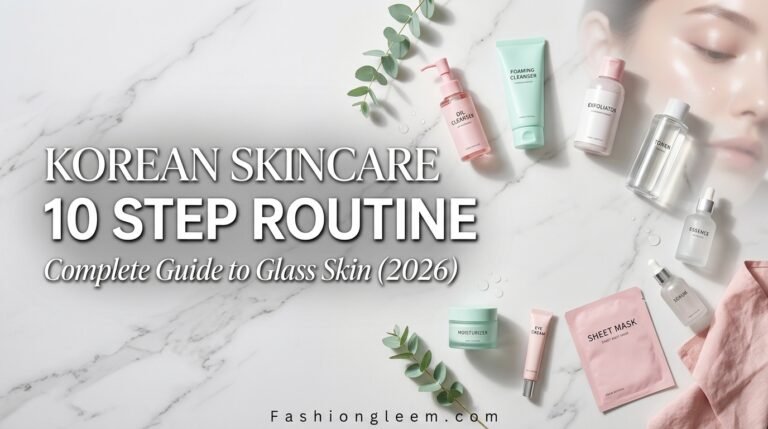
Best Skincare Routine for Glowing Skin: Complete AM & PM Guide
The best skincare routine for glowing skin is one that consistently supports hydration, a healthy skin barrier, an even-looking complexion, smooth texture, and protection from environmental damage.
A practical routine usually starts with gentle cleansing, followed by targeted treatment when needed, moisturizer, and daily sunscreen. At night, cleansing, treatment, and moisturization form the foundation. The exact products should depend on whether your skin is dry, oily, combination, sensitive, acne-prone, or affected by concerns such as dullness, dark spots, or uneven texture.
This guide explains exactly how to build a morning and nighttime routine, which ingredients can support a brighter-looking complexion, how to choose products for your skin type, how to layer them correctly, which mistakes to avoid, and how long you should realistically expect to wait for results.
Quick answer: The best skincare routine for glowing skin is a simple, consistent routine built around gentle cleansing, hydration, targeted ingredients, moisturizer, and broad-spectrum sunscreen. You do not need every skincare product available. Choose products according to your skin type and introduce active ingredients gradually.
Why a Skincare Routine Makes Skin Look More Glowing
What “Glowing Skin” Actually Means
Glowing skin is not a medical condition or a specific skin type. In everyday skincare language, it usually describes skin that looks hydrated, smooth, healthy, even-toned, and less dull.
Several factors contribute to this appearance. Well-hydrated skin can look plumper and smoother, while an even surface can reflect light more consistently. Sun protection also matters because repeated UV exposure contributes to premature skin aging and uneven pigmentation.
The goal should therefore be healthy-looking skin rather than trying to create an artificial shine.
The Main Factors Behind a Healthy-Looking Glow
A good routine should address several fundamentals:
- Adequate hydration
- A healthy skin barrier
- Gentle cleansing
- Appropriate exfoliation
- Antioxidant protection
- Even-looking skin tone
- Daily sun protection
- Consistent product use
No single serum can replace all of these factors.
Why Consistency Matters More Than Complexity
A simple routine followed consistently is generally more useful than a complicated routine that causes irritation or becomes difficult to maintain.
The American Academy of Dermatology emphasizes simple skincare habits, including gentle cleansing, moisturizing and broad-spectrum sunscreen. Cleveland Clinic likewise recommends tailoring skincare to individual skin type and goals rather than automatically using numerous products.
This is particularly important for beginners. Adding several active ingredients at once makes it difficult to determine which product is helping or causing irritation.
The Best Morning Skincare Routine for Glowing Skin
Step 1: Start With a Gentle Cleanser
Morning cleansing removes sweat, excess oil, residue from nighttime products, and other substances that accumulate while you sleep.
Choose a cleanser according to your skin type rather than choosing the strongest formula available.
For dry or sensitive skin, a gentle cream, lotion, or low-foaming cleanser may be more comfortable. Oily skin can often tolerate a lightweight gel cleanser, provided it does not leave the skin feeling tight or stripped.
A useful sign is how your skin feels afterward. If cleansing consistently leaves your face tight, burning, or uncomfortable, the formula may be too aggressive.
Step 2: Apply a Targeted Serum When Needed
A serum is optional rather than mandatory.
If your main goal is a brighter-looking complexion, an antioxidant or brightening serum may be useful. Vitamin C is commonly used in morning routines because of its antioxidant properties and role in addressing the appearance of uneven pigmentation.
Niacinamide is another versatile ingredient that can support the appearance of the skin barrier, tone, and oil balance.
Do not introduce several serums simultaneously. Start with one targeted product and give your skin time to adjust.
Step 3: Use Moisturizer
Moisturizer helps support hydration and the skin barrier.
Dry skin generally benefits from richer cream-based formulas containing ingredients such as ceramides, glycerin, or other moisturizing agents. Oily skin may prefer lightweight gels or lotions.
Even oily skin can become dehydrated. Producing more oil does not mean that the skin has adequate water or that moisturizer should automatically be skipped.
Step 4: Finish With Broad-Spectrum Sunscreen
Sunscreen is one of the most important parts of a daytime skincare routine.
The American Academy of Dermatology recommends broad-spectrum, water-resistant sunscreen with SPF 30 or higher. Sunscreen helps protect against ultraviolet radiation that contributes to premature skin aging and other forms of sun damage.
Apply sunscreen as the final skincare step before makeup.
If you spend extended time outdoors, follow the product’s reapplication directions, particularly after swimming, sweating, or towel drying.
Morning Routine at a Glance
| Step | Product | Main purpose | Priority |
|---|---|---|---|
| 1 | Gentle cleanser | Remove oil and residue | Essential |
| 2 | Targeted serum | Address specific concerns | Optional |
| 3 | Moisturizer | Hydration and barrier support | Essential |
| 4 | Sunscreen | UV protection | Essential |
The Best Nighttime Skincare Routine for Glowing Skin
Step 1: Remove Makeup and Sunscreen
If you wear makeup or water-resistant sunscreen, start by removing those products thoroughly.
A cleansing balm, cleansing oil, micellar water, or another suitable makeup remover can be useful before your regular cleanser.
The objective is effective removal without aggressive rubbing.
Step 2: Cleanse the Skin

Nighttime cleansing removes makeup residue, sunscreen, excess sebum, sweat, and environmental debris.
Use lukewarm rather than very hot water and avoid scrubbing your face aggressively.
If your skin becomes dry or irritated after cleansing, reassess the cleanser rather than adding more products to compensate.
Step 3: Apply One Appropriate Treatment
Night is often the most practical time for targeted treatments.
Depending on your concern, this could include a retinoid, exfoliating acid, azelaic acid, or another targeted ingredient.
Beginners should introduce active ingredients gradually. Using several powerful treatments together can increase irritation without necessarily producing better results.
Step 4: Moisturize
Finish with a moisturizer that supports your skin’s hydration needs.
If your skin is dry, a richer cream may be appropriate. If your skin is oily or acne-prone, choose a lightweight non-comedogenic option if that formulation works well for you.
Night Routine at a Glance
| Step | Product | Main purpose |
|---|---|---|
| 1 | Makeup/sunscreen remover | Remove surface products |
| 2 | Cleanser | Clean the skin |
| 3 | Treatment | Address a specific concern |
| 4 | Moisturizer | Hydrate and support the barrier |
Best Skincare Ingredients for Glowing Skin
Vitamin C
Vitamin C is one of the most popular ingredients for brightening-focused routines.
It functions as an antioxidant and is commonly included in products designed to improve the appearance of dullness and uneven pigmentation.
Vitamin C products can vary significantly in formulation, concentration, stability, and tolerability. More concentrated does not automatically mean better for every person.
If you are new to vitamin C, introduce it gradually and monitor your skin’s response.
Niacinamide
Niacinamide, a form of vitamin B3, is a versatile skincare ingredient.
It can be useful in routines focused on:
- Skin-barrier support
- Oil management
- Uneven-looking skin tone
- Overall skin appearance
- Hydration support
It is often easier for beginners to incorporate than stronger exfoliating or retinoid products.
Hyaluronic Acid
Hyaluronic acid is primarily associated with hydration.
It is a humectant, meaning it helps attract and retain water within the skin’s surface environment.
It can be especially useful when dullness is partly related to dehydration. However, a hyaluronic acid serum is not essential if your moisturizer already provides sufficient hydration.
Ceramides
Ceramides are naturally occurring lipids associated with the skin barrier.
Products containing ceramides can be particularly useful when the goal is maintaining or supporting a compromised-feeling barrier.
If your skin is dry, flaky, tight, or easily irritated, barrier-focused skincare may be more useful than repeatedly adding brightening acids.
Retinoids
Retinoids include ingredients such as retinol and prescription retinoids.
They are widely used for concerns involving acne, texture, and visible signs of skin aging.
Retinoids can cause dryness or irritation when introduced too quickly. Beginners should generally start slowly rather than applying them every night immediately.
Alpha Hydroxy Acids
Alpha hydroxy acids, including glycolic and lactic acid, exfoliate the skin’s surface.
They can help improve the appearance of rough texture and dullness when used appropriately.
However, excessive exfoliation can cause irritation and barrier disruption. More frequent use is not automatically better.
Salicylic Acid
Salicylic acid is a beta hydroxy acid commonly used for oily and acne-prone skin.
It can help address clogged pores and excess oil while contributing to smoother-looking skin.
People with dry or sensitive skin may need to use it less frequently.
Peptides
Peptides are short chains of amino acids used in many skincare formulations.
They are often included in products designed around skin conditioning and the appearance of firmness or fine lines.
They can be useful as part of a broader routine, but they do not replace the fundamentals of cleansing, moisturizing, and sun protection.
Which Ingredients Should Beginners Start With?
A Simple Beginner Ingredient Strategy
Beginners do not need to use vitamin C, retinol, glycolic acid, salicylic acid, niacinamide, and several other actives simultaneously.
A more manageable approach is:
- Establish a basic cleanser, moisturizer, and sunscreen routine.
- Allow your skin to adjust.
- Identify your primary concern.
- Choose one targeted active.
- Introduce it gradually.
- Monitor your skin before adding another active.
This approach makes your routine easier to understand and reduces unnecessary experimentation.
Essential Versus Optional Products
| Product | Most people need it? | Main purpose |
|---|---|---|
| Cleanser | Yes | Cleansing |
| Moisturizer | Usually | Hydration/barrier support |
| Sunscreen | Yes during daytime | UV protection |
| Targeted serum | Optional | Specific concerns |
| Exfoliant | Optional | Texture/exfoliation |
| Toner | Optional | Depends on formula and goal |
| Essence | Optional | Hydration/conditioning |
| Eye cream | Optional | Targeted cosmetic care |
| Face mask | Optional | Additional treatment |
The most effective routine is not necessarily the longest one.
Best Skincare Routine by Skin Type
Routine for Dry Skin
Dry skin usually benefits from a routine focused on gentle cleansing, hydration, moisturization, and barrier support.
A suitable routine may include:
Morning: gentle cleanser or water rinse if appropriate → hydrating serum → moisturizer → sunscreen.
Night: gentle cleanser → hydrating treatment → richer moisturizer.
Look for products containing ingredients such as glycerin, ceramides, squalane, and other moisturizing ingredients.
Avoid repeatedly using harsh cleansers or aggressive exfoliants if your skin is already dry or flaky.
Routine for Oily Skin
Oily skin produces more sebum, but it still needs hydration.
A practical routine can include:
Morning: lightweight cleanser → optional niacinamide or antioxidant serum → lightweight moisturizer → sunscreen.
Night: cleanser → appropriate acne or pore-focused treatment → lightweight moisturizer.
Non-comedogenic products may be useful if clogged pores are a concern.
Do not attempt to eliminate every trace of oil by repeatedly washing the face. Over-cleansing can leave the skin irritated.
Routine for Combination Skin
Combination skin has areas with different characteristics, often an oilier T-zone and drier cheeks.
You do not necessarily need separate products for every part of your face.
Start with balanced products and adjust only where necessary.
For example, a lightweight moisturizer may work across the face, while a targeted acne treatment can be applied only to areas where congestion occurs.
Routine for Sensitive Skin
Sensitive skin benefits from simplicity.
Choose gentle, fragrance-free products where possible and avoid introducing multiple active ingredients at once.
A basic routine might be:
Morning: gentle cleanser → moisturizer → sunscreen.
Night: gentle cleanser → moisturizer.
Once the skin is stable, introduce one targeted ingredient at a time.
The American Academy of Dermatology recommends testing new skincare products on a small area before applying them broadly. Dermatologists commonly advise testing products twice daily for 7–10 days when evaluating potential reactions.
Routine for Acne-Prone Skin
Acne-prone skin needs both effective treatment and barrier-friendly care.
A typical routine can include:
- Gentle cleanser
- Non-comedogenic moisturizer
- Appropriate acne treatment
- Sunscreen
- Limited exfoliation where appropriate
Salicylic acid may help with clogged pores, while other acne treatments may be more appropriate depending on the type and severity of acne.
Persistent or severe acne should be assessed by a dermatologist rather than managed solely through cosmetic skincare.
Routine for Mature Skin
Mature skin often benefits from prioritizing hydration, sun protection, and ingredients that address visible signs of aging.
A simple approach includes:
Morning: cleanser → antioxidant treatment → moisturizer → sunscreen.
Night: cleanser → retinoid or another appropriate treatment → moisturizer.
Avoid building a routine around aggressive exfoliation simply because the goal is to increase cell turnover.
Best Skincare Routine by Skin Concern
For Dull Skin
Dull-looking skin can be associated with dryness, uneven texture, accumulated surface cells, environmental exposure, or other factors.
A sensible routine focuses on:
- Hydration
- Moisturization
- Sun protection
- Antioxidants
- Appropriate exfoliation
Do not assume that dull skin needs daily scrubbing.
For Dark Spots and Uneven Skin Tone
Dark spots require patience.
A routine can include sunscreen plus ingredients such as vitamin C, niacinamide, azelaic acid, or other evidence-supported brightening treatments.
Sun protection is particularly important because UV exposure can worsen uneven pigmentation.
If pigmentation is persistent, spreading, or difficult to identify, professional evaluation is appropriate.
For Rough Texture
Texture-focused routines often combine hydration with controlled exfoliation.
An AHA such as glycolic or lactic acid may be useful for some people. Retinoids can also influence skin texture over time.
Avoid introducing both aggressive exfoliation and a strong retinoid simultaneously when starting.
For Enlarged-Looking Pores
Pores cannot simply be permanently “closed.”
Their appearance can sometimes be minimized cosmetically by reducing excess oil, keeping pores clear, and improving overall skin texture.
Salicylic acid can be useful for some oily or acne-prone skin types.
For Fine Lines
Daily sunscreen should be a foundation of any routine concerned with visible skin aging.
Retinoids are also widely used for photoaging and texture-related concerns.
Hydration can temporarily make fine lines appear less noticeable, but hydration does not permanently remove wrinkles.
What Is the Correct Skincare Order?
Morning Skincare Order
A practical order is:
Cleanser → treatment serum → moisturizer → sunscreen → makeup
The general principle is to apply products from lighter textures toward heavier textures, with sunscreen as the final dedicated skincare layer in the morning.
Nighttime Skincare Order
A practical nighttime sequence is:
Makeup/sunscreen removal → cleanser → treatment → moisturizer
If you use multiple products, follow the directions provided by the manufacturers because certain formulations may have specific application requirements.
Where Does Exfoliation Fit?
Exfoliating products generally go after cleansing and before moisturizer.
However, the exact placement depends on the product.
Do not automatically combine multiple exfoliating products because they appear at the same stage in a routine.

How Often Should You Exfoliate?
Why Exfoliation Can Help
Appropriate exfoliation can improve the appearance of rough or dull skin by removing or loosening surface dead skin cells.
It can make the skin feel smoother and can improve the appearance of texture.
Why Too Much Exfoliation Is a Problem
Over-exfoliation can cause:
- Burning
- Redness
- Dryness
- Peeling
- Increased sensitivity
- Tightness
- Irritation
- Barrier disruption
If your skin starts reacting, reduce active products rather than adding additional soothing products on top of an increasingly aggressive routine.
A Better Exfoliation Strategy
Start conservatively.
Use one exfoliating product and follow its directions. If your skin tolerates it well, maintain a consistent schedule rather than increasing frequency simply because you want faster results.
Vitamin C vs Niacinamide vs Retinol
| Ingredient | Primary purpose | Typical routine placement | Beginner consideration |
|---|---|---|---|
| Vitamin C | Antioxidant/brightening | Often AM | Introduce gradually |
| Niacinamide | Barrier/oil/tone support | AM or PM | Generally versatile |
| Retinol | Texture/photoaging/acne-related concerns | Usually PM | Start slowly |
| AHA | Exfoliation | Usually PM | Avoid overuse |
| BHA | Pore/acne support | AM or PM depending on product | Can be drying |
Which One Should Beginners Choose?
Choose based on the main problem rather than popularity.
If your main concern is dullness or uneven-looking tone, an antioxidant or brightening ingredient may be appropriate.
If your concern is oiliness and visible pores, niacinamide or salicylic acid may be more relevant.
If your focus is visible signs of aging or texture, a retinoid may be appropriate.
You do not need all three immediately.
Can You Use Multiple Active Ingredients Together?
Ingredient Compatibility Is Not the Same as Need
Two ingredients may be technically compatible but still unnecessary to use together.
For example, combining several exfoliating acids with retinol can increase irritation even if there is no absolute chemical incompatibility.
Your skin’s tolerance matters.
A Safer Introduction Strategy
Introduce one active at a time.
Give yourself enough time to determine:
- Whether your skin tolerates it
- Whether you notice improvement
- Whether dryness develops
- Whether irritation appears
- Whether another product is contributing to the reaction
This is particularly important for sensitive skin.
How to Patch Test New Skincare Products
Step-by-Step Patch Testing
When trying a new product:
- Choose a small test area.
- Apply the product according to its normal directions.
- Repeat the test as recommended.
- Monitor the area for irritation.
- Stop if significant redness, burning, swelling, itching, or other unexpected symptoms develop.
The American Academy of Dermatology recommends testing skincare products on a small area before broader use. If a reaction occurs, discontinue the product; persistent or severe reactions may require professional evaluation.
Why “Natural” Does Not Automatically Mean Gentle
Botanical ingredients and essential oils can still cause irritation or allergic reactions.
Similarly, labels such as “hypoallergenic” should not be interpreted as a guarantee that a product cannot cause a reaction. The FDA explains that there is no federal standard or definition for the term “hypoallergenic” in cosmetics.
How to Choose Skincare Products for Glowing Skin
Check the Ingredient List
Do not select products based solely on marketing claims.
Look at:
- Active ingredients
- Fragrance
- Potential personal triggers
- Moisturizing ingredients
- Product texture
- Skin-type suitability
- Directions for use
Ingredient lists are more informative than phrases such as “glow,” “radiance,” or “glass skin.”
Understand Fragrance-Free and Unscented
“Fragrance-free” and “unscented” are not necessarily identical concepts.
The FDA notes that cosmetic labeling terms such as “hypoallergenic,” “fragrance-free,” and “for sensitive skin” do not have a single federal definition establishing exactly what every product must contain.
If you have known fragrance sensitivity, examine the ingredient list and product information carefully.
Consider Non-Comedogenic Products
If you are acne-prone, non-comedogenic formulations may be worth considering.
However, “non-comedogenic” does not guarantee that a particular product will work for every individual. Skin responses vary.
Do Not Choose Products Only Because They Are Expensive
Price does not automatically determine effectiveness.
A less expensive cleanser can perform its basic function very well, while a more expensive serum may provide additional ingredients or a more sophisticated formulation.
Focus on:
ingredients → formulation → skin compatibility → evidence → consistency → price
rather than price alone.
Common Skincare Mistakes That Prevent Glowing Skin
Using Too Many Products
A crowded routine makes it difficult to identify what works.
It can also increase the chance of irritation.
Start with the essentials and add products only when you have a clear reason.
Skipping Sunscreen
Using brightening products while repeatedly exposing your skin to UV radiation can undermine your overall routine.
Sunscreen should be considered a foundational daytime step rather than an optional finishing touch.
Over-Exfoliating
Scrubbing harder or using acids more frequently does not guarantee faster results.
If your skin becomes irritated, step back.
Changing Products Too Quickly
Skincare generally requires consistency.
Changing products every few days makes it difficult to evaluate results and can create unnecessary irritation.
Copying Someone Else’s Routine
A routine that works for someone with oily skin may not work for someone with sensitive or dry skin.
Your routine should be based on your skin type, concerns, tolerance, and lifestyle.
Ignoring Product Directions
More product is not necessarily better.
Follow the manufacturer’s instructions, especially for concentrated actives and treatments.
How Long Does It Take to Get Glowing Skin?
Why Results Differ
There is no universal timeline for glowing skin.
Results depend on:
- Your starting skin condition
- The ingredient being used
- Product formulation
- Frequency of use
- Skin sensitivity
- The specific concern
- Sun exposure
- Consistency
Hydration-related improvements can sometimes become noticeable relatively quickly, while pigmentation, acne, texture, and visible aging concerns often require considerably more time.
When to Reassess Your Routine
Instead of changing your entire routine after a few days, evaluate it systematically.
Ask:
- Is my skin more comfortable?
- Is dryness improving?
- Is irritation occurring?
- Does the product fit my skin type?
- Am I using it consistently?
- Am I protecting my skin from the sun?
If a product repeatedly causes irritation, reassess sooner rather than waiting for a predetermined timeline.
A Simple Beginner Skincare Routine
Three-Product Routine
If you are starting from zero, keep the routine simple.
Morning:
- Gentle cleanser
- Moisturizer
- Broad-spectrum sunscreen
Night:
- Gentle cleanser
- Moisturizer
After this foundation is stable, add one targeted product based on your primary concern.
Four-Product Routine
A beginner who wants a targeted treatment can use:
Morning: cleanser → treatment serum → moisturizer → sunscreen.
Night: cleanser → moisturizer.
The treatment could be added to the morning or evening depending on the ingredient and product instructions.
Advanced Routine
An advanced routine might contain:
Morning: cleanser → antioxidant → hydrating serum → moisturizer → sunscreen.
Night: cleanser → targeted treatment → moisturizer.
Additional products such as exfoliants, masks, or eye products should have a specific purpose rather than being added simply to make the routine longer.
Skincare Routine Decision Matrix
| Your main concern | Priority | Ingredients/products to consider |
|---|---|---|
| Dullness | High | Hydration, antioxidants, gentle exfoliation |
| Dryness | High | Ceramides, glycerin, richer moisturizer |
| Oily skin | High | Gentle cleanser, lightweight moisturizer |
| Clogged pores | High | Salicylic acid where appropriate |
| Uneven tone | High | Vitamin C, niacinamide, sunscreen |
| Dark spots | High | Sunscreen, targeted brightening ingredients |
| Rough texture | Medium/High | Gentle exfoliation, retinoids |
| Fine lines | High | Sunscreen, retinoids, hydration |
| Sensitivity | Very High | Minimal routine, gentle products |
| Acne | High | Evidence-based acne treatment, gentle moisturizer, sunscreen |
What You Should Not Expect From a Skincare Routine
Skincare Cannot Fix Everything Overnight
A skincare routine can support the appearance and health of your skin, but it cannot instantly erase pigmentation, wrinkles, acne, or scars.
Be cautious with claims promising immediate permanent transformation.
Skincare Is Not a Replacement for Medical Treatment
Some skin problems require professional diagnosis and treatment.
Seek medical advice for:
- Severe acne
- Persistent rash
- Significant swelling
- Severe burning
- Recurrent unexplained reactions
- Rapidly changing pigmentation
- Persistent eczema-like symptoms
- Painful skin lesions
Cosmetic skincare can support everyday skin care, but it should not replace appropriate medical treatment.
How to Build a Routine That You Can Actually Maintain
Keep the Routine Short
A routine with four reliable products is more sustainable than one with twelve products that you rarely use correctly.
Introduce One Product at a Time
This is one of the most useful habits for beginners.
If you add five products simultaneously and develop irritation, you will not know which product caused it.
Track Your Skin
For a few weeks, record:
- Products used
- Frequency
- Irritation
- Dryness
- Breakouts
- Texture
- Overall appearance
This creates a more objective picture than changing products based on one day’s appearance.
Frequently Asked Questions About the Best Skincare Routine for Glowing Skin
What is the best skincare routine for glowing skin?
The best routine is usually a simple combination of gentle cleansing, hydration, moisturizer, targeted treatment when needed, and daily broad-spectrum sunscreen. Choose products according to your skin type and introduce active ingredients gradually.
How can I get glowing skin naturally?
Focus on gentle cleansing, adequate moisturization, sun protection, sufficient sleep, a balanced diet, and consistent skincare. Avoid assuming that “natural” ingredients are automatically safer or more effective.
What is the best morning skincare routine for glowing skin?
A practical morning routine is cleanser, optional antioxidant or targeted serum, moisturizer, and broad-spectrum sunscreen. The exact products should be adjusted for your skin type and concerns.
What is the best nighttime skincare routine for glowing skin?
At night, remove makeup and sunscreen, cleanse gently, apply an appropriate treatment if needed, and moisturize. Beginners should avoid introducing multiple strong actives simultaneously.
Do I need toner for glowing skin?
No. Toner is optional. Some toners provide hydration or contain targeted ingredients, but a toner is not essential if your cleanser, treatment, moisturizer, and sunscreen already meet your needs.
Do I need a serum?
No. A serum can be useful when you have a specific goal, such as hydration, pigmentation, antioxidant protection, or acne. However, a basic routine can work without one.
Is vitamin C good for glowing skin?
Vitamin C is commonly used for antioxidant protection and improving the appearance of dullness and uneven skin tone. Product formulations differ, so introduce vitamin C gradually if you have sensitive skin.
Is niacinamide good for glowing skin?
Niacinamide can support the appearance of the skin barrier, oil balance, hydration, and uneven-looking tone. It is a versatile ingredient that can fit many routines.
Is hyaluronic acid good for glowing skin?
Hyaluronic acid can support hydration and make skin appear temporarily plumper and smoother. However, you do not necessarily need a separate hyaluronic acid serum if your moisturizer already provides adequate hydration.
Is retinol good for glowing skin?
Retinol can improve the appearance of texture, fine lines, and other signs of photoaging over time. It can also cause irritation, so beginners should introduce it gradually and follow product directions.
How often should I exfoliate for glowing skin?
There is no universal frequency. Your skin type, product strength, and tolerance determine how often exfoliation is appropriate. Start conservatively and reduce use if dryness, burning, peeling, or irritation develops.
Can over-exfoliation make skin look dull?
Yes. Excessive exfoliation can irritate and disrupt the skin barrier, leading to dryness, redness, peeling, or discomfort. If your skin becomes irritated, simplify your routine instead of exfoliating more.
What is the best skincare routine for dry skin?
Dry skin generally benefits from gentle cleansing, hydrating ingredients, a moisturizer suited to dry skin, and daily sunscreen. Avoid unnecessarily harsh cleansing and frequent exfoliation.
What is the best skincare routine for oily skin?
Oily skin can benefit from gentle cleansing, lightweight hydration, targeted ingredients such as niacinamide or salicylic acid when appropriate, and non-comedogenic sunscreen. Avoid repeatedly stripping the skin.
What is the best skincare routine for sensitive skin?
Sensitive skin generally benefits from fewer products, gentle cleansing, fragrance-conscious product selection, moisturizer, and sunscreen. Introduce new active ingredients one at a time and patch test when appropriate.
What is the best skincare routine for acne-prone skin?
Use gentle cleansing, an appropriate acne treatment, non-comedogenic moisturizer, and sunscreen. Persistent or severe acne should be evaluated by a dermatologist because cosmetic skincare alone may not be sufficient.
How long does it take to get glowing skin?
The timeline depends on your skin concern and products. Hydration can sometimes improve the appearance relatively quickly, while pigmentation, acne, texture, and visible aging generally require longer and more consistent treatment.
Can I use vitamin C and niacinamide together?
These ingredients can generally be used in the same overall routine, provided your skin tolerates both formulations. You can introduce them separately first so you can identify any irritation.
Can I use vitamin C and retinol together?
They can be part of the same overall skincare plan, but using multiple active ingredients requires attention to irritation and formulation instructions. Many beginners find it easier to use vitamin C in the morning and retinoids at night.
Can I use AHA and retinol together?
Using strong exfoliating acids and retinoids together can increase irritation, especially for beginners or sensitive skin. Consider alternating them rather than automatically layering them.
Should I moisturize oily skin?
Yes. Oily skin still needs hydration and barrier support. Choose a lightweight moisturizer if richer creams feel uncomfortable.
What is the most important skincare step?
Daily sun protection is one of the most important daytime steps, while gentle cleansing and moisturization provide the basic foundation. A targeted treatment can then address a specific concern.
Can I get glowing skin without expensive products?
Yes. Expensive products are not automatically better. Focus on appropriate ingredients, effective formulations, consistency, and basic skincare principles rather than price alone.
How to Make This Routine More Effective
Prioritize the Fundamentals
Before buying another serum, check whether your routine already includes the fundamentals:
- Gentle cleansing
- Appropriate hydration
- Moisturization
- Daily sunscreen
- A targeted treatment when genuinely needed
These steps provide a stronger foundation than collecting products.
Match Products to Your Actual Concern
Do not select an ingredient simply because it is trending.
If your main concern is dryness, focus on hydration and barrier support.
If your concern is pigmentation, focus on sun protection and appropriate brightening ingredients.
If your concern is acne, prioritize evidence-based acne management.
If your concern is texture and visible aging, consider a gradual retinoid strategy where appropriate.
Give Your Routine Time
A routine should be evaluated systematically rather than changed constantly.
Use the same basic routine long enough to determine whether your skin is tolerating it and whether the targeted concern is improving.
Final Skincare Checklist
Morning Checklist
- Cleanse gently if needed.
- Apply your targeted serum if using one.
- Moisturize.
- Apply broad-spectrum sunscreen.
- Reapply sunscreen according to product directions when appropriate.
Night Checklist
- Remove makeup and sunscreen.
- Cleanse.
- Apply your selected treatment.
- Moisturize.
- Avoid unnecessary product layering.
Weekly Checklist
- Review whether your skin feels comfortable.
- Check for dryness or irritation.
- Avoid adding multiple new products.
- Assess whether exfoliation is actually necessary.
- Replace products according to their directions and storage requirements.
Final Verdict: The Best Skincare Routine for Glowing Skin
The best skincare routine for glowing skin is not the routine with the most steps. It is the routine that consistently supports hydration, skin-barrier health, even-looking tone, smooth texture, and protection from UV exposure.
For most people, the foundation is straightforward: cleanse, treat when necessary, moisturize, and protect your skin from the sun.
From there, personalize the routine.
Dry skin may need more hydration and richer moisturization. Oily skin may benefit from lightweight products and carefully selected pore-focused ingredients. Sensitive skin generally benefits from fewer products and gradual introduction of actives. Acne-prone skin requires targeted treatment without sacrificing barrier support.
Ingredients such as vitamin C, niacinamide, hyaluronic acid, ceramides, retinoids, AHAs, and salicylic acid can all have useful roles, but they should not automatically be combined. The right ingredient depends on the problem you are trying to solve.
The biggest mistake is assuming that faster results require more products. A recent dermatologist survey found considerable concern about overly complex skincare routines, reinforcing the value of simpler, evidence-informed routines and consistent sun protection.
Most importantly, glowing skin should mean healthy-looking, comfortable, well-supported skin, not an unrealistic promise of perfection.
Ready to Build Your Skincare Routine?
If you are choosing skincare products, start with your skin type and primary concern, then build from the essentials. Compare ingredients and formulations rather than choosing products only because they are popular or expensive.
For englishhexa, the strongest next step is to create supporting guides for vitamin C, niacinamide, retinol, sunscreen, skin types, dark spots, exfoliation, and skin-barrier care. Linking those resources together will strengthen topical authority around the broader skincare topic while giving readers a clear path from basic education to product selection.