Blurring Balm: The Category Danessa Myricks Built, Laura Mercier Challenged, and Technique Decides
A blurring balm used to mean one product: a single viral pan that every oily skin creator on the internet pressed into their pores.
That is over. Since January 2026 the term names a category with two flagships, a budget bench, a blush, and a setting spray.
Danessa Myricks built the category on a Swedish mineral called Upsalite. Laura Mercier challenged it this year with a tinted blur balm of its own.
The two products differ in price, shades, and philosophy, and the reviews of both are decided less by formula than by technique.
This page runs the fight fairly: dated prices, the ingredient science with its sources labeled, the shade systems, and the press and roll protocol that separates the five star reviews from the one star ones.
Blurring Balm in 30 Seconds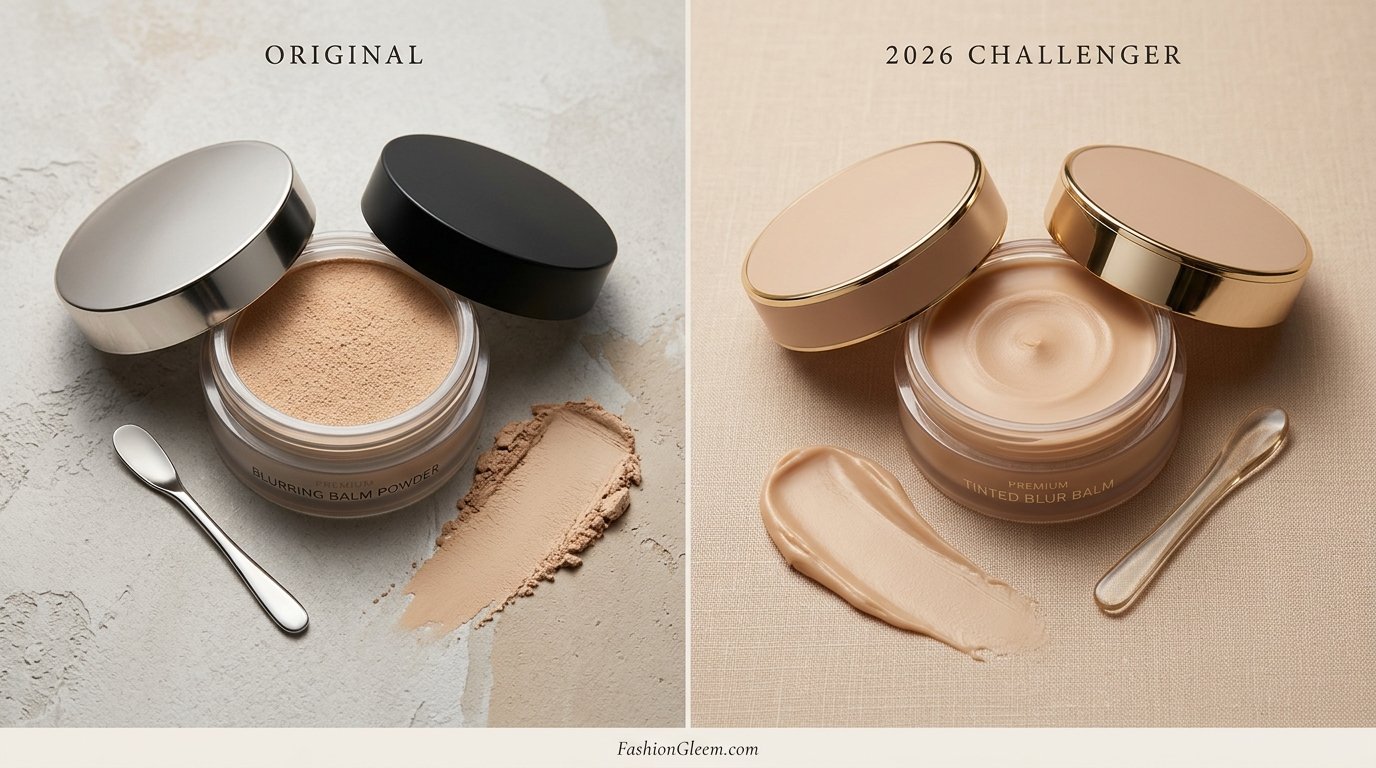
A blurring balm is a balm to powder complexion product. It blurs pores and texture optically while a mineral system absorbs oil and sweat underneath.
The flagship costs $39 for 18 g and holds an Allure Best of Beauty award. Its challenger costs $44 and claims 12 hour wear in 8 shades.
The honest one line verdict: best in class oil control with a real learning curve, rated 3.96 out of 5 across 2,109 reviews at its main retailer.
If you read nothing else, read the technique section. Most negative reviews describe an application error, not a formula failure.
The Category Fight: One Term, Two Flagships
Search the term today and three things compete. The inventor product, the 2026 challenger, and a shelf of putty primers and powders doing adjacent jobs.
Even the search results hedge: a lip balm with blur in its name surfaces for the query, which tells you how unsettled the category still is.
The explainer intent is real too. A three way comparison in the HerZindagi blurring balm explainer exists because readers now ask what the category is before asking which one to buy.
Danessa Myricks: The Inventor Product
Yummy Skin Blurring Balm Powder is the original. A balm to powder pan, sold with a spatula, classified by its retailer as a tinted primer and foundation.
It is vegan, light coverage, and natural matte, and it carries the Allure Best of Beauty award into every comparison written about it.
Its structure is the category template: two colorless finishes for priming and setting, plus a numbered tinted range for coverage, contour, and highlight.
Editors keep it in the canon. It holds the best balm primer slot in the Who What Wear best primers roundup, with an editor’s note that it applies like butter and should be used sparingly.
Laura Mercier Tinted Blur Balm: The 2026 Challenger
The challenger arrived on January 25 to 26, 2026. A balm to powder skin tint with peptides and vegan squalane, launched on the brand site first.
Its claim set is bolder: 12 hour wear, smoother texture, and visible pore reduction, detailed in the Laura Mercier Tinted Blur Balm page with the brand’s clinical numbers attached.
Its weakness is arithmetic. Eight shades, numbered 00 to 07, against the Danessa range, drew shade complaints from the launch week onward.
Reviewers add a value strand. Customer reports in the Nordstrom Tinted Blur Balm reviews flag shades running surprising and a pan that empties fast for its $44 price.
The Budget and Balm Bench
The bench is older than the category. Putty primers, silk balms, and silicone pore fillers were doing versions of this job for years.
- e.l.f. Poreless Putty Primer, about $10 to $11: the budget benchmark, a squalane putty famous as a luxury dupe.
- Tatcha The Silk Canvas: the pressed silk balm primer the putty is compared against, a soft focus roundup staple.
- Benefit POREfessional: the original silicone balm to powder pore filler, translucent, pressed in rather than rubbed.
- Milk Makeup Blur Stick: a twist up translucent blurring stick built for no mirror application.
The balm’s claim against the bench is absorption. The putties smooth; the flagship balm also drinks oil, which is the science section’s subject.
The Science: Upsalite, the Mineral Doing the Blurring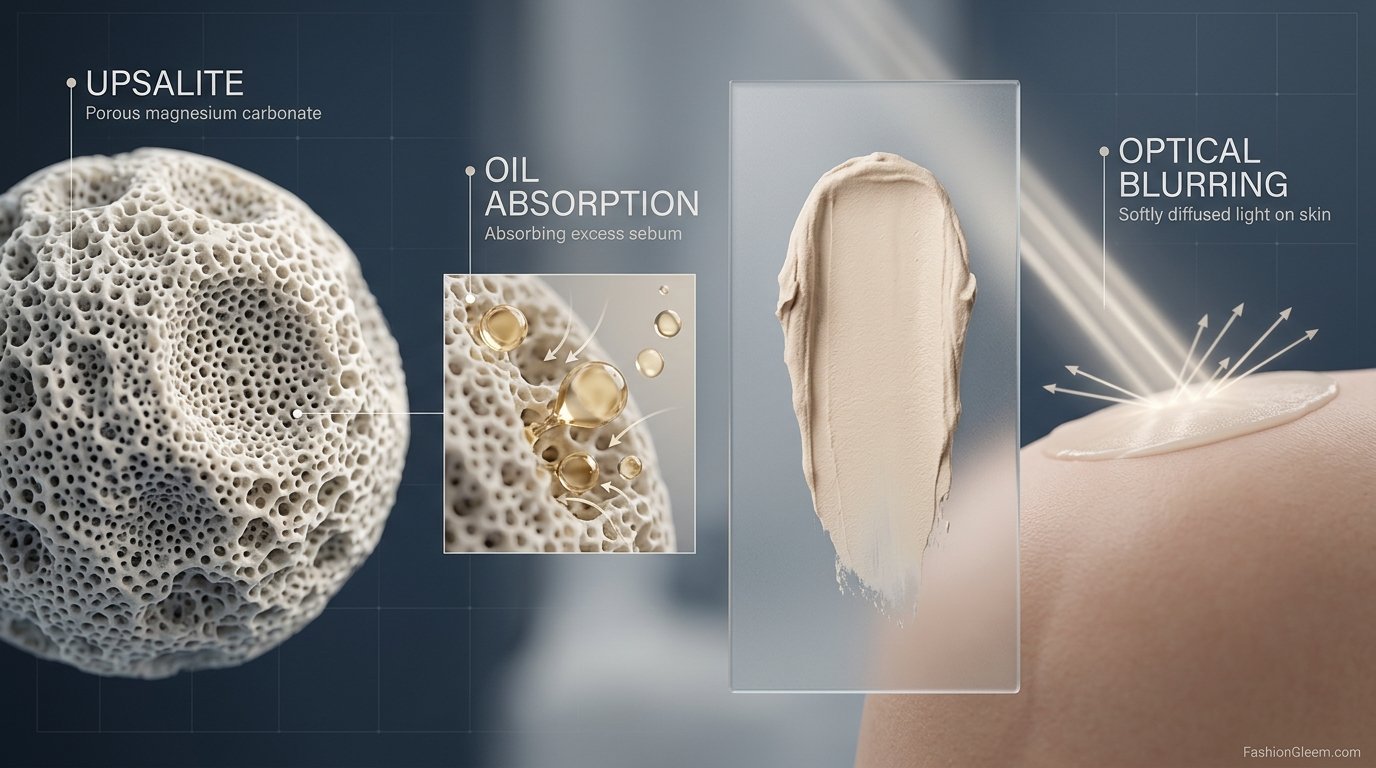
The first ingredient is the story. The Danessa formula opens its INCI list with magnesium carbonate, which is Upsalite by its trade name.
The material’s maker runs a dedicated site, the Upsalite manufacturer site, and the science there is unusually specific for a makeup ingredient.
What Upsalite Is, in Plain Words
Upsalite is a mesoporous magnesium carbonate. Imagine a mineral sponge: millions of microscopic pores give it an enormous internal surface for its size.
It was invented in 2012 at Uppsala University in Sweden, by the team that founded Disruptive Materials to commercialize it.
The manufacturer reports it absorbs about 1.2 g of oil per gram, against about 0.5 g for talc. Those are the manufacturer’s numbers, labeled as such.
It also absorbs oil and water at the same time, which is rarer than it sounds, and saturates in about 5 minutes against about 61 for silica.
The blur itself is optics. The porous particles scatter light across the skin surface, softening the look of pores and texture without a pigment layer.
The ingredient is being marketed beyond one brand now. A dedicated consumer site launched in September 2026, reported in the Spray TM Upsalite launch report, covering dry shampoo and deodorant uses too.
The Supporting Cast: Squalane, Hyaluronic Acid, Kaolin
Upsalite does not work alone. The INCI list, published by the retailer, reads like a small committee with assigned jobs.
Olive derived squalane balances and conditions, the reason the matte finish does not feel like a desert on combination skin.
Hydrolyzed sodium hyaluronate, the hyaluronic acid form listed, holds water at the surface while the mineral handles oil.
Kaolin is the second absorber, a familiar clay doing quiet support work. Ginger, linseed, and meadowfoam oils round out the list.
Silicones carry the texture. Dimethicone and its relatives build the smooth, blurring film the brand calls its texture reducing barrier.
What a Blurring Balm Actually Does (and Does Not Do)
It does three jobs with limits. Primer, light foundation, and setting layer are all real roles, and none of them is unlimited.
As a primer, a thin layer blurs and grips, and the brand’s study reports 93 percent of wearers saying foundation looked natural over it.
As a foundation, tinted shades even tone at light coverage. Marks, strong redness, and anything you would point at in a mirror show through.
As a setting layer, the colorless shade tapped over foundation absorbs and blurs without powder, which is its most quietly useful trick.
What it does not do is cover like a foundation or set like a powder at full strength. Expecting either is the disappointment engine in the reviews.
The Job Table: Balm vs Primer vs Powder vs Skin Tint
|
Product |
Primary job |
Oil control |
Coverage |
Finish |
Watch out for |
|---|---|---|---|---|---|
|
Blurring balm |
Prime, cover lightly, set |
Highest of the four, mineral absorption |
Light, tinted shades only |
Natural matte |
Technique sensitivity, dry patches |
|
Silicone primer |
Smooth and grip |
Moderate |
None |
Satin to matte |
No absorption system, no coverage |
|
Setting powder |
Set and mattify |
Good, surface level |
None to sheer |
Matte, can read dry |
Talc dryness on mature skin |
|
Skin tint |
Even tone |
Low |
Sheer to light |
Dewy to natural |
Shine returns fastest |
Read the table as a routing tool. Oily skin chasing noon is the balm’s home; dry skin chasing glow belongs further down the list.
Danessa vs Laura Mercier: The Head to Head
This is the comparison the term now means. Two balms, two philosophies, and a five dollar gap that is not the real difference.
|
Attribute |
Danessa Myricks Blurring Balm Powder |
Laura Mercier Tinted Blur Balm |
|---|---|---|
|
Price and size |
$39, 18 g (Sephora US, Nov 2026) |
$44 (brand site, Nov 2026) |
|
Position |
The original: primer, foundation, setter |
A balm to powder skin tint |
|
Key story |
Upsalite mineral absorption |
Peptides plus vegan squalane |
|
Shades |
2 colorless finishes plus a wide numbered tinted range |
8 shades, 00 to 07 |
|
Headline claim |
All day oil and sweat absorption, no hour figure |
12 hour wear and blur |
|
Clinical style claims |
Brand one day study, 30 women |
Brand clinical: 100% smoother texture, 96% fewer fine lines |
|
Rating signal |
3.96/5 across 2,109 retailer reviews |
Review strands flag shade surprises and fast pan use |
|
Best for |
Oily and combination skin, shade depth needs |
Skin tint wearers who fit the 8 shades |
The verdict is conditional, not coronation. Danessa wins range, price per pan, and the absorption science; Laura Mercier wins the simpler tint story where its shades fit.
The copy debate at launch misses the point. A prestige incumbent launching the same format within four years is what category validation looks like.
The Shade System: Universal, Radiant, and the Numbered Range
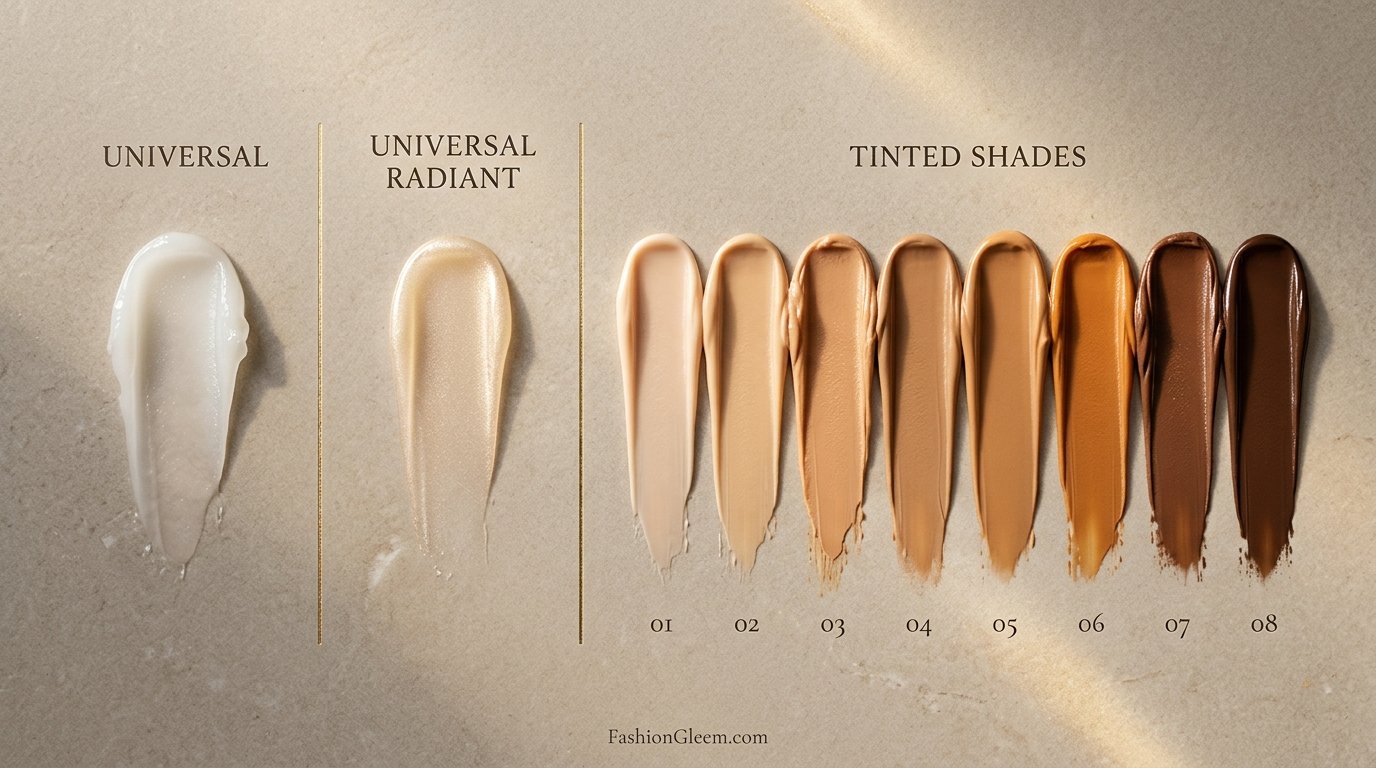
Danessa’s system has three doors. Choose the door by job first; shade matching only happens behind the third one.
Universal is colorless and translucent: prime, blur, and set, with no coverage and no color to match. It is the shade with no wrong answer.
Universal Radiant is the same colorless idea with a soft gold pearl, blurring with a lit finish instead of a flat matte one.
The tinted range adds light coverage, numbered from 0.5 (fair, cool) through 11 (deep, neutral), with half and quarter steps inside.
Shade counts in print conflict, so hold them as strands: 19 per a November 2026 listicle, 18 tinted plus 2 Universal per a pro retailer’s variants, 13 tinted in older copy.
The expansion direction is the fact that matters. Social proof quoting the range appears in the BuzzFeed before and after roundup, whose entry repeats the 19 shade strand and the $39 price.
Choosing Your Shade Without a Counter
Match depth first, undertone second. Take your usual foundation depth into the numbered range, then read the undertone wording in each shade description.
Half shades are a feature, not a typo. Steps like 3.5, 3.75, and 5.5 exist because the common complaint about this category is landing between shades.
Buy the door before the shade. If your job is priming and setting, Universal ends the decision; coverage seekers do the matching work.
Use the contour rule deliberately. The brand directs that a shade two or more steps deeper doubles as contour, and lighter placement highlights.
Fair skin has its own matching traps across formats. The same undertones first logic runs through our best blush for fair skin guide for the cheek category.
How to Apply Blurring Balm: The Protocol
Technique is the product’s second ingredient. The same pan produces the five star and the one star review, and the difference is a four step protocol.
- Prep and set your layers. Moisturize, apply sunscreen if it is daytime, and let everything dry down for a minute or two.
- Take a tiny amount. One small spatula scoop is a full face; less covers a T-zone. Over scooping is the original sin of this product.
- Press and roll, never sweep. Work the balm in with fingertips, the brand brush, or a sponge, pressing into texture and rolling over pores.
- Give it 60 seconds. As a primer it needs about a minute to set before foundation; as a base it is ready when the balm feel turns to powder.
Sheer versus fuller is a tool choice. Fluffy brush or fingertips sheers it out; a dense brush or sponge builds the coverage, per the brand’s own guidance.
Order with foundation runs both ways. Under for priming, over for setting and touch ups, alone for the light base, all three documented in the brand directions.
Step Order With Skincare, Sunscreen, and Foundation
The stack is skincare, sunscreen, balm, then color. Each layer sets before the next arrives, and the balm is pressed, never rubbed, over sunscreen.
Foundation, where used, goes over a set primer layer or under a tapped Universal set. Concealer belongs on top of the balm, not beneath it.
Blush sits last in the stack. The balm family has its own blush, and outside it, the layering logic in our blush makeup tips guide applies over a balm base.
The Pilling Problem and Its Five Fixes
Pilling is the category’s signature complaint. Little rolled crumbs on application mean the layers beneath never set, or the products are fighting.
- Fix one: wait. Unset moisturizer and wet sunscreen are the commonest cause; give each layer its minute.
- Fix two: use less. A thick balm layer rolls against itself; the tiny amount rule is also the anti pilling rule.
- Fix three: press, do not drag. Sweeping and rubbing roll the film; pressing and rolling lay it down.
- Fix four: audit the acids. Some acid heavy skincare under the balm is a reported trigger in creator troubleshooting content.
- Fix five: spot the dry zones. On very dry skin, rich prep on the dry areas only keeps the film even.
Pilling is diagnostic, not damning. It reports a layering problem with a fix attached, which is why the tutorials outnumber the returns.
A Morning With the Balm: One Worked Routine
Concrete beats abstract. Here is the protocol running inside one ordinary oily skin morning, with the clock visible.
7:00, prep. Cleanser, a light moisturizer, and sunscreen, each given its minute. The balm never meets a wet layer, so the pilling fix is built into the schedule.
7:05, the scoop. One small spatula scoop, warmed between fingertips. Half goes to the T-zone, pressed and rolled across the nose and forehead where the pores live.
7:07, the rest. The remainder presses over cheeks and chin, sheer by fingertip. The tinted shade is doing light foundation duty today, so no second base follows.
7:09, the set. Sixty seconds while the kettle boils. The balm feel turns to powder, and a tapped extra pass seals the nose, the known early shine zone.
7:12, color. Flushed on the cheeks over the balm base, pressed not swept, and the face is done in twelve minutes with three products out.
13:00, the verdict hour. The test the reviews describe: forehead matte, nose holding, no powder used. The absorption claim either survives this checkpoint or it does not.
21:00, removal. Off thoroughly with a proper cleanse, the acne prone caution honored by routine rather than by worry.
Blurring Balm by Skin Type: The Honest Verdicts
One product, four different reviews. Skin type predicts the verdict better than any other variable in the record.
|
Skin type |
Verdict |
The condition |
|---|---|---|
|
Oily |
The home ground: strongest praise |
Judge it at noon, not at application |
|
Combination |
Excellent, T-zone led |
Balm where the oil is, lighter elsewhere |
|
Dry |
Polarizing: love or flakes |
Moisture prep is mandatory, thin layer |
|
Mature |
A real case, prep dependent |
Avoids talc powder dryness; watch dry patches |
|
Acne prone |
Caution strands only |
Thorough night removal; T-zone test first |
Oily skin writes the love letters. Review quotes curated in the BuzzFeed roundup include a wearer calling it the only product that stops a baby oil look by noon.
Dry skin writes the warnings. A detailed independent verdict in the Blusheee independent review reports the balm emphasizing dry patches, the recurring mild form of the complaint.
An extreme strand exists and should be named as one. A single one star review reports a burning sensation and a chemical smell; it is an outlier in the record, not a pattern.
Acne prone guidance stays humble. No clinical verdict exists in the sources; the independent review’s protocol is thorough removal at night and a T-zone trial, printed here as one reviewer’s method.
The Review Record: A 3.9 Star Product and What It Means
The average is the message. A 3.96 out of 5 across more than two thousand reviews is not a failed product; it is a technique sensitive one.
Consensus products cluster near 4.5 with mild opinions. This one clusters at the poles, which means fit and method decide who lands where.
The Praise, in Reviewers’ Own Pattern
Oil control is the headline win. No shine by noon, makeup slept in and still presentable, touch ups that blur without disturbing the base.
Texture praise follows. Pores and texture read blurred without a cakey powder layer, and the finish photographs naturally at events, per reviewer reports.
Dry and mature wearers add a strand. Several long form reviews praise it as kind to skin that hates talc powders, mattifying without drawing moisture out.
The Complaints, Treated as a Syllabus
Every major complaint has a technique address. Pilling points at layering, heaviness at the scoop size, patch clinging at prep, and coverage disappointment at expectations.
The learning curve is real and short. Most wearers who cross it describe one bad first application, then the press and roll habit taking over.
Coverage is the exception with no fix. If you need a foundation’s cover, this category will disappoint you at any technique level, and the honest pages say so early.
The Claim Audit: Who Says What, and How Strong Is It
Claims in this category arrive wearing four different uniforms. Separating them is the difference between reading marketing and reading evidence.
|
Claim |
Source kind |
The fine print |
|---|---|---|
|
93% said pores looked blurred as a primer |
Brand study |
One day, 30 women, brand commissioned |
|
96% said skin appeared less oily as a foundation |
Brand study |
Same one day study, self reported |
|
100% saw smoother texture; 96% fewer fine lines |
Rival brand clinical |
Laura Mercier’s own testing, its product only |
|
12 hour wear |
Brand claim |
Laura Mercier; no independent wear test in the sources |
|
Absorbs about 1.2 g oil per gram |
Manufacturer data |
Upsalite maker, material level, not on skin |
|
3.96 out of 5 across 2,109 reviews |
Retailer aggregate |
The only large n evidence in the category |
Read the study rows as direction, not proof. Thirty women for one day can show a product pleases its testers; it cannot settle a category.
The aggregate row is the heavyweight. Two thousand retail reviews, uncommissioned and unfiltered, outweigh every percentage in the table for a buying decision.
The material row needs its label kept. A gram of mineral absorbing oil in a lab is mechanism evidence; what it does on your face by noon is the review record’s question.
The Franchise: Flushed, Lowlighter, and the Liquid Spray
The balm is now a family. The powder started it, and three relatives cover blush, glow, and refresh.
Flushed is the blush: a buildable soft matte balm for lips and cheeks at $27 for 6 g, listed in the Thirteen Lune Flushed listing with its core shades.
Its shade count is a moving target: 7 core shades at retailers, while the brand showed 11 including Grape Soda in October 2026.
Next to the stain logic in our jelly blush guide, Flushed is the balm family’s answer to the same cheek job with a powder dry finish.
Lowlighter is the glow branch: soft focus shades like a peachy Lowkey and a baby pink Unbothered, with US pricing not yet verified in the sources.
The Liquid Blurring Balm Spray is the newest format: the mineral system as a mattifying spray to prime, set, or refresh, at the Camera Ready Cosmetics spray listing for $23 (50 ml) and $36 (100 ml).
Its reviews rhyme with the powder’s. Oily and combination wearers praise it; dry and mature verdicts split, at 4.57 out of 5 across 72 reviews at one retailer.
Cost, Pan Speed, and Value
Run the arithmetic before the adjectives. The Danessa pan is $39 for 18 g, about $2.17 per gram, with a tiny amount rule stretching each pan.
The challenger costs $44 with fast pan complaints in its review record. A balm used generously at that price is a recurring expense, not a staple.
The bench undercuts both: the putty benchmark at about $10 does the smoothing job without the absorption system, at roughly a quarter of the price.
Value verdict: oily skin that uses the tiny amount buys the category’s best tool fairly; heavy handed users should price the habit before the pan.
Sale timing matters for a prestige staple. Color adjacent staples in the same basket, like the shades in our peach blush makeup guide and our dusty rose blush guide, reward the same patience.
Mistakes That Make Blurring Balm Look Bad
The complaint list and the mistake list are the same list. Work through it before blaming the formula.
- Scooping like a moisturizer. The pan is concentrated; a full face is one small scoop, and the T-zone needs less.
- Sweeping instead of pressing. Dragging rolls the film into pills and moves it off the texture it should fill.
- Layering over wet skincare. Unset moisturizer and sunscreen are the pilling engine; the minute of patience is part of the product.
- Expecting foundation coverage. It is a light base with a blur; judging it as a full foundation manufactures the one star review.
- Skipping dry skin prep. Unprepped flakes get outlined, not blurred; moisturize, set, then press thinly.
- Judging at the mirror. The absorption claim is about hours; the only honest test is your face at noon.
One habit fixes most of it. Less product, pressed in, over set skin, judged at midday: the five star pattern in four clauses.
The wider makeup cluster continues from our FashionGleem home page, where the base, blush, and lip categories sit together.
Frequently Asked Questions
1. What is a blurring balm?
A balm to powder complexion product. It blurs pores and texture while absorbing oil, built around the mineral Upsalite in the Danessa flagship.
It works as a primer, a light foundation, or a setting layer in one pan.
2. Is a blurring balm a primer or a foundation?
It claims all three jobs. Under foundation it primes, alone in a tinted shade it is a light foundation, and tapped over the top in Universal it sets.
Light coverage is the limit: it does not replace a full foundation.
3. What is the difference between Danessa Myricks and Laura Mercier blurring balm?
Original versus challenger. Danessa ($39, 18 g) is Upsalite based with two colorless finishes and the wide numbered range.
Laura Mercier ($44, January 2026) is a peptide skin tint balm with a 12 hour claim and 8 shades.
4. How much does Danessa Myricks blurring balm cost?
Thirty nine dollars for 18 g. That is the Sephora US price checked in November 2026.
Older roundups printing about $36 are stale, and the Flushed blush version costs $27 for 6 g.
5. How many shades does Danessa Myricks blurring balm come in?
The counts conflict, honestly. BuzzFeed said 19 shades in November 2026; a pro retailer lists 18 numbered tinted shades plus two Universal finishes; older brand copy said 13 tinted.
The range has expanded over time.
6. What is the Universal shade of blurring balm?
The colorless finish. Universal primes, blurs, and sets with no pigment and no coverage.
Universal Radiant adds a soft gold pearl for a lit finish, and the tinted shades are the ones that add light coverage.
7. How do you apply blurring balm?
Tiny amount, pressed in. About one spatula scoop for a full face, applied with fingertips, brush, or sponge, pressed and rolled rather than swept.
As a primer, give it about 60 seconds to set before foundation.
8. Why does my blurring balm pill?
Unset layers underneath. Heavy skincare, wet sunscreen, or clashing products make it pill.
Let each layer dry a minute or two, use less balm, and press instead of dragging.
9. Do you put blurring balm before or after foundation?
Both, by design. Before foundation it is the blurring, oil controlling primer.
After foundation, the Universal shade tapped over the top sets and touches up, and tinted shades alone replace foundation for a light base.
10. Does blurring balm go before or after sunscreen?
After, always. Sunscreen belongs under makeup.
Let it dry down for a minute or two, then press the balm over it; pressing rather than rubbing also protects the sunscreen film.
11. How much blurring balm should I use?
Far less than instinct suggests. Reviewers and the brand converge on a tiny amount: one small scoop for the whole face, less for the T-zone alone.
Too much is the commonest cause of a heavy feel.
12. Is blurring balm good for oily skin?
Oily skin is its home ground. The mineral absorbs oil and sweat to a natural matte, and 96 percent in the brand’s one day study said skin appeared less oily through the day.
13. Can dry skin wear blurring balm?
Yes, with prep, and it is the polarizing case. Moisturize and let it set, because the balm can cling to dry patches.
Talc shy dry wearers often love it; flaky skin strands report the opposite.
14. Is blurring balm good for mature skin?
It has a real case. Blurring without a talc powder base suits many mature wearers.
Strands conflict, praise beside dry patch complaints, so thin layers and prep decide which side you land on.
15. Does blurring balm cover acne and redness?
Not really. Coverage is sheer to light, and expecting foundation cover is the commonest disappointment in negative reviews.
It evens and blurs; marks and strong redness need concealer.
16. Is blurring balm safe for acne prone skin?
No clinical verdict exists. One independent review advises removing it thoroughly at night and restricting it to the T-zone if bumps appear.
That is one reviewer’s protocol, printed as such.
17. How long does blurring balm control oil?
No numbered claim from Danessa. The brand promises all day absorption and reviewers test it at noon.
Laura Mercier claims 12 hours for its balm, and results vary with skin and climate either way.
18. Does blurring balm have SPF?
No. Neither flagship balm is a sunscreen.
Wear a separate sunscreen under it, let the film set, and press the balm over the top.
19. What is Upsalite?
A patented porous mineral. Upsalite is mesoporous magnesium carbonate, invented in 2012 at Uppsala University.
The manufacturer reports about 1.2 grams of oil absorbed per gram, against about 0.5 for talc.
20. Is blurring balm the same as putty primer?
Cousins, not twins. The e.l.f.
Putty (about $10) is a squalane pore smoother.
The Danessa balm adds the Upsalite absorption system, tinted coverage shades, and a setting role at roughly four times the price.
21. Can you wear blurring balm alone?
Yes, and many do daily. Tinted shades alone give a light natural matte base.
The Universal shade alone gives a blurred no makeup finish on bare skin.
22. How do I choose my blurring balm shade?
Start from the job. Universal to prime and set, tinted for coverage.
Match your usual foundation depth, read the undertone letters, expect half shade steps, and remember a shade two steps deeper contours.
23. What does Universal Radiant do differently?
Glow instead of flat matte. Universal Radiant is colorless like Universal but carries a soft gold pearl, so it blurs and sets with a lit finish.
It adds glow, not coverage.
24. Does blurring balm photograph well or cause flashback?
Reviewers say it photographs well. A natural matte finish in event photos is the repeated report.
No controlled flashback test appears in the sources, so photo performance stays reviewer opinion.
25. Can I use blurring balm as a setting powder replacement?
In Universal, for many wearers yes. Tapped over foundation it absorbs oil and blurs without powder.
Very oily wearers may still want T-zone powder, and the franchise’s own spray covers the refresh job.
26. What is Blurring Balm Powder Flushed?
The blush member of the family. A buildable soft matte balm blush for lips and cheeks at $27 for 6 g.
Retailers list 7 core shades; the brand showed 11 including Grape Soda in October 2026.
27. What is the Liquid Blurring Balm spray?
The franchise in spray form. An Upsalite powered mattifying setting spray to prime, set, or refresh: $23 for 50 ml, $36 for 100 ml.
Oily skin reviews praise it; dry and mature verdicts split.
28. Is Laura Mercier Tinted Blur Balm a dupe of Danessa Myricks?
A challenger, not a dupe. Different formula story, skin tint positioning, a higher price, and 8 shades against the wide Danessa range.
The launch drew copy debate, and shade range is Danessa’s clearest lead.
29. Why are blurring balm reviews so mixed?
Technique and expectations. Sephora averages 3.96 out of 5 across 2,109 reviews: oil control wins devotees, while pilling, dry patch clinging, and sheer coverage disappoint buyers who used it like a cream foundation.
30. How long does a pan of blurring balm last?
No official figure. The tiny amount rule stretches the 18 g pan.
Reviewers of the rival balm complain its pan runs fast, which is a strand behind its price criticism, not a measurement.
31. Can I contour with blurring balm?
Yes, by the brand’s own directions. A tinted shade two or more steps deeper than your base works as contour, and the balm format blends with pressing motions.
32. What brush or tool is best for blurring balm?
All three work. Fingertips, the brand’s Yummy Face 2.0 brush, or a sponge.
Fluffy brush or fingertips for sheer, dense brush or sponge for fuller coverage, pressing on texture areas.
33. Does blurring balm work over powder?
It is built for both sides of foundation. Reviewers use Universal for touch ups over makeup.
Over heavy powder it can cake, so the reported technique is a light hand and pressing, never sweeping.
34. Is blurring balm vegan and talc free?
Vegan per Sephora, and no talc in the INCI. The published ingredient list contains no talc; magnesium carbonate and kaolin do the absorbing.
Check the current INCI on the retailer page before buying.
35. What is the suede skin trend?
The finish these balms sell. Matte but not flat, blurred but skin like: the opposite pole from glass skin.
A 2026 roundup of blurring powders and balms uses suede skin as its frame.
36. Can men use blurring balm?
Yes. The Universal shade is colorless, so it reads as oil control and blur with no visible makeup, which is why it turns up in grooming and on camera routines.
37. Is blurring balm good for summer and humidity?
Its strongest use case in reviews. Sweat and oil absorption is the headline claim, and the noon shine test dominates summer wear reports.
Keep the touch up option in extreme humidity.
38. How do I stop blurring balm clinging to dry patches?
Prep is the fix in the complaint record. Moisturize, let it set fully, apply thinly, and skip actively flaky areas or treat them first.
Pressing rather than sweeping reduces the emphasis too.
39. Where can I buy Danessa Myricks blurring balm?
Sephora US and pro retailers. Camera Ready Cosmetics carries it at the same $39.
The Laura Mercier balm sells on the brand site and rolled into Sephora and Ulta from February 2026.
40. Is there a mini or travel size of blurring balm?
Not verified for the US Danessa pan. A 5 g Laura Mercier listing appears at Boots in the UK.
Check the retailer page for current sizes before assuming a mini exists.
41. What should I buy first: the balm, the Flushed, or the spray?
The powder balm, in your finish. It is the original, the shade system lives there, and the review record concentrates there.
Add Flushed for a blush gap, the spray for refreshing a finished face.
42. Does blurring balm expire or dry out?
No expiry guidance in the sources. As a wax and oil based balm, keep the lid closed and the spatula clean, and check the period after opening symbol printed on your pan.
Conclusion
A blurring balm is best understood as a category with a founder, a challenger, and a technique. Danessa Myricks built it on a Swedish mineral and a wide shade range; Laura Mercier proved the category by joining it.
Choose by your skin and your patience. Oily and combination wearers with a minute to learn the press get the category at its best; dry and flaky skin should prep carefully or start with the tinted challenger.
Whichever pan you pick, use less than you think, press it in, and judge it at noon rather than at the mirror. That is where this product either earns its reputation or loses it.
Start from our FashionGleem home page for the wider makeup cluster, and let your blurring balm be the base your skin type, not the trend, selected.

Dilawar is a contributing writer at Fashiongleem.com, focusing on beauty, hairstyles, skincare, fashion accessories, and personal grooming. He creates informative, easy-to-follow articles that help readers explore new looks, understand popular beauty trends, and improve their everyday styling routines. His writing emphasizes practical advice, useful product information, and accessible fashion inspiration for modern readers.