
Buzz Cut Styles for Every Face Shape: Find Your Match
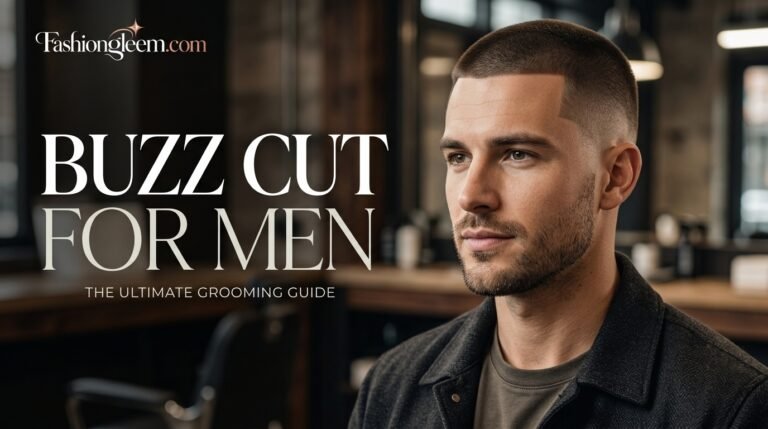
Buzz cut styles for every face shape start with balance, not with a guard number alone. A short uniform cut can sharpen one face and widen another, so the shape, fade height, top length, and beard must be chosen together. The right match makes bone structure clearer, keeps maintenance simple, and avoids a cut that fights the face.
Face shape is the outline formed by forehead width, cheekbone width, jaw width, and face length. No single measurement decides the result, because the relationship between those four points creates the shape. Most men sit between two shapes, so the dominant jaw and widest point should drive the choice.
Quick answer: oval faces suit almost any buzz cut, round faces suit height on top with tight sides, and square faces suit a clean #2 or #3 with a low taper. Oblong faces need side fullness and low fades, diamond faces need texture on top with a mid fade, and heart faces need length plus beard weight at the jaw. Triangle faces need crown volume and controlled sides, not a very short uniform cut.
How to Find Your Face Shape in Two Minutes
Measure Four Points, Not One Feature
Pull hair back from the forehead and stand square to a mirror in even light. Measure forehead width across the widest part, usually between the temples, and measure cheekbone width from the sharpest point on one cheekbone to the other. Measure jaw width from chin tip to the jaw corner below one ear, then double that number for full jaw width. Measure face length straight from the centre of the hairline to the tip of the chin.

Compare the four numbers before naming a shape, because a wide forehead alone does not prove a heart shape. Length clearly greater than width points toward oval or oblong, while length close to width points toward round or square. Cheekbones as the widest point point toward diamond, forehead widest points toward heart, and jaw widest points toward triangle. Jaw angle then separates soft shapes from angular shapes, since a hard jaw corner reads square and a curved jaw reads round.
Use a mirror trace if tape numbers feel confusing, by tracing the face outline on glass with a washable marker. Leave ears and hair out of the outline, because hair volume can fake width at the temples. Step back and read the traced shape, then check it against the four measurements for a second opinion. A straight-on photo also helps, but an angled selfie often distorts width and length.
Read the Result Like a Barber
Barbers read three signals fast: jaw angle, width to length ratio, and the widest point of the face. Jaw angle separates the square family from the round family, while width to length ratio separates long faces from balanced faces. Widest point separates diamond, heart, and triangle faces, even when length looks similar. Asking a barber to name the shape at the start of a cut often prevents a full appointment built on a wrong guess.
Between two shapes is normal, and the stronger feature should win the styling decision. Oval with a square jaw should follow square guidance for side treatment, while round with high cheekbones should still prioritise length on top. A beard changes the reading, because a full beard adds jaw width and can make a heart face look more balanced. Judge shape with the beard normally worn, then recheck shape if the beard is shaved off.
Hairline matters too, because a receding hairline changes where face length appears to start. Measure from the current hairline for a practical cut decision, not from a hairline remembered from five years ago. A widow’s peak can also sharpen a heart shape, while a high forehead can make an oblong face look longer. Tell the barber about hairline concerns before the clippers start, so the fringe and lineup do not expose a weak point.
The Master Match Table
| Face shape | Best buzz cut | Top guard | Fade choice | Avoid first |
| Oval | Classic uniform buzz or induction | #1 to #4 | Any height | Heavy fringe hiding balance |
| Round | High fade or high and tight | #3 to #4 on top | High fade | Uniform very short cut |
| Square | Tapered buzz or low fade | #2 to #3 | Low fade or taper | Boxy lineup with very short guard |
| Oblong | Butch or crew with fuller sides | #3 to #5 | Low fade or no fade | High fade and induction |
| Diamond | Textured buzz with mid fade | #3 to #4 | Mid fade | Induction with no variation |
| Heart | Longer buzz with beard | #4 or #3 to #4 | Low fade | High and tight |
| Triangle | Textured or brush top | #3 to #4 on top | Low to mid fade | Uniform very short cut |
Use the table as a starting point, not as a rule that overrides hair type, head shape, or workplace limits. Guard numbers vary slightly by brand, so always pair a guard number with a millimetre length at booking. Fade height changes the face more than a one guard change on top, because sides control width while top length controls height. Beard length can rescue a close call, especially for heart and round faces.
Guard Lengths in Plain Numbers
| Guard | Length | Look | Best first use |
| #0 | About 1.5 mm | Skin close stubble | Induction, bold short look |
| #1 | About 3 mm | Very short, scalp visible | Burr, sharp military look |
| #2 | About 6 mm | Short classic buzz | First short buzz, square faces |
| #3 | About 9 to 10 mm | Fuller buzz | Safe first buzz, most shapes |
| #4 | About 12 to 13 mm | Soft buzz, crew edge | Heart, oblong, diamond |
| #5 | About 16 mm | Longer buzz | Brush cut, texture |
| #6 | About 19 mm | Short haircut edge | Longer top, oblong width |
| #8 | About 25 mm | Longest standard guard | Crew length, not a classic buzz |
Brands vary by about 0.5 mm on some guards, so a #3 from one brand may read slightly longer or shorter than another. Lever open adds roughly 0.5 to 1 mm on many clippers, according to competitor barber guides, so a barber should confirm lever position for a blend. Start longer than planned for a first buzz, because a longer cut can be shortened in the same visit while a too short cut cannot be undone. Photograph the cut from front, side, and back at the chosen guard, so the next visit uses the same numbers.
Guard 3 or 4 is the safest test length for most first time buzz cuts, according to BuzzCutHub. Guard 2 suits confident short looks and strong bone structure, while guard 1 suits bold, low maintenance looks with clear scalp show. Guard 4 and above softens the cut, shows more texture, and hides head shape quirks better than skin close lengths. Length choice should follow face shape first, then hair density, then personal comfort with scalp visibility.
Oval Face: The Most Forgiving Shape
Why Oval Works With Almost Any Buzz
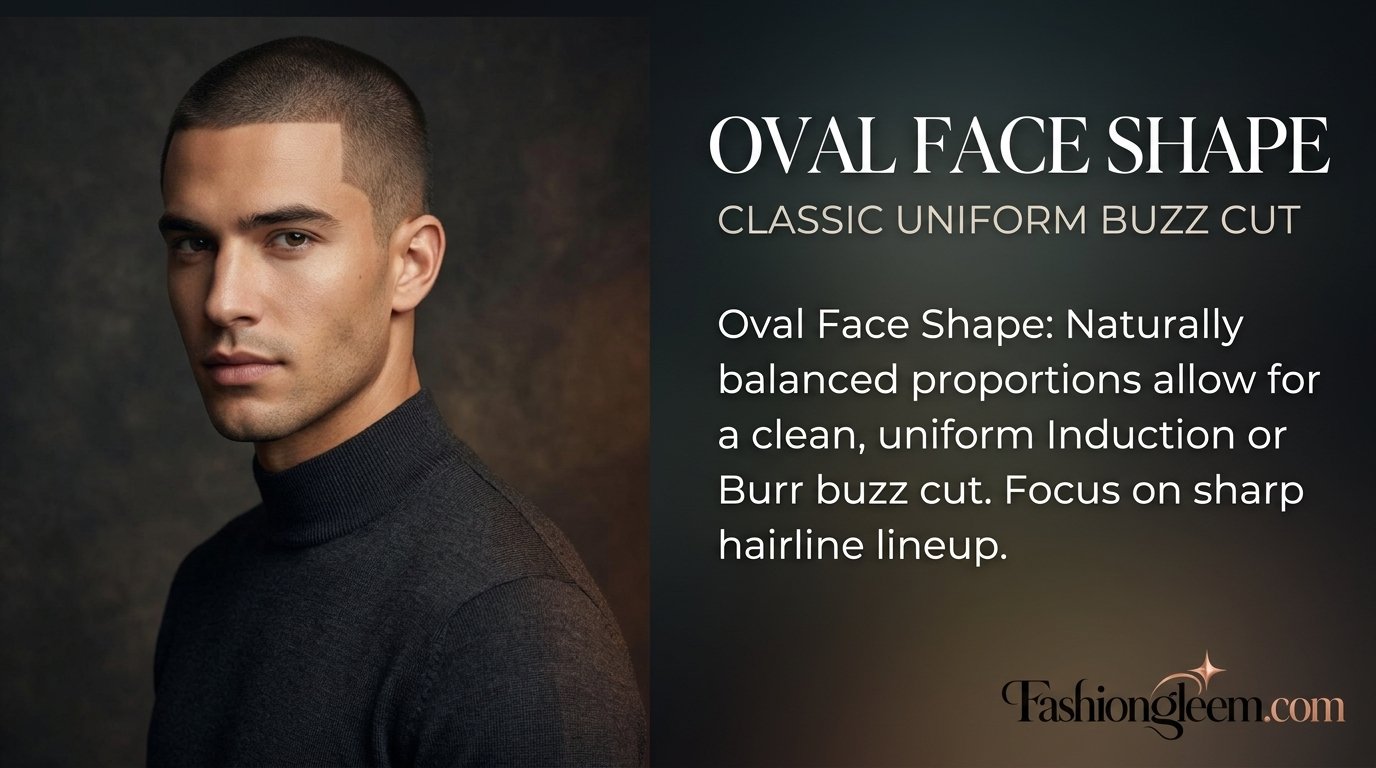
Oval faces are longer than wide, with a forehead slightly wider than the jaw and a gently rounded jawline. Balanced proportions mean no single feature needs hiding, so a buzz cut mainly needs to avoid covering that balance. Classic uniform buzz, induction, burr, butch, brush, and faded buzz cuts all sit naturally on an oval face. Fade height becomes a style choice here, not a correction tool, so low, mid, and high fades can all work.
The main oval mistake is a heavy fringe that covers the forehead and shortens the face. Buzz cuts avoid that trap by keeping the hairline clean and the silhouette simple, which suits oval proportions well. Texture on top can add interest without breaking balance, especially at #3 or #4 where hair still shows movement. A lineup should follow the natural hairline, not force a square corner that fights the softer oval outline.
Best Oval Cuts and Barber Script
Best oval picks are a #2 or #3 uniform buzz for a sharp everyday look, and a #3 or #4 with low taper for a softer office look. High fade works for a bold oval look, while a textured buzz adds modern movement without extra styling time. Crew cut is the longer cousin worth choosing when a little front length is wanted, with tapered sides and a slightly longer top. Skin fade is safe on oval faces, but it needs more frequent trims to stay crisp.
Ask the barber: “#3 all over, low taper at the neck and ears, natural hairline, no boxy lineup.” Add a fade request only if a sharper side is wanted, such as “mid fade, blend up to the #3 top.” Beard pairing can be clean shaven, short stubble, or a full beard, since oval balance tolerates all three without a major correction. Glasses also sit easily on oval faces, because frame width does not need to fix a narrow or wide zone.
Round Face: Add Height, Tighten the Sides
Why Round Faces Need Vertical Lines
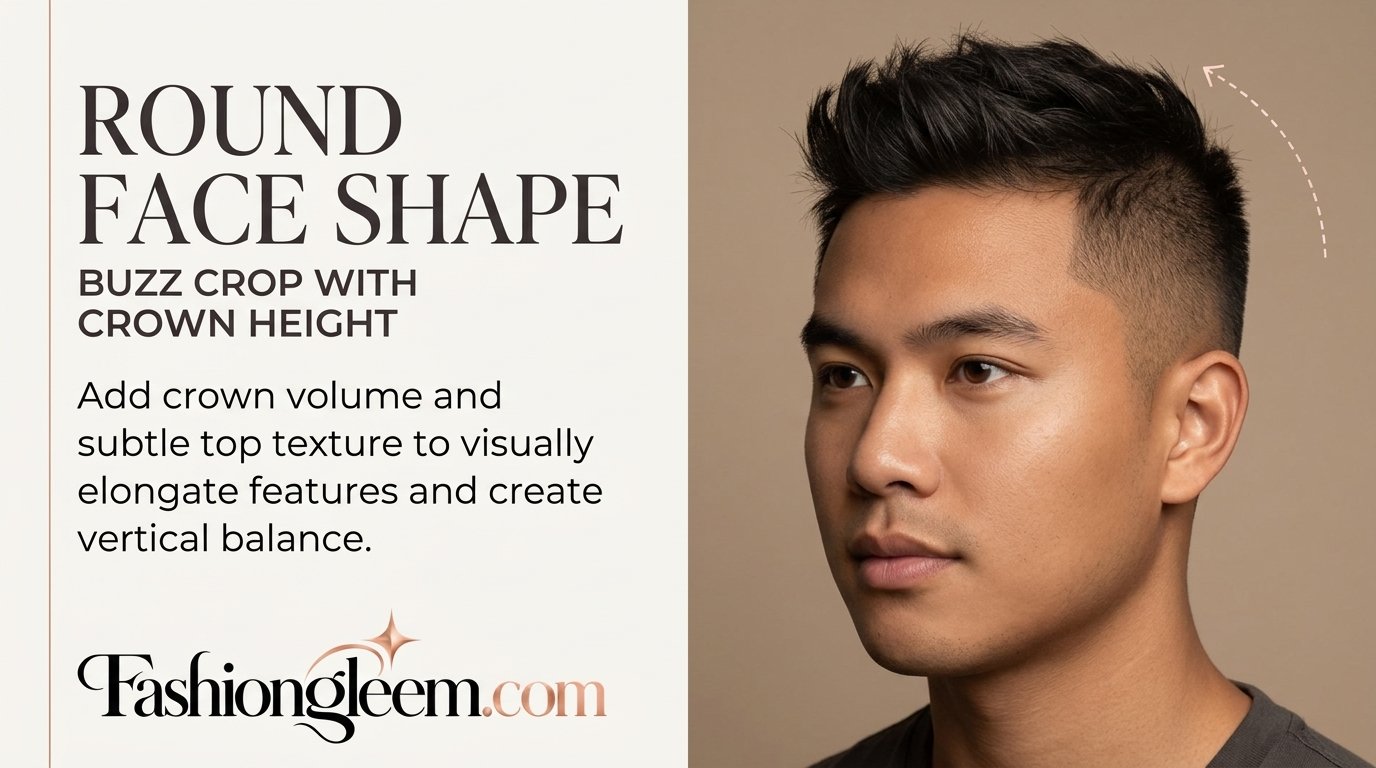
Round faces have length and width close to equal, full cheeks as the widest point, and a soft jaw with no hard angles. Uniform very short cuts can reinforce roundness, because one even length adds no vertical direction and no side contrast. Height on top plus tight sides breaks the circle, by drawing the eye upward and removing width at ear level. A high fade is the strongest version of that idea, while a high and tight keeps the same logic with a longer top and very short sides.
One conflict in competitor guides needs a clear answer. Manhattan Barbershop NYC suggests a #4 or longer brush cut for round faces to add softness, while BuzzCutHub and Vagazine push a high fade for elongation. Both routes can work, but they solve different problems: high fade elongates best, while longer brush plus beard defines best without a fade. Choose high fade for maximum lengthening, and choose longer top plus structured beard for a softer look with less fade upkeep. Do not choose a uniform #1 or #2 all over and expect it to lengthen a round face.
Best Round Cuts and Barber Script
Best round picks are a high fade buzz with #3 to #4 on top, a high and tight with a longer top, and a crew cut with height for men who want more front length. Low taper alone is weaker for round faces, because it leaves too much side width at cheek level. Textured top helps at longer guards, since texture reads as height rather than flat width. Side part buzz is less useful here, because a flat side sweep can widen the face instead of lifting it.
Ask the barber: “High fade, #3 to #4 on top, tight sides, keep height through the crown, no bulk at the ears.” Add beard guidance in the same sentence, such as “short beard, longer at the chin, tapered at the cheeks.” A chin length beard adds vertical weight below the jaw, which supports the elongation goal. Avoid a full round beard that adds cheek width, because it can undo the fade benefit. Avoid heavy horizontal fringe as well, since a straight line across the forehead can chop the face shorter.
Square Face: Show the Jaw, Control the Box
Why Square Faces Suit Buzz Cuts So Well
Square faces have forehead, cheekbones, and jaw at roughly equal width, with a strong angular jaw corner. Buzz cuts suit square faces because short hair removes distraction and lets bone structure carry the look. Book of Barbering gives a precise square script: #2 or #3 all over (6 to 10 mm) with a #1 taper at the neck and around the ears. Low fade sharpens the outline without turning the cut into a full fade, while a low skin taper at the sideburns adds definition. Uniform buzz is the cleanest square statement, and it needs no texture trick to work.
The square decision is whether to echo the angles or soften them slightly, not whether a buzz will work at all. Sharp lineup plus very short guard can look severe on an already angular face, according to BuzzCutHub, so that pairing should be a deliberate choice. Textured top softens square angles while the jaw still reads strong, which suits men who want less severity. Mid fade also works, but a very high fade can make the jaw look too rigid if the top is also very short. Bulk at jaw level should be avoided, including a wide boxy beard that adds weight to the bottom third.
Best Square Cuts and Barber Script
Best square picks are a #2 or #3 uniform buzz, a tapered buzz, a low fade buzz, and a butch cut for a slightly fuller version. Induction cut suits square faces with well proportioned heads, but it shows every head contour and needs confidence. Burr cut at #1 to #2 is sharp and low maintenance, while crew cut adds a styled front for work or formal settings. Caesar buzz can work on square faces, but the fringe should stay short and clean rather than heavy.
Ask the barber: “#2 or #3 all over, #1 taper at the neck and ears, low fade if wanted, natural or soft lineup.” Add texture only if softening is wanted, such as “light texture on top, keep sides tight.” Beard pairing should stay structured and tapered, with cheek lines clean and chin length controlled. A short beard adds contrast without widening the jaw, while a long wide beard can make the lower face look heavy. Glasses with angular frames echo square structure, while softer frames can balance a very hard jaw.
Oblong and Rectangle Face: Add Width, Cut Height
Why Long Faces Must Protect Side Fullness
Oblong faces are noticeably longer than wide, with forehead, cheeks, and jaw in a similar narrow band and straighter sides. Height is the enemy here, because every extra centimetre on top stretches an already long face. Width is the fix, because side fullness interrupts the vertical line and makes the face read shorter. Low fade or no fade protects that width, while high fade removes side hair and lengthens the face further. Induction cuts are also risky, because skin close sides leave a long vertical outline with no counterweight.
Best oblong length sits at #3 to #5, which gives enough coverage to soften length without adding styling work. Butch cut at #3 to #4 is a strong default, while crew cut with fuller sides adds a little front interest without height. Brush cut at #4 to #6 can work, but the top should stay controlled and not brushed upward into a tall shape. Side volume should be kept neat, not puffy, because messy bulk at the sides can look untidy rather than balanced.
Best Oblong Cuts and Barber Script
Best oblong picks are a uniform #3 to #4 buzz, a butch cut, a crew cut with longer sides, and a low taper buzz that keeps side length. Skin fade should be skipped, and high fade should be skipped unless a longer top is deliberately avoided for another reason. Textured buzz can work if texture stays low and wide, not tall and spiky. Fringe helps in longer styles, but a buzz fringe should stay short and forward, not swept up.
Ask the barber: “#4 all over or #3 sides with #4 top, low taper only, no skin fade, keep side fullness.” Add a width check by asking the barber to leave sides slightly longer than a normal fade would. Beard pairing should stay short to medium, with side fullness rather than chin length, because a long chin beard can stretch the face further. Thick glasses frames add width near the top of the face, but very tall frames can add vertical emphasis on an oblong face. Hats should sit naturally, not pushed high on the crown, for the same height reason.
Diamond Face: Balance the Cheekbones
Why Diamond Faces Need Top and Jaw Balance
Diamond faces have cheekbones as the clear widest point, with a narrower forehead and a narrower chin. Ultra short uniform cuts can leave cheekbones as the only wide feature, because no top texture or jaw weight competes with them. Texture on top balances a narrower forehead, while a mid fade keeps cheek width controlled without exposing it fully. Slightly longer top length softens the diamond outline, especially at #3 to #4, where hair still shows shape. Low to mid fade is safer than a very high fade, which can draw attention straight to the widest point.
Diamond styling goal is to draw attention toward the top and jaw, not toward the middle of the face. A short beard can help by adding jaw weight, but it should stay tapered so it does not widen the cheeks. Sideburn length should stay controlled, because long wide sideburns can merge with cheek width. Glasses with wider frames can balance a narrow forehead, while very narrow frames can make cheekbones look wider by contrast. A lineup should stay soft, not boxy, so the forehead does not look boxed in.
Best Diamond Cuts and Barber Script
Best diamond picks are a textured buzz with #3 to #4 on top, a mid fade buzz, and a brush cut with controlled sides. Classic uniform buzz can work at #3 to #4, but it is weaker at #1 where no texture balances the cheeks. Crew cut adds front length for diamond faces that want more styling range. Induction cut should be avoided first, because it exposes the full diamond shape with no hair to moderate it. High fade should also be avoided first, for the same cheekbone reason.
Ask the barber: “#3 to #4 on top with texture, mid fade, soft lineup, keep temple width controlled.” Add beard guidance such as “short tapered beard, longer at chin than cheeks.” Product should stay light at this length, because heavy wax can clump texture and expose scalp patches. Trim timing matters for diamond faces, since a grown out mid fade can widen the sides and change the balance. A tidy up every 3 to 4 weeks keeps the fade and texture in the intended ratio, according to Book of Barbering.
Heart Face: Soften the Forehead, Fill the Jaw
Why Heart Faces Need Bottom Weight
Heart faces, also called inverted triangle faces, have the forehead as the widest point and a narrower, sometimes pointed chin. High and tight styles expose more forehead, which is the opposite of what a heart face needs. Longer buzz length reduces forehead emphasis, while a beard fills out the narrower jaw so the face does not narrow to a point. Low fade keeps the transition soft, while #3 to #4 gives enough top coverage to balance the upper face. Volume should stay low, because tall height on top can make the forehead look wider.
Heart face balance comes from width at the jaw, not from height at the crown. A short to medium beard is the most useful tool here, with length focused at the chin and taper at the cheeks. Clean shaven heart faces can still wear a buzz, but they should choose a longer guard and a low fade rather than a skin fade. Fringe helps in longer cuts, but a buzz fringe should stay short and natural, not heavy across the forehead. Side part buzz can work if the part stays soft, because a hard part can sharpen the forehead line.
Best Heart Cuts and Barber Script
Best heart picks are a #4 buzz with low fade, a #3 to #4 uniform buzz with beard, and a textured buzz with low sides. Crew cut with a slightly longer fringe area can also balance a heart face, especially for men who want more front styling. High fade should be avoided first, and induction should be avoided first unless a strong beard compensates. Skin fade is risky here, because it removes temple width and leaves the forehead as the dominant width.
Ask the barber: “#4 on top, low fade, soft lineup, keep top length, no high fade.” Add beard guidance in the same visit, such as “beard longer at chin, tapered cheeks, clean neckline.” Glasses with a wider lower frame can balance a narrow chin, while very wide top heavy frames can widen the forehead further. A goatee can add chin weight, but it should stay neat and not too narrow, or it can sharpen the pointed chin effect. Hairline care matters for heart faces with a widow’s peak, so the lineup should follow the natural peak rather than erase it.
Triangle Face: Build the Crown, Control the Jaw

Why Triangle Faces Are the Reverse of Heart Faces
Triangle faces, also called pear faces, have the jaw as the widest point and a narrower forehead. Name confusion is common here, because some sources use triangle for forehead wide and chin narrow, which is the heart shape in most barber guides. Use the widest point test instead of the name alone: jaw widest means triangle or pear, forehead widest means heart or inverted triangle. Very short uniform buzz cuts leave the jaw as the dominant feature, because no crown height competes with it. Crown volume is the counterweight, so a #3 to #4 textured or brush top works better than a skin close cut.
Triangle styling goal flips the heart goal: add fullness up top and keep sides controlled, not add width at the jaw. A wide boxy beard can make a triangle jaw look heavier, so beard sides should stay tapered and chin length should stay moderate. Sideburns should stay neat, because wide sideburns can merge with jaw width. Glasses with a wider top frame can balance a narrow forehead, while narrow frames can leave the jaw looking wider by contrast. A flat top buzz can add height for triangle faces, but it needs thick or coily hair to hold the shape.
Best Triangle Cuts and Barber Script
Best triangle picks are a textured buzz with #3 to #4 on top, a brush cut with controlled sides, and a low to mid fade buzz with top texture. Crew cut with a longer top also works, because front length adds crown presence. High fade should be used carefully, since it can remove temple width and leave the jaw exposed, but a mid fade with top length is safer. Uniform #1 buzz should be avoided first, and tight skin sides with no top texture should also be avoided first.
Ask the barber: “#3 to #4 textured top, low to mid fade, keep crown fullness, taper beard sides.” Add a crown check by asking the barber to leave the crown slightly longer than the front if the crown sits flat. Product should stay light, because heavy product can flatten texture and remove the crown benefit. A short structured beard can work, but the beard should be shaped to taper inward at the jaw corners. First time triangle buzz should start at #4, then step down only if the jaw still reads balanced in photos.
Buzz Cut Styles Library
Classic and Military Styles
Classic uniform buzz uses one guard all over, with no fade and no length change from top to sides. Induction cut uses #0 or #1 and gives a near bald, bold, military look with maximum scalp show. Burr cut uses #1 to #2 and keeps a little more coverage than induction while staying very short. Butch cut uses #3 to #4 and is the most popular buzz length, because it reads as a deliberate haircut rather than a shave. Brush cut uses #4 to #6 and lets hair stand slightly, which softens the cut and shows more texture.
High and tight keeps the top longer while sides go very short or shaved, which creates strong contrast and vertical emphasis. Crew cut is the longer buzz cousin, with tapered sides and a top that graduates longer toward the front. Ivy League buzz keeps a slightly longer front top for a subtle side sweep, which suits longer and oval faces best. Flat top buzz levels the top into a flat shape, which adds height and suits thick or tightly coiled hair. Textured buzz uses point cutting or natural texture to break up a flat top, which helps diamond, triangle, and square faces.
Fade and Taper Styles
Low fade starts just above the ears and neckline, keeps the look soft, and suits square, heart, oblong, and office settings. Mid fade starts around the temple midpoint, gives balanced contrast, and suits diamond, triangle, and oval faces. High fade starts near the temples, gives bold contrast, and suits round faces best for elongation. Skin fade blends down to bare skin, gives the sharpest contrast, and needs the most frequent trims. Taper is softer than a fade, keeps more hair at the neckline and sideburns, and grows out more gracefully.
Burst fade curves around the ear like a burst, suits oval, heart, and oblong faces in competitor guides, and needs precise shaping. Temple fade focuses the taper around the sideburns, frames the face cleanly, and pairs well with lineups and beard fades. Drop fade follows the head curve and drops lower at the back, which can soften a fade for round and square faces. Shadow fade leaves a faint shadow instead of bare skin, which suits conservative workplaces and first time fade wearers. Fade height should be chosen by face shape first, then by how often trims are realistic.
Detail Styles: Lineup, Caesar, Fringe, and Beard Pairing
Lineup uses a trimmer to define a sharp hairline edge, which suits oval, square, and round faces with strong hairlines. Caesar buzz adds a short straight fringe across the forehead, which can soften a high forehead or receding front if kept short. Short fringe buzz adds a tiny front fringe to soften the hairline and draw attention to the eyes. Hard part shaves a part line into the cut, which adds structure but can sharpen an already angular face. Side design adds a shaved line or pattern, which suits younger or fashion forward wearers but needs frequent upkeep.
Buzz with beard is the most useful pairing in face shape work, because beard shape can fix a jaw or chin imbalance. Buzz with stubble adds light definition without beard weight, which suits oval and square faces well. Buzz with short beard adds jaw structure for heart and round faces, when the beard is longer at the chin. Buzz with full beard adds strong contrast, but it needs tapering so it does not widen a round or triangle jaw. Buzz with goatee adds chin weight for heart faces, but the goatee should stay wide enough to avoid sharpening a pointed chin.
Face Shape Plus Hair Type Matrix
| Hair type | What changes | Guard tip | Face shapes to watch |
| Straight | Shows lines cleanly, scalp shows evenly | Any guard, clean blend | All, best for square and oval |
| Wavy | Adds natural texture at #3 plus | #3 to #4 for movement | Diamond, triangle, round |
| Curly | Springs up, looks shorter than measured | Go one guard longer first | Diamond, triangle, oblong |
| Coily | Appears much shorter, holds shape | Longer guard, dry check | Round height, triangle crown |
| Fine or thin | Scalp shows more, flat at long guards | Shorter clean buzz often reads better | Thinning, heart, diamond |
| Thick or coarse | Holds texture, can look bulky at sides | Taper sides, texture top | Round sides, square bulk |
| Thinning | Lower guard reduces contrast | #1 to #2 for strong thinning | All, check crown light |
| Receding | Uniform length removes rim effect | #2 to #4, forward or Caesar | Heart, oval, square |
Straight hair gives the cleanest buzz, because lines and blends read evenly at every guard. Wavy hair adds organic texture at #3 and longer, which softens angular faces without product. Curly hair needs a longer guard first, because curl shrinkage makes a measured length look shorter once dry. Coily hair holds a flat top or textured shape well, but it can look much shorter than the guard number suggests. Fine hair shows scalp sooner, so a shorter cleaner buzz often reads more intentional than a long flat buzz.
Thick hair can look bulky at the sides if a fade is skipped, so a taper or fade helps control width. Thinning hair benefits from a lower guard, because short uniform length removes contrast between thick and sparse patches. Receding hair benefits from uniform length, because it removes the rim between fuller back hair and a receded front. Grey or silver hair shows texture differently, because lighter hair can look softer and less dense at the same guard. Check hair dry and under overhead light before choosing a final guard, since wet hair hides thin patches and crown shape.
Head Shape, Scalp, Ears, and Glasses
Head Shape Can Override Face Shape
Buzz cuts expose head shape more than longer styles, because short hair cannot hide flat spots, bumps, or uneven contours. Flat back of the head benefits from a slightly longer top and a low taper, rather than a skin close cut that shows the flat plane.
Pronounced cowlick benefits from a shorter guard, because very short hair cannot stick up or swirl visibly. Uneven hairline benefits from a natural lineup, not a forced square corner that highlights asymmetry. Scars, moles, or scalp patches should be checked before a #0 or #1 cut, because skin close lengths show every mark.

Start longer if head shape is a worry, then step down one guard at a time across visits. Guard 4 to 5 hides head shape quirks far better than guard 0 to 1, according to Manhattan Barbershop NYC. Photograph the back and crown after a cut, because the front mirror view hides the areas most affected by head shape. Tell the barber about a flat spot, a bump, or a scar before the cut, so the blend can be adjusted. A barber can leave a little extra length over a flat area to round the silhouette, which is a small change with a large visual effect.
Ears, Glasses, and Neckline Details
Ears that stick out can look more prominent with a high skin fade, because the fade removes hair that softens the ear outline. Low taper is safer for prominent ears, because it keeps some hair around the ear and blends the edge. Sideburn length should match face shape: short sideburns sharpen square and oval faces, while slightly longer sideburns can balance a long face. Neckline shape also matters, with a tapered neckline looking softer and a blocked neckline looking sharper and more angular. Blocked neckline suits square faces, while tapered neckline suits round and heart faces better.
Thick glasses frames add width near the top of the face, which helps round and heart faces but can overwhelm a narrow oblong face. Thin frames add less width, which suits oblong faces and strong square faces without extra bulk. Longer top length helps balance thick frames, because a skin close top can make frames look oversized. Frame colour also changes contrast, with dark frames adding a stronger top line than light frames. Try the cut with glasses on during the barber check, not just without them, because the final look includes the frames.
Beard Pairing by Face Shape
| Face shape | Beard goal | Best beard | Avoid |
| Oval | Keep balance | Stubble, short, or full | Very long beard that stretches face |
| Round | Add chin length | Short beard, longer at chin | Full round beard at cheeks |
| Square | Keep jaw clean | Short structured beard | Wide boxy beard at jaw |
| Oblong | Add side width | Short to medium, fuller sides | Long chin beard |
| Diamond | Add jaw weight | Short tapered beard | Wide cheek beard |
| Heart | Fill narrow jaw | Short to medium, chin focused | Clean shaven with high fade |
| Triangle | Control jaw width | Short tapered beard | Wide boxy beard |
Beard fade should blend from buzz sides into beard length, so the transition does not create a hard step at the jaw. Cheek line should stay clean for round faces, because cheek hair adds width where round faces least need it. Neckline should sit above the Adam’s apple for a clean look, with a slight curve that follows the jaw. Beard oil and balm help short beards look intentional, especially when the top is very short and the beard carries more visual weight. Stubble length around 1 to 3 mm suits men who want definition without a full beard commitment, according to beard guides.
Clean shaven works best with oval and square faces, because those shapes do not need beard correction. Round faces clean shaven need a stronger fade or top height, because no beard is available to add chin length. Heart faces clean shaven should choose a longer guard and low fade, because no beard is available to fill the jaw. Triangle faces clean shaven need crown texture most, because no beard is available to balance the jaw from below. Beard growth pattern should be checked honestly, since patchy cheeks can look worse with a sharp cheek line.
Workplace, Age, and Lifestyle Fit
Office, Formal, and Conservative Settings
Low taper buzz is the safest office buzz, because it looks clean without a stark skin line. Uniform #3 or #4 reads professional in most workplaces, while #1 with skin fade reads bolder and may feel too aggressive in conservative offices. Shadow fade is a useful middle ground, because it gives fade shape without bare skin contrast. Lineup should stay natural in formal settings, not razor sharp with a hard corner. Beard should stay groomed and tapered for work, with cheek lines clean and neckline tidy.
Older men often suit a softer #3 or #4 low taper, because it looks polished without the severity of a skin close cut. Book of Barbering notes crew cut as a default for square faced men over 40, which shows how a slightly longer top can age well. Grey hair at buzz length looks intentional when the cut is even, but patchy grey can look uneven at very long guards. First time buzz after long hair should start at #3 or #4, because the change is already large without adding scalp shock. Workplace dress code should be checked for visible scalp designs, which are fashion choices rather than office defaults.
Sport, Helmets, Hats, and Seasons
Athletes suit high fade and burr cuts, because short sides stay clean under helmets and sweat dries fast. Helmet wearers should keep sides tight, because bulk under a helmet can shift the helmet and flatten the top unevenly. Hat wearers should choose a cut that still reads clean after a hat is removed, which favours uniform length over tall texture. Swimmers suit shorter guards, because chlorine and frequent washing make long buzz texture harder to maintain. Runners suit low maintenance buzz cuts, because no styling time is lost before training.
Summer sun is a real scalp risk with short buzz cuts, because exposed scalp burns faster than covered scalp. Sunscreen or a hat should be used for #0 to #2 cuts, especially for fair skin and outdoor work. Winter cold makes longer guards more comfortable, because #4 to #6 gives slightly more insulation than skin close lengths. Dry scalp shows more at short guards, so moisturiser and gentle shampoo help keep the scalp looking healthy. Sweat and product should be rinsed after sport, because buildup can irritate a freshly faded scalp.
Barber Scripts for Every Face Shape
Use one script per shape, and add hair type and beard notes only where they change the cut. Guard plus millimetre should be spoken together, because guard numbers vary slightly by brand. Fade height should be named, not described as short on the sides, because short can mean low taper to one barber and skin fade to another. Lineup style should be named too, because natural, soft, and sharp lineups give very different face frames. Bring front, side, and back photos of the same person, not a celebrity with a different face shape.
- Oval script: “#3 all over, low taper at neck and ears, natural hairline, no heavy fringe.”
- Round script: “High fade, #3 to #4 on top, tight sides, height through crown, no bulk at ears.”
- Square script: “#2 or #3 all over, #1 taper at neck and ears, low fade if wanted, soft lineup.”
- Oblong script: “#4 all over or #3 sides with #4 top, low taper only, no skin fade, keep side fullness.”
- Diamond script: “#3 to #4 textured top, mid fade, soft lineup, control temple width.”
- Heart script: “#4 on top, low fade, soft lineup, beard longer at chin, tapered cheeks.”
- Triangle script: “#3 to #4 textured top, low to mid fade, keep crown fullness, taper beard sides.”
- First time script: “#4 all over first, check photos, step down one guard next visit if wanted.”
- Thinning script: “#2 all over or #1 to #2, uniform length, no fade that highlights thin patches.”
- Curly script: “One guard longer than planned, dry check, texture on top, taper sides.”
Red flags in the chair include a barber who starts with #1 before confirming shape, a fade started high without asking, and a lineup squared without checking the natural hairline. Stop and check at the first guard pass if the length looks too short, because a second pass only removes more hair. Ask for a mirror check from the side and back before the fade is blended, since fade height is hard to reverse. Write the winning script down after a good cut, with guard, fade, lineup, beard, and trim date, so the next visit repeats it exactly.
DIY Buzz Cut by Face Shape
Tools and Preparation
Good clippers with a full guard set, a hand mirror, a cape or old towel, and a trimmer for edges are the core DIY kit. Guard check matters more at home, because a loose guard can cut shorter than planned and ruin a face shape plan. Clean and oil blades before cutting, since dull blades pull hair and create uneven patches. Cut dry hair for a true length reading, because wet hair lies flatter and can hide thin areas. Work in bright light with a second mirror for the back, since the back view controls neckline and fade shape.
Start with the face shape guard from the master table, not with the shortest guard in the box. Oval and square can start at #3, round and diamond at #3 to #4 on top, and oblong, heart, and triangle at #4. Fade guards should step down one guard at a time, with lever adjustments for blending rather than jumping straight to skin. A second person helps most for fades, back blends, and neckline straightness, especially for first time DIY fades. A barber cleanup after a DIY cut can fix a blend line without redoing the whole cut.
Numbered DIY Steps
- Wash and dry hair fully, then comb it in its natural direction before any clipping.
- Snap the top guard on firmly, tug it to confirm the lock, and test it on a small back section.
- Cut the top first in slow overlapping strips, moving against hair growth for even length.
- Cut the sides next with the same guard for a uniform buzz, or with a longer guard for a crew style.
- Set the fade guideline only after the top and sides are even, starting low for a safe fade.
- Blend upward with one guard lower and lever open, using small flicking strokes at the guideline.
- Clean the ears and neckline with a trimmer, keeping the neckline tapered or blocked as planned.
- Check the back with a hand mirror, looking for lines, missed patches, and uneven crown length.
- Define the lineup lightly with a trimmer, following the natural hairline rather than forcing a square shape.
- Brush off loose hair, moisturise the scalp lightly, and photograph front, side, and back views.
DIY fade warning applies most to round and diamond faces, because fade height controls their main balance effect. A low fade is the safest DIY fade, while a high skin fade should be left to a barber for a first attempt. If a line appears, blend it with a guard between the two lengths and lever open, rather than cutting shorter overall. If the top looks too short, do not try to fix it by cutting the sides shorter, because that can make the face shape problem worse. Wait for regrowth if a DIY cut goes too short, and use a slightly longer guard next time.
Maintenance, Trim Schedule, and Grow Out
| Cut type | Trim interval | Weekly task | Grow out note |
| Induction #0 to #1 | Every 1 to 2 weeks | Check scalp, sunscreen | Grows fast visually, needs frequent cuts |
| Burr #1 to #2 | Every 2 to 3 weeks | Ear and neck cleanup | Stays sharp with short intervals |
| Butch #3 to #4 | Every 3 to 4 weeks | Neckline tidy | Graceful grow out to brush length |
| Brush #4 to #6 | Every 4 to 5 weeks | Light texture check | Transitions to short haircut |
| Low fade | Every 2 to 3 weeks | Sideburn tidy | Fade softens first, top lasts longer |
| Mid fade | Every 2 to 3 weeks | Blend check | Mid line blurs as sides grow |
| High or skin fade | Every 1 to 2 weeks | Skin line cleanup | Loses sharpness fastest |
| Textured buzz | Every 3 to 4 weeks | Texture refresh | Texture grows into crew shape |
Trim intervals above come from Manhattan Barbershop NYC and Book of Barbering guides, and they describe crisp maintenance rather than a medical rule. Fade cuts need shorter intervals than uniform cuts, because the fade line blurs before the top length changes much. Uniform buzz cuts can stretch a week longer, but face shape balance fades as sides grow wider. Weekly edge cleanup of about five minutes keeps neckline and ears tidy between full cuts. Book the next trim before leaving the barber, especially for high fades and skin fades.
Grow out plan should be decided before the first cut, because a buzz can grow into a crew, textured crop, or longer style with planning. Leave the top untouched while cleaning sides only, if the goal is a longer top style. Micro trims every few weeks keep the shape while length builds, rather than a full buzz reset. Awkward phase appears most at #1 to #2 grow out, because uneven growth shows faster at short lengths. Product becomes useful only at #4 and above, where hair has enough length to hold light texture.
Cost honesty matters, because no verified national US price was found in this research for a face shape buzz cut. One competitor fade guide lists about 25 to 60 dollars in most US cities plus a 15 to 20 percent tip, labelled here as competitor reported only. Local price varies by city, barber experience, fade type, and beard service, so a local quote beats any online range. DIY cost is mainly clippers, guards, oil, and a trimmer, but a bad DIY fade can cost a barber fix visit. Tip and frequency should be counted together, since a high fade every two weeks costs more over a year than a uniform buzz every four weeks.
10 Mistakes That Break Face Shape Balance
- Choosing a celebrity cut with a different face shape, hair type, and bone structure.
- Starting with #1 on a first buzz, when #3 or #4 would have shown the shape safely.
- Using a uniform very short cut on a round face and expecting it to add length.
- Adding a high fade to an oblong face and stretching an already long face further.
- Pairing a boxy lineup with a very short guard on an already angular square face.
- Leaving no top texture on a diamond face, so cheekbones become the only wide feature.
- Exposing the forehead with a high and tight on a heart face that needs jaw weight.
- Cutting sides too tight on a triangle face with no crown texture to balance the jaw.
- Adding a wide round beard to a round face, which adds cheek width instead of chin length.
- Copying a guard number without a millimetre length, fade height, or lineup style.
Mistake recovery starts with a longer guard next time, not with cutting shorter to hide a problem. A bad fade can often be softened into a taper, while a bad uniform cut needs regrowth time. A too sharp lineup can be softened by letting the hairline grow for a week, then redefining it naturally. A beard mistake is faster to fix than a top mistake, because beard length can be reshaped in one visit. Photographs after a mistake help the barber see what went wrong, far better than a vague description.
10 Expert Tips for a Better Buzz
- Measure shape first, then choose guard, fade, and beard in that order.
- Start one guard longer for any first buzz, first fade, or new face shape guess.
- Name fade height in words, not just short sides, so the barber blends at the right line.
- Pair guard with millimetres, because brand guard sizes vary slightly.
- Use beard as a shaping tool, not just as facial hair, especially for heart and round faces.
- Check the cut dry, under overhead light, and from front, side, and back.
- Keep texture low and wide for oblong faces, and higher for round and triangle faces.
- Protect short scalps with sunscreen or a hat in strong sun, especially at #0 to #2.
- Book fades more often than uniform cuts, because fade lines blur first.
- Save the winning script with guard, fade, lineup, beard, and trim date for repeat visits.
Tip for photos is to use the same lighting and angle each time, so guard changes can be compared fairly. Tip for barber trust is to ask what shape the barber sees before the cut, because a good barber will answer in seconds.
Tip for curly and coily hair is to check length dry, because wet length can mislead a guard choice. Tip for glasses wearers is to bring glasses to the appointment and check the cut with them on. Tip for workplace cuts is to choose low taper first, then test a higher fade on a weekend if wanted.
Styles by Occasion and Personality
Everyday, Minimal, and Low Effort
Classic uniform buzz suits minimal routines, because it needs no product and no daily styling. Butch cut suits everyday wear best, because it looks deliberate without looking severe. Low taper buzz suits men who want a clean edge without fade upkeep. Burr cut suits hot climates and gym routines, because it dries fast and stays neat. Brush cut suits men transitioning from longer hair, because it feels less drastic than a skin close cut.
Minimal style still needs scalp care, because short hair shows dry skin, sunburn, and irritation more clearly. No product is a benefit at #1 to #3, while light product only helps at #4 and above. Morning routine for most buzz cuts is shower, towel dry, and done, which is the main lifestyle appeal.
Travel suits buzz cuts well, because no styling tools are needed and a trimmer can handle edge cleanups. A simple routine should not mean no routine, since neckline and ear cleanups still keep the cut sharp.
Bold, Fashion, and Statement Looks
Skin fade buzz suits bold fashion looks, because the contrast between bare skin and short top is sharp. High fade buzz suits statement looks for round and oval faces, because it adds drama and height. Textured buzz with design suits younger fashion wearers, but designs need frequent re-cutting to stay clean. Flat top buzz suits bold retro looks, but it needs thick hair and regular shaping. Buzz with hard part suits structured fashion looks, but it can sharpen square and heart faces if overdone.
Statement cuts need a higher trim budget, because bold lines blur fastest. A design or hard part should be planned around workplace rules, since some offices view shaved designs as casual. Colour can change a buzz look, but bleached or dyed buzz hair needs scalp care and regular root upkeep. A bold cut should still respect face shape, because a striking fade on the wrong shape can look loud rather than sharp. Test a bold fade on a weekend first, so a workday does not become the first trial.
FAQs about Buzz Cut Styles for Every Face Shape
What buzz cut suits an oval face best?
Almost any buzz cut suits an oval face, because balanced proportions need no major correction. Classic uniform buzz at #2 or #3 is the safest sharp choice, while low taper gives a softer office version. High fade, mid fade, and skin fade all work on oval faces, so the choice can follow personal style. Avoid a heavy fringe that hides forehead balance, and keep the lineup natural rather than boxy.
What buzz cut suits a round face best?
High fade or high and tight suits a round face best, because tight sides plus top height create vertical length. Top length #3 to #4 works well, while sides should stay tight at ear level. Uniform very short cuts should be avoided first, because they can reinforce roundness. A beard longer at the chin adds further length, while a full round beard at the cheeks should be avoided.
What buzz cut suits a square face best?
Tapered buzz or low fade buzz suits a square face best, with #2 or #3 all over as a strong default. Book of Barbering gives that exact square script, with a #1 taper at the neck and ears. Uniform buzz shows the jaw cleanly, while textured top softens angles slightly without hiding bone structure. Avoid a boxy lineup plus very short guard if a softer square look is wanted.
What buzz cut suits an oblong face best?
Butch or crew cut with fuller sides suits an oblong face best, because side fullness adds width. Guard #3 to #5 gives enough coverage without adding height, while low fade or no fade protects side width. High fade and induction should be avoided first, because both stretch a long face further. A short to medium beard with fuller sides helps, while a long chin beard can stretch the face more.
What buzz cut suits a diamond face best?
Textured buzz with mid fade suits a diamond face best, because top texture balances a narrow forehead. Guard #3 to #4 gives enough length for texture, while mid fade controls cheek width without exposing it fully. Induction cuts should be avoided first, because they leave cheekbones with no competing feature. A short tapered beard can add jaw weight, but cheek beard width should stay controlled.
What buzz cut suits a heart face best?
Longer buzz with low fade and beard suits a heart face best, because jaw weight balances a wide forehead. Guard #4 or #3 to #4 reduces forehead emphasis, while low fade keeps the transition soft. High and tight should be avoided first, because it exposes more forehead. A beard longer at the chin fills the narrow jaw, while clean shaven heart faces should choose a longer guard.
What buzz cut suits a triangle face best?
Textured or brush buzz with crown fullness suits a triangle face best, because top volume balances a wide jaw. Guard #3 to #4 on top with low to mid fade gives the safest balance. Uniform very short cuts should be avoided first, because they leave the jaw as the dominant feature. A short tapered beard works, but a wide boxy beard can make the jaw look heavier.
How do I know if I have a triangle or heart face?
Check the widest point, not the name alone, because some sources swap triangle labels. Forehead widest with a narrow chin means heart or inverted triangle, while jaw widest with a narrower forehead means triangle or pear. Measure forehead, cheekbones, jaw, and face length to confirm the widest point. A barber check can settle a close call, especially when the jaw and forehead look similar.
Is a buzz cut good for a round face or does it make it rounder?
A buzz cut can work for a round face, but only with the right fade and top length. High fade with top height lengthens a round face, while uniform very short buzz can make it look rounder. Manhattan Barbershop NYC also suggests a longer #4 brush cut for softness, which is a valid softer route. Choose elongation with high fade, or choose soft definition with longer top plus chin beard, but do not expect a flat uniform cut to do either job alone.
What guard should a first time buzz cut use?
Guard #3 or #4 is the safest first time buzz length for most men, according to BuzzCutHub. Guard #3 gives a clear buzz look with fuller coverage, while #4 softens the change from longer hair. Guard #2 suits confident short looks, while #1 should be saved for a second visit unless the goal is bold and skin close. Photograph the first cut from three angles, so the next guard step can be judged fairly.
Does a buzz cut suit a long face?
A buzz cut can suit a long face if sides stay fuller and height stays controlled. Uniform #3 to #4 or crew with longer sides works, while high fade should be avoided. Low taper keeps width, and a short beard with side fullness helps balance length. Avoid tall texture, spiky tops, and skin fades, because all three add vertical emphasis.
Can a buzz cut hide a receding hairline?
A buzz cut does not regrow hair, but uniform short length can reduce the contrast of a receding hairline. Guard #2 to #4 removes the rim between fuller back hair and a receded front, which makes recession less obvious. Forward buzz or Caesar buzz can add a short fringe that softens the front line. A lineup should follow the natural hairline, not draw a new hairline that looks false.
Can a buzz cut help thinning hair?
A buzz cut can help thinning hair look more intentional, because short uniform length reduces contrast between thick and sparse areas. Guard #1 to #2 works best for strong thinning, while #3 suits early thinning with more coverage. A fade that highlights thin patches should be avoided, and a uniform length is safer than a faded top. Check the crown under overhead light before choosing, because crown thinning shows most from above.
What is the difference between a buzz cut and a crew cut?
Buzz cut uses one guard length all over, or a buzz top with faded sides, while crew cut graduates the top longer toward the front with tapered sides. Crew cut top often sits around one inch or longer at the front, which gives more styling range. Buzz cut suits low maintenance goals best, while crew cut suits men who want a short style with a styled front. Oblong and round faces often benefit from crew length, because it adds controlled top interest.
What is the difference between a taper and a fade?
Taper blends hair gradually and keeps more length at the neckline and sideburns, which grows out softly. Fade blends down to much shorter hair or skin, which gives sharper contrast but needs more frequent trims. Low taper suits office and conservative looks, while skin fade suits bold looks. Face shape should decide fade height, because high fades lengthen round faces and can stretch oblong faces.
How often should a buzz cut be trimmed?
Uniform #3 to #4 buzz needs a trim every 3 to 4 weeks to stay crisp, according to barber guides. Burr #1 to #2 needs every 2 to 3 weeks, while induction #0 to #1 needs every 1 to 2 weeks. Low and mid fades need every 2 to 3 weeks, while high and skin fades need every 1 to 2 weeks. Weekly ear and neck cleanup keeps the shape tidy between full cuts.
Does hair type change the best buzz cut for my face?
Hair type changes guard choice, even when face shape stays the same. Curly hair looks shorter than measured, so one guard longer is safer first. Coily hair holds shape well but appears much shorter, so dry length should be checked. Fine hair shows scalp sooner, so a shorter clean buzz often reads better. Thick hair needs side tapering, or it can add width that fights round and square face goals.
Do glasses change which buzz cut suits my face?
Glasses can change the balance, because thick frames add width near the top of the face. Thick frames help round and heart faces, but they can overwhelm a narrow oblong face. Thin frames suit oblong and square faces without extra bulk. Longer top length helps balance thick frames, because a skin close top can make frames look oversized. Check the cut with glasses on before leaving the barber.
Should I keep a beard with a buzz cut?
A beard is a shaping tool, not just an extra feature, especially for heart and round faces. Heart faces need beard weight at the chin, while round faces need beard length at the chin rather than width at the cheeks. Square faces need a short structured beard, while oblong faces need side fullness rather than chin length. Triangle faces need a tapered beard, not a wide boxy beard that adds jaw weight.
What buzz cut suits a diamond face with curly hair?
Textured buzz with mid fade suits a diamond face with curly hair, because curl adds natural top texture. Guard #3 to #4 should be tested first, since curl shrinkage makes length look shorter dry. Mid fade controls cheek width, while ultra short induction should be avoided. Light product can define curl without clumping, while heavy wax can flatten texture and expose scalp.
What buzz cut suits an older man with a square face?
Butch or crew cut with low taper suits an older square faced man well, because it looks polished without severity. Guard #2 to #3 shows the jaw cleanly, while #3 to #4 softens the look for formal settings. Skin fade can look too stark for some older wearers, while low taper grows out gracefully. A short structured beard adds contrast without widening the jaw, if a beard is wanted.
Can I cut a face shape buzz at home?
A uniform buzz can be cut at home with good clippers, a firm guard check, and dry hair. Low taper is the safest home fade, while high skin fade should be left to a barber first. Face shape guard should be chosen from the master table, then tested one guard longer. Back and crown checks with a hand mirror are essential, because those areas control neckline and fade shape. A barber cleanup can fix a blend line without redoing the whole cut.
What should I do if my buzz cut looks wrong for my face?
Do not cut shorter to fix it, because shorter sides can worsen a face shape problem. Wait for regrowth if the top is too short, and choose one guard longer next time. Soften a bad fade into a taper, and soften a sharp lineup by letting the hairline grow for a week. Reshape the beard first, since beard changes are faster than top regrowth. Bring photos to the barber, so the fix uses clear evidence rather than a vague description.
Does a buzz cut work for every face shape?
A buzz cut can work for every face shape, but not the same buzz cut for every face. Oval faces can wear almost any version, while round, oblong, diamond, heart, and triangle faces need specific fade, guard, and beard choices. Head shape, hair type, and beard can shift the best version further. The wrong uniform cut can fight a face, while the matched cut can sharpen it with very little daily effort.
Conclusion on Buzz Cut Styles for Every Face Shape
Buzz cut styles for every face shape work best when shape is measured first, guard is chosen second, and fade plus beard are chosen third. Oval faces can experiment freely, round faces need height with tight sides, square faces need clean length with a low taper, and oblong faces need side fullness with low fades.
Diamond faces need texture with a mid fade, heart faces need longer length with chin beard weight, and triangle faces need crown fullness with controlled sides. Book a barber visit with the script for the matching shape, bring front, side, and back photos, name the guard in millimetres, and start one guard longer if any doubt remains, so the first matched buzz cut becomes a repeatable style rather than a guess.