
Buzz Cut for Men: Guard Lengths, Face Shapes, Fades, and How to Get One
Buzz cut for men is a short hairstyle cut with electric clippers to a uniform length all over the head. It can also use one top guard plus faded or tapered sides and back for a sharper, more modern look. That guard number, not styling, defines the cut.
First-timers should start with a #3 or #4, not an impulse #1. A #3 gives soft coverage at about 10 mm, while a #4 gives fuller coverage at about 13 mm. If you love it, go shorter next time; if you hate it, half an inch grows back faster than you think.
Quick Answer: Which Buzz Cut Should You Get?
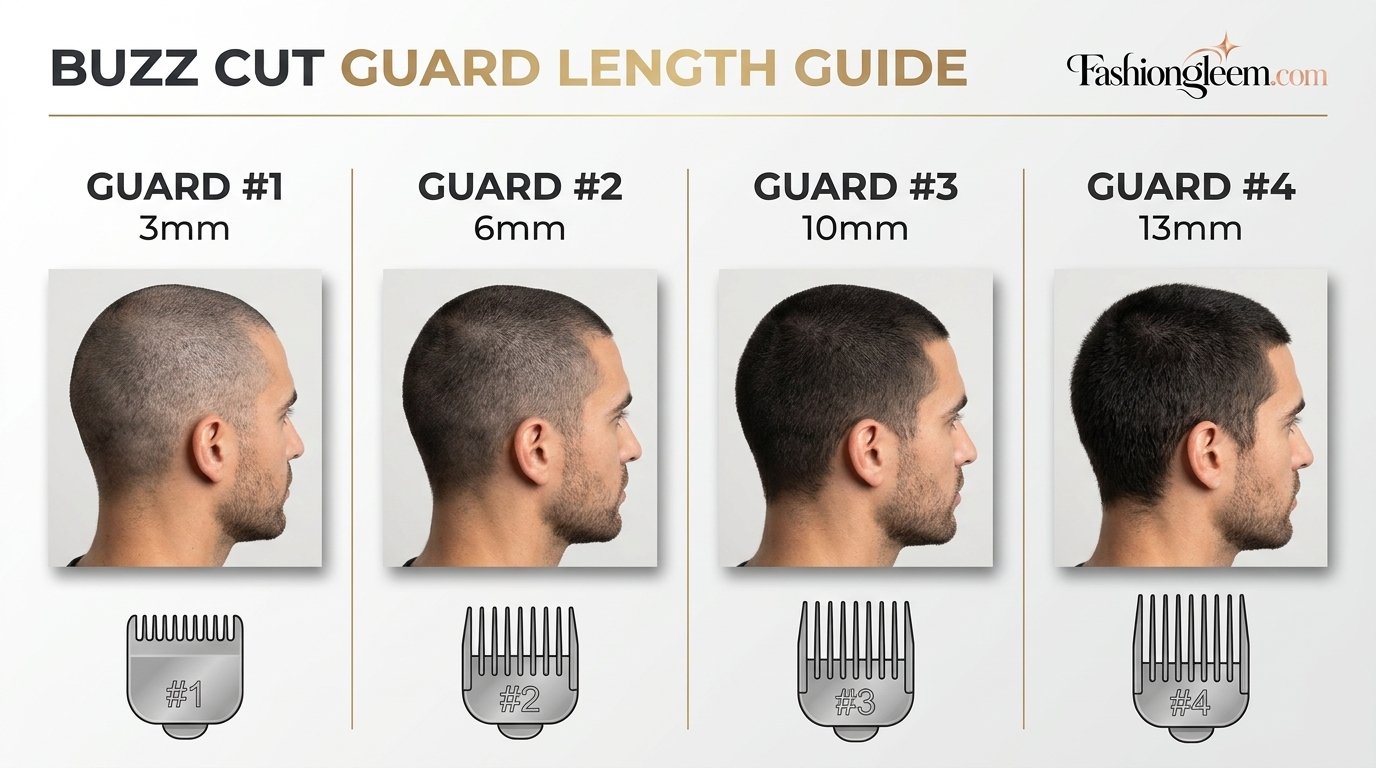
A buzz cut for men is a short hairstyle cut with electric clippers to a uniform length all over the head, or to a uniform top length with faded or tapered sides. A #1 leaves about 3 mm, a #2 about 6 mm, a #3 about 10 mm, and a #4 about 13 mm.

First-timers should start with a #3 or #4 with a low taper. That combination looks clean, office-safe, and easy to maintain, without the shock of a near-shaved head. Thinning or receding hair suits a #1–#2, because short, even hair reduces contrast between thicker and thinner areas.
Key Points
- Definition: One clipper guard over the whole head, or one top guard plus a fade.
- First-timer rule: Start #3–#4, live with it a week, then go shorter if you love it.
- Thinning rule: #1–#2 makes density look even, but it does not hide recession completely.
- Heavy recession rule: Zero or razor shave plus stubble suits patchy spots better than a #1.
- Maintenance rule: Trim every 2–4 weeks, wash 2–3 times per week, and use daily scalp SPF.
- DIY rule: Start longer, step down one guard, and never cut an impulse #1 at home.
- Barber rule: Say the guard, top versus all over, fade height, and hairline in one sentence.
LRV Note: Guard Numbers Are Not Universal
Guard numbers vary slightly by brand, usually by about 0.5 mm, and the millimetre figure is stamped on the guard itself. Two brands’ “#4” can look a hair different, which is why you should stick with the same brand once you like a look. Always say whether the number is for the top or for all over, because that distinction changes the result completely.
Buzz Cut Guard Chart: What Each Number Leaves Behind
Guard numbers are the language of clipper work. Once you know the lengths, you stop guessing and start planning, and you can ask a barber for exactly what you want. Grade, level, number, and guard are four names for the same thing, so a “level 3” and a “grade 3” are the same cut.
Guard Table
| Guard | Leaves roughly | In inches | What it looks like |
| No guard | Under 1 mm | — | Shadow, scalp with a tint over it |
| #0.5 | 1.5 mm | 1/16 | Three days of growth, still mostly skin |
| #1 | 3 mm | 1/8 | A week of growth, colour without much texture |
| #1.5 | 4.5 mm | 3/16 | Short, but scalp has stopped showing through |
| #2 | 6 mm | 1/4 | The standard buzz, velvet, holds its own colour |
| #3 | 9.5–10 mm | 3/8 | You can feel it move under your palm |
| #4 | 13 mm | 1/2 | Short but soft, the first grade with any weight |
| #5 | 16 mm | 5/8 | Long enough to sit a parting into if pushed |
| #6 | 19 mm | 3/4 | Not really a buzz any more |
| #8 | 25 mm | 1 | Longest standard guard, tidy top, usually paired with scissors |
The jump that matters most is not between the numbers at the top, but between no guard and a grade one. That is the step where your hair stops being hair and becomes scalp colour, which is why a #0 suits advanced thinning or military precision, not first-timers.
Above a #5, a cut stops behaving like a buzz and starts wanting to be combed. A #5–#6 top with faded sides is a short crop or crew cut, not a buzz, and it needs comb blending or scissors for a professional result. Keep that boundary in mind when you ask for a “long buzz,” because a barber will hear “short crop” instead.
Half Guards and Taper Lever: How to Blend Without Lines
Half guards like #0.5 and #1.5 are blending heroes, great for melting hard lines between steps. If you see a visible step between #1 and #2, pop on a #1.5 with the lever open and feather just on the line with short, flick-out strokes. That technique saves time and keeps blends velvety, without a harsh line.
Your clipper’s taper lever fine-tunes length without changing guards, with lever open slightly longer and lever closed slightly shorter. Lever open adds about 0.5–1 mm depending on the model, while lever closed removes about the same amount. Use the lever to blend lines between guards or to soften heavy spots around the ridge of the head.
Beginner fades use a simple ladder: bottom #1, mid #2, near top #3, then blend with #1.5. That ladder gives a smooth transition from skin to top length, without a hard step at any point. Do not jump from #1 to #3 without a #1.5 or #2 step, because that jump creates the line most DIY fades suffer from.
Buzz Cut vs Crew Cut vs Caesar Cut vs Shaved Head
A buzz cut is not a crew cut, a Caesar, or a shaved head, and confusing them leads to the wrong barber request. A crew cut keeps a longer, combed top, a Caesar adds a straight fringe across the forehead, and a shaved head leaves no hair at all. A buzz is one guard over the whole head, or one top guard plus a fade.
Comparison Table
| Cut | Top length | Sides | Fringe | Best for |
| Buzz cut | One guard, #0–#4 | Same guard, or fade/taper | None, natural hairline | Low maintenance, thinning, hot weather |
| Crew cut | Longer, combed, #5–#8 | Shorter, #2–#4 | None, combed forward or side | Conservative, office, transition from longer hair |
| Caesar cut | Short, forward fringe | Faded, often skin fade | Straight fringe across forehead | Tall forehead, temple recession with hair behind it |
| Shaved head | No hair, razor | No hair, razor | None | Heavy recession, patchy spots, bold statement |
| High and tight | Slightly longer top | Very short, high fade | None | Military, defined, sharp look |
A Caesar fringe earns its place when your forehead is tall or your temples have started to go back a little. The eye sees a straight line instead of the corners of your hairline, which softens recession visually. A buzz does the opposite: it shows everything, which looks clean on a strong, even hairline and very clear on a receding hairline.
There is a limit to what a Caesar can cover, because it can only cover what has enough hair behind it. Once the front is thin, a forward fringe looks see-through and draws attention to the exact spot you wanted to hide. At that point, a buzz usually looks better, because short, even hair reduces contrast between thicker and thinner areas.

20 Buzz Cut Styles for Men
Each style below follows the same format: guard, fade, best for, and what to avoid. Use the style name plus your guard, face shape, density, and hair type when you plan, not just the style name alone, because the same style needs a different guard on curly hair versus straight hair.
1. Classic Buzz Cut
A classic buzz cut is a uniform length all over the head, cut with one clipper guard from front to back. It is clean, simple, and always looks good, and it is the most common men’s haircut for first-timers. Choose a number from 1 to 4, with 1 being the shortest and 4 being the longest, and keep the natural hairline for a clean, intentional look.
Guard: #1–#4 all over. Fade: None, or low taper. Best for: First-timers, office, gym, hot weather. Avoid: An impulse #1 on your first buzz, because it cannot be fixed by a barber, only by time.
2. Induction Cut
An induction cut is the shortest buzz cut, often achieved with a zero or half guard, and it is the go-to for guys who want the most low-maintenance style possible. It is super close to the scalp, giving a very clean look, and it is also a great choice for hiding thinning in advanced cases. It shows every bump, cowlick, and scalp imperfection, so it is not recommended for first-timers.
Guard: #0 or #0.5. Fade: None, or skin fade base. Best for: Military, advanced thinning, bold statement. Avoid: First buzz, uneven head shape, or a strong cowlick you would rather hide.
3. Butch Cut
A butch cut is slightly longer than an induction cut, typically clipped to about 1/4 inch, and it provides a bit more length and texture. It is a classic short buzz that suits traditional buzz cut seekers and professional settings, with a velvet texture that holds its own colour. It is also the most popular starting point for men who want a traditional buzz without going ultra-short.
Guard: #2 all over. Fade: None, or low taper. Best for: Traditional buzz, office, dense hair. Avoid: Thin crowns where length covers the thin area, because a #2 removes that cover.
4. Burr Cut
A burr cut is similar to a classic buzz cut, but usually a bit longer, often cut using a number 2 or 3 guard. It provides a slightly softer look than an induction cut and is perfect if you want a bit more hair to work with. It suits men who want a soft buzz with good coverage, without moving into crew cut territory.
Guard: #2–#3 all over. Fade: None, or low taper. Best for: Softer buzz, first-timers, thick hair. Avoid: Very fine hair that shows scalp under bright light, because a burr still shows scalp at #2.
5. High and Tight
A high and tight has a military vibe, with very short sides and back and slightly longer hair on top. It features a high fade on the sides and back, with a slightly longer top, and it is a popular choice for guys who want a clean and sharp look. It suits square faces and strong jaws, because the high fade emphasises facial structure.
Guard: Top #2–#3, sides #0–#1. Fade: High fade. Best for: Military, square faces, defined look. Avoid: Long faces, because a high fade stretches the face even longer.
6. Buzz Cut Low Fade
A buzz cut low fade combines a traditional short buzz with a smooth low fade that creates a fresh look around the sides and back. The fade starts low, just above the ears, and blends gradually into the top length, which makes it office-safe and easy to maintain. It works well for different face shapes and hair types, because the low fade adds definition without drama.
Guard: Top #2–#4, sides #1–#2 low fade. Fade: Low fade. Best for: First-timers, office, round faces. Avoid: Very high contrast if you want a subtle look, because a low fade is meant to be subtle.
7. Buzz Cut Mid Fade
A buzz cut mid fade combines a clean buzz with a stylish fade around the middle section of the sides, giving a sharp and balanced appearance. It creates a smooth transition from skin to top length, with the fade starting at the middle of the sides, which suits men who want a simple yet fashionable look. It is the most versatile fade, because it balances definition and subtlety.
Guard: Top #2–#4, sides #1–#3 mid fade. Fade: Mid fade. Best for: Round faces, modern look, balanced contrast. Avoid: Long faces if the fade is too high, because a mid fade can still lengthen the face.
8. Buzz Cut High Fade

A buzz cut high fade features a high fade on the sides and back, with a slightly longer top, for a bold, defined look. It starts high on the sides, near the top of the head, and creates strong contrast between skin and top length. It suits men who want a sharp, modern edge, and it pairs well with a beard for balance.
Guard: Top #1–#3, sides #0–#1 high fade. Fade: High fade. Best for: Square faces, bold look, beard pairing. Avoid: Long faces and first-timers, because a high fade is the hardest fade to grow out gracefully.
9. Buzz Cut Skin Fade / Bald Fade
A buzz cut skin fade fades the sides and back down to skin, creating the sharpest contrast and the most modern edge. It is also called a bald fade, because the lowest part is shaved to skin, with a gradual blend up to the top length. It needs the most frequent touch-ups, because skin fade grows out visibly within a week.
Guard: Top #1–#3, sides skin to #1. Fade: Skin fade. Best for: Bold look, square faces, beard pairing. Avoid: First-timers who cannot trim weekly, because a skin fade loses its sharpness fast.
10. Buzz Cut Taper Fade
A buzz cut taper fade gradually tapers the hair from the top down to the sides and back, creating a more blended look than a traditional buzz. It is softer than a skin fade, because the taper never goes to skin, and it suits office and professional settings. A taper also suits men who want definition without a hard fade line.
Guard: Top #3–#4, sides #2–#3 taper. Fade: Taper fade. Best for: Office, first-timers, conservative look. Avoid: Men who want maximum contrast, because a taper is intentionally subtle.
11. Buzz Cut Burst Fade
A burst fade combines a buzz cut with a burst fade, where the hair is tapered down to the skin around the ears and back of the head in a circular burst shape. It adds a modern twist to a classic buzz, with a burst effect that follows the ear curve rather than a straight fade line. It suits men who want a trendy, Instagram-ready fade without a full high fade.
Guard: Top #2–#4, sides burst fade around ears. Fade: Burst fade. Best for: Trendy look, round faces, beard pairing. Avoid: Office settings if your workplace prefers subtle fades, because a burst fade is visually bold.
12. Buzz Cut Drop Fade
A buzz cut drop fade drops the fade line lower at the back of the head, following the natural curve of the skull, for a clean, rounded finish. It suits men who want a fade that looks natural from behind, without a straight line across the back. A drop fade also pairs well with a bleached top, because the drop line frames the colour.
Guard: Top #3–#4, sides drop fade. Fade: Drop fade. Best for: Trendy look, bleached buzz, rounded head shape. Avoid: First-timers doing DIY, because a drop fade is hard to cut evenly at the back without a mirror.
13. Textured Buzz Cut
A textured buzz cut keeps a little length on top with a shorter fade on the sides, so texture shows where people look. It suits curly and thick hair best, because texture is visible at #3–#4, while a #0–#1 loses texture completely. Use lightweight products to add volume or texture as hair grows longer, especially for a textured buzz that is growing out.
Guard: Top #3–#4, sides #1–#2. Fade: Low or mid fade. Best for: Curly hair, thick hair, textured look. Avoid: Very fine hair, because texture needs density to show.
14. Disconnected Buzz Cut
A disconnected buzz cut features a sharp line between very short sides and a longer top, with no blend between them. It is a bold, modern variation that suits men who want a clear contrast, not a gradual fade. It needs a barber to cut the line cleanly, because a DIY disconnected line is easy to get crooked.
Guard: Top #3–#5, sides #0–#1, sharp line. Fade: None, disconnected line. Best for: Bold look, thick hair, modern style. Avoid: Office settings and first-timers, because a disconnected line is intentionally dramatic.
15. Bleached Buzz Cut
A bleached buzz cut combines a short military-inspired haircut with a bold colour transformation, for a clean, sharp, and fashionable look. It gives people a strong personal style with very little styling time, because the colour does the work. Bleached #3–#4 with a drop or burst fade is a current trend, with high-contrast fades and clean lines.
Guard: #3–#4 bleached, sides drop or burst fade. Fade: Drop or burst fade. Best for: Bold look, fashion-forward men, celebrities. Avoid: Damaged hair or sensitive scalps, because bleach on very short hair still needs care and a patch test.
16. Buzz Cut with Line Up / Edge Up
A buzz cut with line up adds a sharp, clean hairline and edge around the forehead, temples, and neckline, for a crisp, polished finish. It is also called an edge up or shape up, and it suits men who want a defined outline rather than a natural hairline. A line up needs frequent touch-ups, because a sharp line grows out visibly within days.
Guard: #1–#4 top, line up with trimmer. Fade: Any fade, plus line up. Best for: Sharp look, dark hair, defined hairline. Avoid: Receding hairlines pushed back, because a line up should follow the natural hairline, not push it back.
17. Buzz Cut with Beard
A buzz cut with beard pairs short hair with facial hair for a balanced, masculine look tailored to different face shapes. Light stubble or a neatly trimmed beard can emphasise a square jawline, while keeping some beard length helps round faces improve proportion. A buzz with a beard also balances a shaved or very short top, because the beard adds visual weight below the face.
Guard: Top #1–#4, beard stubble to short beard. Fade: Any fade. Best for: Square faces, round faces, masculine look. Avoid: Untrimmed beards with ultra-short buzz, because the contrast can look unbalanced without beard shaping.
18. Curly Buzz Cut
A curly buzz cut keeps curl visible at #2–#4, with a low taper on the sides and a longer top where people look. Most men with curls are happiest in the #2–#4 range, because below that the curl disappears completely, and above a #4 you are moving into a short curly crop. Cut dry, not wet, because wet curls shrink and look shorter when dry.
Guard: Top #3–#4, sides #1–#2 taper. Fade: Low taper. Best for: Curly hair, coily hair, textured look. Avoid: #0–#1 if you want curl to show, because those guards remove curl completely and raise bump risk.
19. Buzz Cut for Thinning Hair
A buzz cut for thinning hair reduces contrast between thicker and thinner areas, making hair loss far less noticeable. It helps when longer hair exaggerates the problem, because extra length adds bulk where hair is still dense and makes a thin crown look worse by comparison. It backfires when length covers a thin crown, because at 6 mm there is almost nothing left to fall across it.
Guard: #1–#2 for moderate thinning, #0 for advanced thinning. Fade: Low or mid fade. Best for: Thinning crown, receding temples, even density. Avoid: Assuming shorter always hides thinning, because sometimes it puts more scalp on display.
20. Buzz Cut for Receding Hairline
A buzz cut for receding hairline is one of the best haircuts for recession, because it shortens everything to a near-uniform length so thinning spots blend in. The best lengths are a #1 or #2 guard for moderate recession and a #0 induction for more advanced thinning, with optional faded sides for a cleaner look. A buzz does not stop hair loss, but it makes the visual impact much less dramatic.
Guard: #1–#2 moderate recession, #0 advanced thinning. Fade: Low or mid fade. Best for: Receding temples, uneven density, strong jaw. Avoid: Hoping a buzz will hide recession completely, because a buzz shows hairline shape clearly.
Buzz Cut by Face Shape, Head Shape, and Density
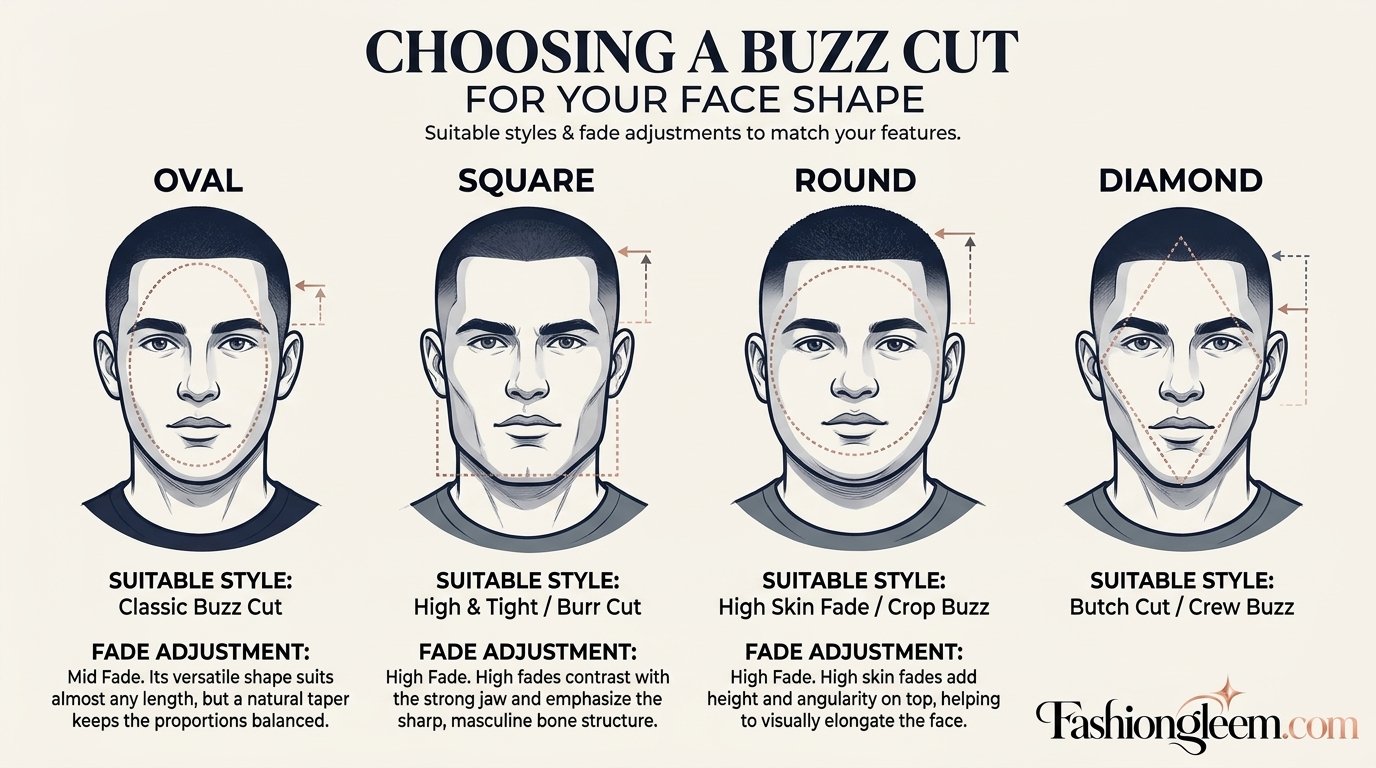
Face shape matters with a buzz, because neither a buzz nor a Caesar leaves much hair to balance anything. A few simple rules help, but head shape and density matter more at very short lengths. At 6 mm, head shape and density change the result far more than face shape, so check those first.
Face Shape Table
| Face shape | Best buzz | Why it works | Avoid |
| Oval | Classic buzz, #2–#4 | Balanced proportions suit almost every length | None, choose by routine and forehead |
| Round | High or mid fade, #1–#3 top | Fade slims sides, adds definition, makes face appear longer | Single even length all over, which follows roundness |
| Square | Military buzz, low to mid taper, #2–#4 | Strong jaw balances short hair, looks intentional | None, square faces carry buzz exceptionally well |
| Long | Crew or butch with longer sides, #3–#4 | Longer sides add visual width, interrupt vertical line | Induction cuts, very high fades, which stretch face longer |
| Diamond | Low fade, #3–#5 top | Volume up top balances narrow forehead and chin | Very short uniform buzz, which emphasises cheekbones |
| Heart | Textured buzz, longer top | Length on top balances wider forehead, narrower chin | Very short sides with no top length, which emphasises forehead |
| Triangle | Mid taper, #3–#5 top | Extra volume at crown balances heavier jawline | Very short uniform buzz, which makes jaw dominant by default |
Head Shape and Density Table
| Factor | What to check | Best guard | Why |
| Flat spot at back | Feel back of head, ask barber | #3–#4 top | Slightly more length disguises flat spots better than ultra-short |
| Cowlick | Check crown and front hairline | #3–#4 top | More length gives barber more to work with than #0–#1 |
| Bumps | Feel scalp, especially curly hair | #2–#4, avoid #0–#1 | Ultra-short shows every bump, higher bump risk on curly hair |
| Uneven hairline | Check temples and forehead | #3–#4, natural hairline | Natural hairline looks intentional, pushed-back line looks artificial |
| Dense hair | Thick, full coverage | #2–#4, textured buzz | Dense hair holds texture and colour at longer guards |
| Fine hair | Shows scalp under bright light | #2–#3, avoid #0–#1 | Fine hair looks flatter longer, but ultra-short shows more scalp |
| Sparse / patchy hair | Thin crown, sparse patches | #0–#1, or zero/razor + stubble | Short, even hair reduces contrast, but check crown photo first |
| Thick curly hair | Tight coils, dense curls | #3–#4 top, taper sides | Curl shows at #3–#4, disappears below #2 |
To check whether a buzz will help thinning, look at your hair dry and unstyled, and take a phone photo of your crown under overhead light. If length mostly exaggerates thin areas, a #2 can make sense, because it shrinks the difference between dense and thin areas. If length covers thin areas, hold off, because a #2 removes that cover and shows more scalp.
How to Get a Buzz Cut at Home: Step-by-Step DIY Guide
DIY buzz cuts look simple, but they expose inconsistency fast, so guard control matters more than speed. Start longer, work in small sections, and use a mirror for the back, because the back is where most DIY buzz cuts go uneven. Clean and oil your clippers before you start, because a dirty blade pulls hair and creates lines.
Numbered Steps
- Prepare clippers and guard. Clean and oil clippers, attach the longer guard first, and test on a small section before committing to the whole head.
- Start with a longer guard. Start with a #4 for a safe length, then drop to #3 or #2 if you want closer, because you can always go shorter but cannot put hair back.
- Cut against the grain. Move clippers against the grain in small sections, with overlapping passes, to get a clean, even cut without missed patches.
- Work front to back, top to sides. Cut the top first, then sides, then back, with a hand mirror for the back, so you can see lines before they become permanent.
- Blend edges with half guards. Use a #1.5 half guard with the lever open and feather just on the line with short, flick-out strokes to melt hard lines between steps.
- Tidy the neckline last. Clean up the neckline and around ears with a trimmer, following the natural neckline, not pushing it up unnaturally high.
- Check under bright light. Check the cut under bright, overhead light from front, sides, and back, and fix missed patches with the same guard, not a shorter one.
- Clean up and moisturise. Brush off loose hair, wash the scalp, moisturise, and apply scalp SPF if you will be outside, because short hair gives less sun protection.
For a beginner fade at home, use a simple ladder: bottom #1, mid #2, near top #3, then blend with #1.5. That ladder is the easiest fade to learn, because each step is only one guard apart. Do not attempt a skin fade at home on your first buzz, because a skin fade needs a steady hand and a mirror system most beginners do not have.
What to Say to Your Barber: Buzz Cut Scripts by Style
A barber script prevents the most common buzz cut regret: asking for “a buzz cut” without a guard number. Barbers talk in guard numbers, so learn five numbers and you can ask for exactly what you want. Always say whether the number is for the top or for all over, because that distinction changes the cut completely.
Barber Script Table
| Style you want | Say this to your barber |
| First buzz, safe start | “#4 all over with a low taper at the sides and neck. Keep my natural hairline. I might go shorter next time.” |
| Classic buzz, traditional | “#2 all over, natural hairline, tidy neckline.” |
| Buzz low fade | “#3 on top, low fade on the sides and back, natural hairline.” |
| Buzz mid fade | “#3 on top, mid fade on the sides and back, natural hairline.” |
| Buzz skin fade | “#2 on top, skin fade on the sides and back, sharp neckline.” |
| Curly buzz, keep curl | “#3 on top, cut dry, with a low taper on the sides. Keep some curl showing, not a smooth shadow.” |
| Thinning hair buzz | “#1 or #2 all over, low fade, natural hairline. I want even density, not a pushed-back line.” |
| High and tight | “High and tight: very short sides and back, slightly longer on top, high fade.” |
| Buzz with beard | “#2 buzz with a low fade, and shape my beard to match — short, neat, and balanced with my jaw.” |
Keep your natural hairline in every script, unless you specifically want a line up. A pushed-back hairline looks artificial and grows out badly, while a natural hairline looks intentional and grows out gracefully. Mention cowlicks, flat spots, and bumps to your barber before committing to guard #0 or #1, because slightly more length on top can disguise those far better than an ultra-short cut.
Buzz Cut Maintenance: Trim Schedule, Wash, Scalp Care, Sun Protection
Proper maintenance includes regular trims with the appropriate clipper guard, moisturising the scalp, exfoliation to prevent ingrown hairs, and sun protection to keep the scalp healthy. A buzz cut is low maintenance, not no maintenance, because short hair shows growth faster than long hair. Trimming every 2–4 weeks keeps the look fresh and sharp, while washing 2–3 times per week keeps the scalp clean without drying it out.
Maintenance Schedule Table
| Guard | Trim interval | Wash | Scalp care | Sun protection |
| #0–#1 | Every 1–2 weeks | 2–3 times per week | Moisturise daily, exfoliate weekly | Daily SPF, essential |
| #2 | Every 2–3 weeks | 2–3 times per week | Moisturise, exfoliate weekly | Daily SPF |
| #3–#4 | Every 3–4 weeks | 2–3 times per week | Moisturise, exfoliate as needed | Daily SPF if outside |
| Buzz + fade | Every 2–3 weeks | 2–3 times per week | Moisturise, exfoliate weekly | Daily SPF |
| Buzz + beard | Hair every 2–4 weeks, beard weekly | 2–3 times per week | Moisturise scalp and beard | Daily SPF |
Styling a buzz cut can be enhanced with lightweight products to add volume or texture, especially as hair grows longer or for styles like a disconnected buzz. Use a tiny amount of matte paste or cream on a #3–#4 top for texture, but avoid heavy waxes on a #1–#2 buzz, because there is not enough hair to hold product. For a bleached buzz, use colour-safe shampoo and moisturising conditioner, because bleach dries short hair just as it dries long hair.
How to Grow Out a Buzz Cut Without an Awkward Stage
Growing out a buzz cut feels awkward because the top and sides grow at the same rate, but the shape changes as length increases. The solution is barber tidy-ups, not waiting it out untouched, because a tidy-up on the sides and neckline keeps the shape intentional while the top grows. Let the top grow to a #4–#6, get sides tidied every 3–4 weeks, and bridge to a crew cut or short crop.
Grow-Out Stages
| Stage | Length | Barber tidy-up | Next style |
| Week 1–2 | #1–#2 growing to #2–#3 | None, let it grow | Still a buzz, just softer |
| Week 3–4 | #3 growing to #4 | Tidy sides and neckline only | Fuller buzz, close to crew cut |
| Week 5–8 | #4 growing to #5–#6 | Tidy sides, shape top with scissors | Crew cut bridge |
| Week 9–12 | #6 and longer | Shape top, blend sides with comb | Short crop, textured crop, or longer style |
Do not promise yourself a fixed grow-out date, because hair growth varies by person and by season. A #1 to #4 transition is faster than a #1 to a medium crop, because each guard step is only a few millimetres, but the awkward stage is normal, not a mistake. Ask your barber for a tidy-up schedule, not a fixed date, and keep the neckline clean between visits.
Mistakes to Avoid with a Buzz Cut
Mistake 1: Impulse #1 on Your First Buzz
The cut people most often regret is an impulse #1, because it cannot be fixed by a barber, only by time. A #1 shows every bump, cowlick, and thin patch, and it takes weeks to grow back to a #3. Fix it by starting with a #3 or #4, living with it for a week, and then going shorter if you love it.
Mistake 2: Jumping Guards Without a Blend Step
Jumping from #1 to #3 without a #1.5 or #2 step creates a visible line that looks like a mistake, not a fade. Fix it with half guards and flick-out strokes on the line, and always blend with a guard one step between your two main guards. That rule applies to DIY and barber fades alike, because a fade is a ladder, not a jump.
Mistake 3: Pushing Back the Hairline
Pushing back the hairline with a line up or a high fade makes recession look worse, not better, because it creates an artificial line that grows out badly. Fix it by keeping your natural hairline in every barber script, and asking for a line up only if your natural hairline is strong and even. A natural hairline looks intentional, while a pushed-back line looks like a cover-up.
Mistake 4: Ignoring Head Shape and Density
Ignoring head shape and density leads to a buzz that looks uneven, because a buzz exposes head shape in a way longer styles never do. Flat spots, cowlicks, and bumps all show more at #0–#1, so tell your barber about them before committing to ultra-short. Fix it with slightly more length on top, a #3–#4 top with a taper, which disguises flat spots and cowlicks far better than a #0.
Mistake 5: No Scalp Sun Protection
Short hair provides less protection from ultraviolet exposure, so a buzz cut scalp sunburns faster than a longer hairstyle. Fix it with daily SPF on the scalp, especially for #0–#2 buzz cuts, and reapply per label if you are outside for long periods. This is general grooming advice, not medical advice, but it is the most overlooked buzz cut maintenance step.
Mistake 6: Assuming Shorter Always Hides Thinning
Assuming shorter always hides thinning backfires when length covers a thin crown, because at 6 mm there is almost nothing left to fall across it. Fix it with a crown photo check: look at your hair dry and unstyled under overhead light, and decide whether length exaggerates thin areas or covers them. If length covers them, hold off on a #2 and talk to your barber about a #3–#4 with a taper instead.
Shopping List for a Buzz Cut
Use this list as a starting point, not a fixed cart. Verify price and availability before buying, because clipper models and guard sets change, and shop links in competitors are not editorial picks without disclosure. Choose clippers by motor, blade, corded versus cordless, and guard set, not by marketing alone.
Shopping List Table
| Item | Budget pick | Pro pick | Notes |
| Clippers | Cordless clippers with guard set | Pro-grade clippers, magnetic motor | Verify model on manufacturer site |
| Guard set | Standard plastic guards, #0–#8 | Premium magnetic guards, half guards included | Half guards are essential for fades |
| Trimmer | Detail trimmer for line up | Pro trimmer for line up and neckline | Use for line up, not for full buzz |
| Hand mirror | Basic hand mirror | Large hand mirror with handle | Essential for DIY back check |
| Clipper oil | Standard blade oil | Pro blade oil, cleaning brush included | Clean and oil before every cut |
| Scalp moisturiser | Basic scalp moisturiser | Fragrance-free scalp moisturiser | Moisturise daily for short buzz |
| Scalp SPF | Daily SPF, scalp-safe | Daily SPF, non-greasy, scalp-safe | Essential for #0–#2 buzz |
| Shampoo | Gentle shampoo, 2–3 times per week | Colour-safe shampoo for bleached buzz | Do not overwash, which dries scalp |
Expert Tips for Buzz Cut for Men
- Start longer, step down one guard. Start with a #4, then drop to #3 or #2 if you want closer, because you can always go shorter.
- Start #3–#4 for your first buzz. A #3–#4 gives soft, fuller coverage without the shock of a near-shaved head.
- Say the guard, top versus all over, fade, and hairline. A barber script prevents the most common buzz regret: asking for “a buzz” without a number.
- Use half guards for fades. Half guards like #1.5 melt hard lines between steps with flick-out strokes.
- Check your crown photo before a #2 for thinning. Dry hair under overhead light reveals whether length exaggerates or covers thin areas.
- Tell your barber about cowlicks and flat spots. Slightly more length on top disguises flat spots and cowlicks better than ultra-short.
- Trim every 2–4 weeks by guard. #0–#1 needs 1–2 weeks, #2 needs 2–3 weeks, and #3–#4 needs 3–4 weeks.
- Use daily scalp SPF for short buzz cuts. Short hair gives less sun protection, so SPF is essential for #0–#2 buzz cuts.
- Cut curly hair dry, not wet. Wet curls shrink when dry, so a dry cut gives a truer length for curly buzz cuts.
- Keep your natural hairline. A natural hairline looks intentional and grows out gracefully, while a pushed-back line looks artificial.
FAQs
What is a buzz cut for men?
A buzz cut for men is a short hairstyle cut with electric clippers to a uniform length all over the head. It can also use one top guard plus faded or tapered sides and back, and it is defined by the clipper guard number, not by styling.
What guard should I get for a buzz cut?
First-timers should start with a #3 or #4, not an impulse #1. A #3 gives soft coverage at about 10 mm, while a #4 gives fuller coverage at about 13 mm, and you can go shorter next time if you love it.
What does a number 2 buzz cut look like?
A number 2 buzz cut is a classic short buzz at about 6 mm, with a velvet texture that holds its own colour. It suits traditional buzz seekers and professional settings, and it is the most popular starting point for a traditional buzz.
What does a number 3 buzz cut look like?
A number 3 buzz cut is a soft buzz with good coverage at about 10 mm, where you can feel it move under your palm. It is the best first-timer buzz, because it still looks like hair and gives a softer appearance than a #1 or #2.
How do I do a buzz cut at home?
Clean and oil clippers, attach a longer guard first, cut against the grain in small sections, blend edges with half guards, use a hand mirror for the back, and tidy the neckline last. Start longer, because you can always go shorter but cannot put hair back.
How often should I trim a buzz cut?
Trim every 2–4 weeks to keep the look fresh and sharp, with #0–#1 needing touch-ups every 1–2 weeks and #3–#4 lasting closer to 3–4 weeks. Wash 2–3 times per week, moisturise, and use scalp sun protection daily for short styles.
Does a buzz cut suit a round face?
Yes, with a mid or high fade and a shorter top (#1–#3) to slim the sides and add definition. A very short buzz with a subtle fade can make a round face appear longer and leaner, especially with some beard length for proportion.
Does a buzz cut suit an oval face?
Yes, oval faces have the most flexibility and suit almost every buzz length, from #0 induction to #3 guard. Choose by routine and by how much forehead you want to show, not by face shape alone.
Does a buzz cut hide a receding hairline?
It does not hide recession, but it makes it less noticeable by reducing contrast between thinning areas and the rest of the scalp. A #1 or #2 guard suits moderate recession, while a #0 induction suits more advanced thinning, with optional faded sides for a cleaner look.
Does a buzz cut help thinning hair?
It helps when longer hair exaggerates the problem, because extra length adds bulk where hair is still dense and makes a thin crown look worse by comparison. It backfires when length covers a thin crown, so check dry hair and a crown photo under overhead light first.
Does a buzz cut work for curly hair?
Yes, most men with curls are happiest in the #2–#4 range, with a #3 or #4 on top and a low taper on the sides. Below #2, curl disappears completely, and above #4 you are moving into a short curly crop, so cut dry to keep curl showing.
Should I get a fade with a buzz cut?
A fade adds contrast and a modern edge to a classic buzz, with low fade for a subtle office-safe look, mid fade for a balanced sharp look, and high fade for a bold defined look. Skin fade gives the sharpest contrast but needs the most frequent touch-ups.
What is the difference between a buzz cut and a crew cut?
A buzz cut is one guard over the whole head (or one top guard plus a fade), while a crew cut keeps a longer, combed top with shorter sides. A #4 buzz is close to a crew cut, but a crew cut top is usually #5–#8 and combed, not buzzed.
What is the difference between a buzz cut and a Caesar cut?
A buzz cut shows everything, including hairline shape, while a Caesar adds a straight fringe across the forehead that covers a tall forehead or temple recession. A Caesar only covers what has enough hair behind it, so once the front is thin, a buzz usually looks better.
How do I ask my barber for a buzz cut?
Say the guard, whether it is for the top or all over, the fade height, and the hairline in one sentence. For example: “#4 all over with a low taper at the sides and neck. Keep my natural hairline. I might go shorter next time.”
How do I grow out a buzz cut?
Let it grow to a #4–#6, get barber tidy-ups on the sides and neckline every 3–4 weeks, and bridge to a crew cut or short crop. Do not expect a fixed date, because hair growth varies, and the awkward stage is normal, not a mistake.
Can I get a buzz cut with a beard?
Yes, a buzz cut pairs well with various beard styles, creating a balanced and masculine look tailored to face shape. Light stubble emphasises a square jawline, while some beard length helps round faces improve proportion.
Does a buzz cut need sunscreen on the scalp?
Yes, shorter hair provides less protection from ultraviolet exposure, so daily SPF on the scalp is recommended for short styles. This is general grooming advice, not medical advice, and you should use a scalp-safe sunscreen and reapply per label.
What clippers are best for a buzz cut?
Competitors name Wahl, Andis, and Oster generically, but do not test specific models in this sample. Choose by motor, blade, corded versus cordless, and guard set, and verify a specific model on the manufacturer’s site before buying.
Is a buzz cut good for hot weather and gym?
Yes, a buzz cut is practical in hot weather and for athletic lifestyles, because it needs no styling, dries fast, and stays neat with minimal effort. Pair it with scalp sun protection and regular trims, because short hair shows growth faster than long hair.
Conclusion
Buzz cut for men works when the guard matches your face, head shape, density, and hair type, not just your style preference. A #3–#4 with a low taper suits most first-timers, a #1–#2 suits thinning and receding hair with even density, and a #2–#4 suits curly hair with texture to show. Those three rules prevent most buzz cut regrets, because they replace guessing with a guard decision.
Start longer, say your guard clearly, and keep your natural hairline in every barber script. Use half guards for fades, a mirror for the back, and a crown photo check for thinning, because those small steps prevent lines, uneven backs, and thin-crown surprises. Trim every 2–4 weeks, moisturise, exfoliate, and use daily scalp SPF, because a buzz is low maintenance, not no maintenance.
That plan is what turns a buzz cut for men from a risky impulse into a clean, confident, low-maintenance haircut you can keep, grow out, or go shorter with next time. Pick your guard, book a barber or cut at home with a longer guard first, and let the buzz do what it does best: stay sharp, stay simple, and stay out of your way every morning.





3 Comments