
Layered Haircuts for Men: Styles, Face Shapes, and Barber Guide
Layered haircuts for men are cuts where a barber cuts hair at different lengths to add shape, texture, movement, and volume. Layered haircuts for men work because one flat length often looks heavy, flat, or shapeless, especially as hair grows past the ears.
Layered haircuts for men suit almost every length, from a short textured crop to shoulder length flow. The result depends on length first, then layer type, then side treatment, then hair type and face shape.
Layered haircuts for men fail most often through vague requests, not bad hair. A request like “just add layers” leaves layer start, side length, fringe direction, and finish open to guesswork.
Short Answer: Layers Are a Technique, Not One Style
Quick answer: Layers describe how hair is cut, not a single named style. A layered quiff, layered flow, layered shag, layered wolf cut, and layered undercut all use layers differently.
| Question | Short answer |
| What are layers? | Hair cut at different lengths for shape and movement |
| Best for thick hair? | Longer blended layers that remove bulk |
| Best for fine hair? | Soft layers with a solid perimeter for lift |
| Best for curls? | Dry cut layers that prevent a pyramid shape |
| Trim frequency? | Short and fade layers 4 to 5 weeks, medium 6 to 8 weeks, long 8 to 10 weeks |
What layers do in one paragraph
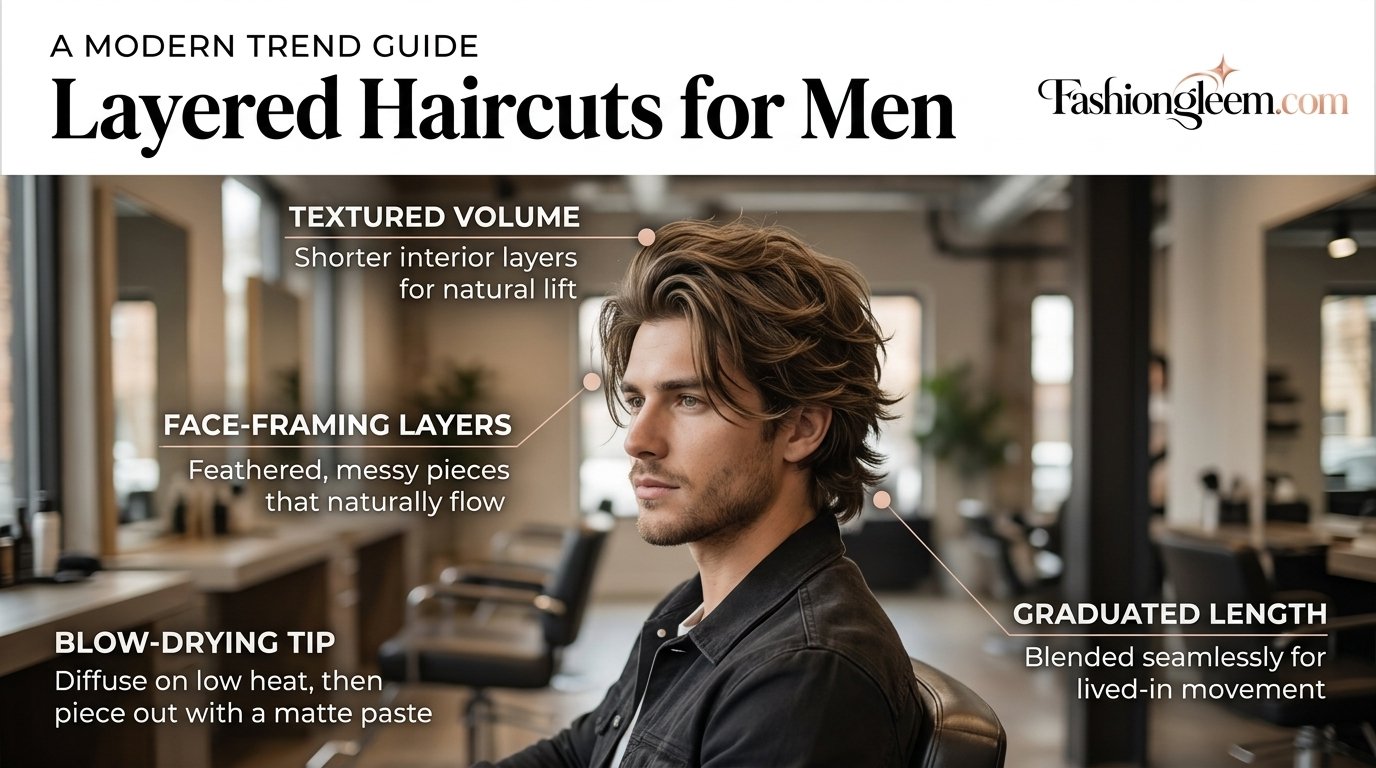
Layers remove weight where hair is heavy, create lift where hair is flat, and guide direction so hair falls into a shape. Blended layers create smooth movement, while choppy layers create visible texture and separation.

Layers also frame the face when shorter pieces sit near the cheekbones, jaw, or forehead. Face framing layers soften strong features, balance a long face, and stop long hair from hiding the face completely.
Layer type table: blended, choppy, graduated, feathered, internal
| Layer type | Look | Best for | Risk |
| Blended layers | Smooth, natural movement | Medium and long hair, office looks | Too subtle if cut too long |
| Choppy layers | Visible, piecey texture | Shag, wolf cut, messy styles | Can look uneven if overdone |
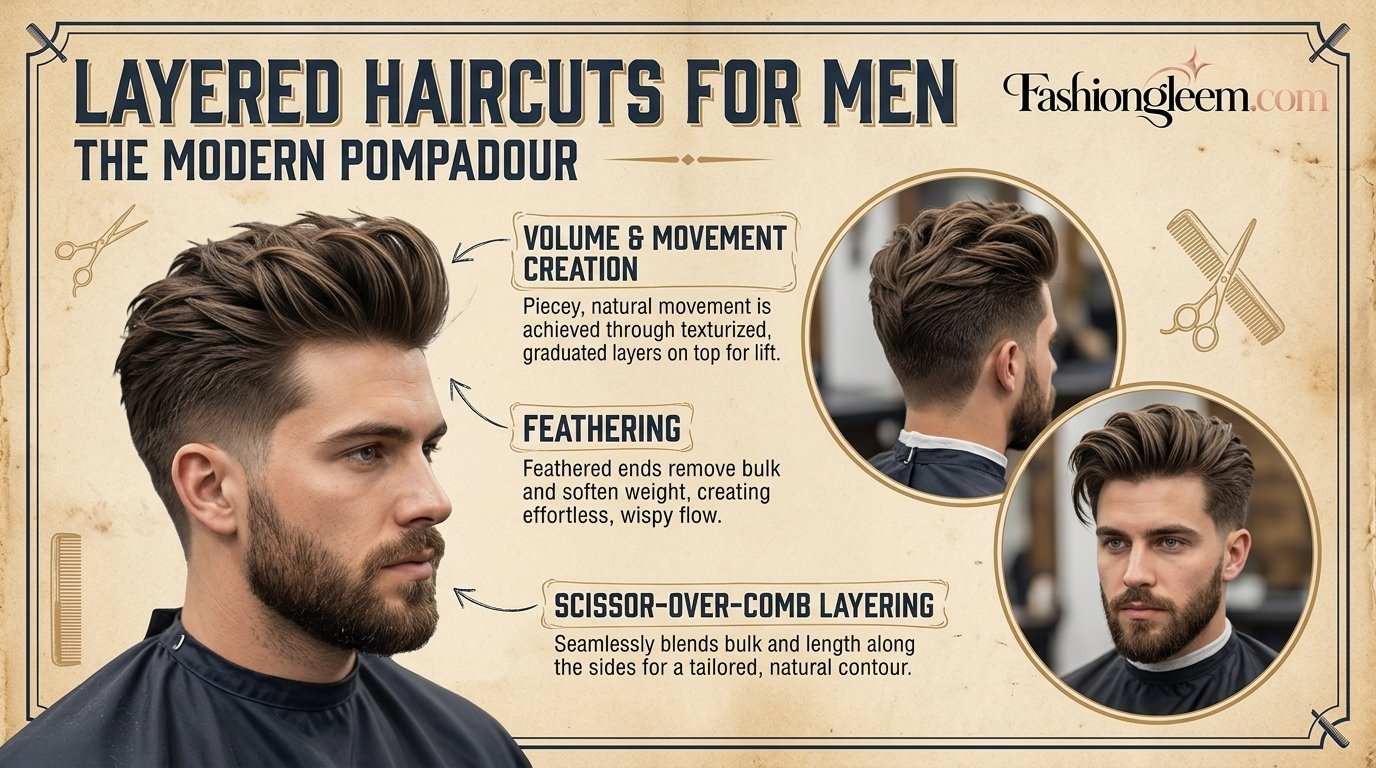
| Graduated layers | Weight builds in one area | Quiff, pompadour, crown volume | Can look heavy at the back |
| Feathered layers | Soft, wispy ends | Flow, curtains, side sweep | Can look thin on fine hair |
| Internal layers | Hidden lift under the top | Thick hair, long hair, sleek styles | Invisible benefit if not explained |
Blended layers suit men who want movement without an obvious layered look. They work best for side parts, slick backs, and long styles that need flow rather than texture.
Choppy layers suit men who want a messy, lived in, or edgy finish. They need point cutting, where scissors cut into hair at an angle, to create textured ends rather than blunt lines.
Graduated layers build weight and lift in a chosen area, usually the crown or front. They give a quiff its height and a pompadour its controlled bump, but they need blow drying to hold shape.
Feathered layers soften the perimeter and face framing pieces. They suit curtains and side swept styles, because wispy ends move naturally and do not create a hard line across the forehead.
Internal layers sit under the top layer and remove bulk without shortening the visible length. They suit thick and long hair, because they keep length while stopping the cut from looking like a heavy helmet.
Layered versus blunt, crop, shag, wolf, and mullet
| Style | How it differs from layered |
| Blunt cut | One length perimeter, no layer movement |
| Textured crop | Short top with forward fringe, layers only on top |
| Shag | Choppy layers all over, messy and lived in |
| Wolf cut | Shag plus mullet, heavy crown, longer back |
| Modern mullet | Short front and sides, longer back, layers soften the jump |
A blunt cut gives a clean, heavy edge and suits straight, fine hair that needs a solid shape. A layered cut gives movement and lightness, but it needs more frequent trims to keep the shape clear.
A textured crop uses layers on top only, with short faded or tapered sides. A full layered cut can use layers through the top, sides, and back, which suits medium and long hair better.
A shag uses choppy layers throughout, with shorter crown layers and longer face framing pieces. A wolf cut takes that idea further, with a heavier crown, more contrast, and a longer, wispier back.
A modern mullet keeps the short front and long back idea, but layers blend the transition so it does not look like two separate haircuts. Men who want a mullet should ask for blended layers, not just a longer back.
Choose by Length First: Short, Medium, and Long Layers
Length decides styling time, trim frequency, and which layer types work. Short layers need precision, medium layers need balance, and long layers need weight control.
Short layered cuts
Short layered cuts keep hair above the ears to about 2 inches on top. They suit men who want low maintenance, a clean outline, and a style that dries quickly.
Short layers work best as a textured crop, layered French crop, short quiff, layered Caesar, or short bro flow. Each keeps length on top for texture, while sides stay tapered or faded for a clean edge.
Short layers need trims every 4 to 5 weeks when paired with a fade, because fade grow out shows quickly. Without a fade, a short layered cut can last 5 to 6 weeks before the shape softens too much.
Medium layered cuts
Medium layered cuts fall from the ears to the shoulders, and they are the most versatile length for layers. They suit flow, curtains, side parts, quiffs, undercuts, and two block styles.
Medium layers need a clear layer start point, usually around the eyes, cheekbones, or jaw, depending on face shape. Layers that start too high can look thin, while layers that start too low can look heavy and flat.
Medium layers need trims every 6 to 8 weeks as a general rule, with fringe touch ups every 3 to 4 weeks if the fringe covers the eyes. That schedule comes from reconciling ForteSeries and Vagazine guidance, both of which give 4 to 6 weeks as a general rule, which is too frequent for longer medium layers.
Long layered cuts
Long layered cuts fall past the shoulders, and layers are essential, not optional, at that length. Without layers, long hair hangs heavy, hides the face, and forms a flat, triangular shape at the ends.
Long layers need longer, blended layers through the mid lengths and ends, with face framing layers near the front. Short, choppy layers through long hair can look disconnected and hard to grow out.
Long layers need trims every 8 to 10 weeks, with micro trims to remove split ends without losing length. That schedule is longer than the general 4 to 6 week guidance in competitor pages, because long layers hide grow out better than short fades.
Length decision table with styling time and trim frequency
| Length | Styling time estimate | Trim frequency | Best layer type |
| Short | 2 to 5 minutes | 4 to 5 weeks with fade | Choppy, textured |
| Medium | 5 to 10 minutes | 6 to 8 weeks | Blended, feathered |
| Long | 10 to 20 minutes | 8 to 10 weeks | Blended, internal |
Styling times are estimates for a practiced routine, not measured data. A first attempt at a new routine often takes twice as long, while a familiar routine with the right product takes less time.
Short Layered Haircuts for Men
Short layered styles prove that layers are not only for long hair. Short layers add depth, texture, and lift, even when hair is only a few inches long on top.

Textured crop with layers
A textured crop keeps sides short and faded or tapered, with a textured top cut in broken layers. The fringe falls forward, but point cutting stops it from looking like a solid, heavy line.
This style suits straight, wavy, and lightly curly hair with medium density. It suits oval, square, and round faces, because the forward fringe and short sides balance height and width.
Ask for a textured crop with point cut layers on top, a low or mid fade, and a soft, broken fringe. Show a front photo and a side photo, and point to the fringe length you want, because fringe length changes the whole look.
Style it by working matte clay or texture paste through damp hair, then pushing the fringe forward and slightly to one side. Use fingers, not a comb, to keep separation and avoid a flat, helmet like finish.
Layered French crop with fade
A layered French crop is similar to a textured crop, but the fringe is shorter and more defined. Layers on top add movement, while a low fade keeps the outline clean and masculine.
This style suits men who want low maintenance and a clean finish, including office workers and men with straight hair. It also suits men with a high forehead, because the fringe shortens the forehead visually.
Ask for a French crop with layered texture on top, a low fade, and a fringe that sits just above the eyebrows. Mention whether you want the fringe blunt or broken, because that choice changes the edge completely.
Style it with a pea sized amount of matte clay on towel dried hair, pushed forward and scrunched lightly. Avoid heavy pomade, which can make short layers look greasy and flat.
Short layered quiff
A short layered quiff keeps length at the front, styled up and back, with graduated layers for height. Sides stay tapered, so the quiff stands out without looking disconnected.
This style suits thick and wavy hair best, because natural volume helps the quiff hold. Fine hair can wear a short quiff, but it needs root lift, texture powder, and blow drying for height.
Ask for a short quiff with graduated layers at the front, tapered sides, and enough length to sweep up and back. Show how high you want the quiff, because height changes the side balance.
Style it by blow drying the front up and back with a vent brush, then finishing with matte clay for hold without shine. A light mist of flexible hairspray helps the quiff survive wind and humidity.
Layered Caesar with high fade
A layered Caesar keeps a short, forward fringe with layers on top for texture, paired with a high fade for contrast. The high fade draws attention to the top, so layers must be clean and intentional.
This style suits square and oval faces, and men who want a sharp, athletic look. It suits straight and wavy hair, but curly hair needs a longer top to show curl pattern.
Ask for a Caesar with layered texture on top, a high fade, and a short, even fringe. Confirm the fade height before cutting, because high fades grow out faster and show mistakes more clearly.
Style it with sea salt spray on damp hair, ruffled with fingers for a fresh, casual finish. A small amount of clay adds definition, but too much product can make short layers look stiff.
Short bro flow with beard
A short bro flow keeps hair slightly longer on top, brushed back with soft layers, paired with a beard for balance. Layers give flow without length, which suits men growing hair out from a short cut.
This style suits straight and wavy hair with medium density, and men who want a relaxed, masculine look without a full long style. A trimmed beard balances the flow and stops the face from looking too soft.
Ask for a short bro flow with soft, blended layers on top, tapered sides, and length brushed back. Mention beard length, because beard and hair together decide the overall silhouette.
Style it by applying light styling cream to damp hair, brushing back with fingers, and letting it dry naturally. A touch of sea salt spray adds texture, but heavy products kill the relaxed flow.
Medium Layered Haircuts for Men
Medium layers are the heart of this topic, because they offer the most styles, the most face shape options, and the most styling flexibility. Medium hair also shows layer mistakes most clearly, so consultation matters more here.

Layered flow
Layered flow is a medium length style where hair sweeps back and falls naturally around the ears and neck. Layers follow natural growth patterns, creating a relaxed, surfer inspired look with minimal styling.
This style suits wavy and straight hair with medium to thick density. It suits oval, square, and long faces, because flow adds width and movement without adding height.
Ask for a layered flow with blended layers through the mid lengths, face framing pieces, and natural sides. Show a side photo, because flow shape depends on how hair sits behind the ears.
Style it by applying sea salt spray to damp hair, blow drying back with fingers, and finishing with light cream for soft hold. Tucking hair behind the ears on one side can change the look from casual to polished.
Layered side part
A layered side part combines a classic part with soft layers for movement and lift. Sides stay tapered, while the top sweeps to one side with natural texture.
This style suits professional settings, formal events, and men with straight or wavy hair. It suits oval, square, and heart faces, because the side sweep balances the forehead and jaw.
Ask for a layered side part with subtle layers on top, tapered sides, and a clear part line. Mention part side and sweep direction, because hair grows in a natural direction and fighting it wastes styling time.
Style it by blow drying in the part direction with a round brush, then finishing with light pomade or cream for definition. A low shine finish looks modern, while high shine looks more formal.
Layered curtains
Layered curtains use a centre part with long fringe that splits to both sides like curtains. Layers through the front prevent heaviness and create flowing, face framing movement.
This style suits straight and wavy hair with medium length, and oval, round, and heart faces when layers start high enough. For round faces, layers should start higher and sides should stay slim, to avoid widening the cheeks.
Ask for medium length curtains with layered shaping around the face, light tapering at the sides, and textured ends. That wording comes from Pete and Pedro round face guidance, adapted for general use, and it prevents a heavy, flat curtain.
Style it by misting sea salt spray into damp hair, setting the centre part where it naturally sits, and blow drying back from the face with root lift. Hand shake the ends to keep curtains airy, not heavy.
Layered quiff
A layered quiff at medium length keeps longer layers on top styled up and back, with a gradual fade or taper on the sides. Layers remove bulk from the top while keeping enough length for height.
This style suits thick, wavy, and curly hair, and oval and square faces, because lifted height balances and softens the overall look. Fine hair needs root lift and texture powder to hold a medium quiff.
Ask for a layered quiff with longer layers on top, a gradual fade, and a front that sweeps up and back. Confirm quiff height and side fade height, because both decide whether the cut looks balanced or top heavy.
Style it by blow drying the top up and back with a round brush, then working matte clay through the hair for texture and hold. A flexible hairspray helps the quiff last, without creating a stiff, helmet like finish.
Layered undercut
A layered undercut pairs very short sides, often faded or shaved, with a longer, layered top. The contrast is bold, while layers on top give styling versatility, from swept back to messy.
This style suits thick and wavy hair, and men who want a strong, modern contrast. It suits oval and square faces, but round faces need longer top layers and a softer fringe to avoid widening.
Ask for a layered undercut with a disconnected or faded side, longer layered top, and a clear finish direction. Mention whether sides should be skin faded, tapered, or shaved, because each creates a different contrast.
Style it by applying texture clay to damp hair, blow drying up and back for volume, and finger shaping for separation. A slicked back finish looks formal, while a messy finish looks casual.
Layered two-block cut
A two-block cut, popular in Korean styling, features longer hair on top and shorter hair on the sides and back, as two distinct blocks. Layers through the top add movement and texture, while keeping the block contrast clear.
This style suits straight to slightly wavy hair, and men who want a clean, modern, youthful look. It suits oval and heart faces, because top volume balances a narrower chin.
Ask for a two-block cut with layered texture on top, shorter sides and back, and a blended or disconnected transition. Mention transition type, because a blended transition looks softer and a disconnected transition looks bolder.
Style it sleek for professional settings with light cream and a comb, or tousled for casual settings with sea salt spray and fingers. The same cut can look completely different with product and direction changes.
Layered comb over
A layered comb over adds layers and texture to a traditional comb over, brushing hair back and to one side. Layers prevent the comb over from looking flat, stiff, or old fashioned.
This style suits straight and wavy hair, and men who want a classic look with modern movement. It suits oval, square, and heart faces, and pairs well with a trimmed beard.
Ask for a layered comb over with soft layers on top, tapered sides, and a sweep direction that follows natural growth. Show a photo with a similar hairline, because comb over shape depends on hairline and part.
Style it with light pomade or cream on damp hair, combing to one side while allowing layers to lift naturally. A matte finish looks modern, while a shinier finish looks more formal.
Layered slick back
A layered slick back updates the classic slick back with feathered layers and texture, creating a smooth but natural flow. Sides stay tapered, while the top sweeps back with light, flexible hold.
This style suits thick and straight hair, and men who want a smart casual or formal look without stiffness. It suits oval and square faces, because the swept back top opens the face.
Ask for a layered slick back with feathered layers on top, tapered sides, and enough length to sweep back. Mention shine level, because slick back can range from matte and textured to shiny and polished.
Style it by blow drying back with a vent brush, then finishing with light pomade or paste for smooth control. A small amount of product keeps layers visible, while too much product flattens them.
Long Layered Haircuts for Men
Long layers need the most weight control, the most face framing, and the most honest maintenance advice. Long hair without layers looks heavy, while long hair with short layers looks disconnected.
Long layered cut
A long layered cut keeps hair past the shoulders with soft layers through the mid lengths and ends. Face framing layers blend into longer lengths, creating natural flow and movement.
This style suits straight, wavy, and curly hair with medium to thick density. It suits oval, long, and square faces, because length and layers balance height and jaw width.
Ask for a long layered cut with soft, blended layers, face framing pieces, and a solid perimeter. Mention whether you want ends flipped, straight, or textured, because end finish changes the whole silhouette.
Style it by blow drying backward with fingers, lifting roots for volume, and finishing with a few drops of argan oil for shine. Avoid heavy oils, which weigh long layers down and make them look greasy.
Shoulder length layers
Shoulder length layers sit at the shoulders, with long layers that frame the face and keep ends light. Volume builds around the crown, while sides fall naturally for a lived in look.
This style suits wavy and straight hair, and men who want versatility without full long hair commitment. It suits oval and heart faces, because shoulder length layers balance the jaw and forehead.
Ask for shoulder length layers with face framing pieces, crown volume, and light ends. Show a back photo, because shoulder length shape depends on how layers sit at the nape.
Style it by blow drying with fingers lifted at the roots, twisting a few pieces for texture, and finishing with texture powder for grip. Tucking hair behind the ears gives a neat, polished alternative.
Layered shag
A layered shag uses choppy layers throughout, with shorter crown layers and longer face framing pieces. The result is relaxed, textured, and lived in, with natural volume and movement.
This style suits wavy and curly hair best, because natural texture enhances the shag shape. Straight hair can wear a shag, but it needs point cutting and texture products to avoid a flat finish.
Ask for a layered shag with choppy layers through the crown and mid lengths, face framing pieces, and textured ends. Mention whether you want a fringe, because fringe changes shag balance completely.
Style it by scrunching sea salt spray or texture cream into damp hair, diffusing for curls or air drying for waves. A messy finish is intentional here, but it still needs a clean perimeter to look deliberate.
Layered wolf cut
A layered wolf cut blends shag and mullet, with heavy crown layers, face framing pieces, and a longer, wispier back. The contrast between crown and back is stronger than a shag, but softer than a traditional mullet.
This style suits medium to long hair, and men who want a bold, edgy, rock inspired look. It suits oval, round, and square faces, because face framing layers soften the jaw and cheekbones.
Ask for a layered wolf cut with heavy crown texture, face framing layers, and a longer back that tapers naturally. Confirm back length, because wolf cut back length decides whether the cut looks edgy or messy.
Style it by lifting roots with fingers while blow drying, then finger shaping layers for a messy, controlled finish. Matte paste or texture powder helps separation, while heavy pomade kills wolf texture.
Layered modern mullet
A layered modern mullet keeps a shorter front and sides with a longer back, but layers blend the transition. The result is wearable and modern, not a harsh 1980s mullet with a clear disconnect.
This style suits wavy and straight hair, and men who want a statement cut that still works casually. It suits oval and square faces, because the longer back balances a strong jaw.
Ask for a modern mullet with layered blending from front to back, tapered sides, and a longer back that flows naturally. Mention back length in inches, because mullet back length is the most common misunderstanding.
Style it with sea salt spray for volume and matte clay for definition on top, while letting the back fall naturally. A slicked top with a loose back looks formal, while a messy top with a loose back looks casual.
Layered man bun
A layered man bun gathers long, layered hair into a bun at the crown or back, with face framing pieces left loose. Layers make the bun look fuller and more textured, rather than flat and tight.
This style suits long, thick hair, and men who want a practical style for work, sport, or hot weather. It suits oval and square faces, because loose face framing pieces soften the bun outline.
Ask for a long layered cut that works tied back, with face framing layers and a bun friendly length. Mention bun position, because crown buns and nape buns need different layer lengths.
Style it by tying hair loosely at the crown, leaving face framing pieces out, and finishing with light cream for flyaway control. A tight bun can flatten layers, while a loose bun keeps volume.
Surfer layers
Surfer layers are long, sun kissed, and tousled, with soft layers that enhance natural wave and movement. The look is relaxed and beach inspired, with a lived in finish that does not require perfect styling.
This style suits wavy hair best, because natural wave creates the surfer texture without heat tools. Straight hair needs sea salt spray and scrunching to mimic wave, while curly hair needs longer layers to avoid a pyramid shape.
Ask for long surfer layers with soft, blended layers, natural ends, and face framing pieces. Mention whether you want a centre or side part, because part changes how surfer layers fall.
Style it by scrunching sea salt spray into damp hair, air drying for natural wave, and shaking ends for a tousled finish. Avoid heavy products, which kill the light, beachy movement surfer layers need.
Best Layered Cut by Hair Type
Hair type decides layer length, thinning rule, and cutting method more than any other factor. A layer length that works for thick hair can ruin fine hair, and a wet cut that works for straight hair can ruin curly hair.
Fine and thin hair: soft layers, solid perimeter, no aggressive thinning
Fine hair means thin strands, while thin hair can also mean low density, or fewer strands overall. Both need volume, but they need it through lift and shape, not through aggressive thinning.
Use soft, longer layers with a solid perimeter, so ends look full rather than wispy. Short, choppy layers through fine hair can make ends look thinner, while internal layers can remove too much weight.
Avoid thinning shears as a default, because they can create holes and flyaways in fine hair. Ask the barber to use point cutting lightly, and to keep the perimeter strong, especially at the back.
Best styles for fine hair include layered quiff, soft layered taper, layered side part, and short textured crop. Each adds lift at the crown or front, without sacrificing end fullness.
Thick hair: weight removal, longer blended layers, no pyramid
Thick hair needs weight removal to fall naturally, otherwise it looks bulky, heavy, and helmet like. Layers should be longer and blended, so weight comes out gradually rather than in visible steps.
Use internal layers and texturizing to remove bulk under the top layer, while keeping visible length. Point cutting through the mid lengths also helps thick hair move, without creating a choppy outline.
Avoid short layers through thick hair as a first cut, because short layers can create volume in the wrong place, especially at the sides. Start with longer layers, then add texture only if the cut still looks heavy.
Best styles for thick hair include layered undercut, curly layered undercut, layered flow, layered shag, and long layered cut. Each removes bulk while keeping shape and movement.
Straight hair: texture, point cutting, avoid flat ends
Straight hair shows layer lines clearly, so blending matters more than for wavy or curly hair. A poorly blended straight layered cut looks like steps, while a well blended cut looks like natural movement.

Use point cutting and light texturizing at the ends to stop straight hair from falling flat. Feathered ends and face framing layers help straight hair move, especially in medium and long styles.
Avoid one length ends with no layers for medium and long straight hair, because that creates a heavy, flat curtain effect. Also avoid over thinning, which can make straight hair look wispy and flyaway prone.
Best styles for straight hair include layered side part, layered flow, layered curtains, layered slick back, and long layered cut. Each uses layers to add movement without relying on natural wave.
Wavy hair: enhance wave, avoid mushroom shape
Wavy hair is the easiest hair type for layers, because natural wave already creates movement. Layers enhance wave pattern, remove bulk, and prevent the mushroom shape that happens when wavy hair grows out without layers.
Use longer, blended layers through the mid lengths, with face framing pieces that follow wave direction. Layers should be cut to enhance wave, not fight it, by following natural growth patterns.
Avoid cutting wavy hair too short in layers on a first cut, because wave pattern changes as hair dries and layers can spring up shorter than expected. Start longer, then refine at a follow up trim if needed.
Best styles for wavy hair include layered flow, layered curtains, layered shag, layered bro flow, and medium layered cut. Each lets wave do most of the styling work, with sea salt spray for enhancement.
Curly hair: dry cut, shrinkage, diffuser, avoid pyramid
Curly hair needs dry cutting or low tension cutting to account for shrinkage, where curls spring up shorter when dry than when wet. A wet cut that looks perfect can become too short and too layered once curls dry.
Use longer layers through the top and sides, with soft, stacked layers that let curls sit freely. Layers reduce bulk, enhance curl pattern, and prevent the pyramid or triangle shape that happens when curls grow out without layers.
Avoid brushing curly hair dry, because that breaks curl pattern and creates frizz. Avoid thinning shears through curls as a default, because they can create frizz and uneven curl sizes.
Best styles for curly hair include layered curls, curly layered undercut, messy layered curly hair, and layered curly fringe with fade. Each needs a diffuser, curl cream or leave in conditioner, and a light styling cream for definition.
Coily hair: low tension cut, shape over length, moisture and definition
Coily hair has the tightest curl pattern and the most shrinkage, so length in the chair does not equal length when dry. Layers should prioritise shape, not a specific inch measurement, because shrinkage varies by curl tightness.
Use a low tension cut, with minimal pulling, and check shape dry before finalising layers. Shape matters more than layer count, because coily hair needs a rounded or tapered silhouette, not a flat top with long sides.
Avoid cutting coily hair wet and tight, because that can remove too much length and create an uneven shape once curls spring up. Avoid heavy products that build up and flatten coils, and use moisture first, then definition.
Best styles for coily hair include tapered layered top, curly layered undercut with a longer top, and layered afro shape with tapered sides. Each needs regular moisture, a wide tooth comb on damp hair, and a barber experienced with coily textures.
Hair type matrix table
| Hair type | Layer rule | Cutting method | Best product type |
| Fine | Soft, longer layers, solid perimeter | Point cutting lightly, no aggressive thinning | Texture powder, light mousse |
| Thick | Longer blended layers, weight removal | Internal layers, texturizing | Matte clay, styling cream |
| Straight | Point cut ends, feathered face framing | Wet cut with careful blending | Light pomade, styling cream |
| Wavy | Longer blended layers, follow wave | Wet or dry, start longer | Sea salt spray, light cream |
| Curly | Dry cut, longer layers, no pyramid | Dry or low tension, diffuser | Curl cream, leave in, light cream |
| Coily | Shape first, low tension, moisture | Dry or low tension, shape check | Leave in, curl cream, light oil |
Best Layered Cut by Face Shape
Face shape decides layer start, side treatment, and fringe direction more than style name alone. The same layered flow can flatter an oval face and widen a round face, depending on where layers start and how sides are cut.
Oval face: most flexible, avoid heavy fringe
Oval faces are balanced and versatile, with a forehead slightly wider than the chin and a gently rounded jaw. Almost every layered style works, which makes oval the easiest face shape for layers.
Avoid heavy fringe that hides the face, because that wastes oval balance and makes the face look shorter. Also avoid extreme height with tight sides, which can make an oval face look long.
Best styles for oval faces include layered flow, layered quiff, layered side part, layered curtains, and long layered cut. Each keeps balance, because oval faces do not need correction, only enhancement.
Round face: height, slim sides, layers start higher
Round faces are similar in width and length, with full cheeks and a soft jaw. Layers should add height on top and slimness at the sides, to elongate the face visually.
Use longer layers on top, layers that start higher, and light tapering at the sides. Weight removal around the cheeks and temples helps, while textured ends keep layers airy rather than bulky.
Avoid width at the sides, heavy cheek volume, and blunt fringes that cut the face in half. Also avoid a centre part with heavy, flat curtains that widen the cheeks.
Best styles for round faces include layered quiff, layered curtains with high layers, layered undercut with longer top, and medium flow with slim sides. Each adds vertical flow and keeps side width controlled.
Square face: soften angles, avoid extra boxiness
Square faces have a strong jaw, broad forehead, and straight sides. Layers should soften angles, not add more boxiness, by using soft, feathered, and face framing layers.
Use soft layers around the jaw and forehead, with a side sweep or textured fringe to break the straight lines. A tapered side works better than a sharp, boxy fade for most square faces.
Avoid blunt, boxy fringes, sharp square outlines, and heavy side volume that emphasises jaw width. Also avoid a flat top with tight sides, which can look like a box.
Best styles for square faces include layered side part, layered flow, layered curtains, soft layered taper, and layered quiff with texture. Each softens angles while keeping a masculine outline.
Heart face: side balance, avoid top heavy volume
Heart faces have a wider forehead and narrower chin, with cheekbones that stand out. Layers should balance the forehead with side fullness, and avoid top heavy volume that makes the chin look even narrower.
Use longer side layers, face framing pieces, and medium length styles that add width at the jaw level. A side part or side sweep also helps, because it breaks the forehead width visually.
Avoid skin tight sides with huge top volume, because that exaggerates the heart shape. Also avoid very short sides with a tall quiff as a first choice for heart faces.
Best styles for heart faces include layered side sweep, layered curtains, layered medium cut, and layered flow with side fullness. Each adds balance at the sides, not just height on top.
Long face: width, not height, fringe helps
Long faces are longer than they are wide, with a long forehead, nose, or chin area. Layers should add width at the sides and temples, not height on top, to balance proportions.
Use side layers, textured fringe, and medium length styles that add fullness at the temples and cheeks. A fringe, especially a side swept or textured fringe, shortens the forehead visually.
Avoid extreme height, tall quiffs, and tight sides, because those make a long face look even longer. Also avoid very long, flat hair with no side layers, which adds length without width.
Best styles for long faces include layered side part with fringe, layered curtains, textured fringe with taper, and medium flow with side volume. Each adds width where a long face needs it.
Diamond face: temple coverage, avoid temple exposure
Diamond faces have narrow forehead and chin, with wide cheekbones as the widest point. Layers should cover the temples and add fullness at the forehead and jaw, to balance cheekbone width.
Use longer layers at the temples, textured fringe, and side parts that soften cheekbone dominance. Curls and longer layers also help, because they add softness around the cheekbones.
Avoid too much temple exposure, skin fades that highlight cheekbones, and slicked back styles with no side fullness. Those choices make cheekbones look even wider.
Best styles for diamond faces include textured fringe, longer layers, side part with layers, and curly layers with temple coverage. Each keeps temple area fuller and balances the diamond shape.
Triangle face: top width, tapered sides, temple fullness
Triangle faces have a narrow forehead and wider jaw, the opposite of a heart face. Layers should add width and volume on top, with tapered sides that do not exaggerate jaw width.
Use curls or volume on top, 5 to 10 centimetres (about 2 to 4 inches) for curly tops in Book of Barbering guidance, with a low or mid taper. Side swept layers of 6 to 10 centimetres (about 2.4 to 3.9 inches) also work, with fullness kept at the temples.
Avoid skin tight sides with no top volume, because that makes the jaw look even wider. Also avoid heavy side volume at the jaw level, which adds width where triangle faces already have it.
Best styles for triangle faces include curly top with taper, pompadour with tapered sides, and side swept layers with temple fullness. Each adds top width and keeps sides controlled.
Face shape matrix table
| Face shape | Layer start | Side treatment | Fringe advice | Avoid |
| Oval | Flexible | Taper, fade, or natural | Light, textured | Heavy fringe hiding face |
| Round | Higher, for height | Light taper, slim sides | Textured, side swept | Side width, blunt fringe |
| Square | Soft, face framing | Taper, soft fade | Side swept, textured | Boxy outline, flat top |
| Heart | Side layers, jaw level | Medium taper, side fullness | Side sweep, curtains | Skin sides plus tall top |
| Long | Side layers, temples | Natural or taper, side volume | Textured fringe | Tall quiff, tight sides |
| Diamond | Temple coverage | Longer sides, soft taper | Textured fringe | Temple exposure, slick back |
| Triangle | Top volume, temples | Low or mid taper | Side swept, full temples | Skin sides, jaw volume |
Receding hairline, high forehead, glasses, and beard balance
A receding hairline suits brushed up top layers with shorter sides around the natural hairline, as shown in MenHairstylesWorld. Brushing up adds height and draws attention away from the hairline, while keeping sides neat.
A high forehead suits longer fringe, curtains, or side swept layers that shorten the forehead visually. Avoid slicked back styles with no fringe, which expose the full forehead.
Glasses suit layered styles with a clear fringe line, so hair does not compete with frames. Avoid heavy, low fringe that sits on glasses, and avoid side layers that push glasses forward.
Beard balance matters, because long hair plus a long beard can look heavy, while short hair plus a short beard can look unbalanced. Match hair volume to beard volume, and keep one element cleaner when the other is fuller.
Side Treatments: Taper, Fade, Undercut, or Natural
Side treatment decides how clean, bold, or natural a layered cut looks, even when top layers stay the same. The same top layers can look professional with a taper, modern with a fade, or bold with an undercut.
Taper versus fade versus undercut table
| Side treatment | Look | Maintenance | Best for |
| Taper | Gradual, natural, clean | 4 to 6 weeks | Office, classic, most faces |
| Fade | Blended to skin or short, sharp | 3 to 5 weeks | Modern, athletic, textured crops |
| Undercut | Short sides, long top, high contrast | 3 to 4 weeks for sides | Bold, thick hair, statement styles |
| Natural | Scissor cut, no clipper line | 6 to 8 weeks | Long, flow, shag, natural looks |
A taper gradually shortens hair from top to nape, without a skin line. It suits professional settings, because it looks clean without looking shaved.
A fade blends hair down to skin or very short, with low, mid, or high heights. Low fades are subtle, mid fades are balanced, and high fades are bold and show grow out fastest.
An undercut keeps sides very short and disconnected from a longer top, creating high contrast. It suits thick hair and bold styles, but it needs frequent side maintenance to keep the contrast clear.
A natural side uses scissors only, with no clipper line, and suits long, flow, and shag styles. It grows out more gracefully than a fade, but it can look messy if layers are not maintained.
Low, mid, and high fade with layers
Low fades start just above the ears, and suit men who want a clean outline without a dramatic change. They pair well with layered side parts, quiffs, and textured crops.
Mid fades start around the middle of the sides, and suit most layered styles, because they balance clean sides with top volume. They are the safest fade height for a first layered fade.
High fades start near the top of the sides, and suit bold styles like layered Caesar, textured crop, and undercut fades. They show grow out fastest and need trims every 3 to 5 weeks.
Fade height should be confirmed before cutting, with a photo and a finger point on the side. A barber who guesses fade height can create a cut that looks completely different from the photo.
Disconnected undercut with layered top, when it works and when it does not
A disconnected undercut works when top layers are long enough to style and sides are clean enough to show contrast. It works for thick, wavy, and straight hair with medium to long tops.
A disconnected undercut does not work when top layers are too short to style or when hair is very fine and flat. In those cases, the contrast looks like a shaved side with a flat top, not a deliberate style.
A disconnected undercut also needs daily styling, because the top must be shaped to show layers. Men who want a wash and go style should choose a tapered or natural side instead.
How to Ask Your Barber for Layers: Exact Script
Barber communication is the second intent for this keyword, and it deserves a full script, not a vague tip. A good script gives length, layer start, side, fringe, finish, and styling routine in one clear request.
7 step consultation script with photos, length, layer start, side, fringe, and finish
- Bring 2 to 3 photos. Bring front, side, and back photos of men with similar hair texture and thickness to yours, not just a celebrity with different hair.
- State length on top in inches. Say the top length you want left, for example 3 inches on top, rather than saying medium or long, which means different things to different barbers.
- State side treatment and length. Say taper, low fade, mid fade, high fade, undercut, or natural, and say how short the sides should go.
- State layer start and layer type. Say blended, choppy, graduated, feathered, or internal layers, and point to where layers should start, for example at the cheekbones or jaw.
- State fringe direction and length. Say centre part, side part, side sweep, forward fringe, or curtains, and say how long the fringe should be.
- State finish and styling routine. Say messy, sleek, textured, or natural, and say how much time you will spend styling each morning.
- Ask for a dry check. Ask the barber to check shape dry, especially for curly and wavy hair, before finalising layers, because wet hair sits longer than dry hair.
Full example scripts: medium layered flow, short textured crop, long layered shag
Medium layered flow script: “I want a medium layered flow, about 3 inches on top, tapering to shorter on the sides but not too short, about 1.5 inches. I want textured, blended layers throughout the top to create movement, and I usually part my hair on the side and style it with some volume.”
That script comes from Vagazine, adapted for general use, and it works because it gives length, side, layer type, part, and styling in one request. Show a side photo with it, because flow shape depends on side and back layers.
Short textured crop script: “I want a short textured crop, about 2 inches on top, with point cut layers for texture, a low fade on the sides, and a soft, broken fringe that sits just above my eyebrows. I style it forward with matte clay in about 2 minutes.”
That script works because it gives top length, layer method, fade height, fringe type, fringe length, and styling product in one request. A barber can cut that script without guessing fringe or fade.
Long layered shag script: “I want a long layered shag, past my shoulders, with choppy layers through the crown and mid lengths, face framing pieces at my cheekbones, and textured ends. I want to air dry it with sea salt spray, so keep layers blended enough to dry naturally.”
That script works because it gives length, layer type, layer placement, face framing, end finish, and drying method. A shag that is cut for blow drying will look different from a shag cut for air drying, so drying method matters.
Barber red flags and what to do if the cut goes wrong
Red flags include no consultation, no photo discussion, no length confirmation, and no dry check for curls. A barber who starts cutting without asking about layer start, side, or fringe is guessing, not consulting.
Other red flags include thinning shears as a first step for fine hair, wet cutting curls to a precise inch length, and no explanation of maintenance. Each suggests a barber who does not specialise in layered or curly hair.
If a cut goes wrong, do not try to fix it at home with clippers or thinning shears, because that usually makes uneven layers worse. Book a correction with a different barber, bring photos of the original request, and ask for a reshape, not a shorter cut, unless length must go.
How to Style Layered Hair at Home
Styling layered hair is easier than styling a blunt cut, because layers already create shape. The routine should match length and hair type, not copy a routine for a different length.
Short routine
Short layered routines take 2 to 5 minutes as an estimate, and they need the least product. Start with towel dried hair, work a pea sized amount of matte clay or texture paste through the top, and push hair in the desired direction with fingers.
Use fingers, not a comb, for short layers, because fingers create separation and texture. A comb can flatten short layers and make them look like a uniform crop.
Finish with a light mist of flexible hairspray only if needed, for wind or humidity. Most short layered styles do not need hairspray for everyday wear.
Medium routine
Medium layered routines take 5 to 10 minutes as an estimate, and they need blow drying for shape in most cases. Start with damp hair, apply sea salt spray or light mousse for texture, and blow dry with fingers or a round brush in the desired direction.
Use fingers for messy and flow styles, and a round brush for side parts, quiffs, and slick backs. Fingers create lived in texture, while a round brush creates smooth lift and bend.
Finish with matte clay for texture, styling cream for softness, or light pomade for polish, depending on the finish you want. Use a small amount, because too much product weighs medium layers down and hides layer movement.
Long routine
Long layered routines take 10 to 20 minutes as an estimate, and they need heat protection if blow drying. Start with damp hair, apply leave in conditioner or light cream to mid lengths and ends, and blow dry backward with fingers or a round brush.
Use a round brush for bend and movement at the layers, especially for long layered cuts and shoulder length layers. Use a diffuser for curly long layers, and air dry for wavy long layers when time allows.
Finish with a few drops of argan oil on the ends for shine and frizz control, not on the roots, which can look greasy. A light hold hairspray helps long layers survive wind, without stiffness.
Air dry, diffuser, and blow dry routines by hair type
Air drying suits wavy and curly hair, because it preserves natural pattern and reduces frizz. Apply sea salt spray or curl cream to damp hair, scrunch lightly, and let hair dry without touching it too much.
Diffusing suits curly and wavy hair that needs volume and definition without frizz. Use a diffuser on low heat and low speed, cupping curls upward, and stop when hair is about 80 percent dry to avoid frizz.
Blow drying suits straight, fine, and quiff styles that need lift, bend, and direction. Use a round brush for lift at the roots and bend at the ends, and a vent brush for faster drying on medium hair.
Product comparison table: spray, clay, cream, pomade, powder
| Product type | Hold | Shine | Weight | Best hair type |
| Sea salt spray | Light | Matte | Light | Wavy, medium, long |
| Matte clay | Medium to strong | Matte | Medium | Short, medium, thick |
| Texture powder | Light to medium | Matte, dry | Very light | Fine, flat, short |
| Styling cream | Light to medium | Low shine | Light | Medium, long, straight |
| Pomade | Medium to strong | Medium to high | Medium to heavy | Side part, slick back |
| Light mousse | Light to medium | Low shine | Light | Fine, wavy, volume |
Product claims in competitor pages, especially ForteSeries, are brand marketing, not independent tests. Step 2 style content should compare product types, not present one brand as the best for every hair type.
Maintenance, Trim Schedule, and Grow-Out Plan
Maintenance decides whether layers look intentional or messy after a few weeks. Layers grow out unevenly, because shorter layers grow at the same rate as longer layers, but they start from different lengths.
Trim table by length and side treatment
| Length and side | Trim interval | Fringe touch up |
| Short with fade | 4 to 5 weeks | 3 to 4 weeks if fringe covers eyes |
| Short with taper | 5 to 6 weeks | 4 weeks if needed |
| Medium with taper | 6 to 8 weeks | 3 to 4 weeks for curtains or fringe |
| Medium with fade | 4 to 6 weeks for sides, 6 to 8 weeks for top | 4 weeks |
| Long, natural sides | 8 to 10 weeks | 6 to 8 weeks for face framing |
Trim intervals above reconcile ForteSeries and Vagazine general guidance of 4 to 6 weeks with length specific needs. Short fades need more frequent trims, long layers need less frequent trims, and medium layers sit in the middle.
Washing, conditioning, and heat protection routine
Wash layered hair 2 to 3 times per week in competitor guidance, because over washing strips natural oils that help define layers. Use a lightweight conditioner that does not weigh layers down, and a leave in conditioner for longer layers to prevent tangling.
Use clarifying shampoo occasionally to remove buildup that makes layers feel flat and heavy, as ForteSeries suggests for its own products. Use heat protectant before blow drying or hot tools, especially for long layers and quiffs that need heat for shape.
Use hydrating conditioner and a few drops of argan oil on mid lengths and ends for long layers, to prevent dry ends and frizz. Avoid heavy oils on roots, which flatten layers and make hair look greasy.
Grow-out stages and micro-trim plan
Grow out happens in stages, not all at once, because layers start at different lengths. Short layers catch up to longer layers first, which can make the cut look less layered and more uniform over time.
Use micro trims every 6 to 8 weeks during grow out, to remove split ends and reshape layers without losing length. Micro trims keep layers intentional, as Vagazine notes, even when growing hair out.
Plan grow out by deciding the target length first, then trimming only the ends and fringe, not the top layers, until the target length is reached. Once target length is reached, reshape layers in one appointment, rather than cutting everything short.
10 mistakes to avoid, numbered
- Asking for layers without length, side, or fringe details. Vague requests create guesswork and uneven results.
- Using thinning shears on fine hair as a default. Thinning can create holes, flyaways, and thinner ends.
- Cutting curly hair wet to a precise length. Shrinkage makes wet cuts look shorter when dry.
- Choosing short, choppy layers for a first layered cut. Start with longer, blended layers, then add texture if needed.
- Using heavy pomade on fine or short layers. Heavy products flatten layers and make hair look greasy.
- Skipping trims for long layers. Split ends and uneven layers make long hair look messy, not lived in.
- Blow drying against natural growth direction. Fighting growth direction wastes time and creates cowlick problems.
- Copying a photo with different hair texture. A style that works for wavy hair may not work for straight or coily hair without changes.
- Ignoring side maintenance for fades and undercuts. Fade grow out shows quickly and ruins the contrast that makes those styles work.
- Fixing a bad cut at home with clippers. Home fixes usually make uneven layers worse, so book a correction with a different barber.
10 expert tips, numbered
- Show front, side, and back photos. Each view reveals layer start, side, and nape shape that a front photo alone hides.
- State length in inches, not just short, medium, or long. Inches remove guesswork and make correction easier.
- Point to layer start on your own head. Pointing to cheekbones, jaw, or shoulders shows the barber exactly where layers should begin.
- Ask for a dry check for wavy and curly hair. Dry checks prevent shrinkage surprises and pyramid shapes.
- Start longer, then refine. Longer layers can be shortened at a follow up, but short layers cannot be lengthened.
- Use fingers for texture, brushes for polish. Fingers create separation, brushes create smooth lift and bend.
- Apply product to damp hair, not dry hair. Damp hair spreads product evenly and helps layers sit in shape.
- Finish with a small amount of product. Too much product hides layers, while too little product lets layers fall flat.
- Book the next trim before leaving the shop. Booking ahead prevents grow out from ruining layer shape.
- Match product to hair type, not to trend. Sea salt spray suits waves, clay suits texture, cream suits softness, and powder suits fine hair lift.
Layered Hair in Real Life
Real life constraints decide whether a layered style survives a normal week, not just a photo shoot. Office dress codes, gym sweat, helmets, hats, glasses, and beards all change which layered style works.
Office and formal settings
Office layered styles need clean sides, controlled fringe, and a matte or low shine finish. Layered side parts, layered tapers, layered slick backs, and short textured crops suit most office dress codes.
Avoid disconnected undercuts, high fades, and very messy shags for conservative offices, unless the workplace allows bold styles. A medium layered side part with a taper is the safest office layered style.
For formal events, blow dry layers for polish, use light pomade for definition, and keep fringe controlled. A layered quiff or slick back with a taper looks formal without looking stiff, if product amount stays light.
Gym, helmet, and hat wearing
Gym layered styles need short sides and a top that can be reset quickly after sweat. Short textured crops, layered French crops, and short quiffs survive gym sessions better than long flows.
Helmet wearing flattens quiffs, pompadours, and tall layered styles, because helmets press hair down and create sweat. Men who ride motorcycles or cycle daily should choose shorter layers, tapered sides, and a style that recovers with fingers and a small amount of product.
Hat wearing also flattens layers, especially crown layers and quiffs. A layered style with a natural side and medium length recovers better from hats than a tall, structured quiff.
Older men, teenage boys, and first layered cut
Older men suit layered cuts with a solid perimeter, tapered sides, and natural grey or white hair texture. MenHairstylesWorld shows older men with brushed back layered hair and a beard, which balances age and style without looking like a teenage cut.
Teenage boys suit short to medium layered cuts with texture, such as textured crops, layered fringes, and short flows. Those styles are low maintenance, school friendly, and easy to style with a small amount of clay or sea salt spray.
A first layered cut should be medium length, blended layers, tapered sides, and a clear barber script. That combination is forgiving, easy to grow out, and easy to adjust at the next trim, unlike a wolf cut or disconnected undercut as a first layered cut.
FAQs
What is a layered haircut for men?
A layered haircut for men is a cut where hair is cut at different lengths to add shape, texture, movement, and volume. Layers remove bulk from thick hair, add lift to fine hair, and stop medium and long hair from looking heavy or flat.
How do I ask my barber for a layered haircut?
Bring 2 to 3 photos, state top length in inches, state side treatment, state layer type and layer start, state fringe direction, and state finish. A full script prevents guesswork and makes correction easier if the cut is not right.
Are layered haircuts good for thin hair?
Yes, layered haircuts can add volume to thin hair, but they need soft, longer layers and a solid perimeter. Aggressive thinning or short, choppy layers can make thin hair look thinner, so ask for lift, not weight removal.
Are layered haircuts good for thick hair?
Yes, layered haircuts are ideal for thick hair, because longer blended layers and internal layers remove bulk without losing length. Thick hair without layers often looks heavy, bulky, and helmet like.
Are layered haircuts good for curly hair?
Yes, layered haircuts suit curly hair, because layers reduce bulk, enhance curl pattern, and prevent a pyramid shape. Curly layers should be cut dry or with low tension, to allow for shrinkage.
Should curly hair be cut dry for layers?
Yes, curly hair should be cut dry or with minimal tension for layered cuts, because curls spring up shorter when dry than when wet. A dry check before finalising layers prevents a cut that is too short once curls dry.
What face shape suits layered haircuts for men?
Layered haircuts suit most face shapes, including oval, round, square, heart, long, diamond, and triangle, but layer start and side treatment must change by shape. Oval faces are most flexible, round faces need height and slim sides, and long faces need width, not height.
Are layered haircuts good for a round face?
Yes, layered haircuts suit round faces when layers start higher, sides stay slim, and top height is added. Avoid side width, heavy cheek volume, and blunt fringes that widen the face.
Can I combine a layered cut with a fade?
Yes, layered cuts combine well with low, mid, and high fades, because fades keep sides clean while layers add texture on top. Fade height should be confirmed before cutting, because high fades grow out fastest.
Can I combine a layered cut with an undercut?
Yes, layered cuts combine well with undercuts, because short sides contrast with a longer, layered top. Undercuts need frequent side maintenance and daily top styling, so they suit men who will style hair each morning.
What is the difference between layered and blunt haircuts?
A blunt haircut leaves hair at one length with a solid perimeter, while a layered haircut cuts hair at different lengths for movement and texture. Blunt cuts look clean and heavy, layered cuts look lighter and more textured.
What is the difference between layered and wolf cut?
A wolf cut is a specific layered style that blends shag and mullet, with heavy crown layers and a longer back. A general layered cut can be blended, soft, and professional, while a wolf cut is intentionally choppy, bold, and high contrast.
What is the difference between choppy and blended layers?
Choppy layers are visible, piecey, and textured, with clear separation between lengths. Blended layers are smooth, natural, and subtle, with gradual transitions that create movement without obvious steps.
How often should I trim a layered haircut?
Short layered hair with a fade needs trims every 4 to 5 weeks, medium layered hair needs trims every 6 to 8 weeks, and long layered hair needs trims every 8 to 10 weeks. Fringe touch ups may be needed every 3 to 4 weeks if fringe covers the eyes.
How do I maintain a layered haircut at home?
Wash 2 to 3 times per week in competitor guidance, use lightweight conditioner, use heat protectant before blow drying, and use a small amount of product matched to hair type. Regular trims and micro trims during grow out keep layers intentional.
How do I style layered hair without a blow dryer?
Apply sea salt spray or curl cream to damp hair, scrunch lightly for waves or curls, and let hair air dry without touching it too much. Air drying suits wavy and curly layers best, while straight layers may need a round brush for lift.
How do I stop layered hair from looking flat?
Use root lift, texture powder for fine hair, sea salt spray for waves, and blow drying with fingers or a round brush for lift. Avoid heavy pomade on roots, and avoid over conditioning, which can weigh layers down.
How do I grow out a layered haircut without an awkward stage?
Use micro trims every 6 to 8 weeks to remove split ends and reshape layers, trim only ends and fringe until target length is reached, then reshape layers in one appointment. Growing out works best with a target length decided in advance.
What products are best for layered hair men?
Sea salt spray suits wavy and medium hair, matte clay suits short and textured hair, texture powder suits fine hair, styling cream suits medium and long hair, and pomade suits side parts and slick backs. Product type matters more than brand, and ForteSeries product claims are brand marketing, not independent tests.
Can I wear layered hair with glasses or a beard?
Yes, layered hair works with glasses and beards, but fringe and side layers should not compete with frames or beard volume. Keep fringe clear of glasses, and balance hair volume with beard volume, keeping one element cleaner when the other is fuller.
Does layered hair look good on men?
Yes, layered hair looks good on men across short, medium, and long lengths, because layers add texture, movement, and shape that one length cuts cannot. The key is matching length, layer type, side treatment, hair type, and face shape, not copying a photo with different hair.
What is a two-block layered cut?
A two-block layered cut features longer hair on top and shorter hair on the sides and back, as two distinct blocks, with layers through the top for movement. It suits straight to slightly wavy hair and works sleek for professional settings or tousled for casual settings.
Conclusion: Layered Haircuts for Men, Length, Layer Type, and Side
Layered haircuts for men work best when length, layer type, and side treatment are chosen together, not separately. Short layers need texture and a clean fade or taper, medium layers need balance and face framing, and long layers need weight control and blended movement.
Hair type and face shape then refine that choice, because fine hair needs lift without thinning, thick hair needs weight removal without a pyramid, curly hair needs a dry cut, and round, long, diamond, and triangle faces need different layer starts and sides. A barber script with photos, inches, layer start, side, fringe, and finish turns that decision into a cut that can be repeated.
Book a consultation, bring front, side, and back photos, and copy the script for the style that matches your length, hair type, and face shape. That preparation, plus a trim schedule by length and a product matched to hair type, keeps layered haircuts for men sharp, textured, and easy to style, week after week.




One Comment