Overgrown Buzz Cut: Length, Styles, and Grow-Out Guide
Overgrown buzz cut looks fuller, softer, and more natural than a fresh buzz, because extra length lets texture show while the overall shape stays short, clean, and easy to manage.
Overgrown buzz cut also causes confusion, because the same phrase describes two different situations: a deliberate longer buzz style, and a fresh buzz that has simply been left uncut for weeks.
Overgrown buzz cut works best when readers know which situation they have, because the fix for a deliberate style is a guard recipe, while the fix for a neglected grow-out is an outline trim.
Overgrown buzz cut length usually sits in a band, not at one exact guard, with guides giving 8 to 12 mm for the intentional style and longer top guards for faded versions.
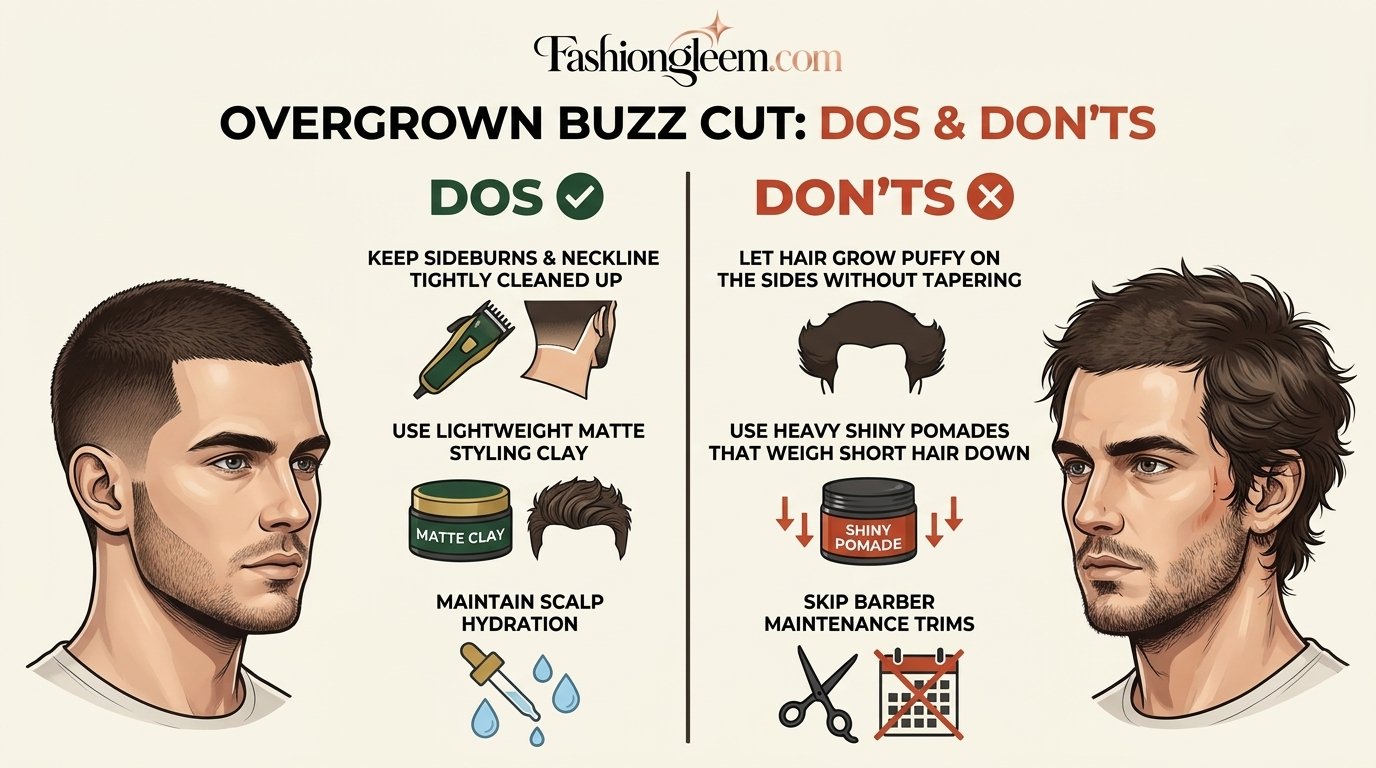
Overgrown buzz cut maintenance is lighter than most short styles, but it still needs neckline cleanups, ear cleanups, and a clear plan, or it quickly stops looking intentional.
Overgrown buzz cut suits many face shapes and hair types, yet the best version changes with top length, side length, fade height, beard length, and natural texture.
What Is an Overgrown Buzz Cut
Intentional style versus neglected grow-out
Intentional overgrown buzz cut means a barber cuts the hair longer on purpose, usually with a #3, #4, or #5 guard on top, and keeps the outline sharp from the start.
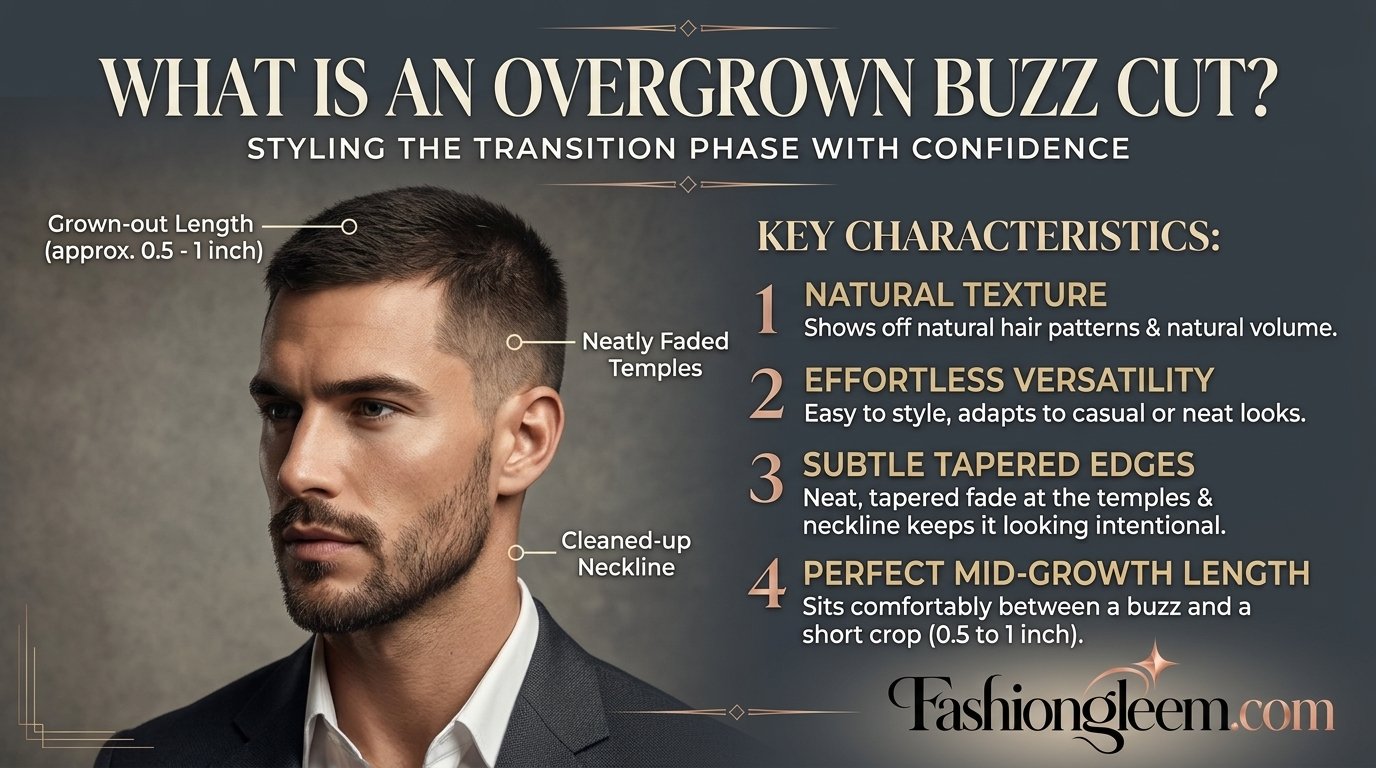
Neglected overgrown buzz cut means a fresh buzz grows for three to six weeks without a trim, so the sides puff out, the neckline softens, and the shape loses its clean edge.
Intentional style looks deliberate because the top length, side length, and neckline were chosen together, even though the hair is longer than a classic buzz.
Neglected grow-out looks accidental because only the top grew, while the sides, ears, and neckline were never tidied to match the new length.
Both versions share extra length and visible texture, which is why photos alone cannot tell readers whether a cut was planned or simply overdue for a trim.
Barbers treat them differently, because an intentional style needs a full guard recipe, while a neglected grow-out needs an outline-only tidy before any new style decision.
The one-line test: which one do you have
Check your neckline first, because a sharp, clean neckline usually signals an intentional cut, while a fuzzy, overhanging neckline usually signals a neglected grow-out.
Check around your ears next, because tidy hair above and behind the ears looks planned, while hair sticking out over the ears usually means the outline needs work.
Check your sides in a mirror, because even sides that follow the head shape look intentional, while puffy sides that widen the head usually need tapering or fading.
Check your top texture, because even, soft texture across the top suggests a chosen length, while patchy, uneven texture suggests uneven growth or an old fade growing in.
Check your last cut date, because three to six weeks after a fresh buzz is the usual window when a neat buzz first starts to read as overgrown.
Ask one question before deciding anything: did a barber choose this length, or did time alone create it, because the answer decides whether to keep, reshape, or grow out.
Length band in mm, inches, and guards
Length band for the intentional style is most usefully given as 8 to 12 mm, which covers a #3 guard at about 10 mm through a #4 guard at about 13 mm in round terms.
Faded versions go longer on top, with #4 or #5 on top and #2 or #3 on the sides in one common recipe, and #5 on top with #3 or #4 on the sides in another.
Neglected grow-out passes that band quickly, because hair grows about half an inch per month on average, so a #2 buzz can reach crew length in about two months.
Guides disagree on exact guards, which is normal, because brands vary by about half a millimetre, head shapes differ, and texture changes how length reads on top.
Readers should therefore use a length band and a photo, not one guard number alone, when they ask a barber for an overgrown buzz cut.
Inches help American readers convert guards, because 10 mm is about 0.4 inches, 13 mm is about 0.5 inches, 16 mm is about 0.6 inches, and 25 mm is about 1 inch.
Overgrown Buzz Cut Guard Chart
Full guard ladder from #0 to #10
Guard #0 leaves about 1.5 mm, which is almost bare skin, and it sits below the overgrown range, so it belongs to induction and ultra-short buzz styles only.
Guard #1 leaves 3 mm, which still shows scalp clearly and feels very short, and it also sits below the usual overgrown band for most men.
Guard #2 leaves 6 mm, which is a classic short buzz length, and it is a common starting point before hair grows into the overgrown range.
Guard #3 leaves about 10 mm, which sits squarely inside the overgrown band, and it gives visible colour, soft texture, and some scalp coverage.
Guard #4 leaves 13 mm, which is the upper end of the classic overgrown band, and it shows more texture, especially on wavy and curly hair.
Guard #5 leaves 16 mm, which is longer than the 8 to 12 mm band, but it works well as a faded overgrown top when sides stay shorter.
Guard #6 leaves 19 mm, which starts to read as a short crop rather than a buzz, and it needs more shaping to avoid a round, puffy silhouette.
Guard #8 leaves 25 mm, which is about 1 inch, and it belongs to longer crops and brush styles, not to a standard overgrown buzz.
Guard #10 leaves 1.25 inches, or 32 mm, and it is an extended guard, not part of most standard #0 to #8 sets, so readers should confirm stock before asking for it.
Brand variation matters, because one brand #4 can differ from another brand #4 by about half a millimetre, so a photo matters as much as a number.
Lever positions change length too, because an open lever adds length and a closed lever cuts closer, so barbers should confirm lever setting when precision matters.
At-home cutters should test a longer guard first, because clippers cut shorter than expected on a first pass, and regrowth takes weeks to correct a too-short mistake.
Manufacturer charts are the correct source for exact guard sizes, because barber guides round figures, and brands do not all use identical guard measurements.
Three recipes: uniform, tapered, faded
Uniform overgrown recipe uses one guard all over, usually #3 or #4, with a clean neckline and tidy ears, for the simplest, most rugged, most low-maintenance version.
Tapered overgrown recipe uses #4 or #5 on top, with sides tapered down to #2 or #3 near the ears and neck, for a softer transition and a cleaner side profile.
Faded overgrown recipe uses #4 or #5 on top, with a low, mid, or high fade on the sides, for the sharpest contrast and the most structured, modern version.
Uniform version suits men who want zero styling and a consistent silhouette, but it can widen round faces and puffy sides if the neckline is left untidy.
Tapered version suits most workplaces, because it keeps length on top while removing bulk at the ears and neck, which is where overgrown first looks messy.
Faded version suits men who want definition, because the fade creates a clear line between top length and skin, even when the top stays soft and textured.
Fade height changes the face, because a low fade keeps fullness near the temples, a mid fade balances top and sides, and a high fade elongates round faces.
Side guard choice matters more than top guard choice for many men, because sides control width, while top length controls texture and overall softness.
| Recipe | Top guard | Sides guard | Neckline | Best for |
|---|---|---|---|---|
| Uniform overgrown | #3 or #4 | Same as top | Clean, squared or rounded | Simplest look, rugged feel, zero styling |
| Tapered overgrown | #4 or #5 | Taper to #2 or #3 | Tapered, tidy | Office, most face shapes, clean sides |
| Faded overgrown | #4 or #5 | Low, mid, or high fade | Faded, sharp | Definition, modern look, strong jawlines |
What to say to your barber, word for word
Say the style name first, then the guards, then the sides, then the neckline, because barbers need the full picture before clippers start, not one number alone.

Uniform script reads: I want an overgrown buzz cut, #4 all over, clean neckline, tidy around the ears, no fade, keep the top even.
Tapered script reads: I want an overgrown buzz cut, #5 on top, tapered sides down to #3 at the ears and neck, clean neckline, keep the top length.
Faded script reads: I want an overgrown buzz cut, #4 on top, low fade on the sides, sharp lineup only if my hairline suits it, clean neckline.
Growing-out script reads: I am growing my hair out, please do not touch the top, just tidy the sides, around the ears, and the neckline so it looks clean.
Bring a photo of the destination style, not of a short cut, because a photo of the goal prevents a barber from cutting the top short out of habit.
Mention texture and cowlicks before cutting, because a crown cowlick, a front cowlick, or a strong wave changes how top length should be left and blended.
Mention beard plans in the same visit, because beard length, cheek line, and sideburn blend all change how the buzz sides should be tapered or faded.
Confirm the back with two mirrors before leaving, because the rear neckline is the first place an overgrown buzz loses its sharp, intentional look.
How an Overgrown Buzz Cut Looks
Top, sides, neckline, and ears
Top texture is the main visual change, because extra length lets natural wave, curl, and direction show, instead of lying flat like a fresh buzz.
Sides lose sharpness first as hair grows, because short side hair points outward before it gains enough weight to lie down, which creates puffiness above the ears.
Neckline softens next, because new growth fills the clean line at the nape, and that soft edge is often what makes a cut read as neglected rather than intentional.
Ears collect bulk quickly, because hair above and behind the ears sticks out before top length catches up, so ear cleanups give the highest visual return.
Crown area can look round or flat depending on growth direction, because cowlicks appear as length increases, with one patch lying flat while another sticks up.
Overall silhouette should follow the head shape, not widen it, which is why tapered or faded sides matter more than extra top length for most men.
Colour reads more clearly at overgrown length, because 8 to 12 mm shows hair colour and grey blending better than a 3 to 6 mm buzz, which mostly shows scalp.
Scalp visibility drops as length increases, which gives some natural coverage and sun protection compared with an induction or ultra-short buzz, but not full protection.
Texture, colour, and scalp visibility
Straight hair texture at overgrown length often stands up or out first, because stiff strands lack weight, then settles as the top gains a little more length.
Wavy hair texture gives the softest overgrown result, because natural wave creates movement and dimension with almost no product or styling effort.
Curly hair texture shows curl pattern earlier, because curls form at shorter lengths, and the silhouette widens before it lengthens, which needs tidy sides.
Coily hair texture forms a fuller silhouette quickly, because tight curls build volume, and the overgrown buzz can transition naturally into short textured styles.
Colour and grey show more at overgrown length, because longer strands catch light and reveal variation, while very short buzzes mostly reveal scalp tone.
Scalp visibility still matters for thinning hair, because overgrown length can either soften a thin crown or expose patchiness, depending on density and growth direction.
With a beard versus clean shaven
Clean shaven overgrown buzz looks modern and minimal, because the short top and clean jawline create one simple, consistent grooming message.
Stubble with overgrown buzz adds rugged balance, because light facial hair softens the transition from short top hair to bare skin on the face.
Short beard with overgrown buzz is the most popular pairing in trend guides, because beard weight balances top length and frames a strong jawline.
Longer beard with overgrown buzz creates a lumberjack feel, especially in colder months, but it needs beard shaping, or the whole look can turn heavy and shapeless.
Beard cheek line should be kept clean, because a fuzzy cheek line plus a fuzzy neckline doubles the neglected signal, even when the top length is correct.
Sideburn blend connects buzz sides to beard sides, so barbers should blend that junction, rather than leaving a hard step between hair and beard.
| Beard option | Balance with overgrown buzz | Watch out for |
|---|---|---|
| Clean shaven | Modern, minimal, consistent | Thin crown shows more without beard balance |
| Stubble | Rugged, soft transition | Patchy stubble plus patchy top can look uneven |
| Short beard | Most balanced, frames jaw | Cheek line and neckline both need regular tidying |
| Longer beard | Lumberjack, colder months | Heavy silhouette, needs shaping to avoid shapeless look |
Overgrown Buzz Cut by Face Shape
Oval, round, square
Oval face suits almost any overgrown buzz, because balanced forehead, cheekbones, and jaw allow uniform, tapered, or faded versions without a major correction.
Oval face barber script can use #3 or #4 uniform, or #5 top with tapered sides, because oval proportions do not need elongation or widening tricks.
Round face needs elongation or definition, because a uniform overgrown buzz can widen an already round face, especially when sides puff out.
Round face first route uses a high fade with #3 or #4 on top and tight sides, which lengthens the face visually and removes side width.
Round face second route uses a longer #4 brush top with a chin-length beard, which adds definition at the jaw without a high fade, for a softer result.
Square face suits overgrown buzz well, because a strong jaw already gives structure, and #2 or #3 all over with a #1 taper at neck and ears keeps that structure clean.
Square face caution involves boxy lineups paired with very short guards, because that combination can look harsh, while a slightly longer top softens the boxiness.
Face shape measurement should use widest point, not name alone, because forehead width, cheekbone width, jaw width, and face length together decide the true shape.
Oblong, diamond, heart, triangle
Oblong face needs width, not height, because a long face already looks elongated, so fuller sides and a low fade or no fade work better than a high fade.
Oblong face script uses #3 to #5 on top with fuller sides, because side fullness balances face length, while a high fade would stretch the face further.
Diamond face needs softness at the cheekbones, because wide cheekbones with a narrow forehead and jaw can look sharp with ultra-tight sides.
Diamond face script uses textured #3 or #4 on top with a mid fade, because texture on top softens cheekbone width without removing all side structure.
Heart face has a wider forehead and narrower jaw, so longer buzz length on top with a low fade plus beard weight at the jaw balances the proportions.
Heart face script uses #4, or #3 to #4, on top with a low fade, plus short beard weight at the jaw, because beard weight fills the narrower lower face.
Triangle face means jaw widest, also called pear shape, so textured or brush top with #3 or #4 length, low to mid fade, and crown fullness works best.
Triangle face caution involves uniform very short cuts, because they expose jaw width without top balance, while crown fullness helps rebalance the silhouette.
Widest-point test prevents the most common face-shape mistake, because triangle means jaw widest, while heart means forehead widest, and many guides swap those labels.
Four-point measurement gives a reliable check: forehead width, cheekbone width, jaw width from chin tip to jaw corner doubled, and face length from hairline to chin.
| Face shape | Overgrown buzz recipe | Avoid |
|---|---|---|
| Oval | Almost any, #3 to #5, any fade height | No major avoid, keep neckline clean |
| Round | High fade #3 to #4, or longer #4 brush plus beard | Uniform very short with puffy sides |
| Square | #2 to #3 all over, #1 taper at neck and ears | Boxy lineup plus very short guard if softer look wanted |
| Oblong | Fuller sides, #3 to #5, low fade or no fade | High fade, induction length |
| Diamond | Textured #3 to #4, mid fade | Induction, ultra-tight sides |
| Heart | Longer #4, low fade, beard weight at jaw | High and tight |
| Triangle, jaw widest | Textured brush top #3 to #4, low to mid fade | Uniform very short |
Overgrown Buzz Cut by Hair Type
Straight hair sticking up stage
Straight hair often has the strongest sticking-up stage, because stiff strands stand straight out before they gain enough weight to lie down or sweep.
Thick straight hair amplifies that stage, because density plus stiffness creates a round, fuzzy silhouette that looks wider than the head underneath.
Matte paste helps straight overgrown hair, because a pea-sized amount worked through with fingers gives direction without making short hair look greasy or stiff.
Blow drying down can also help, because warm air pointed downward smooths flyaways, and a cool shot at the end helps lock the shape in place.
Patience matters most for straight hair, because the sticking-up stage passes as length increases, and cutting the top too early restarts the same stage.
Wavy hair soft texture
Wavy hair gives the easiest overgrown result, because natural wave creates soft texture, movement, and dimension with almost no product at 8 to 12 mm.
Wavy hair styling needs only a wash and finger shaping in most cases, with a small amount of styling cream if flyaways or uneven direction appear.
Wavy hair sides still need tidying, because wave at the sides can puff out above the ears even when the top looks soft and intentional.
Wavy hair parting can shift slightly to the side for a modern feel, or sweep forward for a textured fringe effect, without needing a full restyle.
Curly hair width first
Curly hair seems to grow more slowly, because curl pulls length back in, so the silhouette gets wide before it gets long, which surprises many first-time growers.
Curly overgrown buzz needs tidy sides, because side width plus top curl can create a round shape, while a tapered or faded side keeps balance.
Curl enhancer or light cream can help define curls at overgrown length, but heavy product weighs curls down and makes short hair look greasy or clumpy.
Curly hair top should be left to build up, because cutting the top to even it out too early removes curl length that took weeks to gain.
Coily hair fuller silhouette
Coily hair forms a fuller silhouette quickly at overgrown length, because tight curls build volume in all directions, not just in length.
Coily overgrown buzz transitions naturally into short textured styles, because the fuller shape already reads as a deliberate textured cut with tidy sides.
Moisturising and brushing help coily overgrown hair, because regular brushing trains direction, prevents tangling, and supports a cleaner silhouette as length builds.
Side tapering matters most for coily hair, because untapered sides widen the head quickly, while a clean taper keeps the fuller top balanced.
Thick hair stiff stage
Thick hair creates the strongest fuzzy stage, because density plus stiffness means many strands stand up together, forming a round, tennis-ball-like shape.
Thick hair product should stay light, because heavy gel or wax on thick short hair looks greasy, clumpy, and stiff, while matte clay gives control without shine.
Thick hair barber visits should focus on sides and neckline, because removing side bulk does more for shape than cutting the top, which only restarts the fuzzy stage.
Fine and thinning hair flat risk
Fine hair lies down sooner, so the fuzzy stage is shorter, but the later risk is a flat, thin look, especially on top where density is lowest.
Textured crop transition helps fine hair later, because light layering and texture create movement that flat, uniform length cannot provide on its own.
Thinning hair needs honest assessment, because overgrown length can soften a thin crown in some cases, but it can also expose patchiness in others, depending on growth direction.
Buzzing does not make hair grow thicker, because cutting hair does not change thickness, colour, or growth rate, and blunt ends only feel coarser at first.
| Hair type | Overgrown behaviour | Best move |
|---|---|---|
| Straight | Sticks up, stiff stage, round silhouette | Matte paste, blow dry down, leave top alone |
| Wavy | Soft texture, easy styling, side puff | Finger styling, tidy sides, light cream if needed |
| Curly | Width first, curl shows early | Tidy sides, light curl cream, let top build |
| Coily | Fuller silhouette, volume fast | Taper sides, moisturise, brush regularly |
| Thick | Strong fuzzy stage, dense round shape | Light matte product, side bulk removal, patience |
| Fine | Lies down sooner, flat risk later | Textured crop transition, light layering, avoid heavy product |
| Thinning | Can soften or expose crown | Honest barber check, texture over uniform length |
Overgrown Buzz Cut Maintenance
Neckline and ear cleanup interval
Neckline cleanup is the cheapest, fastest tidy-up, because a clean nape line instantly makes an overgrown buzz look deliberate again, even when top length stays the same.
Ear cleanup interval should follow neckline cleanup, because hair above and behind the ears sticks out first, and tidy ears frame the whole cut.
Full cut interval for an intentional overgrown buzz is typically every three to five weeks, depending on growth speed, starting guard, and how sharp the outline needs to stay.
Outline-only interval during grow-out is different, because the first proper visit comes at weeks seven to ten, then every four to six weeks after that for shaping.
At-home edge cleanup between barber visits can work for neckline and ears, but it needs a mirror check for the back, or the rear line can drift unevenly.
Two-mirror back check should happen the night before any important day, because the rear hairline is the first place an overgrown buzz loses its sharp look.
Outline-only trim rule
Outline-only trim rule is simple: cut the outline, leave the length you are growing, because that rule separates a tidy grow-out from a restart.
First month rule is no cutting on top, with a neckline tidy at most, because top length needs time to gain weight and direction before any shaping helps.
Weeks seven to ten rule is first proper visit, sides, ears, and neck only, because that visit removes side bulk without sacrificing top length.
After that rule is every four to six weeks, shaping sides and back toward the destination style, with a little off the top only to even it out if needed.
Stay with one barber through a grow-out when possible, because one barber can see shape growing visit to visit and will not remove length you waited months to gain.
Tell the barber the goal first, every visit, because a barber who does not know the plan may fade the sides back down out of habit.
Washing, scalp care, and sun protection
Washing an overgrown buzz needs only regular shampoo and conditioner, because short hair dries fast, but scalp buildup still needs removal for comfort and appearance.
Conditioner adds softness at overgrown length, because longer strands benefit from manageability, while very short buzzes often need no conditioner at all.
Scalp moisturising helps prevent dryness and flaking, because short hair exposes scalp to air, washing, and sun more than longer styles do.
Light oils or lotions can moisturise scalp without making hair greasy, but heavy oils on short hair look shiny and flat, so a small amount works best.
Sun protection matters at short lengths, because scalp skin at 3 to 5 mm is exposed enough for sunburn risk without a cap or sun protection, in general guidance.

Overgrown length gives some coverage, because 8 to 12 mm retains more natural protection than a 3 mm buzz, but it does not replace a hat or sunscreen on sunny days.
Scars, dents, and head shape show more at short lengths, so running a hand over the skull before a first buzz helps set honest expectations about the result.
Dandruff and flaking should be checked by a professional if persistent, because this page gives general grooming information only, not medical advice or treatment guidance.
Product amounts: matte clay and paste
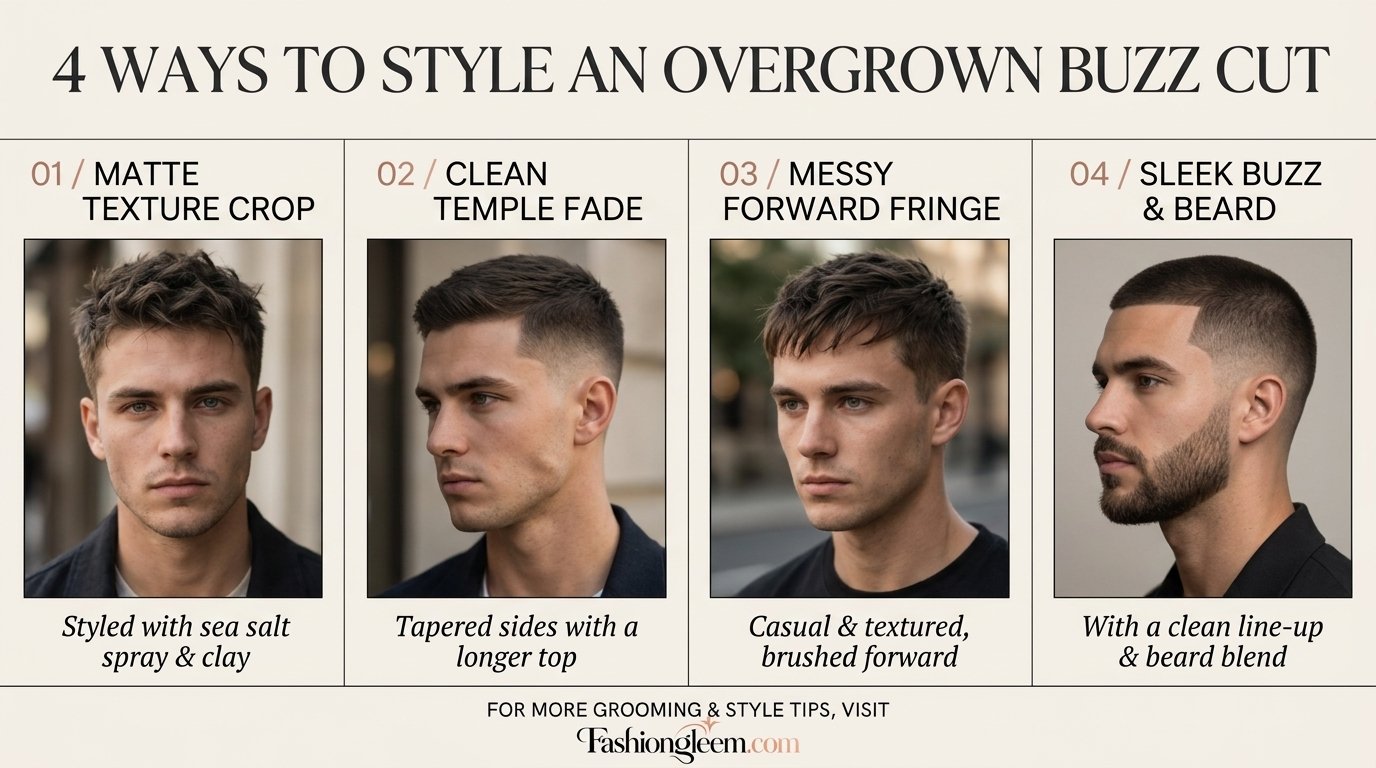
Matte clay is the best default product for overgrown buzz hair, because it adds texture and control with a matte finish, without shine or stiffness.
Texture paste works similarly, with a slightly softer hold, and it suits wavy and curly overgrown hair that needs definition without a crunchy finish.
Pea-sized amount is the correct starting dose, because short hair needs very little product, and a small amount worked between hands spreads more evenly.
Finger styling beats comb styling at overgrown length, because fingers create relaxed, piecey texture, while a comb can flatten natural movement.
Sea salt spray can add grip and lived-in texture on damp hair, especially for wavy hair, but it can dry hair out if used daily without conditioning.
Texture powder at the roots can add lift on a night out, because a light dusting gives grit and volume, but it should stay optional, not daily.
Heavy gel and wax should be avoided on short overgrown hair, because they look greasy, clumpy, and stiff, and they flatten the natural texture that makes the style work.
Product order matters: apply to dry or slightly damp hair, rub between hands first, work through from roots, then shape with fingers, never apply a large blob to one spot.
Grow-Out Timeline from an Overgrown Buzz
Weeks 3 to 6 fuzzy stage
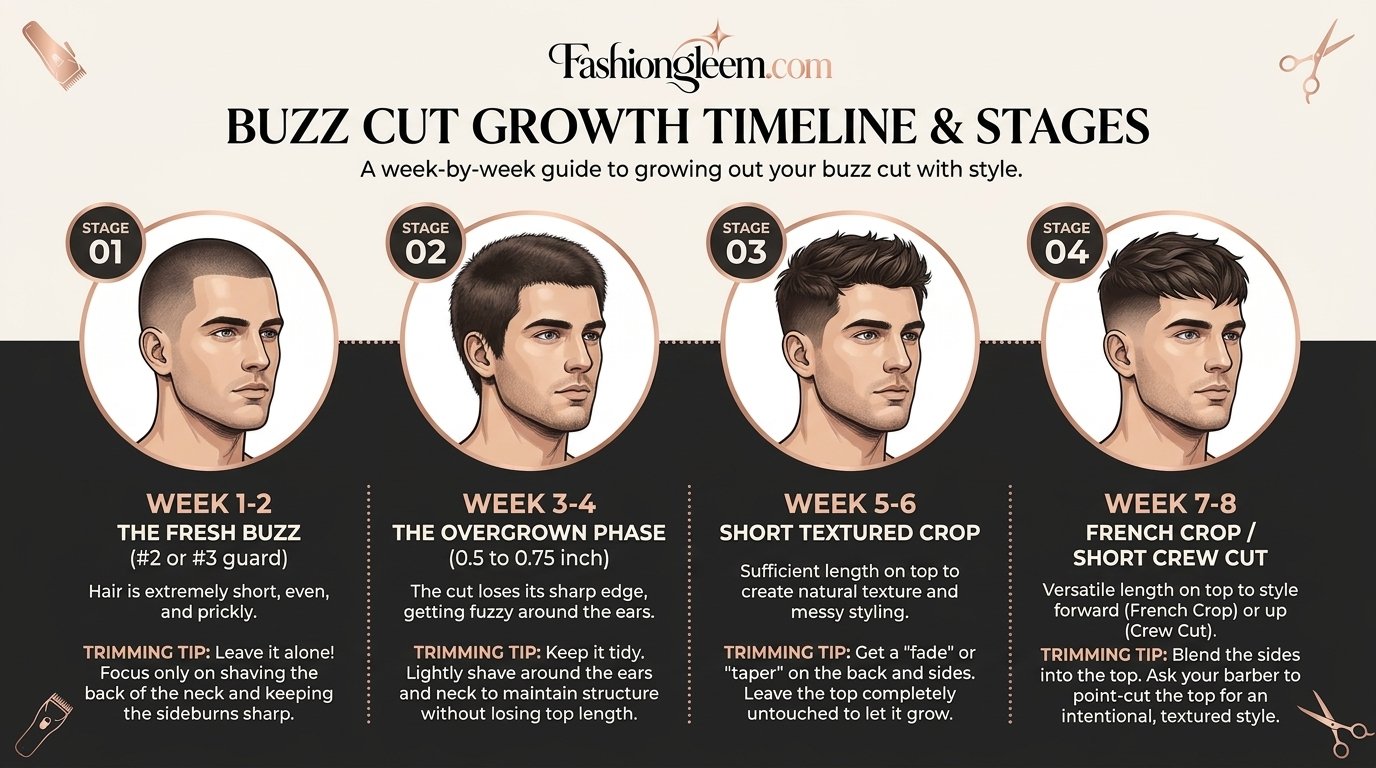
Weeks 1 to 2 still look like a neat buzz, because length has barely changed, and most men think the whole grow-out will stay that simple.
Weeks 3 to 6 bring the fuzzy stage, because hair reaches about half to three quarters of an inch, stands straight up, and forms a round, fuzzy silhouette.
Sides stick out in weeks 3 to 6, because short side hair points outward, which makes it look like sides grow faster than the top, even though they do not.
Neck looks untidy in this stage, because new growth fills the clean nape line, so a quick neckline cleanup is the only cut needed in the first month.
No top cutting should happen in weeks 3 to 6, because cutting the top restarts the fuzzy stage and delays the length needed for the next style.
Product helps little in the fuzzy stage, because hair is too short to hold direction, so a wash, a tidy neckline, and patience matter more than styling.
Weeks 7 to 10 awkward stage
Weeks 7 to 10 form the awkward stage, because hair reaches about three quarters to one and a quarter inches, too long for a buzz and too short to style fully.
Cowlicks appear in this stage, because hair gains enough weight to show natural direction, with one patch lying flat while another sticks up.
Sides and back look heavy in weeks 7 to 10, because outline softens, fade contrast blurs, and any old lineup or design fills in and disappears.
First barber visit should happen now, with a clear instruction: do not touch the top, just tidy the sides, around the ears, and the neckline so it looks clean.
Matte clay helps in the awkward stage, because a pea-sized amount gives short hair direction and stops the just-woke-up look, without greasy buildup.
Hat use is fine on a bad day in this stage, but daily hat hiding flattens growth and hides shape problems that a barber could fix with an outline trim.
Most men quit in weeks 7 to 10, because the stage feels messy and endless, yet it passes in a few weeks if the outline stays tidy and the top is left alone.
Months 3 to 4 crew and crop stage
Months 3 to 4 bring enough length for a crew cut, French crop, or textured crop, with about one and a half to two inches on top in most grow-out guides.
Crew cut goal is the quickest destination, because it needs about an inch on top, a little longer at the front, with shorter sides, as the natural next step after a buzz.
Textured crop goal is the best awkward-phase saver, because keeping length on top with a fringe and short sides looks completely intentional, even when texture is messy.
French crop goal adds a forward fringe, which helps cover a higher forehead or receding hairline without looking like a cover-up, when the fringe is textured and blunt.
Destination choice should happen by months 3 to 4, because knowing the goal lets every trim move toward it, instead of trimming randomly and losing length.
Barber visits in months 3 to 4 should shape sides and back toward the destination, with only small top trims to even out length, never a full top cut.
Months 5 to 6 quiff and side part stage
Months 5 to 6 bring enough length for a quiff, slick back, or side part, with about two and a half to three inches or more on top in most grow-out guides.
Quiff needs lift, because front length must stand up and back, which requires length, light product, and blow drying for most straight and wavy hair types.
Side part needs parting length, because hair must lie to one side cleanly, which needs enough top length to hold direction without sticking up at the part.
Longer textured styles become possible after months 5 to 6, including side sweeps, short pompadours, and bro flows, once top length passes three inches.
Regular trims in months 5 to 6 keep shape, because longer top hair with untidy sides and back creates a mushroom shape, even when the top itself looks good.
Growth speed varies by person, so months are guides, not promises, because genetics, health, and hair type all change how fast length appears in the mirror.
| Stage | Time from #2 buzz | Rough top length | What to do |
|---|---|---|---|
| Neat buzz | Weeks 1 to 2 | 0.25 to 0.5 inches | Nothing, enjoy it |
| Fuzzy stage | Weeks 3 to 6 | 0.5 to 0.75 inches | No top cut, neckline tidy only |
| Awkward stage | Weeks 7 to 10 | 0.75 to 1.25 inches | First barber visit, sides ears neck only |
| Crew and crop stage | Months 3 to 4 | 1.5 to 2 inches | Pick destination, shape sides toward it |
| Quiff and side part stage | Months 5 to 6 plus | 2.5 to 3 inches plus | Regular trims, lift or part styling |
Destination Styles After an Overgrown Buzz
Crew cut
Crew cut is the closest goal after a buzz, because it keeps short sides, a slightly longer front, and a clean, classic silhouette that suits work and sport.
Crew cut length needs about an inch on top, with a little extra at the front, and shorter sides, which makes it reachable in about two months from a #2 buzz.
Crew cut styling needs almost nothing, because a wash and finger shaping are enough, with a tiny amount of matte product only if the front needs direction.
Crew cut face fit suits oval, square, and round faces well when sides are tapered, because the short top keeps proportions clean without adding height.
Textured crop and French crop
Textured crop uses messy, piecey texture on top with short sides, which makes it the best bridge from an overgrown buzz to a longer, intentional style.
French crop adds a blunt, forward fringe to the textured crop, which frames the forehead and eyes, and helps soften a high forehead or receding hairline.
Crop length needs about one and a half to two inches on top, pushed forward with texture, while sides stay tight throughout the transition.
Crop styling uses a small amount of matte paste or clay, worked through with fingers, pushed forward into the fringe, with no blow dryer needed for most hair types.
Crop face fit suits round, heart, and oblong faces well, because forward texture adds structure without height, and short sides keep the silhouette clean.
Ivy League
Ivy League is a neat, polished step beyond a crew cut, with a defined side part, tapered sides, and enough top length to sweep to one side cleanly.
Ivy League length is given differently across guides, from two to three inches in one grow-out page to longer in others, so readers should use a photo, not one inch figure alone.
Ivy League styling needs a side part, light product, and a comb or fingers to set direction, which makes it more formal than a textured crop.
Ivy League face fit suits oval and square faces well, because the side part and taper create a classic, structured look that works for office and formal events.
Quiff, side part, and longer styles
Quiff adds front volume and height, with hair swept up and slightly back, which lengthens round faces and adds presence, but needs length and styling time.
Side part is the most formal destination, with a clean part, tapered sides, and smooth top direction, which suits office, weddings, and formal events best.
Longer textured styles after a quiff or side part include side sweeps, short pompadours, and bro flows, once top length passes three to four inches.
Destination choice should match lifestyle, because a quiff needs daily styling, a side part needs regular trims, and a textured crop needs the least daily effort.
Overgrown Buzz Cut Mistakes
Mistakes cost weeks during grow-out, because one wrong cut can restart a stage, remove months of length, or turn an intentional overgrown buzz into a fresh buzz again.
Mistakes also cost confidence, because a bad awkward stage makes many men quit growing out entirely, even though the stage itself is temporary and fixable.
- Buzzing it again in week four, because frustration with fuzz leads to a restart from zero, while patience through weeks seven to ten would have reached a tidy stage.
- Never seeing a barber, because the outline gets heavy and messy, while an outline-only trim at weeks seven to ten would have kept the grow-out looking deliberate.
- Not telling the barber the goal, because a barber may cut the top short out of habit, while a clear growing-out instruction plus a goal photo prevents that mistake.
- Cutting the top to even it out too early, because top length needs months to gain weight, while side and neck tidying alone usually fixes uneven appearance.
- Using heavy gel or wax on short hair, because heavy product looks greasy and clumpy on short strands, while a pea-sized matte clay gives direction without shine.
- Wearing a hat every day to hide growth, because daily hats flatten hair and hide shape problems, while occasional hat use on a bad day causes no harm.
- Choosing a destination too late, because random trims without a goal waste length, while a crew, crop, or quiff goal lets every trim move forward.
- Ignoring scalp care and sun protection, because dry, flaky, or sunburned scalp undermines an otherwise clean cut, while simple washing and protection keep scalp healthy.
Overgrown Buzz Cut for Work, Gym, and Summer
Office suitability for an overgrown buzz is strong, because tapered or faded versions look clean, structured, and professional, without needing daily styling time.
Office script should favour tapered sides and a clean neckline over a uniform puffy version, because side tidiness reads as professional even when top texture is relaxed.
Gym suitability is also strong, because short hair dries fast, stays out of the eyes, and needs no restyling after sweat, unlike longer styles that collapse.
Gym product should stay minimal, because sweat plus heavy product creates buildup, while a wash after training and a light matte product before events works better.
Summer suitability is excellent for cooling, because less hair mass means faster sweat evaporation and less heat buildup, especially at 8 to 12 mm compared with longer crops.
Summer sun risk still needs attention, because short hair exposes scalp, so a cap or sun protection matters on long sunny days, even at overgrown length.
Winter pairing with a beard works well, because beard weight balances top length and adds warmth to the overall look, especially with tapered sides.
Photo day check should include front, sides, back with two mirrors, neckline, ears, and beard line, because those five checks catch most overgrown neglect before an event.
Keep It, Reshape It, or Grow It Out
Keep it decision suits men who like the current length, because a regular three to five week full cut keeps an intentional overgrown buzz sharp without changing style.
Reshape it decision suits men who like short hair but want more structure, because a taper or fade on the sides transforms a uniform overgrown buzz without losing top length.
Grow it out decision suits men who want a crew, crop, quiff, or longer style, because outline-only trims let top length build while sides stay tidy.
Decision checklist should ask four questions: do I like the top length, do my sides look tidy, does my beard balance the top, and do I have time for the next stage.
If top length is right but sides are puffy, the answer is a taper or fade, not a full cut, because side work alone fixes most overgrown problems.
If top length is wrong and sides are tidy, the answer is either a shorter guard reset or a longer grow-out plan, depending on whether the goal is shorter or longer.
If time is short and styling patience is low, keeping an overgrown buzz or reshaping to a crew cut beats starting a six-month grow-out that needs regular shaping.
If patience is high and a destination photo is clear, growing out through the awkward stage is worth it, because months three to six open far more styling options.
FAQs
What is an overgrown buzz cut?
Overgrown buzz cut is a buzz cut grown past its fresh length, usually 8 to 12 mm for the intentional style, with fuller texture and softer edges than a fresh buzz.
How long is an overgrown buzz cut?
Overgrown buzz cut length sits in a band, with 8 to 12 mm for the classic intentional version and #4 or #5 on top for faded versions with shorter sides.
What guard is an overgrown buzz cut?
Overgrown buzz cut guard is usually #3 or #4 all over for uniform versions, or #4 or #5 on top with #2 to #4 on the sides for tapered and faded versions.
When does a buzz cut become overgrown?
Buzz cut becomes overgrown after about three to six weeks without a trim, when sides puff out, the neckline softens, and texture becomes clearly visible on top.
How do you style an overgrown buzz cut?
Overgrown buzz cut styling needs almost nothing, with a wash and finger shaping in most cases, plus a pea-sized amount of matte clay if direction is needed.
Can you fade an overgrown buzz cut?
Yes, you can fade an overgrown buzz cut, with a low, mid, or high fade on the sides while keeping #4 or #5 length on top for contrast and structure.
How often should you trim an overgrown buzz cut?
Overgrown buzz cut trimming for an intentional style is typically every three to five weeks, while grow-out outline trims come first at weeks seven to ten.
Should you trim while growing out a buzz cut?
Yes, trim while growing out a buzz cut, but only the outline, with sides, ears, and neckline tidied, while leaving the top alone to gain length.
How do you fix puffy sides on an overgrown buzz cut?
Puffy sides are fixed with a taper or fade, because side bulk removal restores head shape, while cutting the top only restarts the fuzzy stage.
How do you stop an overgrown buzz cut sticking up?
Sticking up is stopped by time, matte product, and blow drying down, because straight hair needs length and weight before it lies down naturally.
Does an overgrown buzz cut suit a round face?
Overgrown buzz cut suits a round face with a high fade and #3 or #4 on top, or with a longer #4 brush top plus beard weight, as two valid routes.
Does an overgrown buzz cut suit a square face?
Overgrown buzz cut suits a square face well, with #2 or #3 all over and a #1 taper at neck and ears, keeping strong jaw structure clean.
Is an overgrown buzz cut good for curly hair?
Overgrown buzz cut is good for curly hair, because curl shows early and adds texture, but sides need tidying to prevent a round, wide silhouette.
Is an overgrown buzz cut good for fine hair?
Overgrown buzz cut can work for fine hair, because it lies down sooner, but flat risk later means a textured crop transition often works better than uniform length.
Is an overgrown buzz cut good for thinning hair?
Overgrown buzz cut for thinning hair needs a barber check, because extra length can soften a thin crown in some cases and expose patchiness in others.
Should you pair an overgrown buzz cut with a beard?
Overgrown buzz cut with a beard is a popular pairing, because short beard weight balances top length and frames the jaw, especially with tapered sides.
Is an overgrown buzz cut good for the office?
Overgrown buzz cut is good for the office when sides are tapered or faded and the neckline is clean, because side tidiness reads as professional even with relaxed top texture.
Is an overgrown buzz cut good for summer?
Overgrown buzz cut is good for summer, because less hair mass cools faster and dries in minutes, although scalp sun protection still matters on sunny days.
What is the difference between an overgrown buzz cut and a crew cut?
Overgrown buzz cut versus crew cut differs in top length and shape, because a crew cut has about an inch on top with a longer front, while an overgrown buzz stays shorter and more even.
What is the difference between an overgrown buzz cut and a textured crop?
Overgrown buzz cut versus textured crop differs in top styling, because a textured crop has longer, piecey, forward-styled top hair, while an overgrown buzz stays short and even.
What comes after an overgrown buzz cut if you keep growing it?
After an overgrown buzz cut, growing out leads to a crew cut at about two months, a textured or French crop at three to four months, and a quiff or side part later.
How long from a buzz cut to a crew cut?
Buzz cut to crew cut takes about two months from a #2 buzz, because hair grows about half an inch per month, with individual speed varying by person.
How long from a buzz cut to a textured crop?
Buzz cut to textured crop takes about three to four months from a #2 buzz, with about one and a half to two inches on top needed for forward texture.
Does buzzing your hair make it grow back thicker?
Buzzing does not make hair grow back thicker, because cutting does not change thickness, colour, or growth rate, and blunt ends only feel coarser at first.
What should you say to your barber for an overgrown buzz cut?
Barber script for an overgrown buzz cut is: I want an overgrown buzz cut, #5 on top, tapered sides to #3, clean neckline, tidy ears, keep the top length.
Conclusion
Overgrown buzz cut succeeds when length, sides, and outline work together, because top texture alone cannot save puffy sides, a fuzzy neckline, or untidy ears.
Overgrown buzz cut guard choice should start with a band, not a single number, using #3 or #4 uniform, #4 or #5 tapered, or #4 or #5 faded, matched to face shape and hair type.
Overgrown buzz cut maintenance is simple but non-negotiable, with neckline and ear cleanups, outline-only trims during grow-out, and a pea-sized matte product when direction is needed.
Overgrown buzz cut grow-out rewards patience, because weeks seven to ten feel awkward, months three to four open crew and crop options, and months five to six open quiff and side part options.
Overgrown buzz cut decision is now clear: keep it with regular full cuts, reshape it with a taper or fade, or grow it out with outline-only trims, and book the next shape-up with the exact script from the guard section.