
Wolf Cut for Women: The Softness Spectrum, Every Length and Fringe, Tuned to Your Face and Texture
A wolf cut for women is the shag and mullet hybrid rebuilt around women’s choices: choppy crown layers for volume, a fringe chosen on purpose, face framing that tunes your features, and longer, tapered length kept at the back.
The mistake most galleries make is showing you forty versions and leaving you to guess which one is yours.
The versions are not random. They sit on one spectrum, from soft and office safe to bold and disconnected, and three levers set your place on it: length, fringe, and texture.
Choose your register first, then your length, then your fringe, and the face shape tuning almost does itself. That order is the whole method.
Wolf Cut for Women at a Glance
|
Register |
Layer Settings |
Fringe |
Back Length |
Upkeep |
|---|---|---|---|---|
|
Soft |
Light, longer crown layers |
Curtain, wispy, or none |
Moderate, feathered |
Lowest, grows out gently |
|
Classic |
Choppy crown, blended tiers |
Curtain or wispy |
Noticeably longer than front |
Moderate, trim cycle standard |
|
Bold |
Heavy, disconnected tiers |
Blunt or micro |
Long, high contrast |
Highest, proportions need trims |
Read the table as your first decision. Everything else in this guide fine tunes the register you pick here.
What a Women’s Wolf Cut Is
The architecture is the one our complete wolf cut guide sets out in full: a 1970s shag’s layered crown and fringe married to a 1980s mullet’s longer back, with wispy tapered ends instead of blunt ones.
The women’s version is the same architecture with different defaults. The fringe becomes a headline decision rather than an afterthought.
The length is chosen from a ladder instead of left long by default. And the whole cut is tuned to face shape and texture before the scissors move.
Perfect Corp’s guide to wolf cuts for women quotes the definition working stylists use, a mix between a shag and a mullet with lots of layers creating a slightly wild, undone shape. The registers below decide how wild yours gets to be.
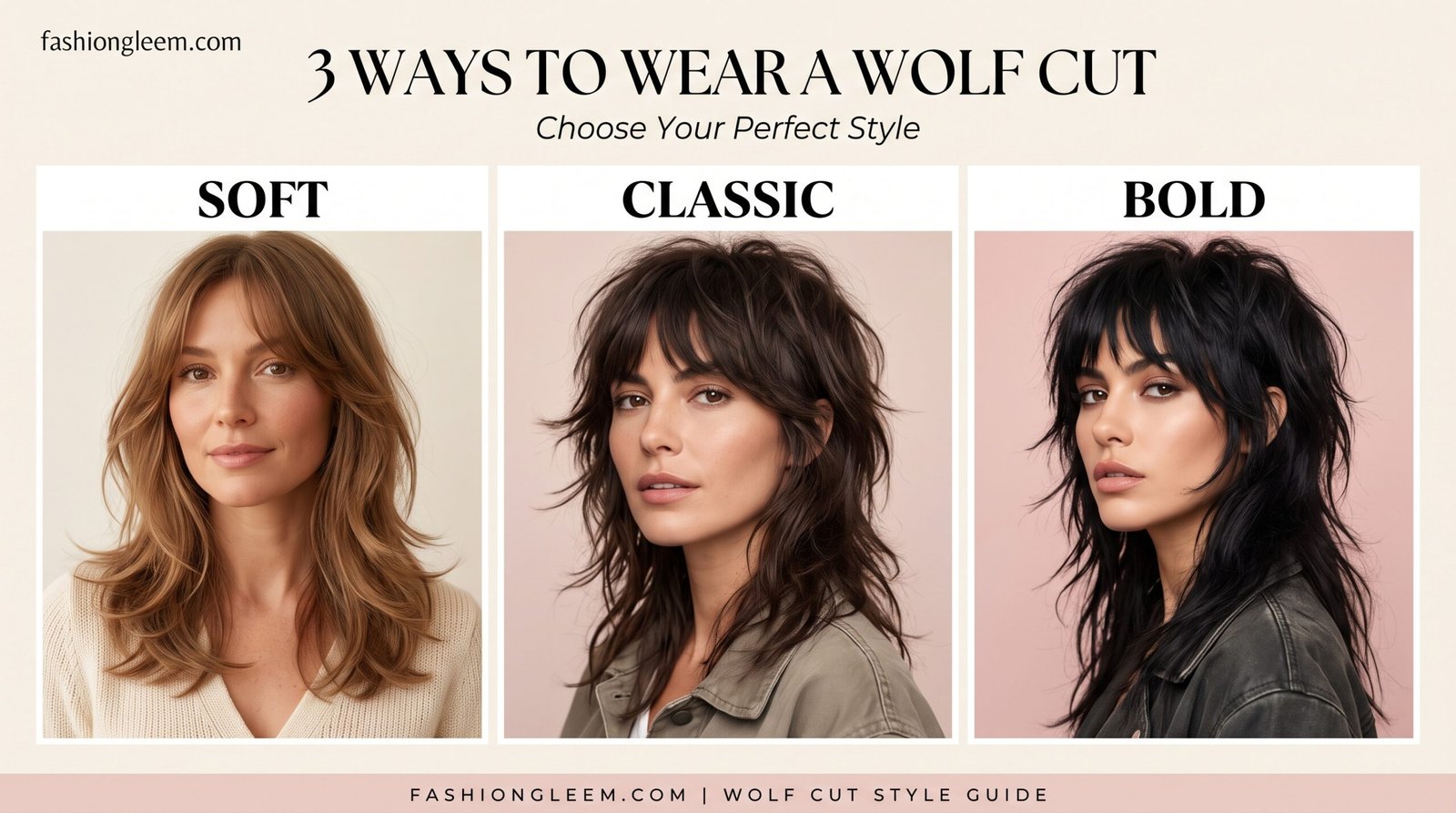
The Softness Spectrum: Choose Your Register First
Soft and Subtle: The Professional Register
Every dial turned down: lighter and longer crown layers, gentle contrast between the tiers, feathered ends, and a fringe that sweeps rather than announces. In most offices this reads as a layered haircut with texture, not as a statement.
This is the register for first timers, conservative workplaces, fine hair, and most women over 40. It is also where demand is moving: Hairsaide’s wolf cut for women gallery reports stylists seeing clients shift toward softer versions and curtain fringes heading into 2026.
The Classic Middle: Shag Forward, Wearable Daily
The textbook wolf: choppy crown layers with real lift, blended but visible tiers, a curtain or wispy fringe, and a back that is clearly longer than the front. This is the version in most of the photos that made you want the cut.
It suits the widest range of faces and textures. If a gallery image made your heart beat faster, it was almost certainly shot at these settings.
Bold and Disconnected: The Statement Register
Every dial turned up: heavy crown layers cut deliberately disconnected from the long back, a blunt or micro fringe, and contrast you can see across a room. Hairstyle Inspirations’ wolf cut collection shows this end of the spectrum at its best, all edge and intention.
Choose it knowingly. The bold register needs the most upkeep, dates fastest as it grows, and overwhelms fine hair and soft features. It is a genuine look, not a mistake, but it should never happen to anyone by accident.
The Length Ladder
|
Version |
Overall Length |
Best Textures |
Upkeep Level |
|---|---|---|---|
|
Short wolf and pixie wolf |
Nape to jaw |
Straight, wavy |
High, proportions drift fast |
|
Wolf bob |
Jaw to collarbone |
Most textures |
Moderate, grows into medium |
|
Medium wolf |
Shoulder length |
Wavy, curly, straight |
Moderate |
|
Long wolf |
Past shoulders |
Medium to thick hair |
Lowest per week, longest grow out |
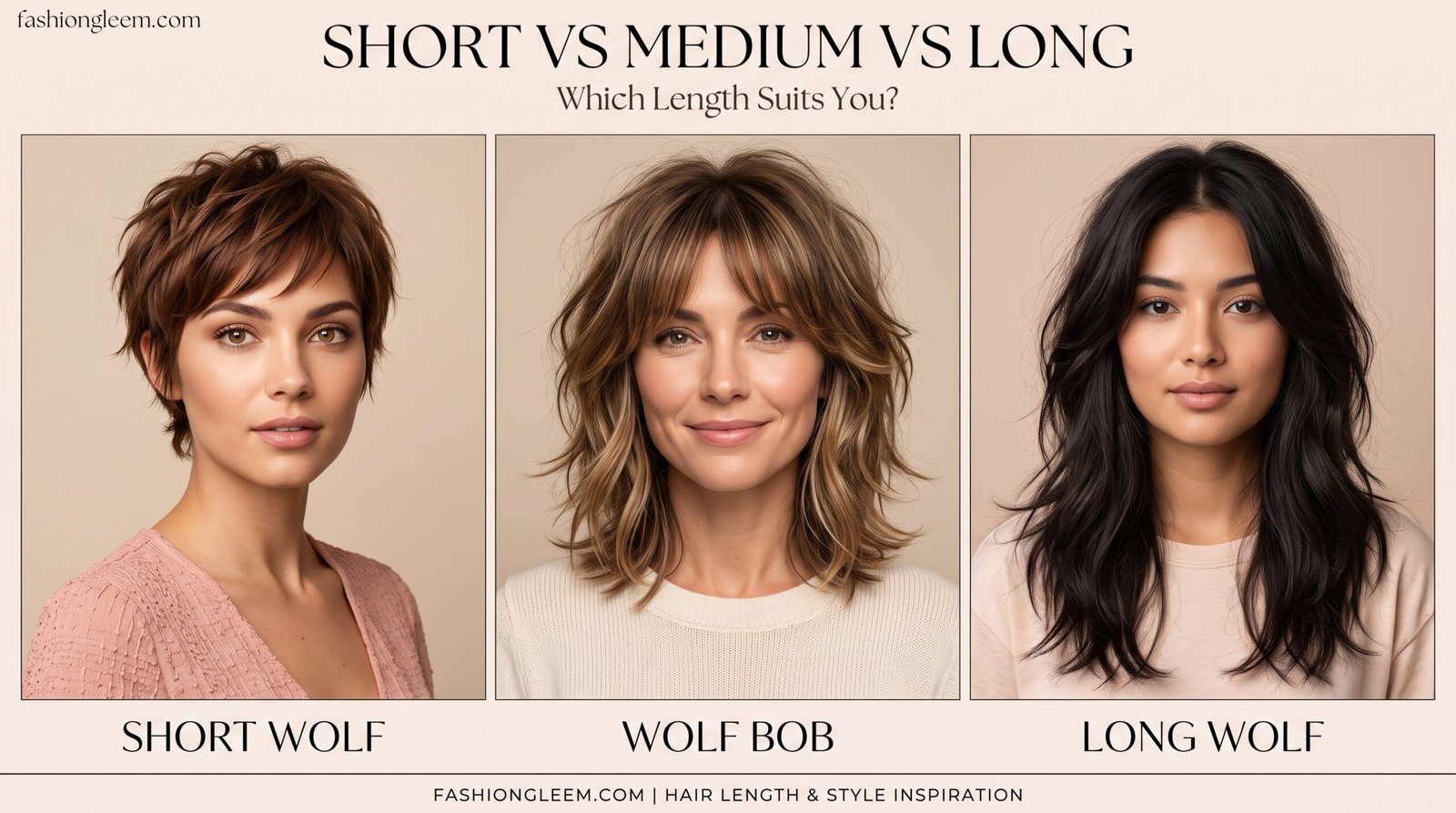
Short Wolf Cut and Pixie Wolf
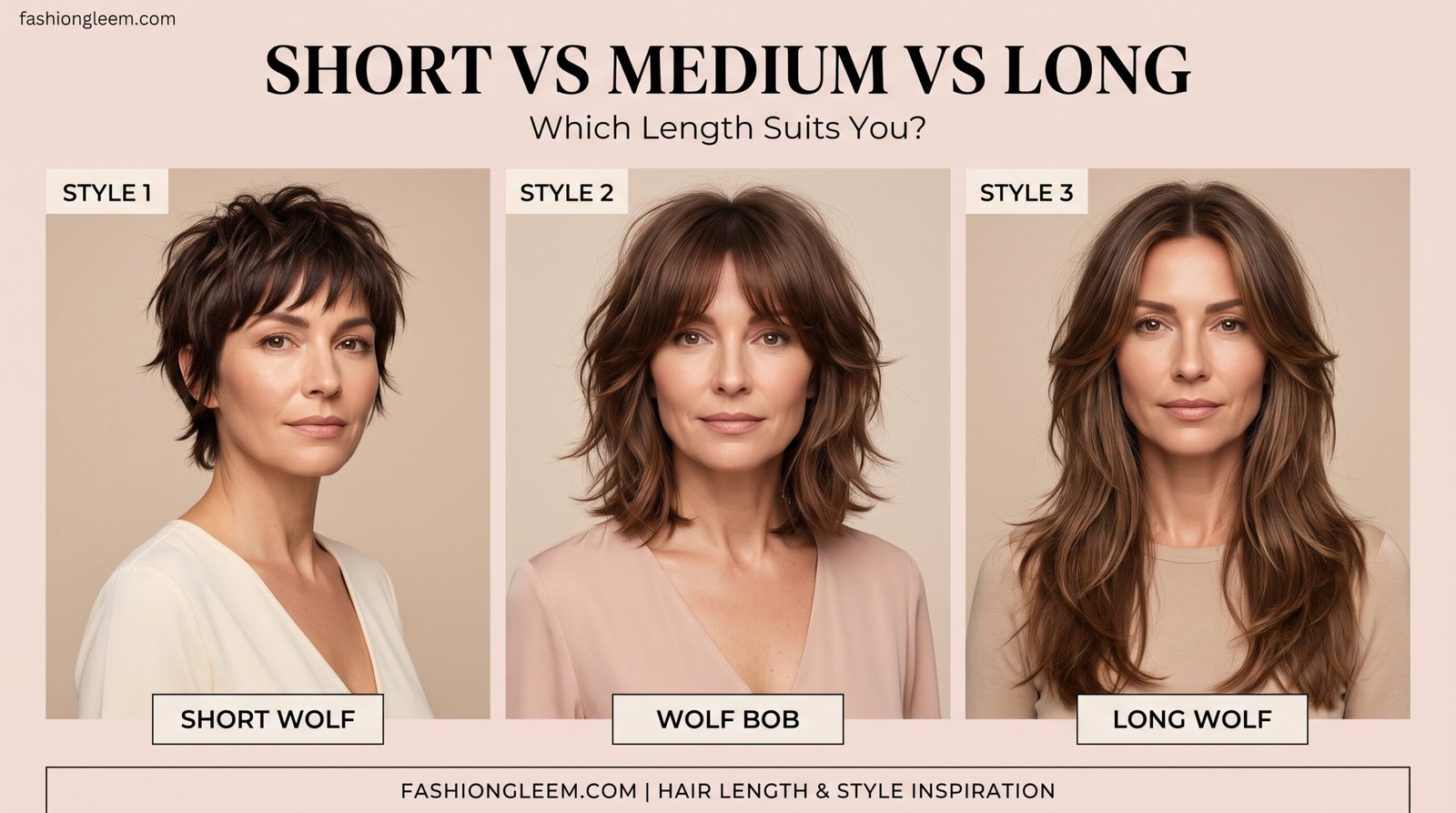
The architecture compressed: short choppy crown, tight face framing, and a back ending at the nape or jaw. It carries the most attitude per inch, dries in minutes, and holds its shape with almost no heat.
It flatters oval, heart, and square faces best. It also commits you: short versions drift out of proportion fastest and sit at the frequent end of the trim cycle.
The Wolf Bob: Chin to Collarbone
Wolf layering built into a bob, the entry point version. The crown keeps its choppy lift and the ends stay wispy, but the overall length stops where a bob stops, so the mullet signal stays quiet.
It is the most office friendly shape in the family and the safest first wolf. Grow it and it becomes a medium wolf cut rather than collapsing, which no other short version can promise.
Medium and Shoulder Length
The balanced rung: enough length for the two tier silhouette to read clearly, enough crown layering for lift, and ponytail options still on the table. Most first full wolf cuts land here.
Long Wolf Cut: Keep the Length
Interior and crown layers supply the movement while your length stays past the shoulders. This is the version for women who want the texture without giving up the hair they grew.
It suits medium and thick hair best, because long hair has weight to spare. On fine hair the long version needs the lightest layering in the family, or the ends read thin and tired.
The Fringe Decision
|
Fringe |
Mood |
Best Face Fit |
Grow Out Behaviour |
|---|---|---|---|
|
Curtain bangs |
Soft, current, versatile |
Almost everyone |
Melts into face framing |
|
Wispy or bottleneck |
Light, romantic |
Round, heart, mature faces |
Easy, blends fast |
|
Blunt bangs |
Bold, retro |
Oval, longer faces |
Awkward middle stage |
|
No bangs |
Clean, lowest commitment |
All, with layer tuning |
Nothing to grow out |
Curtain Bangs: The 2026 Default
Parted in the middle and sweeping to the cheekbones, curtain bangs are the fringe the trend has settled on. They frame without covering, suit nearly every face shape, and grow out into face framing layers instead of through an awkward stage.
If you are undecided, start here. A curtain fringe can be cut blunter later; a blunt fringe cannot be uncut.
Wispy and Bottleneck Bangs
Wispy bangs fall lightly across the forehead and blend into the front layers with no visible line. Bottleneck bangs sit narrower at the top and widen at the cheeks, a softer cousin of the curtain shape.
Both are kind to round and heart shaped faces and to mature clients, because they suggest a fringe rather than declaring one, and they need the least upkeep of any fringe.
Blunt Bangs: The Retro Statement
A straight, full fringe is the boldest single choice in the cut, the Joan Jett end of the family. It flatters oval and longer faces and powers the statement register.
Know its two costs: it doubles the angles on a square face, and its grow out passes through a genuinely awkward middle length.
No Bangs: Face Framing Only
The fringe is a module, not a requirement. A no bangs wolf uses longer face framing layers starting at the cheekbones or chin, swept aside, and keeps everything else: crown lift, tiers, tapered back.
It is the lowest commitment entry to the cut. Choose it if you hate fringe upkeep or want to test the silhouette before adding a fringe later.
Texture Tuning
Curly and Coily: Dry Cutting and Shrinkage
Curly hair is one of the cut’s natural homes, because layered weight removal is exactly what curls need to lift instead of forming a triangle. The method matters more than the version.
Curly wolf cuts should be cut dry, or at least finished dry.
Every curl type shrinks at its own rate as it dries, so wet cutting guesses where the shortest layers will land. Ask for a stylist who dry cuts, and judge the shape only when your curls are dry and styled as you wear them.
Wavy: The Easiest Canvas
Natural wave is the texture stylists name as the sweet spot, and a stylist’s honest wolf cut guide says so outright: medium density hair with a bit of natural wave is the ideal starting point.
The layers fall into separation on their own, and air drying does most of the styling.
If this is your texture, your main decision is register, not feasibility. Spend your consultation time on fringe and length instead.
Straight: Product Led Texture
Straight hair wears the cut well, with one honesty clause: the lived in texture comes from styling, not from the haircut alone. The cutting must also be cleaner, because straight hair shows every layer line, and point cutting does the blending.
Your routine is texture spray through the ends, a diffuser or quick round brush pass for bend, and dry shampoo for day two lift. Budget the ten minutes and the cut delivers; skip them and it reads as a plain layered cut.
Fine Hair Rules and Thick Hair Freedom
Fine hair can wear this cut and even gain from it, because crown layering creates separation that reads as fullness. The rules are restraint: fewer and longer layers, no heavy razor work through the ends, volumizing product at the roots.
Thick hair gets the opposite brief: layering removes the weight that makes it hang like a curtain, the bolder registers are safe, and thick versions hold their shape longest. The same engine drives layered haircuts for men on the men’s side of the library.
The Face Shape Tuning Chart
|
Face Shape |
Add This |
Avoid This |
|---|---|---|
|
Round |
Crown height, face layers past the chin, curtain fringe |
Blunt fringe, volume out at the sides |
|
Square |
Feathered jaw layers, wispy or curtain fringe |
Blunt fringe, blunt jaw length ends |
|
Oval |
Any register, any fringe |
Nothing structural, choose by taste |
|
Heart |
Volume at jaw level, side swept fringe |
Heavy top volume with a bare chin |
|
Long or oblong |
Width at the sides, fuller fringe |
Extra crown height with long straight back |
|
Diamond |
Fringe softness at the forehead, chin level layers |
Severe centre part with bare temples |
Read the chart as tuning, not as a gate. No face shape is excluded; there are only settings: where the volume sits, where the shortest face layer starts, and which fringe balances the proportions.
The mechanism is simple: crown height adds vertical length, which round faces borrow gladly, and feathered jaw layers blur angles, which square faces borrow gladly.
Versions by Life: Age, Work, Glasses, Tying It Up
- Over 40 and over 50: choose the soft register, lighter crown layers, a wispy or curtain fringe, and moderate back length. It reads as movement and freshness, pairs well with grey blending, and avoids the settings that date the look: heavy disconnection and micro fringes.
- For work: the soft register with natural color passes in almost any office as a textured layered cut. Soften in this order: contrast first, fringe boldness second, vivid color third.
- With glasses: decide the fringe with your frames on. Curtain and wispy fringes clear frame tops cleanly; a blunt fringe must be cut to sit correctly with your everyday glasses, so bring them.
- Tying it up: medium and long versions gather into a low ponytail with the fringe escaping. The signature style is half up: top section clipped, lengths loose below. Short versions and wolf bobs half up with clips and do not ponytail.
How to Style It: Wash Day, Day Two, the Product Kit
1. Start on damp hair. Work a volumizing mousse or texture product through the roots and crown, where the lift has to live.
2. Dry for separation. Diffuse or air dry while scrunching the layers upward. The goal is lift and piecey ends, not smoothness.
3. Finish with texture. A texture or sea salt spray through the mid lengths and ends gives the gritty, lived in separation that defines the cut.
4. Set the fringe. A quick round brush pass or a finger styled sweep puts curtain and wispy fringes in place. Blunt fringes may want a flat brush and ten seconds of heat. Any hot tool day starts with heat protectant, the kit’s one non negotiable.
Day two revival, three minutes: dry shampoo at the roots for lift, a light mist of water on the fringe and front pieces to reset their shape, then a scrunch of texture spray through the ends.
The layers wake up because the texture is structural, cut in, not sprayed on.
The product kit, by type: a texture or sea salt spray, a volumizing mousse if your hair is fine, dry shampoo, heat protectant, and a curl cream if you are curly.
John Frieda’s wolf cut guide walks the same logic: product types matched to texture, not a shelf of brands.
At the Salon: Consultation, Language, Time, and Cost
The consultation is the appointment. This cut goes wrong through vague communication more than through technique, a point Hairstyle Inspirations’ wolf cut collection makes the centre of its advice. Settle four things out loud first: crown layer height, fringe choice, back length, and contrast level.
Say it like this:
- “Wolf cut, not a mullet: shaggy layers through the crown and face frame, blended tiers, wispy ends.”
- “Soft version: light crown layers, curtain bangs, keep the back only a little longer than the front.”
- “Wolf bob: bob length overall, choppy crown, feathered ends, no blunt line.”
- “Long wolf: keep my length, interior layers for movement, curtain bangs blended into the front.”
Budget a full haircut slot, roughly an hour, longer with a big change or color.
On cost: no verified national average exists, and a stylist’s honest wolf cut guide gives its own labelled ranges, around 120 to 250 dollars for an initial cut in a major city and 90 to 150 in smaller towns, trims around 70 to 130. Treat those as one guide’s estimates.
Upkeep and Grow Out: The Trim Range by Version
|
Version |
Trim Rhythm From Sources |
Why |
|---|---|---|
|
Short and bold |
Every 6 to 8 weeks |
Proportions drift fastest |
|
Classic medium |
Every 6 to 8 weeks to hold shape |
The stylist guides’ standard |
|
Soft and long |
8 to 10 weeks can work |
Grows toward a shag gracefully |
|
Fringe only |
Every 3 to 4 weeks |
Fringes outgrow their line first |
Sources genuinely conflict on trims, and this guide will not merge them into a fake single number. Stylist led guidance says 6 to 8 weeks; trend roundups say 8 to 10 weeks. Your version decides which end is yours.
Growing out is this cut’s quiet virtue. The back and crown layers level toward each other over the first months, passing through a classic shag while the top catches up. Curtain and wispy fringes melt into face framing; blunt fringes pass through their awkward stage.
The DIY Warning: The Ponytail Method and Correction Costs
Social feeds are full of the ponytail method: gather everything up, snip, and call it a wolf cut.
Stylist guidance says no, for a structural reason: the tiers and face framing cannot be judged from a single ponytail pull, and the method produces uneven layers and holes.
The economics settle the argument. A correction for a botched home cut starts, in the stylist guide’s own figures, near 200 dollars, more than the original salon cut would have cost.
The successful DIY videos are survivorship, not a method. Book the cut; if budget is the issue, book the soft or long version, which forgives a longer gap between appointments.
Wolf Cut vs Shag, Mullet, Butterfly, and Shullet
- Vs shag: the shag distributes its layers fairly evenly; the wolf keeps distinctly more length at the back and a stronger contrast between tiers. Barely longer at the back means shag; a two tier silhouette means wolf.
- Vs mullet: the mullet separates starkly, short sides and a shelf into the back. The wolf keeps fullness around the face and blends the tiers, which is how you order wolf and refuse mullet.
- Vs butterfly cut: the butterfly is long, polished layering that preserves length; the wolf is the bolder, shorter crowned statement. Butterfly to ease in, wolf to commit.
- Vs shullet: the soft neighbour on the same spectrum, with gentler contrast. The labels overlap in salons; bring the photo, because its settings matter more than its name.
Common Mistakes and Corrections
1. Bringing a thick haired photo for fine hair. The version in the photo may be impossible at your density. Correction: choose reference photos of your own texture and density, and let the stylist calibrate the layer weight to your hair.
2. Asking for just a wolf cut. The name alone lets a stylist default to their boldest interpretation. Correction: name the register, the length rung, and the fringe.
3. Cutting the fringe blunt on day one. A blunt fringe is the hardest element to reverse. Correction: start with curtain or wispy, then cut bolder next cycle if you still want it.
4. Expecting wash and go. This is not a wash and go cut. Correction: budget ten to twenty minutes on wash days and three minutes on day two, or choose the soft register, which forgives skipped styling.
5. Skipping trims because it grows out well. Grows out gracefully is not grows out forever; the tiers eventually lose their contrast and the fringe loses its line. Correction: book the trim rhythm your version needs from the table above, fringe trims included.
The Decision Card
Register. How bold, honestly? Soft for work and first timers, classic for the photo look, bold only on purpose.
Length. Which rung can you live with daily: short, bob, shoulder, or long?
Fringe. Curtain by default, wispy for softness, blunt for the statement, none for the lowest commitment.
Texture. Curly needs a dry cutting stylist, straight needs the product routine, fine needs light layers, thick needs weight removed.
Four answers and you walk into the salon with a specification instead of a screenshot and a hope. That specification is the difference between the cut in the photo and the cut on your head.
Frequently Asked Questions
What is a wolf cut for women?
A women’s version of the shag and mullet hybrid: heavy choppy layers and volume through the crown, face framing layers and usually a fringe in front, and longer, tapered, wispy length kept at the back.
The women’s versions run softer than the unisex original: the same architecture, tuned by length, fringe, and texture so the silhouette reads deliberate.
How is a wolf cut for women different from a regular wolf cut?
The architecture is identical: crown layers, face framing, longer back. The difference is tuning: versions chosen by a length ladder, fringe as a headline decision, explicit face shape tuning.
The general cut is the system; the women’s cut is the system fitted.
Who suits a wolf cut?
Most women, with tuning. The cut’s levers, layer weight, fringe, length, and contrast, adjust to face shape and texture.
The cautions are narrow: very fine straight hair can look thin under heavy crown layering, and anyone unwilling to style most days will fight the shape.
Does a wolf cut suit a round face?
Yes, it is one of the cut’s best pairings. Crown height adds vertical length, and face framing layers kept past the chin angle the cheeks and elongate the silhouette.
Keep the fringe parted or curtain style rather than blunt across, start the shortest face layers at or below the chin, and keep volume up rather than out.
What is the best wolf cut for a square face?
A soft one. Square faces carry strong jawlines, and shaggy layers with tapered ends soften angles when the fringe is wispy or curtain style and the jaw layers are feathered, not blunt.
Stylist guides warn square faces away from blunt fringes, which double the angles. Shoulder length or longer keeps the softening pieces where the jaw needs them.
Does a wolf cut work for women over 50?
Yes, in its soft register: lighter crown layers, a wispy or curtain fringe, and moderate back length, which reads as texture and movement rather than costume. It also pairs well with grey blending and low contrast color.
Avoid the extremes: heavy disconnection and micro fringes date the look instead of refreshing it.
What is a short wolf cut for women?
The wolf architecture compressed: short choppy crown layers, tight face framing, and a back ending at the nape to jaw. It carries the most attitude per inch, dries fast, and suits oval, heart, and square faces best.
It also needs the most frequent trims to keep its proportions.
What is a wolf bob?
Wolf layering built into a bob: length stops between the jaw and the collarbone while the crown keeps the choppy layering and the ends stay wispy.
It is the entry point version and the most office friendly shape in the family, and it grows into a medium wolf cut rather than collapsing.
What is a long wolf cut?
The length keeping version: interior and crown layers supply movement and lift while overall length stays long, often well past the shoulders. Curtain bangs blend into the front layers naturally at this length.
It suits thick and medium hair best. On fine hair it needs the lightest layering in the family, or the ends read thin.
Wolf cut with curtain bangs or blunt bangs: which is better?
Different moods, and 2026 demand runs to curtain bangs: stylists report clients shifting from heavy choppy fringes to curtain styles because they are softer, grow out gracefully, and suit more faces.
Blunt bangs give the boldest, most retro read and flatter oval and longer faces. Curtain is the safer first fringe; blunt is the statement.
Can you get a wolf cut without bangs?
Yes. The fringe is a module, not a requirement. A no fringe version uses longer face framing layers starting at the cheekbones or chin, swept aside, and keeps the crown layers and tapered back intact.
It is the lowest commitment entry to the cut and the easiest to grow out.
Does a wolf cut work on curly hair?
It is one of the cut’s natural homes: layered weight removal is what curls need to lift and separate instead of forming a triangle.
The method matters: curly wolf cuts should be cut dry, or at least finished dry, because every curl type shrinks at its own rate.
Loose waves to coils all wear it, with layers placed by how the curl actually falls.
Does a wolf cut work on straight hair?
Yes, with product honesty. Straight hair shows every layer line, so the cutting must be cleaner, and the lived in texture comes from styling: texture spray, a diffuser, or a quick round brush pass.
On very fine straight hair, keep crown layers light. Wavy hair is the easiest canvas, but straight is a styling question, not a disqualification.
Does a wolf cut work for fine hair?
In its light register, yes: layered structure lifts the crown and creates separation that reads as fullness. The rules are restraint: fewer, longer layers, no heavy razor work through the ends, volumizing product at the roots.
Avoid the maximal version; fine hair plus aggressive layering equals wispy ends.
What about thick hair and a wolf cut?
Thick hair is where the cut earns its keep: the layering removes the weight that makes thick hair hang in a curtain, and the crown volume is free.
Thick hair also tolerates the bolder versions that overwhelm fine hair, and holds its shape longest between trims.
How do I ask my stylist for a wolf cut?
Bring two or three reference photos of your length and texture, then settle four things out loud: how short the crown layers start, which fringe, how much length the back keeps, and how soft the contrast should be.
The cut goes wrong through vague communication more than technique, so clarify before scissors move.
What should I tell my stylist to avoid getting a mullet?
Say the sentence the good guides teach: wolf cut, not mullet. Specify shaggy layers through the crown and face frame, a blended rather than shelf like transition to the back, and wispy tapered ends.
A mullet keeps the sides short and the back starkly separate; a wolf cut keeps fullness around the face. Photos of what you do not want help too.
How long does my hair need to be for a wolf cut?
A stylist guide puts the practical floor at about shoulder length for the signature layered effect without collapsing into a short shag, and that guidance suits medium and long versions.
Shorter starting hair is not excluded: it lands in short wolf or wolf bob territory instead. Chin length or above, choose the version first and let the consultation confirm.
How do I style a wolf cut every day?
Short and product led. On damp hair, work volumizing mousse or texture product into the roots and crown. Dry with a diffuser or air dry while scrunching the layers. Finish with texture or sea salt spray through the ends.
The goal is lift and separation, not smoothness; ten to twenty minutes on wash days, far less between.
What products do I need for a wolf cut?
A short kit covers almost everyone: a texture or sea salt spray (the hero product), a volumizing mousse for fine hair, a heat protectant if you use tools, and dry shampoo for day two lift.
Curly versions swap in a curl cream or leave in conditioner. Gallery product picks are examples of a product type, not requirements.
Is a wolf cut high maintenance?
Moderate, and honest pages say so: it is not a wash and go cut. Styling runs ten to twenty minutes on wash days, and the shape has a shelf life set by trims.
It forgives imperfect styling, though, because undone is the aesthetic.
How often does a wolf cut need trimming?
Sources conflict, and the honest answer keeps them separate. Stylist led guidance for holding the shape commonly says every 6 to 8 weeks. Trend roundups praising the grow out say 8 to 10 weeks.
By version: short and bold sit at the frequent end, soft and long at the relaxed end, and fringe trims run on their own faster cycle.
How does a wolf cut grow out?
Better than most fashion cuts, because the grown out state resembles a shag. The back and crown level toward each other over the first months; stylists trim the back while the top catches up.
Curtain and wispy fringes melt into face framing. Blunt fringes pass through an awkward middle length.
How much does a wolf cut cost?
There is no verified national average, and this guide prints none. One stylist guide’s own labelled ranges put an initial cut around 120 to 250 dollars in a major city and 90 to 150 in smaller towns, trims around 70 to 130, corrections from near 200.
Treat those as one source’s estimates; your variables are city, salon tier, and stylist seniority.
Can I cut a wolf cut at home with the ponytail method?
Stylist guidance says no, and the reason is structural: the cut’s disconnected tiers and face framing cannot be judged from a single ponytail pull, and the method produces uneven layers and holes.
Corrections cost more than the original cut would have. The successful DIY videos are survivorship, not a method. Book the cut; maintain a fringe at home only if your stylist teaches you.
Wolf cut vs shag: what is the difference?
The shag is the parent: layered and feathered all over, with length distributed fairly evenly. The wolf keeps distinctly more length at the back and a stronger contrast between tiers.
If the back is barely longer than the front, it is a shag; the two tier silhouette is the wolf’s tell.
Wolf cut vs mullet: what is the difference?
The mullet is the other parent: short front and sides, long back, with a stark separation between them. The wolf softens that separation: the sides keep fullness and face framing, the crown is shag layered, and the tiers blend rather than shelf.
Asking for blended tiers and face framing is exactly how you order wolf and refuse mullet.
Wolf cut vs butterfly cut: which should I choose?
Choose by what you want to keep. The butterfly cut is long, glamorous layering that preserves length and reads polished; the wolf cut is the bolder, more textured shape with a shorter crown.
Butterfly for easing into layers; wolf for the full statement.
What is a Korean wolf cut?
The softer regional register that social media exported worldwide: lighter layering, a gentler fringe (often curtain or wispy), and a polished rather than feral finish, popularized through K-pop and Korean drama styling.
It is the version many first timers actually want when they bring photos. Naming it in the consultation tells the stylist to soften every setting by one notch.
What colors suit a wolf cut?
The layered structure is a color canvas: layers reveal and conceal sections as hair moves, so contrast shows beautifully. Gallery favourites include copper all over, blonde with a darker underlayer, balayage through the long back, and a money piece at the face frame.
Bold interior color hidden in the underlayers is the signature trick only a tiered cut can do.
Does a wolf cut work with glasses?
Yes, and the fringe decision should involve the frames. Curtain and wispy fringes sweep past frames cleanly; blunt fringes can collide with frame tops and need their length set with the glasses on.
Bring your everyday frames to the appointment and have the fringe cut while wearing them.
Can you put a wolf cut in a ponytail?
Mostly, by length. Medium and long versions gather into a low or mid ponytail with the fringe and face layers escaping, which is part of the look. The half up style is the family’s signature updo and works at almost every length.
Short versions and wolf bobs do not ponytail; they half up with clips. If a full sleek ponytail is non negotiable, say so at the consultation.
Is a wolf cut professional enough for work?
The soft version is. Lighter crown layering, a curtain or no fringe, moderate back length, and natural color read in most offices as a textured layered cut.
Soften in this order for conservative workplaces: contrast, fringe boldness, vivid color.
How long does a wolf cut appointment take?
Plan on a full haircut slot, roughly an hour, longer with a big length change or color. One trend source lists 60 to 80 minutes in chair.
The consultation is not overhead: settling layer height, fringe, and back length first is what successful appointments share.
What is a soft wolf cut?
The wolf architecture with every dial turned down: lighter and longer crown layers, a wispy or curtain fringe, gentle contrast, feathered ends.
It is the version for first timers, professional settings, fine hair, and mature clients, and it is where 2026 demand is moving.
Wolf cut or wolf bob: which is better for a first timer?
The wolf bob, for most. It delivers the crown texture and face framing at a length that still feels like a bob, it is the most office friendly shape, and it grows into an ordinary layered bob if you dislike it.
The full wolf cut wins only when you already know you want the long back and the stronger silhouette.
Does a wolf cut need heat styling?
No. The cut was built for air drying and scrunching, and wavy and curly versions often look best with no heat at all. Heat enters for polish or for straight hair that wants bend.
If you use tools, heat protectant is the one non negotiable product.
How do I refresh a wolf cut on day two?
The three minute revival: dry shampoo at the roots for lift, a light mist of water on the fringe and front pieces to reset their shape, then a scrunch of texture spray through the ends.
The layers wake up because the texture is structural. A silk pillowcase or a loose braid protects longer versions overnight.
What face shape suits a wolf cut best?
Oval is the free pass, since balanced proportions accept every setting. But the cut’s real strength is correction: crown height elongates round faces, feathered jaw layers soften square faces, fringe choices adjust long faces.
No face shape is excluded; there are only settings to tune.
Is the wolf cut still in style in 2026?
Yes, in its softened form. The cut has outlived its viral moment and settled into a standing salon shape. Stylist reporting through 2026 describes demand shifting rather than shrinking: softer versions, curtain fringes, wearable lengths.
A shape that adapts by settings does not expire like a single fixed look.
What is the difference between a wolf cut and a shullet?
Shullet is the neighbouring name on the same spectrum: a shag mullet blend described as softer and often curl friendly, with gentler contrast. The terms overlap heavily in salons.
If a shullet photo is what you love, bring it: its settings matter more than the label.
How do I know if a wolf cut will suit me before cutting?
Three checks, in order. Texture honesty: galleries of your own texture and density, not the thick wavy default. Routine honesty: the styling minutes and trim cycle, priced and scheduled.
Third, a preview: virtual try on tools render the cut well enough to judge length and fringe, most convincingly on wavy to curly hair.
Conclusion
The wolf cut for women stops being a gamble the moment you choose it in the right order: register first, then length, then fringe, with texture and face shape tuning the settings.
Soft or bold, bob or long, curtain or blunt, every version in the galleries is one point on that spectrum. Name your point clearly, keep the trim rhythm your version needs, and the cut will make ordinary hair look intentional.
The wider library lives in our hair style library, and the family tree continues in the FashionGleem hair and beauty library, where every cut gets the same treatment: the system first, the versions second, no claim the evidence cannot carry.
Start with the full wolf cut system for the cut itself; this page is its women’s fitting room.