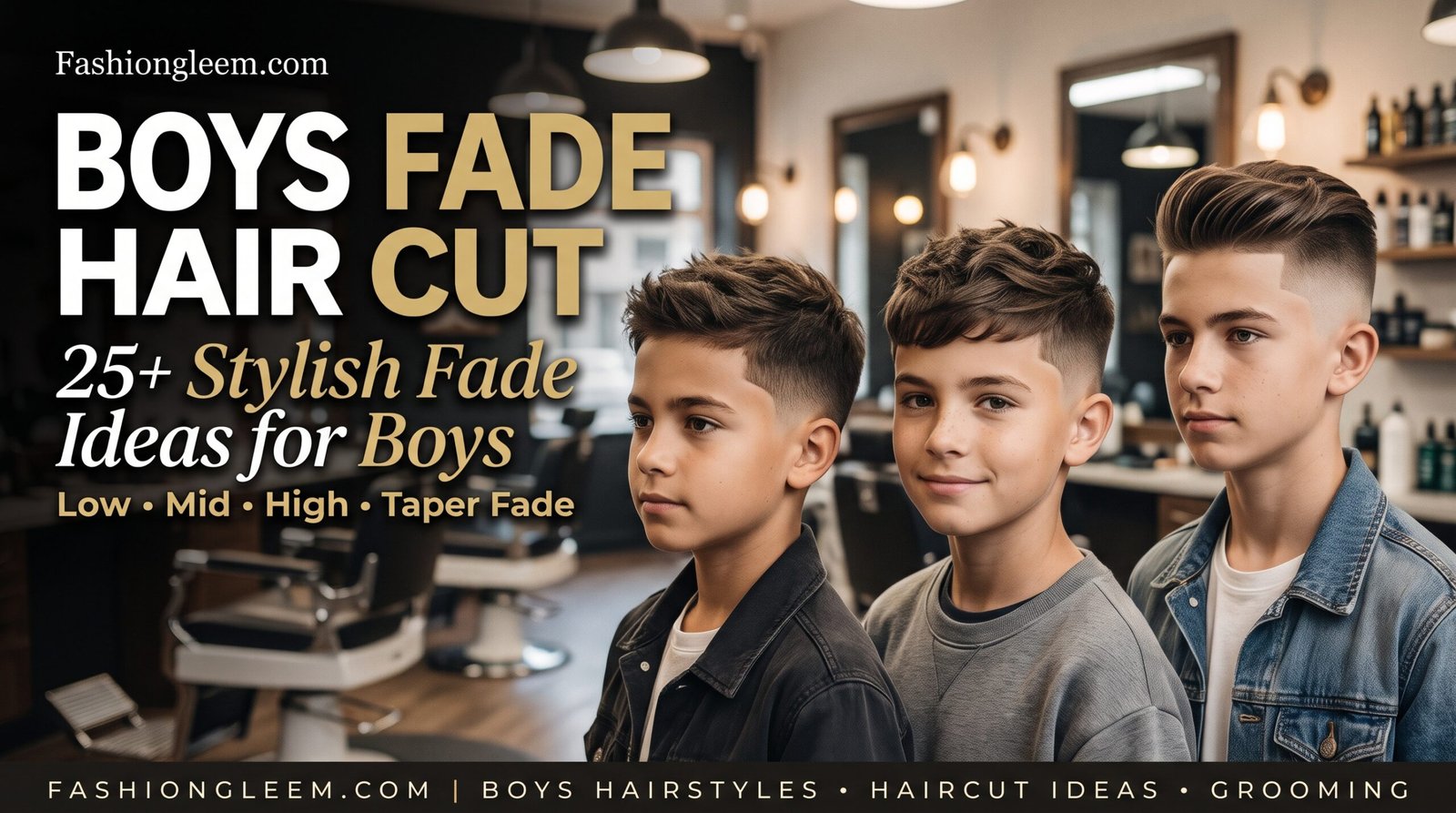
Boys Fade Hair Cut: The Ladder, the Numbers, and the Right Height for His Age
The boys fade hair cut is the style boys ask for by name and parents have to decode at the barbershop door. Fade sounds like one haircut, but it names a whole family of blends.
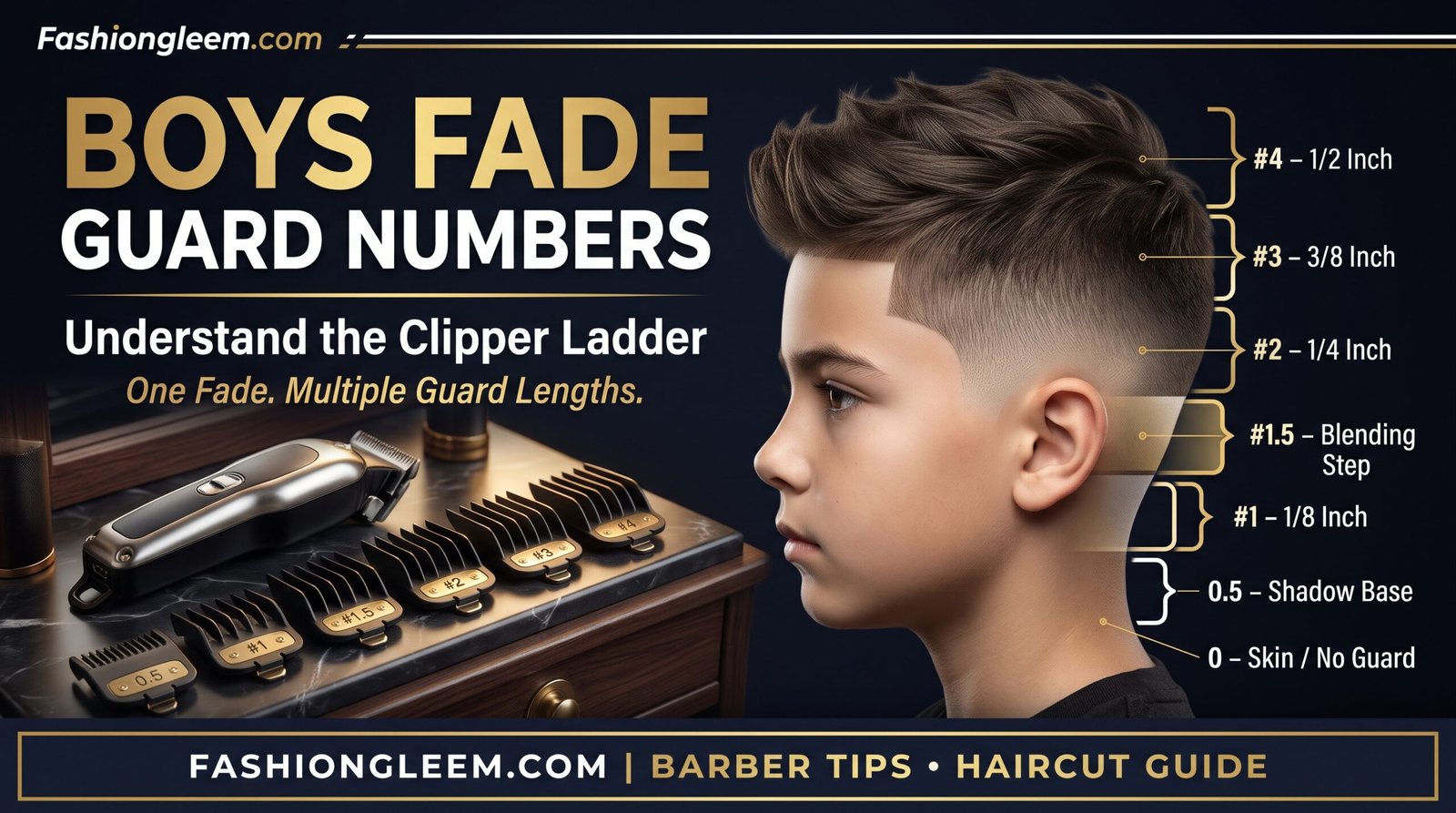
Here is the decode. A fade is a ladder of clipper guard numbers blended up the sides and back: very short at the bottom, longer step by step, until it meets the top.
Every fade a boy can get is three choices. Where the ladder starts (low, mid, or high), how far down it goes (skin, shadow, or taper), and what sits on top (crop, quiff, comb over).
Galleries show fifty named styles because names are free. Barbers work from numbers, photos, and the head in the chair.
FashionGleem collects its boys guidance in the boys hair cut styles guide, and the ladder method there runs through every fade choice that follows.
The Fade Decision Matrix
|
Fade |
Where the blend starts |
Shortest base |
Grow out |
School safety |
Best ages |
|---|---|---|---|---|---|
|
Low taper fade |
Just above ears and neckline |
#1 to #2 |
Softest |
Highest |
Toddlers up |
|
Low fade |
Just above ears |
#0.5 to #1 |
Soft |
High |
4 plus |
|
Mid fade |
Middle of the sides |
#0 to #1 |
Moderate |
High for most |
School age up |
|
High fade |
Near the temples |
#0 to #1 |
Fastest visible |
Check the handbook |
Older boys, teens |
|
Skin fade (any height) |
Height varies |
Bare skin, 0 |
Dates fastest |
Some schools prohibit |
Teens mainly |
|
Shadow fade (any height) |
Height varies |
#0.5 to #1 shadow |
Gentle |
High |
All ages |
Read the matrix by the column your family cares about. Grow out decides between appointments, school safety decides what is allowed, and age decides what a boy can sit through and maintain.
The pattern to notice: nothing on the left side is a different haircut from its neighbor. The rows are the same ladder starting at different heights and bottoming out at different numbers.
The Ladder: A Fade Is Several Numbers
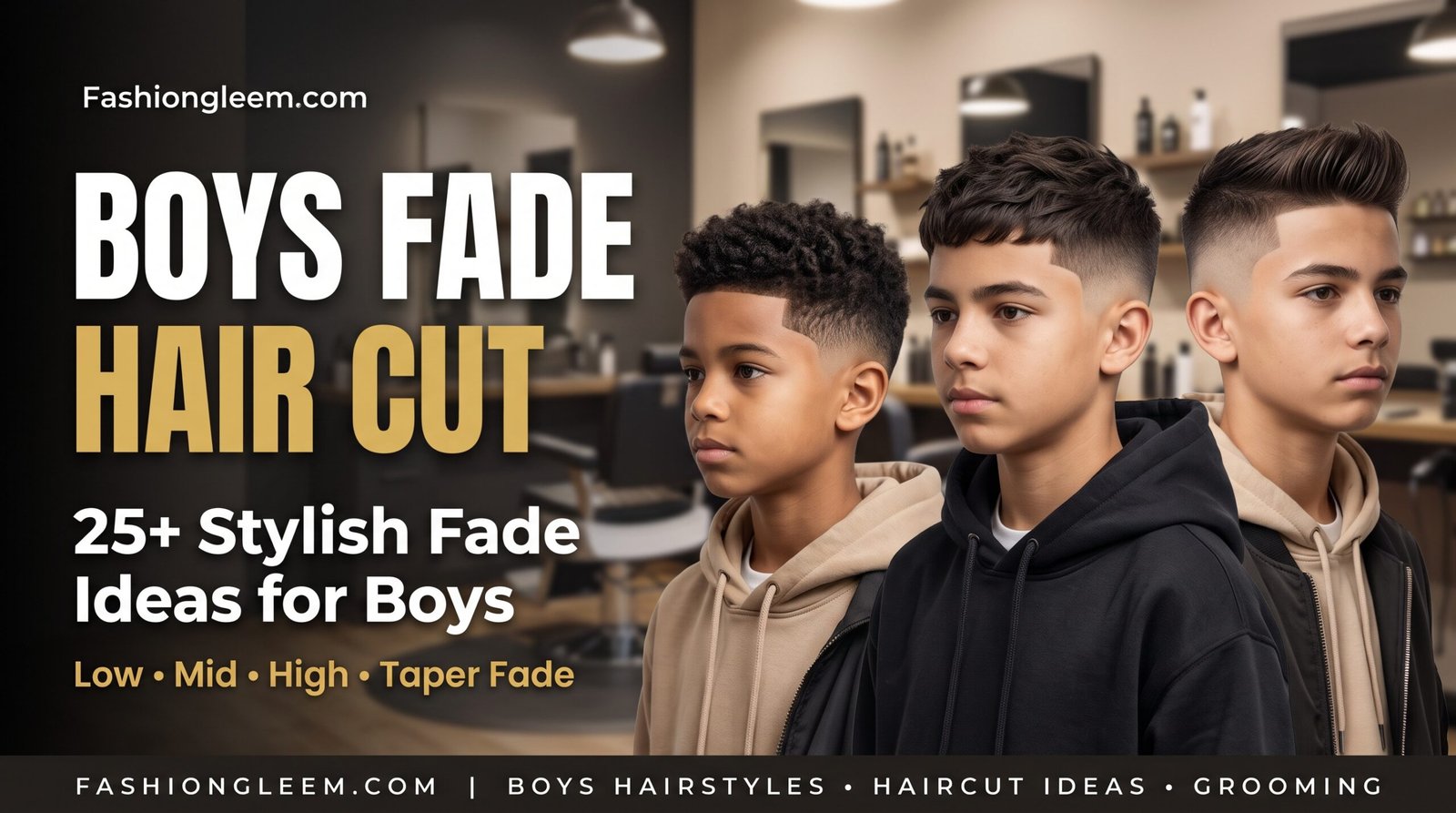
The single most useful fact in this guide is that no fade is one number. A number holds one fixed length; a fade is a gradient, so it must be built from several lengths blended together.
Picture the side of the head as a staircase. At the bottom step, the shortest length: bare skin, or a #0.5 shadow, or a #1.
Climbing up, the lengths grow: a #1 gives way to a #2, the #2 to a #3, and the #3 into whatever length the top wears.
Barbers blend the steps away with technique: the clipper’s lever opens and closes to create half steps, the clipper rides over a comb for in between lengths, and corners are softened freehand.
That blending is the skilled part, and it is why two shops can both deliver “a mid fade” with visibly different softness. The numbers are identical; the blend is the craft.
Low, mid, and high then become simple geography. They name where on the head the staircase’s short zone sits, and how much of the side the gradient covers.
The Guard Chart
Guard numbers are eighths of an inch: the number times one eighth gives the length left on the head. The chart is the industry convention, and it varies by about a millimetre between brands.
|
Guard |
Length left |
Fade role |
|---|---|---|
|
0 (no guard) |
About 1/16 in / 1.5 mm |
The skin fade base |
|
0.5 |
About 1/16 in / 1.5 to 2 mm |
The shadow fade base |
|
#1 |
1/8 in / 3 mm |
Shadow bases, low fade bottoms |
|
#1.5 |
3/16 in / about 5 mm |
The blending step |
|
#2 |
1/4 in / 6 mm |
Low fade tops of the short zone, toddler bases |
|
#3 |
3/8 in / 10 mm |
Where blends meet short tops |
|
#4 |
1/2 in / 13 mm |
Crew length tops, gentle sides |
|
#5 to #8 |
5/8 to 1 in / 16 to 25 mm |
Longer tops, scissor territory begins |
BestBomg’s clipper length guide lays out the full number system, and Hair Everyday’s guard size guide gives the same chart from a second source. Learn the bottom half of the chart and you can follow any fade conversation in any shop.
Two refinements matter in the chair. Half sizes (0.5, 1.5, 2.5) exist as guards on many sets, and the lever on the clipper’s side opens to add roughly another 1/16 inch to whatever guard is fitted.
That is how barbers climb the ladder in small enough steps that no line survives. When a parent says “not too short,” the translation is a shortest number, not a vibe: say the number you can live with at the base.
The Fade Family: Heights
Low Fade
The low fade starts its short zone just above the ears and curves down around the neckline. Most of the side keeps visible length, so the effect reads neat rather than bold.
It is the starter fade: the softest grow out, the widest school acceptance, and the gentlest introduction for a boy new to clippers.
Pair it with almost any top. It is also the fade most likely to still look deliberate at week four.
Mid Fade
The mid fade starts around the middle of the sides, roughly at the temples’ lower edge, splitting the difference between subtle and sharp.
It is the workhorse fade for school age boys and teens: modern contrast on day one, a gradient that stays tidy longest relative to its sharpness, and acceptance at most schools.
If a family can only learn one fade, this is the one. Most gallery photos boys bring in are, on inspection, mid fades wearing different tops.
High Fade
The high fade starts up near the temples, so the short zone covers most of the side and the contrast with the top is dramatic.
It is the boldest of the three heights and the most perishable: regrowth shows against the large short area quickly, and the shape needs its refresh on the short cycle.
High fades suit older boys and teens with the patience and budget for upkeep, bold tops like faux hawks and quiffs, and schools whose handbooks allow them.
The Base: Skin, Shadow, Taper
Height is where the ladder starts; the base is where it ends at the bottom, and it controls both sharpness and lifespan.
A skin fade (bald fade) bottoms out at bare skin. It is the crispest finish in the family, the one in the sharpest photos, and the fastest to look grown out, because stubble against skin announces itself within days.
A shadow fade bottoms out at a #0.5 or #1, keeping a soft shadow of hair. It photographs gently, grows out kindly, and passes more school codes.
A taper bottoms out higher still, with the blend concentrated at the edges only. The base decision is really a calendar decision: how sharp do you need day one to be, and how many weeks must it survive?
Fade vs Taper
The two words get used interchangeably in shops, and the distinction is worth one clean paragraph. Barber guidance puts it this way: a fade blends the whole side and back and can go all the way down to skin.
A taper only tidies the edges, shortening around the ears and the neckline while the sides keep their length.
A taper fade splits the difference, concentrating a real blend at the edges. When a school or a grandparent wants “not too short,” they are almost always asking for the taper end of this spectrum.
Choose by Age
Age changes the right answer because age changes sitting still, clipper tolerance, school rules, and who maintains the style. One kids guide’s age framework, labelled as that guide’s system, organizes the bands this way.
Toddlers, 2 to 5
Low and soft. A low taper or low shadow fade, a natural hairline with no sharp line up, and rounded, gentle edges.
That framework suggests a #2 as the shortest base for young toddlers’ comfort and puts upkeep at four to six weeks, the longest interval in the family, because toddler fades are chosen for grow out, not sharpness.
Preschool age is when many families start, once a boy can sit safely and tolerate the clipper’s sound with a parent close by.
School Age, 6 to 12
Mid is the default. The mid fade with a textured top handles school photos, sports, and growth spurts, and mid tapers satisfy stricter handbooks.
The same framework puts school age upkeep at three to five weeks. This is also the band where light designs and hard parts get requested; both are handbook questions first and style questions second.
Teens, 13 Plus
The full menu opens. High fades, skin fades, line ups, hard parts, pompadour and quiff tops, and the shortest refresh cycle, about two to four weeks in the same framework, because teens wear the sharpest versions.
Teen trend claims (the textured crop as most requested, and similar) circulate as barber blog claims and are labelled that way here; what is verifiable is that teens maintain fades most often because they choose the finishes that date fastest.
Hair Type Filters
The same fade is four different haircuts on four different heads. Run the filter that matches your boy before choosing height and top.
Straight Hair
Straight hair shows every line a clipper leaves, so blending quality is the whole game: mid fades and taper fades with careful gradients read cleanest.
Regrowth lines also appear sooner, so plan the shorter end of trim intervals, and prefer a shadow base, whose grow out has no hard edge against skin.
Curly Hair
Curly hair forgives. The gradient hides inside the curl pattern, regrowth blends itself, and the fade’s real job is removing bulk around the ears and neck so the curls on top own the silhouette.
Judge all lengths dry: wet curls stretch and shrink back, so a guard that looked right in the chair can dry shorter than intended. Keep the top long enough for a full curl to form.
Thick Hair
Thick hair fades beautifully because the gradient has density to work with, but the top needs texture or thinning so it does not sit like a helmet.
Ask for point cutting through the top. Very thick, straight hair may need the more frequent end of trims, as kids hair guides note, because the sides’ bulk returns fast.
Fine Hair
Fine hair shows scalp at the shortest guards, so keep the base at a #1 or higher, choose low or shadow fades, and keep top length for coverage.
Texture and a light matte product make the top read fuller. A skin fade on fine hair can look patchy and leaves the scalp exposed to sun, which is why most families land on the shadow version.
Cowlicks
Cowlicks are a top problem, not a fade problem: the sides behave; the fringe swirl decides the style.
Give the swirl either length and weight (a fringe or crop that lies with it) or a cut short enough that it cannot stand up, and tell the barber where it lives before the first clipper pass.
The Tops: What Sits Above the Fade
Textured Crop
The textured crop is the current default pairing: faded sides, a short choppy top pushed forward, and a straight or textured fringe.
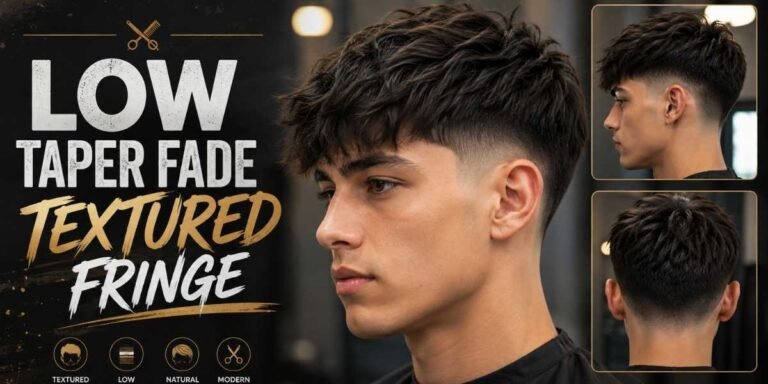
The dedicated low taper fade textured crop haircut shows the gentle low version on a real head. Crops need no morning styling, suit straight and wavy hair, and grow out as a family, top and sides softening together.
Quiff
The quiff keeps the front long enough to lift up and back, and the fade supplies the clean frame. The textured quiff guide covers the shape in detail.
Quiffs suit older boys who will spend a minute with a brush or fingers; on a six year old, the styling step usually defeats the style by Tuesday.
Comb Over and Side Part
The comb over sweeps a longer top across from a part, the neat and photo friendly option. The low taper fade side part hairstyle pairs it with the softest fade in the family.
With a natural part it reads classic; with a hard part it reads sharp and formal, at the price of a two week line to maintain.
Fringe and French Crop
The fringe family wears the top forward and lets the front edge do the styling: cropped, textured, or longer and choppy.
Fringes hide cowlicks under weight, forgive foreheads of every proportion, and ask nothing in the morning. For boys growing out a crop, the fringe is also the natural next stop before longer styles.
Faux Hawk and Mohawk
The faux hawk keeps a wide center strip styled up, framed by a burst or mid fade: mohawk energy, school survivable shape, and combed down it reads as an ordinary textured top.
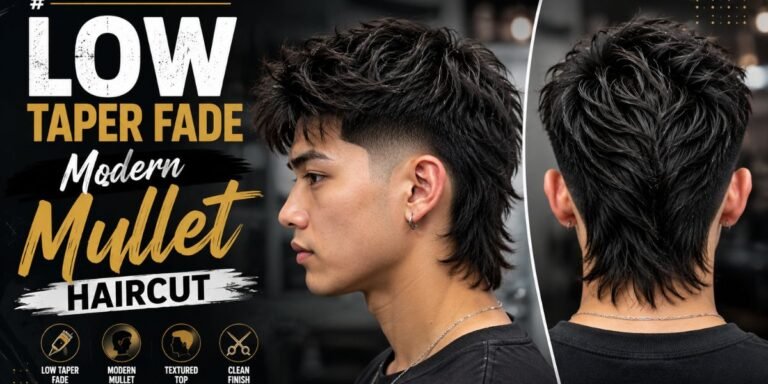
A true mohawk with fully faded sides is the weekend extreme. The faux version is the compromise parents and boys both sign, which is why it fills the galleries.
Crew and Buzz Tops
Short tops close the loop back to simplicity: a crew keeps a little length to brush forward, and a buzz keeps one number everywhere.
The buzz cut for men guide covers the single number end of the family. Boys often run a fade through the school year and take a buzz for summer, then grow back into a fade in the fall.
Longer and layered tops live at the other end of the spectrum, and the layered haircuts for men guide shows how length and a fade share a head when a boy is growing his hair out.
All of these looks sit inside the hair style category, grouped with the rest of the site’s cuts.
The Barber Script
Names fail in barbershops because galleries invent them per website. Numbers, heights, and photos travel. Give the barber four things, in this order.
1. The height. Low, mid, or high, the geography of the blend.
2. The shortest number. “Down to a 1,” or “skin at the bottom,” or “nothing below a 2 for my toddler.” This number controls both sharpness and grow out, so it is the one to negotiate carefully.
3. The top. Style and length in inches or guard terms: “textured crop, about two inches, fringe forward.”
4. The finish. Natural hairline or line up, hard part or none, neckline shape. Finishes are where school rules bite, so decide them at home.
Then show two or three photos of the exact combination. A complete script sounds like this: mid fade, down to a 0.5, textured crop on top, natural hairline, no hard part.
Thirty seconds, no ambiguity, and the same script works in any shop in the country.
At Home: Fades and Touch Ups
A basic fade at home is possible with clippers, a guard set running 0.5 through 4, a mirror arrangement, and patience. Work in small steps between numbers and use the lever to blend, checking the gradient in natural light.
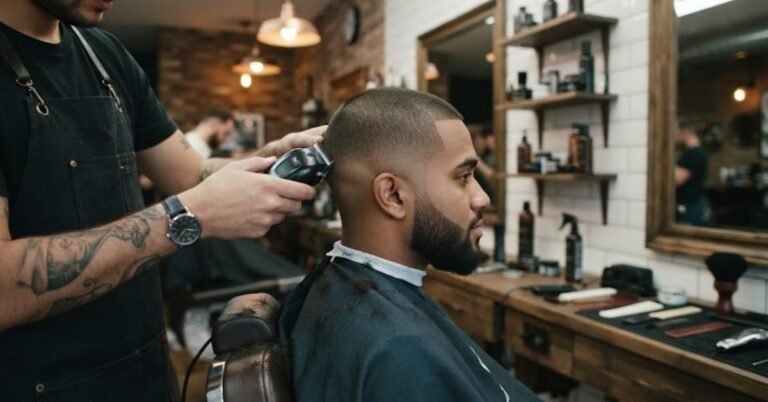
The blend and the back are the hard parts; a second adult helps with both. Most families land on a division of labor: the barber owns the fade, home owns the upkeep, meaning neckline cleanups and around the ears with a trimmer between visits.
Do not re fade the sides at home without practice. A grown out professional fade looks better than a fresh amateur one, and a bad home blend is the hardest thing for a barber to rescue.
The Upkeep Calendar
Fades are subscriptions, not purchases, so plan the cycle before choosing the sharpness. Popees kids hair guide ranges, labelled as one guide’s figures, put low tapers at three to four weeks and mid and high fades at about three.
The age framework used earlier runs longer for toddlers (four to six weeks) and shorter for sharp teen finishes (two to four). Treat all of these as planning ranges from their sources, not promises; your boy’s growth rate writes the real calendar.
Hair type adjusts the ranges: straight and fine show regrowth sooner, curly blends its own regrowth and forgives an extra week. Book the next appointment while you are still in the shop for the sharp finishes.
Surgery: Fades That Went Wrong
|
The problem |
What happened |
The fix |
|---|---|---|
|
Grown out in a week |
Skin or high base, sharp finish, fast growth |
Shadow base or lower height next time |
|
Patchy on fine hair |
Base number too low for the density |
Keep the base at #1 or higher |
|
Lines and steps showing |
Blend rushed, lever steps skipped |
A better blended shop; check work in daylight before leaving |
|
Too harsh for a toddler |
Skin finish and line up on a young child |
Low shadow fade, natural hairline |
|
School sent a note |
Design or hard part against the handbook |
Grow out, re-cut as a mid taper; check the handbook first next time |
|
Fringe splits every morning |
Cowlick ignored in the top’s design |
Length and weight over the swirl, or crop it shorter |
|
Looks great, hates the chair |
Great cut, wrong experience |
Scissor led taper, kid specialist, shorter appointments |
Every row of this table is a settings error, not a style error, which is the hopeful reading: the same boy and the same fade family succeed once the height, base number, and finish match his age, hair type, and school.
Frequently Asked Questions
What is a boys fade haircut?
A fade blends the sides and back gradually from longer at the top down to very short, sometimes bare skin, at the bottom.
It is not one clipper number but a ladder of guard lengths blended together, finished with a styled top: crop, quiff, comb over, fringe, or crew. Low, mid, and high describe where the shortest zone sits.
What is the difference between a low, mid, and high fade for boys?
Height means where the fade’s shortest zone and blend sit. A low fade starts just above the ears and neckline, soft and natural.
A mid fade starts around the middle of the sides, balanced and modern. A high fade starts near the temples, bold with strong contrast. Lower grows out softer; higher looks sharper and dates faster.
What is the difference between a fade and a taper for boys?
A fade blends the whole side and back and can go down to skin. A taper only tidies the edges, around the ears and neckline, while the sides keep visible length.
Parents who want subtle choose a taper or low taper fade. Boys who want the modern blended look choose a true fade.
What guard numbers are used in a boys fade?
A ladder, not a single number. The bottom might be a 0 for a skin fade or a 1 for a shadow fade, climbing through 2 and 3 into the top.
Guard numbers are eighths of an inch: 1 is 3 mm, 2 is 6 mm, 3 is 10 mm, 4 is 13 mm. Half sizes and the clipper lever fill the steps between.
What is a skin fade, and is it right for kids?
A skin fade blends the bottom down to bare skin, no guard or a 0 at the base. It is the sharpest version and looks grown out fastest.
Many guides suggest it suits older boys and teens best. For toddlers, a shadow fade keeps the look without the skin finish.
What is a shadow fade for boys?
A shadow fade keeps a short shadow of hair at the bottom instead of bare skin, typically a 0.5 or 1 at the base.
It reads softer in photos, grows out more gently, and passes school rules more easily. For many families it is the default first fade.
What is a taper fade for boys?
A taper fade concentrates the blend at the edges, around the ears and neckline, rather than climbing the whole side.
It is the gentlest member of the fade family, the most school safe, and the easiest to grow out. Low, mid, and high describe how far up the edge blend reaches.
What is a burst fade and a drop fade?
Two shaping variations. A burst fade curves the blend around the ear in a semicircle, pairing with faux hawks and mohawks.
A drop fade follows the head’s shape, dropping the blend down behind the ear toward the neckline. Both describe the blend’s path, not its height.
What is the best fade for a toddler?
Guide consensus points low and soft: a low taper or low shadow fade, a natural hairline, and no sharp line up.
One kids guide suggests a number 2 as the shortest base for young toddlers; treat that as that guide’s framework. Toddlers also need a patient barber and a short appointment.
What is the best fade for school age boys (6 to 12)?
The mid fade is this age band’s workhorse: modern, clean, and accepted by most school codes. Always check the local handbook; no national rule exists.
Pair it with a textured top for two minute mornings. Light designs appear at this age only where the school allows them.
What fades do teenage boys usually ask for?
Teens drive the trend end: mid and high fades, skin fades, textured and French crops, fringes, quiffs, and blowout tops, plus line ups and hard parts.
Roundups describe the textured crop family as heavily requested by teens; that is a blog claim, reported as such. Teens also refresh fades most often, about every two to three weeks.
How long does a boys fade last?
A fade looks freshest for about two to three weeks, then the blend grows into a softer gradient. Skin and high fades show regrowth fastest, often inside two weeks.
One parent guide’s ranges put mid and high fades at about three week refreshes and low tapers at three to four; those are one guide’s planning numbers.
How often should a boys fade be trimmed?
Plan on roughly every three weeks for most fades, two to three for skin and high fades kept sharp, and three to four for low tapers.
Straight fine hair shows regrowth sooner; curly hair forgives an extra week. Book the next appointment at the current one if the calendar is tight.
What fade is best for curly hair boys?
Curly hair is the fade’s friend: the taper removes bulk around the ears while curls keep the stage on top. Mid and low fades suit most curl patterns.
Ask the barber to judge lengths dry, since curls shrink as they dry. Keep the top long enough for the curl to form, usually a few inches.
What fade is best for straight hair boys?
Straight hair shows every line, so blending quality matters most: mid fades and taper fades with careful gradients look cleanest.
Tops pair with textured crops, fringes, and comb overs. Expect the shorter end of the trim interval, and consider a shadow base for a softer grow out.
What fade works for thick hair?
Thick hair takes a fade beautifully, but the top needs texture so it does not sit like a helmet. Ask for point cutting in the top.
A mid or high fade controls the sides’ bulk. Very thick straight hair may need the more frequent end of trims, as kids guides note.
What fade works for fine or thin hair?
Fine hair shows scalp quickly at the shortest guards, so keep the base at a 1 or higher and choose low or shadow fades.
Keep some top length for coverage; texture and a light matte product help fullness. A skin fade on fine hair can look patchy and exposes the scalp to sun.
Will a fade work with a cowlick?
Yes, if the top respects it. Fringe cowlicks want length and weight that lie with the swirl, or a cut short enough that the swirl cannot stand.
Tell the barber where the cowlicks are before the cut. The fade sits on the sides; the top’s design is where cowlicks are won or lost.
Are fades allowed at school?
It depends entirely on the local school’s grooming code; there is no national rule. Guides agree low and mid fades with natural hairlines are accepted almost everywhere.
Some schools prohibit skin fades, designs, or hard parts. Check the handbook before a bold first fade, especially at private and uniform schools.
What should I ask the barber for a boys fade?
Use a four part script: fade height, shortest number, top style and length, and finish.
Example: a low fade, down to a 1 at the shortest, textured crop on top about two inches, natural hairline, no hard part. Then show two or three photos; names vary by shop and country.
Should a boys fade have a line up?
A line up sharpens the hairline and temples for a crisp frame. It photographs sharply but grows out fastest of all.
Many parents keep a natural hairline for young boys and add line ups for older boys and special occasions. A lined hairline also commits to a shape that may fight natural growth.
What is a hard part in a boys fade?
A hard part is a shaved line along the parting, cut with a trimmer or razor, making the part permanent and bold.
It suits comb overs and side parts on older boys. It grows out visibly within two weeks and needs the fade’s refresh cycle; check school rules first.
How much does a boys fade haircut cost?
Prices vary too much by city and shop type for a national average, and this guide does not invent one.
Kids chains, independent barbers, and kids salons price differently; designs and line ups cost more. The refresh cycle, about every three weeks, matters more to the yearly budget than one cut’s price.
Can I do a boys fade at home?
A basic fade is possible at home with clippers, guards, and patience, and many parents maintain between visits.
The hard parts are the blend (small guard steps, the lever, natural light) and the back. Many families compromise: barber for the full fade, home for neckline cleanups.
What clippers and guards do I need for a boys fade at home?
A standard clipper with guards 0.5 through 4 covers most fades, plus a trimmer for edges if you want them.
Work in small steps, blend with the lever between numbers, and watch a full tutorial first. Start with a low, forgiving fade, not a skin fade.
What age can a boy get his first fade?
There is no minimum age; the gates are sitting still safely, tolerating clipper sound and vibration, and the parents’ taste.
Many families start with low taper or shadow fades in the preschool years. Skin fades and line ups usually wait for the school years or teens.
My son is scared of clippers. What are the options?
Ask for a scissor cut or scissor led taper first, book a kid specialist, and visit once just to watch.
Let him hold or hear the clippers before they touch him. Some shops offer quieter clippers and longer first appointments. A scissor led low taper keeps the look while trust builds.
What is the best fade for a boy who hates haircuts?
Choose for grow out, not day one sharpness: a low taper or low shadow fade, natural hairline, textured top.
It looks intentional at week four, stretching the gap between dreaded appointments. Avoid skin fades, line ups, and hard parts, which announce regrowth immediately.
Do fades need styling products for boys?
Most school day fades need nothing: the cut does the work, and a damp hand settles the top.
Textured crops can take a pea sized amount of light matte paste on dry hair. If a style needs ten minutes daily, it is the wrong style for school mornings.
How do I style a boys fade in the morning?
Ninety seconds: dampen the top, push it into its direction (forward for crops, up and back for quiffs, sideways for comb overs), and let it dry.
Product, if used, goes on after, pea sized, on dry hair. The sides need nothing; that is the point of the fade.
What is a boys fade with a textured crop?
The current default pairing: faded sides with a short, choppy, forward swept top and a textured fringe.
It suits straight and wavy hair and needs no styling beyond a push forward. Roundups call it among the most requested teen cuts; that is a trade blog claim, and its practicality checks out in any schoolyard.
What is a boys fade with a quiff?
A quiff keeps the front long enough to lift up and back, with faded sides supplying contrast.
It suits straight and wavy hair and older boys who will spend a minute styling. It grows out gracefully into a comb over or side part. On very young boys the styling step usually defeats the style.
What is a boys fade with a faux hawk?
A faux hawk keeps a wider central strip styled upward without mohawk extremes; a burst or mid fade frames it.
It gives mohawk energy with a school safer shape, and combed down it reads as a normal textured top. It is the classic compromise cut.
What is a fade with a comb over for boys?
A comb over pairs faded sides with a top swept across, usually with a side part. It is the neat, photo friendly option.
With a hard part it reads sharp and formal; with a natural part, classic. It needs a minute of morning direction, more than a crop, less than a quiff.
Can boys with long tops get fades?
Yes: long top with faded sides is a whole family (fringes, slick backs, shags, loose quiffs). The fade handles the perimeter while length lives on top.
The trade is upkeep asymmetry: sides need the three week refresh while the top can go longer, so some families book fade only touch ups between full cuts.
What fade is best for a round face?
Height on top balances roundness, so mid or high fades with a quiff, faux hawk, or textured volume suit round faces.
Avoid very short tops that mirror the face’s shape. The fade’s tight sides already slim the silhouette; the top adds the vertical line.
What fade is best for hot weather and sports?
Shorter and higher reads cooler: a mid or high fade with a short crop or crew top keeps helmets and hats comfortable and dries fast.
Remember sun protection: freshly faded skin burns, so hats and sunscreen matter in the first days after a skin or high fade, especially at summer camps.
Will a fade fix a flat spot or head shape worries?
A fade cannot change head shape, but gradient choices flatter it: skin zones emphasize every contour, while shadow fades soften them.
Tell the barber the concern and the blend adjusts. For infants with genuine flat head concerns, that is a pediatric conversation, not a barber one.
Is a fade or a buzz cut better for boys?
A buzz is one guard all over, the lowest maintenance cut that exists, refreshed at home easily.
A fade keeps a styled top and shaped sides, costs more upkeep, and offers far more looks. Many boys alternate: buzz for summer, fade for the school year.
What is the difference between a boys fade and an undercut?
An undercut disconnects: sides clipped at one length with no gradient into a much longer top, a hard shelf.
A fade graduates the same territory smoothly. Undercuts grow out with a visible ledge; fades soften into a gradient. The fade is the more forgiving grower of the two.
Why does my son’s fade look grown out after a week?
Four usual causes: a skin or high fade (sharpest finishes date fastest), fast hair growth, straight fine hair showing regrowth lines, or a base number too low for his growth rate.
Fixes next time: a shadow base, a lower height, or a slightly longer shortest guard, all of which buy presentable days.
How do I keep a boys fade looking fresh between cuts?
Small and safe: clean the neckline and ears with a trimmer if you are confident, and reset the top’s direction with water each morning.
Do not re fade the sides at home unless you have practiced; a bad home blend is harder to fix than a grown out one. Book the refresh before it looks urgent.
Conclusion
The boys fade hair cut stops being a guessing game when read as a ladder: numbers blended up the side, a height for his age, a base for its lifespan, and a top for his hair type.
Take the script and the photos, and the cut in the chair will match the cut in his head.
Start with the parent guide to boys hair cut styles for the full menu of boys cuts, then bring this page’s script to the shop: height, shortest number, top, finish.
For a first fade, start low and shadowed; sharpness can always be added at the next visit, and grow out forgiving fades are how boys learn to love the barber’s chair.