
Retinol Body Lotion: Benefits, How to Use It, and the Best Options
Note: This guide is general information only, not medical advice. Skin responses vary. Check with a dermatologist if you have a skin condition or are pregnant.
Retinol body lotion brings the most proven anti-aging ingredient in skincare below the chin. Your arms, legs, chest, and hands age just like your face does.
This guide covers what it does, how it works, and the exact protocol dermatologists recommend for starting safely. You will also learn how to choose a formula and which ingredients pair well with it.
For the full ritual around it, see our body care routine aesthetic guide.
Quick Answer
| Question | Short answer |
|---|---|
| What is it? | A body moisturizer formulated with retinol (vitamin A). |
| What does it do? | Speeds cell turnover and supports collagen, improving texture, tone, and firmness. |
| Who is it for? | Adults concerned with crepey skin, fine lines, dark spots, or rough texture on the body. |
| How do I start? | 2-3 nights per week, low strength, at night, with moisturizer and daytime SPF. |
| How long for results? | 8-12 weeks of consistent use, per dermatologist guidance. |
What Retinol Body Lotion Actually Is
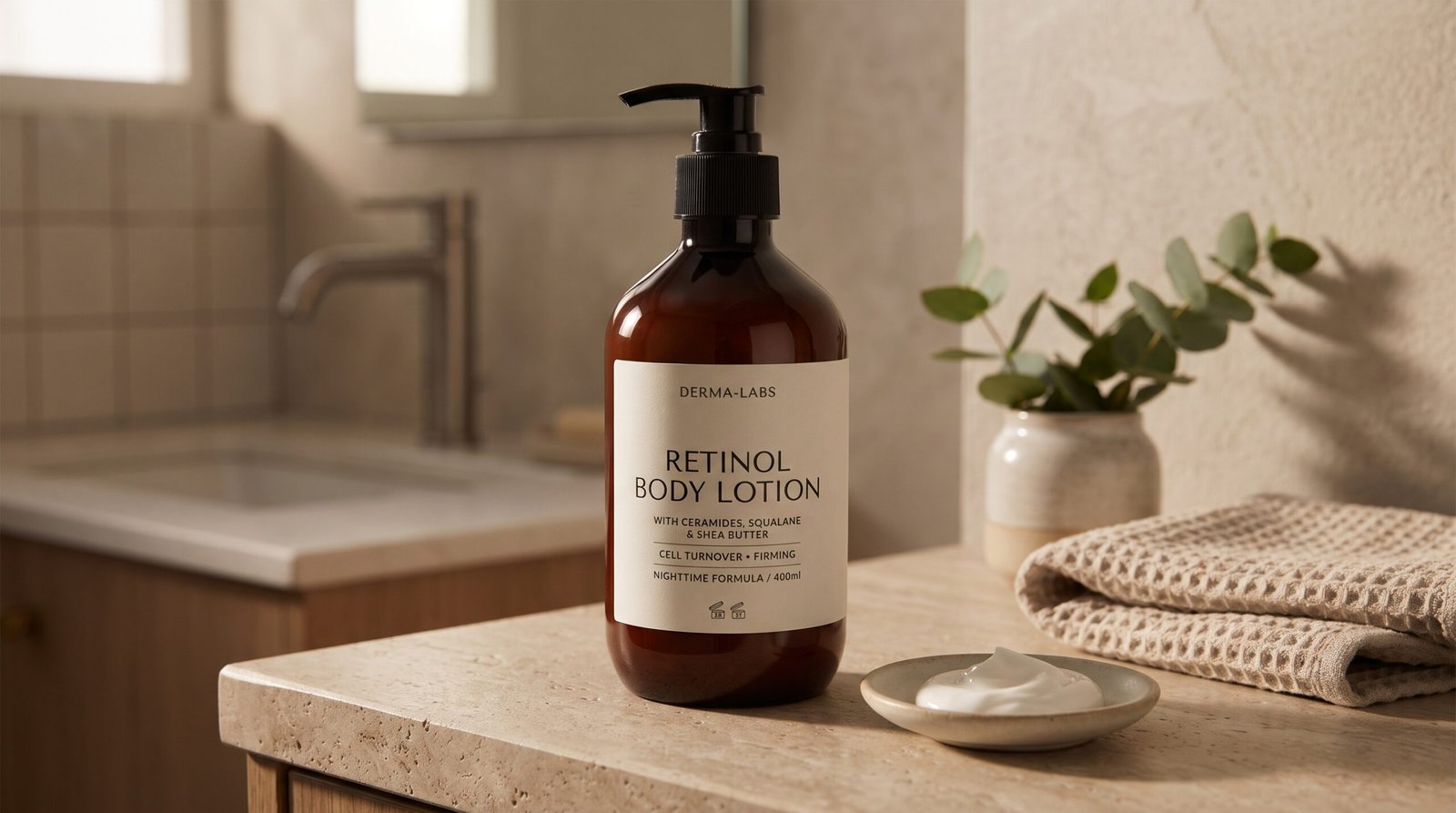
A retinol body lotion is a moisturizer with retinol as an active ingredient. Retinol is a form of vitamin A and the most studied topical anti-aging ingredient in dermatology.
Body formulas differ from face formulas in base and strength. They come in larger bottles, richer moisturizing bases, and concentrations tuned for thicker body skin.
It is a cosmetic product, not a prescription drug. Prescription tretinoin is stronger and requires a doctor. Body lotions stay in the gentler over-the-counter range.
How Retinol Works on Body Skin
Retinol speeds up cell turnover, the process where old skin cells shed and new ones rise. Faster turnover means smoother texture and more even tone.
It also stimulates collagen and elastin production in the deeper skin layers. Collagen is the structural protein that keeps skin firm and thick.
Body skin is thicker than facial skin, so it generally tolerates retinoids better. That does not mean every zone reacts the same way.
The Strength Ladder
Not all vitamin A ingredients are equal. They form a ladder from gentlest to strongest:
| Ingredient | Strength | Notes |
|---|---|---|
| Retinyl palmitate | Gentlest | Must convert twice; mildest results |
| Retinol | Moderate | Converts once to retinal; the body-lotion standard |
| Retinal (retinaldehyde) | Strong | One step from active; faster acting |
| Tretinoin | Strongest | Prescription only; not in body lotions |
Most body lotions use retinol or retinal. Retinyl palmitate appears in gentler formulas. Tretinoin never appears in over-the-counter body lotion.
Retinol vs Retinal vs Bakuchiol
Retinol is the proven middle ground. Decades of research support it for texture, tone, and firmness.
Retinal works faster because it needs one fewer conversion step. It can also irritate faster, so beginners should approach it carefully.
Bakuchiol is a plant-derived alternative, not a true retinoid. It offers milder firming benefits with less irritation risk, which suits very sensitive skin.
Dermatologists quoted in the research call topical retinoids the gold standard for anti-aging, and that science applies below the neck too.
7 Proven Benefits of Retinol Body Lotion

1. Smoother Skin Texture
Faster cell turnover sheds rough, dull surface cells. Skin feels smoother within weeks, even before deeper changes appear.
This is the first benefit most users notice. Rough patches on arms and legs soften.
2. Firmer-Looking Skin
Collagen support helps skin look firmer and more resilient over months. It will not replicate surgery, but texture and bounce visibly improve.
Dermatologists note that firmer skin also tears and bruises less easily as skin thins with age. That functional benefit matters beyond looks.
3. Less Visible Crepey Skin
Crepey skin is thin, wrinkled skin that resembles crepe paper, common on arms, chest, and above the knees. Retinol helps by thickening skin over time through collagen renewal.
Dermatologist guidance says to expect 8 to 12 weeks of consistent use before visible improvement. Severe laxity may still need in-office procedures.
4. Faded Dark Spots
Retinol helps shed pigmented surface cells gradually. Sun spots and post-inflammatory marks fade over 6 to 8 weeks of steady use.
It works cell by cell, so patience matters. Pairing with daily sunscreen prevents new spots while old ones fade.
5. Help for Keratosis Pilaris
Keratosis pilaris, the rough bumps often called chicken skin, responds to increased cell turnover. Retinol loosens the keratin plugs that cause the texture.
Many users combine retinol with gentle exfoliation in the shower for better results on KP-prone arms.
6. Fewer Fine Lines
Fine lines on the neck, chest, and hands soften as collagen rebuilds. These areas show age early because the skin is thin and sun-exposed.
Results are gradual. Deep wrinkles respond less than fine surface lines.
7. Clearer Body Skin
Retinol keeps pores clear and reduces body breakouts on the back, chest, and shoulders. It also fades the dark marks breakouts leave behind.
Anyone dealing with body acne should also review their shower routine in our body wash for glowing skin guide.
How to Use Retinol Body Lotion: The 5-Step Protocol
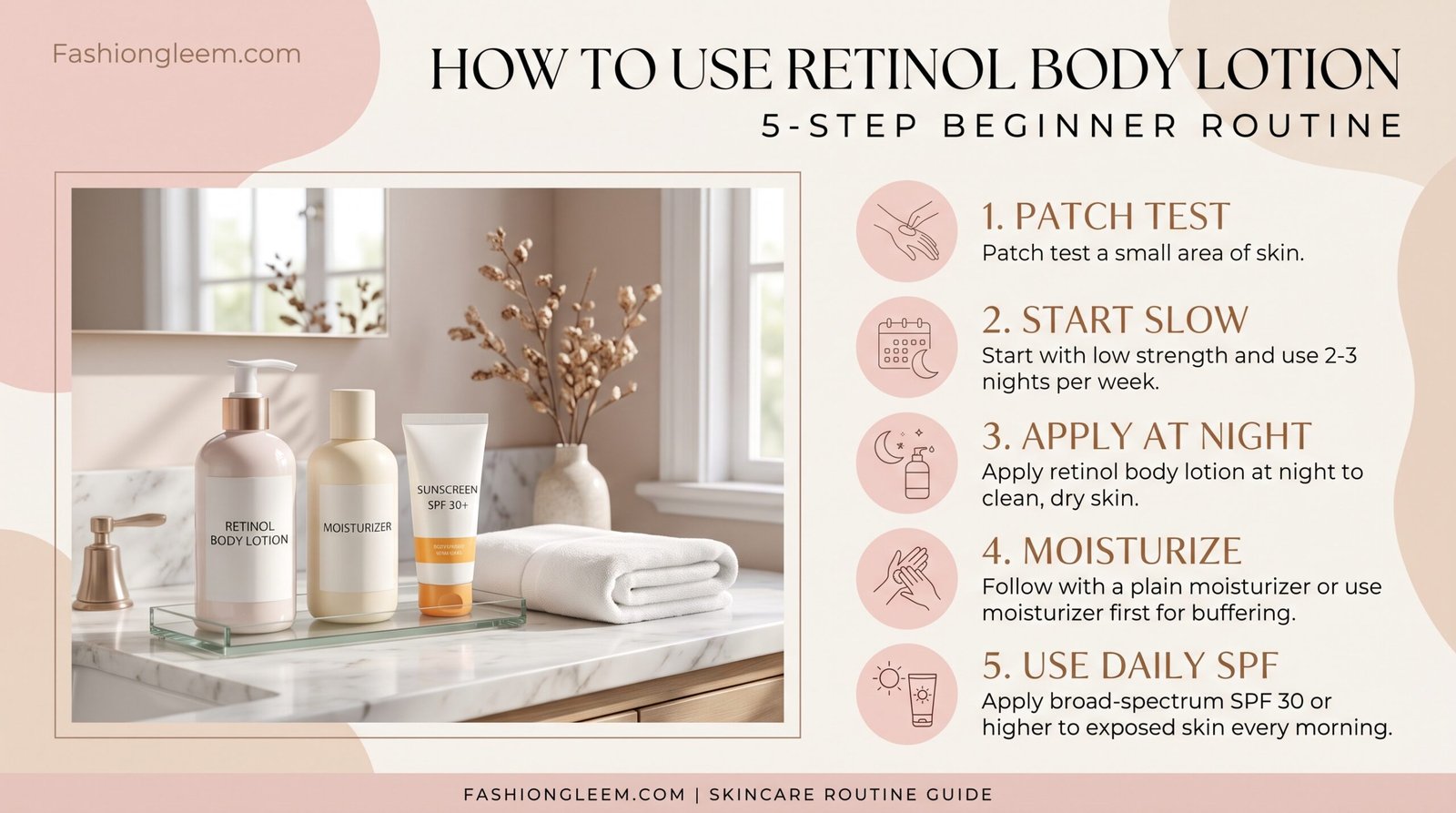
Dermatologists agree on the method. Slow introduction beats aggressive use every time.
Step 1: Patch Test First
Apply a small amount to one area, such as the inner forearm, a few times before full use. Watch for excessive redness, burning, or swelling.
This step is non-negotiable for sensitive skin or anyone with eczema or psoriasis. A reaction on a small patch beats a reaction everywhere.
Step 2: Start Low and Slow
Begin with 2 to 3 nights per week. Use a low-strength formula. Let your skin adapt for two to four weeks.
Increase to every other night only if your skin stays calm. Some people never go beyond a few nights weekly, and that is fine.
| Week | Frequency | What to watch |
|---|---|---|
| 1-2 | 2 nights/week | Mild dryness is normal |
| 3-4 | 3 nights/week | Reduce if peeling or stinging |
| 5-8 | Every other night | Skin should feel adapted |
| 8+ | Maintain or nightly | Only if fully tolerated |
Step 3: Apply at Night
Retinol increases sun sensitivity, so evening application is the standard. Apply a thin layer to clean, dry skin after showering.
A thin layer is enough. More product does not mean faster results, it means more irritation.
Step 4: Layer Smart
If your skin runs dry, apply a plain moisturizer after the retinol lotion. This seals in hydration and cushions the active ingredient.
Very sensitive beginners can buffer: apply plain moisturizer first, then the retinol lotion on top. This slows absorption and reduces irritation.
Prefer oils? Dermatologist guidance says to apply oils before retinol, since oils can block penetration if layered on top.
Step 5: Sunscreen Every Morning
This step is mandatory, not optional. Retinol-treated skin burns faster, and sun damage is the main driver of the aging you are trying to fix.
Use a broad-spectrum SPF 30 or higher on exposed areas daily. Reapply when outdoors for extended periods.
New to layering actives? Our skincare routine for beginners covers the order of operations.
Body-Zone Guide: Where to Apply and Where to Go Easy
| Zone | Tolerance | Guidance |
|---|---|---|
| Legs, arms | High | Best starting zones; skin is thickest here |
| Abdomen, back | High | Good for texture and tone |
| Hands | Medium | Great for spots and lines; moisturize well after |
| Neck | Low | Start 1x/week; skin is thin and reactive |
| Chest | Low | Same caution as neck; go slow |
| Inner arms | Low | Delicate; patch test first |
| Freshly shaved skin | Avoid | Wait 24 hours after shaving |
| Broken or irritated skin | Avoid | Never apply on cuts, rashes, or sunburn |
Start on the legs or arms and expand to delicate zones only after your skin adapts.
What to Look for When Buying
Concentration, Packaging, and Base
Concentration: Beginners should start low. Formulas around 0.05% retinol suit sensitive skin, while experienced users may prefer higher strengths. Higher is not automatically better.
Packaging: Choose dark, opaque, air-restrictive tubes or pumps. Retinol degrades in light and air, and good packaging keeps it potent. Clear jars are a red flag.
Moisturizing base: Since retinol dries skin, the formula should include humectants and emollients like glycerin, shea butter, squalane, or ceramides. A drying formula defeats its own purpose.
Formula Types by Concern
| Concern | Look for |
|---|---|
| Crepey skin | Retinol or retinal plus peptides and rich emollients |
| Dark spots | Retinol plus niacinamide for tone support |
| Rough bumps (KP) | Retinol plus lactic acid or gentle AHAs |
| Sensitive skin | Encapsulated retinol or bakuchiol alternative |
| Very dry skin | Retinol in a cream or body butter base, fragrance-free |
| Budget priority | Drugstore retinol creams; check concentration and packaging first |
Encapsulated retinol deserves special mention. The active ingredient sits inside tiny capsules that release slowly, which reduces irritation while preserving long-term benefits. The Derm Detective best picks and Beauty Radar editor picks both highlight encapsulated formulas among their top choices.
Price Tiers Without the Hype
Drugstore formulas can work well if the concentration, packaging, and base check out. Price often reflects branding and texture, not just potency.
Premium formulas may offer retinal, better encapsulation, or elegant textures. Decide whether those justify the cost for your skin and budget.
No lotion erases deep wrinkles or severe laxity. Treat dramatic claims as marketing, not dermatology. The Parade dermatologist picks show the same pattern: experts recommend by formula, not by price tag.
Ingredient Pairing Guide
| Pair with retinol | Verdict |
|---|---|
| Niacinamide | Yes. Calms skin and supports tone; a great partner |
| Hyaluronic acid, glycerin | Yes. Hydration buffers dryness |
| Ceramides, squalane | Yes. Barrier support reduces irritation |
| Peptides | Yes. Complementary firming signals |
| Vitamin C | Separate. Use vitamin C in the morning, retinol at night |
| Glycolic or lactic acid (strong) | Separate nights. Both exfoliate; together they overdo it |
| Benzoyl peroxide | Avoid together. It can deactivate retinol |
When in doubt, use one active per night. Simplicity prevents most irritation.
Retinol Body Lotion vs AHA Body Lotion
| Feature | Retinol lotion | AHA lotion (glycolic/lactic) |
|---|---|---|
| Main action | Cell turnover + collagen support | Surface exfoliation |
| Best for | Firmness, fine lines, tone | Roughness, dullness, KP |
| Timeline | 8-12 weeks | 2-4 weeks for smoothness |
| Sun sensitivity | Yes, significant | Yes, moderate |
| Pregnancy caution | Avoid (retinoids) | Lactic/glycolic generally considered lower concern; ask your doctor |
| Can combine? | Alternate nights, not same night | Alternate nights, not same night |
Many people use both: AHA for surface smoothness, retinol for deeper firming. Alternate nights and watch for over-exfoliation.
Prefer a manual exfoliation step instead? See our dry brushing routine guide.
Side Effects and How to Fix Them
| Side effect | Why it happens | Fix |
|---|---|---|
| Dryness, flaking | Faster turnover + moisture loss | Moisturize after; reduce frequency |
| Redness | Irritation from too much, too fast | Drop to 1-2 nights/week; try buffering |
| Stinging | Barrier disruption | Pause 3-4 days; restart slower |
| Peeling | Normal retinization | Usually passes in 2-4 weeks; moisturize heavily |
| Breakout purge | Clogged pores clearing | Distinguish from irritation; give it 3-4 weeks |
| Sunburn | Photosensitivity | SPF 30+ daily; consider pausing before heavy sun exposure |
Mild dryness and flaking in the first weeks are normal adaptation, not failure. Severe burning, swelling, or rash means stop and reassess.
The full dermatologist walkthrough behind this protocol is the Byrdie dermatologist guide, with quotes from Drs. Chin, Jacobs, and Lee.
Who Should Skip It or Ask First
Pregnancy and breastfeeding: Topical retinoids are generally avoided in pregnancy. If you are pregnant, planning pregnancy, or nursing, ask your doctor first. Bakuchiol is sometimes discussed as an alternative, but confirm with your clinician.
Eczema or psoriasis flares: Do not apply retinol to actively flaring skin. Wait until the flare resolves, then patch test.
Very sensitive or reactive skin: Start with encapsulated formulas or bakuchiol, or skip retinoids in favor of AHAs and barrier care.
Before procedures: Stop retinol several days before waxing, laser, or chemical peels on treated areas. It increases sensitivity.
Frequently Asked Questions
What does retinol body lotion do?
It speeds cell turnover and supports collagen, improving body skin texture, tone, and firmness over 8 to 12 weeks.
Does retinol body lotion actually work?
Yes, for its proven actions. Dermatologists confirm it improves texture, fine lines, and tone. It will not replicate surgery for severe laxity.
How long until I see results?
Texture improves in 2 to 4 weeks. Firmness and tone need 8 to 12 weeks of consistent use.
Can I use retinol body lotion every day?
Eventually, maybe. Start 2 to 3 nights weekly and increase only if your skin stays calm. Many people never need nightly use.
Should I apply it morning or night?
Night. Retinol increases sun sensitivity, so evening application is the standard.
Do I need sunscreen with it?
Yes, every morning. Broad-spectrum SPF 30 or higher on exposed areas is mandatory while using retinol.
What percentage should I start with?
Low. Formulas around 0.05% suit beginners and sensitive skin. Increase strength only after full adaptation.
What is the difference between retinol and retinal?
Retinal is one conversion step closer to active, so it works faster but can irritate faster. Retinol is the gentler standard.
Is bakuchiol as good as retinol?
Not equivalent. Bakuchiol offers milder firming with less irritation. It suits sensitive skin but lacks retinol’s depth of evidence.
Can I use my face retinol on my body?
You can, but face products come in small sizes and may be too strong or too pricey for large body areas. Body formulas are designed for the job.
Can I use retinol body lotion on my face?
Not recommended. Body formulas may be fragranced or dosed for thicker skin. Use a face-specific product instead.
Does it help crepey skin?
Yes, with patience. It thickens skin over 8 to 12 weeks via collagen support. Severe laxity may need procedures.
Does it help keratosis pilaris?
Yes. Increased turnover loosens the keratin plugs behind the bumps, especially paired with gentle exfoliation.
Does it fade dark spots?
Yes, gradually. Expect 6 to 8 weeks of steady use, plus daily sunscreen to prevent new spots.
Does it help cellulite?
Limited evidence. It may slightly improve surface texture, but cellulite’s structure sits deeper than retinol reaches.
Does it help stretch marks?
Early red marks may improve somewhat. Mature white stretch marks respond minimally to any topical.
Can I use it on my neck and chest?
Yes, carefully. These zones are delicate. Start once weekly and increase only if tolerated.
Is it safe during pregnancy?
Avoid retinoids in pregnancy unless your doctor says otherwise. Discuss alternatives with your clinician.
Why is my skin peeling?
Normal retinization. Faster turnover sheds old cells. It usually settles within 2 to 4 weeks with good moisturizing.
How do I stop the irritation?
Reduce frequency, try buffering with moisturizer first, and pause a few days if needed. Then restart slower.
What is buffering?
Applying plain moisturizer before retinol to slow absorption and reduce irritation. Ideal for beginners.
Can I layer it with vitamin C?
Separate them. Vitamin C in the morning, retinol at night.
Why does it come in dark packaging?
Retinol degrades in light and air. Dark, opaque, air-restrictive packaging keeps it potent.
Does retinol body lotion expire?
Yes. Check the period-after-opening symbol, usually 6 to 12 months. Degraded retinol loses potency.
How much should I apply?
A thin layer per area. More product increases irritation, not results.
Can men use retinol body lotion?
Absolutely. Skin biology is the same. The protocol does not change by gender.
What is the best drugstore retinol body lotion?
Look for stated retinol strength, dark opaque packaging, and a moisturizing base. Those three matter more than the price tag.
Can I use it after shaving?
Wait 24 hours. Freshly shaved skin is sensitized and will sting.
Can I use it with self-tanner?
Separate them. Retinol’s exfoliation fades tanner faster. Use tanner on non-retinol nights.
What happens if I stop using it?
Benefits gradually reverse as cell turnover and collagen stimulation slow. Maintenance keeps results.
Can I use it in summer?
Yes, with strict sunscreen. Some people reduce frequency before heavy sun exposure.
Conclusion
Retinol body lotion earns its reputation. It smooths texture, supports firmness, fades spots, and helps crepey skin, all backed by dermatologist guidance and decades of retinoid science.
The method matters more than the product. Start low, go slow, apply at night, moisturize, and wear sunscreen. Give it 8 to 12 weeks before judging.
Choose a formula by your concern and sensitivity, not by hype. Then stay consistent. That is the entire secret.
Ready to build the routine around it? Revisit our body care routine aesthetic guide and compare current prices at your preferred retailer before you buy.