
Clean Cosmetics: No Legal Definition, Three Layers of Standards, and How to Check a Label
Clean cosmetics means whatever the seller using the words says it means. No US law defines it, no agency approves the claim, and every standard behind it is private.
The meaning lives in three layers instead. Law sets the floor, retailer standards set the shelf rules, and certifications audit narrower claims. Each layer answers a different question.
Here, every count keeps its unit and its source. A count of 2,700 ingredients and a count of 50 groups are not disagreeing, because they count different things. Printing the unit beside the number is the whole honesty trick.
One court case shows why the layers matter. When a shopper sued over a clean seal, the claim failed because the retailer had published its definition. An unpublished definition stands on much weaker ground.
The label in your hand is the final layer. Ingredient lists follow fixed rules, and a five-minute read against a named standard settles most clean claims. The protocol and a worked example sit near the end.
The Short Answer: What Clean Cosmetics Means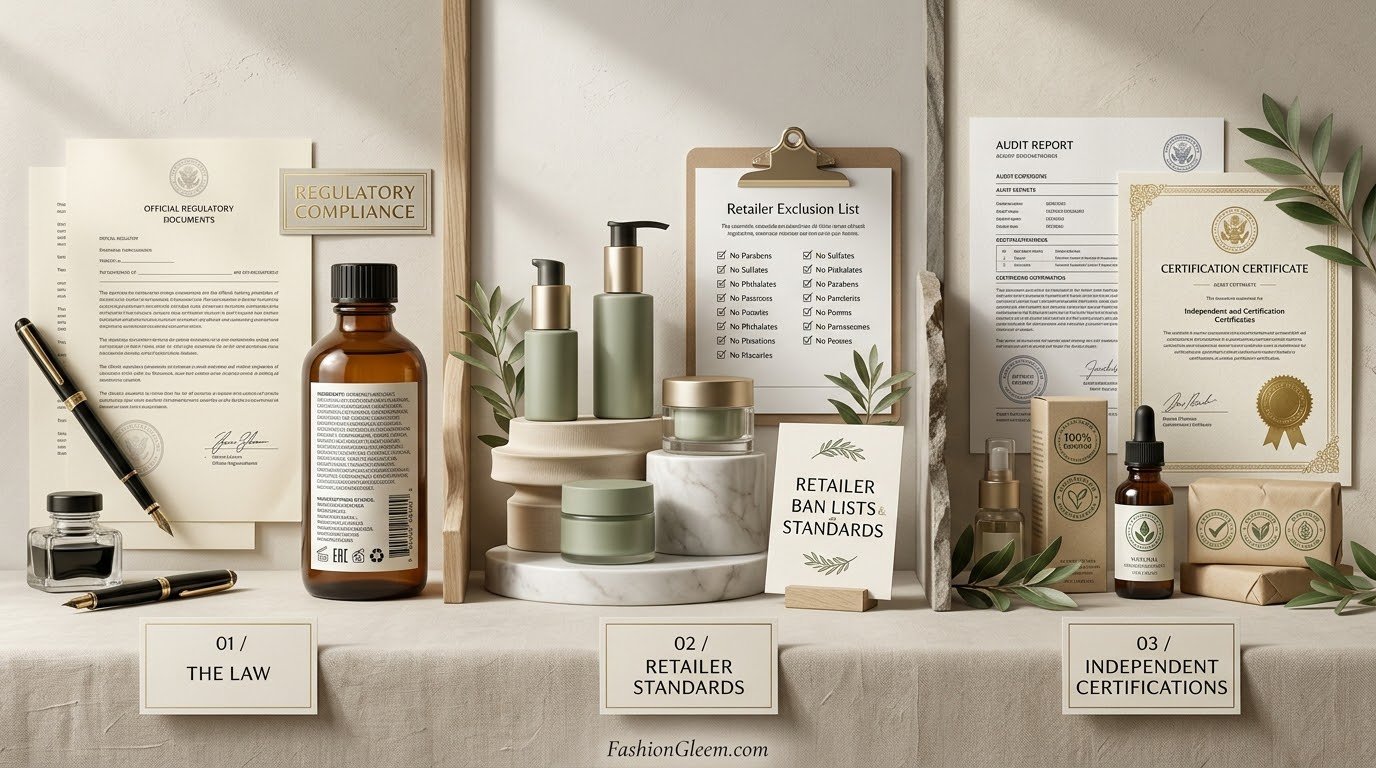
The short answer is a definition with an owner. Clean cosmetics are products formulated without the ingredients on a specific published exclusion list. Change the list and the same product can pass in one store and fail in another.
No layer of government supplies that list. Federal law bans or restricts a short set of ingredients and polices false labeling, but it never defines clean. Retailers and certifiers write the lists that give the word meaning.
- The law. Bans a short list, requires honest labeling, defines none of the marketing words.
- Retailer standards. Private exclusion lists, counted in ingredients, groups or categories depending on the store.
- Certifications. Third-party audits behind narrower claims, from organic content to cruelty-free testing.
|
Layer |
Who sets it |
What it requires |
What it does not do |
|---|---|---|---|
|
The law |
Congress and the FDA |
Registration, listing, honest labels, a short prohibited list |
Define clean or approve products before sale |
|
Retailer standards |
Sephora, Ulta, Target, Credo |
Formulated without each store’s published exclusion list |
Agree with each other or carry legal force |
|
Certifications |
EWG, USDA, Leaping Bunny and others |
Audited criteria for one claim at a time |
Certify a whole product as clean in general |
Layer One: The Law Defines Nothing
Start with the absence. The FDA has no definition of clean, natural or non-toxic for cosmetics, and no page sets criteria for those words. The audit in The Cosmetic Record’s analysis of clean as a retail category counts the terms the agency does address, and these are missing.
Organic gets the same answer. Asked whether it defines organic, the FDA answers no, because the term appears in neither cosmetics law it enforces. The standard behind organic claims belongs to the USDA’s National Organic Program.
Approval works the same way. Cosmetic products and ingredients other than color additives do not need FDA approval before they go on the market, as the FDA’s prohibited and restricted ingredients page states plainly. Color additives are the exception, tested and listed for their intended uses.
What the law does police is honesty. A cosmetic is misbranded if its labeling is false or misleading in any particular, under 21 U.S.C. 362(a), and the FDA’s cosmetics safety Q&A walks the same boundary from the consumer side.
The federal exclusion list fits in one breath. It prohibits bithionol, chloroform, methylene chloride, vinyl chloride and a handful of others, and restricts hexachlorophene and mercury compounds. Everything else a clean standard excludes is excluded by private choice, not federal law.
What MoCRA Changed, and What It Did Not
MoCRA is the real legal event in this field. Enacted December 29, 2022, it is the largest expansion of FDA cosmetics authority since 1938, in the agency’s own framing, and the FDA’s MoCRA page carries the requirements as the agency states them.
The duties are concrete. Facilities register and renew every two years, each product is listed with its ingredients, and companies must keep records supporting adequate safety substantiation. Serious adverse events must reach the FDA within 15 business days.
The scale is already large. The update in the FDA’s MoCRA implementation article reports over 15,000 facility registrations and over 1 million product listings. It also describes the December 2025 review of the 25 most commonly used PFAS in US cosmetics.
Two powers are genuinely new. Mandatory recall authority and records access did not exist for cosmetics before MoCRA, and both now sit with the FDA. Directed rules on fragrance allergens, talc testing and manufacturing practice were still unfinalized in a March 2026 check.
What MoCRA never did matters as much. It created no premarket approval and defined none of clean, non-toxic, green or pure, a point the Label Lookout guide to whether clean beauty is regulated makes its headline. Its five statutory definitions are operational, none a marketing word.
The Lawsuit That Priced a Definition
A published definition survived court, and that is the lesson. In Finster v. Sephora (March 2024), a court dismissed the claim that a clean seal misled buyers, and the Legal 500 summary of the Sephora clean claims case gives the reason: the retailer had defined the term itself.
The definition did the defensive work. The seal meant formulated without Sephora’s own listed ingredients, and the court read the claim that narrowly. A shopper expecting a ban on every synthetic was asking the word to mean something never published.
The FTC layer works by evidence, not definitions. Its Green Guides (16 CFR Part 260) define no shelf word, while sections 260.9 and 260.10 govern free-of and non-toxic claims, and the SPS Commerce guide to ingredient disclosure and clean beauty standards frames that duty: substantiate before you claim.
Allegations are not rulings, and the difference matters. An October 2025 complaint alleged some products under a rival badge contained ingredients its own list promises to exclude. It remains an allegation, printed here as one, not a finding against the retailer.
Layer Two: Retailer Standards, Counted Honestly
Retailers are where clean gets an operational meaning. Each chain publishes an exclusion list, badges qualifying products, and counts the list in its own unit, and the GetCosmetica retailer standards comparison lines the three biggest programs up side by side.
Sephora’s seal is the court-tested one. Clean at Sephora, launched in 2018, is described by secondary sources as excluding over 50 ingredient groups, with a restricted tier beside the bans. Its fragrance rule caps synthetic fragrance under 1 percent and bars undisclosed fragrance.
Ulta’s badge carries the field’s biggest caveat. Conscious Beauty spans five pillars, and one pillar alone can earn the badge. Only its Clean Ingredients pillar, and the Made Without List under it, speaks to formula, as The Green Hue guide to clean standards by retailer explains.
Credo publishes the deepest list in retail. The specialty retailer’s own pages state its products are free from over 2,700 ingredients on its Dirty List. Its own FAQ concedes the point: clean products lack a legal definition, so the standard exists.
Target counts in named chemicals, not classes. It names specific ingredients, propyl- and butyl-parabens among them, and sets formulated without at under 100 ppm in the finished product. It permits mineral oil and coal tar and says nothing about synthetic fragrance.
|
Standard |
Who runs it |
The count, with its unit |
The catch |
|---|---|---|---|
|
Clean at Sephora |
Sephora |
Over 50 ingredient groups, per secondary sources |
Counts groups, not chemicals, with a restricted tier |
|
Conscious Beauty |
Ulta Beauty |
More than 25 chemical categories at launch |
One of five pillars can earn the whole badge |
|
Credo Clean Standard |
Credo Beauty |
Over 2,700 ingredients, per Credo’s own pages |
One retailer’s list, however deep, is still private |
|
Target Clean |
Target |
A named-ingredient list, under a 100 ppm rule |
Names specific chemicals and skips fragrance entirely |
Layer Three: Certifications That Audit Something
Certifications differ from seals in one way: an outsider checks. A retailer grades its own shelf, while a certifier publishes criteria and audits the brands that claim them. That audit is what a shopper actually buys with a certified product.
EWG VERIFIED is the certification the guides cite most. Its program keeps products off an unacceptable list, holds them to limits on a restricted list, and requires full disclosure. Its Skin Deep database scores ingredients from 1 to 10 on hazard data.
Organic is the cluster’s one federally backed word. Certification runs through the USDA’s National Organic Program for agricultural ingredients, while NSF/ANSI 305 covers products claiming to contain organic ingredients. Both publish criteria a shopper can read before paying.
Cruelty-free and vegan have their own machinery. Leaping Bunny audits supply chains for animal testing, PETA’s Beauty Without Bunnies lists pledging companies, and the Vegan Society trademark covers ingredient origin. MADE SAFE assesses every ingredient against its harmful-chemicals list.
Two international schemes complete the layer. COSMOS and NATRUE are named across the field as audited standards for natural and organic cosmetics, with criteria in their own standard documents.
Clean, Natural, Organic and the Rest of the Shelf Words
The shelf words sound interchangeable and are not. Each one answers a different question, and only some have anything standing behind them. The table keeps the seven common terms separate, because blending them is how marketing wins.
|
Term |
Legal definition? |
What stands behind it |
What it does not promise |
|---|---|---|---|
|
Clean |
No |
A private exclusion list, if one is published |
Any measured safety outcome |
|
Natural |
No |
A brand’s sourcing claim |
That natural means gentler or safer |
|
Organic |
Not from the FDA |
USDA National Organic Program certification |
A fully organic finished product |
|
Green |
No |
Sustainability claims about making and packaging |
Anything about the formula itself |
|
Non-toxic |
No |
An FTC substantiation duty on the claim |
A definition anyone can check |
|
Vegan |
No |
The Vegan Society trademark, if carried |
Anything about testing or toxicity |
|
Cruelty-free |
No |
Leaping Bunny or PETA certification |
Anything about ingredients |
One guide prints the verdict as a column. In the Face Cutie clean beauty guide, the same shelf words line up against a regulated-or-not column, and every row lands on no. The table above adds what that column cannot show: what stands behind each word.
Clean can include synthetics, and natural can exclude them. A formula on synthetic preservatives can meet a clean list, while a plant-derived ingredient can fail one. The FDA’s caution, quoted in The Cosmetic Record’s analysis of clean as a retail category: source does not determine safety.
Geography flips two of the words. Cruelty-free is a legal default in the European Union, which has banned cosmetic animal testing since 2013, and a certification claim in the US. Green speaks to manufacture and disposal, not to what touches skin.
The EU and US Numbers, With Their Counting Rules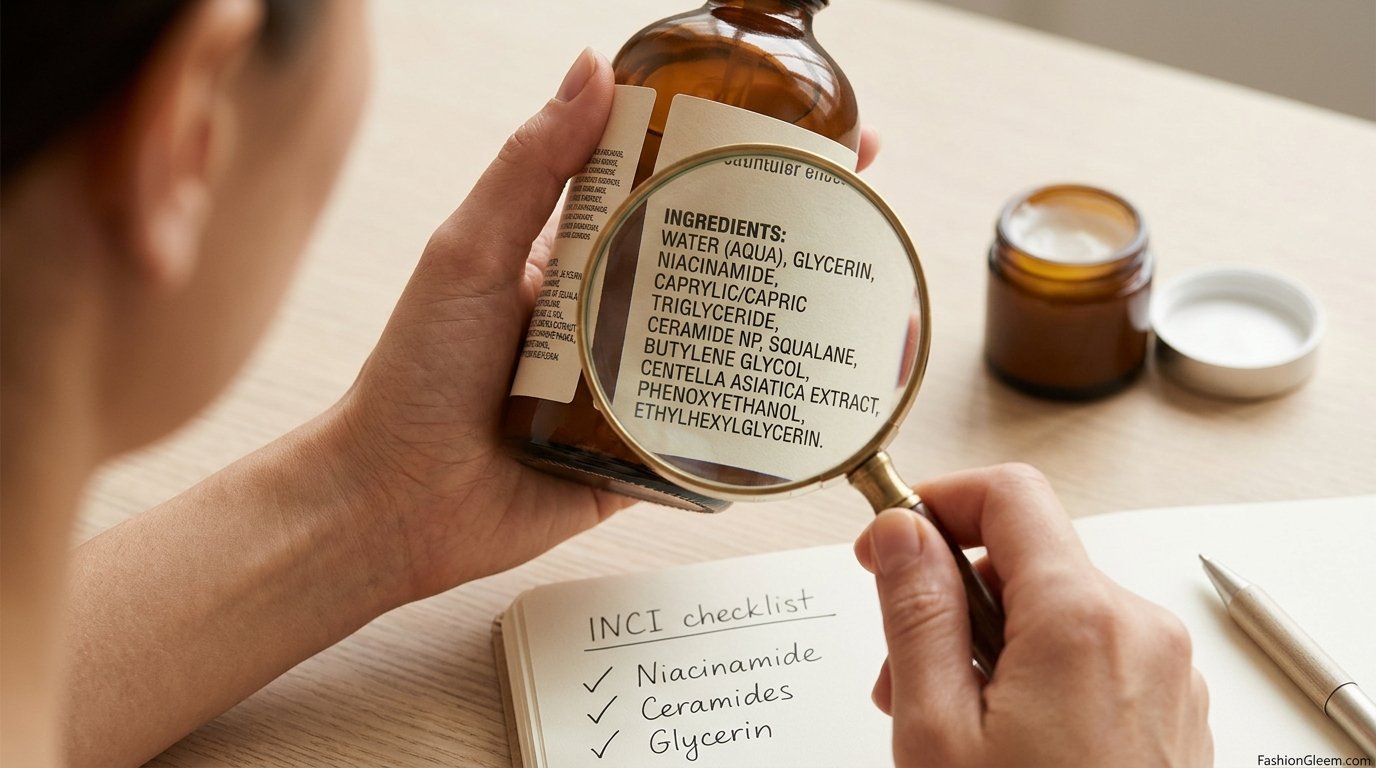
The famous gap is real in direction and slippery in size. Every version of it counts differently, so the table prints each figure with its source and its rule. A single merged number would be the least honest sentence in the field.
|
The figure |
Its source |
Its counting rule |
|---|---|---|
|
About 11 US chemicals |
EWG’s VERIFIED release |
Prohibited and restricted entries counted together |
|
Just nine US ingredients |
EWG’s advocacy page |
Prohibited entries only |
|
More than 1,000 EU ingredients |
EWG’s VERIFIED release |
Banned or restricted, counted conservatively |
|
Over 1,300 EU substances |
The field’s dominant strand |
The Annex II prohibited list as usually cited |
|
Over 1,600 EU substances |
Face Cutie’s guide |
A wider count, printed without its counter named |
|
About 80 percent never used |
RangeMe’s comparison |
Share of the EU list never used in cosmetics |
The counterweight belongs beside the gap. In the RangeMe comparison of allowed ingredients in the EU and US, about 80 percent of the EU’s banned substances were never used in cosmetics at all. The list sweeps in industrial chemicals, so the raw count overstates the difference.
Structure explains more than arithmetic. The EU requires a pre-market safety assessment for every cosmetic and restricts by precaution, while US law works mostly after products reach shelves, and the Esko comparison of US and EU cosmetic regulations walks through the two systems rule by rule.
The Law You Already Live Under: State Bans
States stopped waiting for a definition and started banning ingredients. California and Washington now prohibit by law several ingredients that clean marketing only promises to avoid. A shopper in those states is protected by statute, not by a seal.
California moved in stages. Its Toxic-Free Cosmetics Act banned 24 named ingredients from January 1, 2025, including 13 PFAS and specific parabens and phthalates. A separate law banned intentionally added PFAS as a class from the same date.
California’s next stage carries a printed conflict. A further law adds 26 more ingredients, and sources disagree on a 2025 or 2027 start. The tracker in the Verid8 guide to prohibited cosmetic ingredients and state bans follows state lists, and the conflict is printed here rather than resolved.
Washington wrote the broader act. From January 1, 2025 it bars intentionally added ortho-phthalates, PFAS, formaldehyde, methylene glycol, mercury, triclosan, phenylenediamines and lead at 1 ppm or more, and the Safe Cosmetics regulations page keeps the running tally of state rules as they land.
Three states share one law’s name. California, Washington and Oregon each call their statute a Toxic-Free Cosmetics Act, and the three laws ban different things on different dates. Eight states had enacted PFAS class bans in cosmetics by early 2026.
Ingredient Flashpoints Where Standards Disagree
The exclusions look unanimous until you read them closely. The same ingredient can be banned by one standard, capped by a second and ignored by a third. The table holds the sharpest disagreements, each attached to its owner.
|
Ingredient |
US legal status |
Who excludes it |
The disagreement |
|---|---|---|---|
|
Oxybenzone and octinoxate |
Permitted sunscreen filters |
Sephora and Target |
Legal as drugs, excluded as cosmetics |
|
Fragrance |
One label line, components undisclosed |
Sephora caps it, Ulta applies IFRA rules |
Target’s standard has no fragrance provision |
|
Talc |
Legal, asbestos testing directed |
Nobody major bans it |
Ulta caps it while others stay silent |
|
Parabens |
Legal, specific ones banned in California |
Nearly every standard |
Target and California name specific parabens only |
|
SLS and SLES |
Legal |
Sephora excludes both |
Target names SLES only, one letter apart |
|
PFAS |
Banned as a class in eight states |
Sephora since 2021 |
Lists target added PFAS, tests find fluorine markers |
Fragrance is the deepest split on the shelf. One word on the label can cover hundreds of undisclosed components, protected as trade secrets, and the ToxinFreeMaterials guide to toxic chemicals in personal care products maps where they surface, and MoCRA’s allergen rule is the pending federal answer.
Substitution is the risk exclusion lists create. One leading guide flags brands swapping parabens for methylisothiazolinone, a preservative carrying its own sensitization concerns. The brand testing in the ToxinFreeMaterials clean makeup brands guide treats that swap as the cost of list-driven shopping, printed beside the benefits.
Retinyl palmitate shows the pattern in miniature. Standards exclude this vitamin A derivative while retinol stays a mainstream active, the gap our retinol body lotion guide explores from body care. Lists judge ingredients one by one, not families.
PFAS testing closes the section because it tests the lists themselves. Guides report products under clean seals testing positive for fluorine markers, since lists target intentionally added ingredients. Formulation intent and laboratory results are different kinds of evidence.
How to Read an INCI Label: A Worked Example
Labels follow rules even when claims do not. Ingredients are listed in descending order of predominance, and international INCI names standardize what each line is called. That order is the shopper’s one fixed point in the whole clean debate.
- Find the standard first. Name the seal or list the product claims before reading a single ingredient.
- Read top to bottom. The first lines are the bulk of the formula, so exclusions there matter most.
- Scan for your standard’s names. Parabens end in -paraben, releasers hide under names like quaternium-15, and parfum is one line covering many components.
- Check the badge mechanics. Ask which pillar, tier or list the product actually qualified under.
- Price the trade-off. A formula passing your standard still has to work on your skin and schedule.
Now read one label two ways. The following ingredient list is an illustrative label, not a real product: Aqua, Glycerin, Mineral Oil, Cetearyl Alcohol, Parfum, Phenoxyethanol, Methylparaben, Retinyl Palmitate. Eight lines are enough to split two standards cleanly.
Against a Sephora-style list, it fails three times. Mineral oil and parabens sit in the court-relied definition, and retinyl palmitate is excluded too. The undisclosed parfum line fails the seal’s fragrance rule on its own.
Against a Target-style list, the same label passes. Target names propyl- and butyl-parabens specifically, so methylparaben is not caught, and mineral oil is permitted there. With no fragrance provision, the parfum line passes as well.
Neither verdict says the cream is good or bad. Each says only whether the formula matches a published list, which is all clean has ever meant, and the Halik guide to clean beauty and greenwashing builds its whole label framework on that distinction.
The Greenwashing Checklist
Greenwashing survives on vagueness, so the antidote is a checklist. Each check below takes under a minute and needs nothing but the product page and the label. Run them in order and most unsupported claims fail early.
- Demand the list. No published exclusion list behind the seal means the claim cannot be checked.
- Check the free-from trick. A free-from claim about an ingredient never used in that product type proves nothing.
- Read the badge mechanics. One pillar, one tier or one category may be carrying the whole claim.
- Flip to the ingredient list. Marketing faces forward, while the INCI list is the only regulated text on the pack.
- Verify the certification. Real certifiers publish criteria and list the brands they audit.
- Watch the fragrance line. A clean claim beside an undisclosed parfum line deserves a second look.
The counter-position deserves its sentence too. In the Price and Pick clean beauty myths investigation, many vilified ingredients are used at cosmetic concentrations the evidence does not indict. Holding both thoughts, check the claim and respect the dose, is the adult version of clean shopping.
The Trade-Offs Nobody Prints on the Seal
Exclusion lists optimize for one thing and bill another. Removing preservative systems, film formers and fragrance components changes how a product wears, lasts and feels. Honest guides print those costs, and most do not.
Wear time is where the bill arrives. The brand testing in the ToxinFreeMaterials clean makeup brands guide reports shorter wear and thinner shade ranges honestly. If a lipstick must survive lunch, start with our long-wear lipstick guide and our transfer-proof lipstick guide, where staying power is the test.
Natural is not a synonym for gentle. Essential oils, propolis and lanolin are natural ingredients and common contact allergens, a point skeptical voices press hard. A patch test respects chemistry more than any origin story does.
Price is the quietest trade-off. Audited products cost more to make, and some of that reaches the shelf. Paying for an audit is rational, while paying for an adjective is not, and the label tells you which you bought.
What This Means at the Makeup Counter
Blush is where clean claims meet a daily product. The soft-focus finish in our jelly blush guide and the muted tones in our dusty rose blush guide are exactly the formulas whose pigment and preservative choices decide which lists they pass. Shade first, standard second, claim last.
Fair skin raises the checking stakes. Pale shades show pigment quality fastest, and the matching method in our guide to the best blush for fair skin starts from undertone rather than marketing. One named standard, applied consistently, is the whole clean method in miniature.
Color stories travel across the standard divide. The warmth in our peach blush makeup guide and the earthiness in our terracotta blush makeup guide come from pigment families standards treat differently. Checking a shade you love against your chosen list takes one label read.
Technique outlasts any single formula. The placement method in our blush makeup tips for balancing color with highlighter works whether the blush passed Credo’s list or Target’s. Skill is the one part of a routine no standard can sell you and no reformulation can take away.
The Wider Routine: Fewer Products, Checked Once
A checked routine beats a crowded one. The logic behind our capsule wardrobe guide applies to a bathroom shelf as cleanly as to a closet: fewer pieces, each earning its place. One standard, applied once, ends the per-product research spiral.
The routine frame already exists on this site. The structure in our self care routine guide gives each product a job and a slot, where label checking naturally lives. A product with no job fails the routine before any standard.
Habits compound the same way here. The small repeatable choices in our healthy lifestyle tips and the audience-first framing of our lifestyle tips for women share one premise with this page. Systems beat slogans, in beauty budgets as elsewhere.
Frequently Asked Questions
1. What does clean beauty mean?
Clean beauty means formulated without a chosen exclusion list. No law defines the term, so each brand, retailer or certifier publishes its own list of ingredients left out.
Two products can both say clean on completely different lists.
2. Does the FDA define “clean” for cosmetics?
No, the FDA defines none of it. The agency has no definition of clean, natural or non-toxic for cosmetics, and no FDA page sets criteria for those words.
A brand using them is applying its own private definition.
3. Does the FDA approve cosmetics before they are sold?
No, cosmetics reach shelves without FDA approval. Products and ingredients other than color additives need no premarket approval under US law.
The FDA acts after products are on the market, through misbranding and adulteration rules.
4. What did MoCRA change for cosmetics?
MoCRA added oversight duties, not approvals. Since 2022, facilities register with the FDA, products are listed with their ingredients, and companies must keep safety substantiation records.
It also gave the FDA mandatory recall power for the first time.
5. Did MoCRA define clean beauty?
No, MoCRA defined none of the marketing words. The 2022 law created registration, listing and safety duties but set no meaning for clean, non-toxic, green or pure.
Those words still mean whatever a private standard says they mean.
6. Is clean beauty actually regulated?
Only at the edges, never at the word itself. Cosmetics law, labeling rules and state bans all apply to clean products, and MoCRA added industry duties.
The word clean itself carries no regulatory definition anywhere in US law.
7. Does clean beauty mean a product is safer?
No standard or agency says that. Clean describes which ingredients a private list excludes, not a measured safety outcome.
A product can meet a strict exclusion list and still irritate skin, while excluded ingredients remain legal and widely used.
8. What is the difference between clean and natural beauty?
Clean is about exclusions, natural is about origins. Clean products can include synthetic ingredients a standard accepts, while natural points to plant or mineral sourcing.
Neither word has a legal definition, and the FDA notes an ingredient’s source does not determine its safety.
9. Is “non-toxic” a regulated claim?
The claim is regulated, the word is not. No definition of non-toxic exists, but the FTC Green Guides require the claim to be backed by competent and reliable evidence.
Section 260.10 covers non-toxic claims specifically.
10. What does “chemical-free” mean in beauty?
It is a marketing phrase, not a measurable property. Every cosmetic ingredient, water included, is a chemical, so nothing on a shelf is literally chemical-free.
Treat the phrase as a signal to ask which ingredients the brand actually excluded.
11. What is greenwashing in clean beauty?
Greenwashing is a clean claim the evidence cannot support. Common forms include free-from lists naming ingredients never used in that product type, seals with no published standard, and green packaging on an ordinary formula.
The checks are a published list and a readable label.
12. What should I look for instead of “clean”?
Look for a named standard instead of an adjective. A retailer seal with a published exclusion list, a third-party certification, or the full ingredient list itself all give you something checkable.
The word clean alone gives you nothing to verify.
13. What does Clean at Sephora mean?
It is Sephora’s private formulated-without seal, launched in 2018. Products carrying it are formulated without the ingredients on Sephora’s published exclusion list.
A federal court treated that published definition as what made the claim defensible.
14. How many ingredients does Clean at Sephora exclude?
Secondary sources describe it as over 50 ingredient groups. The count covers categories and groups, not individual chemicals, and Sephora’s list also carries a restricted tier with limits.
Print the number with its unit, because a group can hold many chemicals.
15. What is Credo’s Dirty List?
It is Credo Beauty’s exclusion list under its Clean Standard. Credo publishes the list as the definition behind every product it sells.
The retailer’s own FAQ concedes clean products lack a legal definition, which is why the standard exists.
16. How many ingredients are on Credo’s Dirty List?
Credo’s own pages put it at over 2,700 ingredients. That is the largest count among the major retailer standards, and it counts individual ingredients rather than groups.
The figure comes from Credo itself, restated across its collection pages.
17. What is Ulta’s Made Without List?
It is the ingredient list behind Ulta’s Clean Ingredients pillar. At launch it was framed as free of parabens, phthalates and ingredients from more than 25 chemical categories.
It caps some ingredients, like talc and BHT, instead of banning them.
18. Does a Conscious Beauty badge at Ulta mean a product has clean ingredients?
Not necessarily, and that is the badge’s catch. Conscious Beauty has five pillars, and a product can earn the badge by qualifying for as few as one of them.
A badge earned for packaging or vegan status says nothing about the ingredient list.
19. What does the Target Clean icon mean?
It marks products formulated without Target’s named ingredients. Target lists specific chemicals rather than whole classes, naming propyl- and butyl-parabens, for example.
Its formulated without allows under 100 ppm of a named ingredient in the finished product.
20. What is EWG VERIFIED?
It is a third-party certification run by the Environmental Working Group. Verified products must avoid EWG’s unacceptable list, respect limits on its restricted list, and disclose ingredients fully.
It featured 833 products at its release.
21. How does EWG Skin Deep rate products?
Skin Deep scores ingredients and products from 1 to 10. The scores rest on published hazard data rather than marketing copy, with lower numbers reflecting fewer flagged concerns in its system.
It is a research tool, not a government rating.
22. Is USDA Organic a real standard for cosmetics?
Yes, through the USDA rather than the FDA. The FDA does not define organic for cosmetics, but products with agricultural ingredients can be certified under the National Organic Program.
That makes organic the one shelf word with a federal standard behind it.
23. What is the difference between Leaping Bunny and PETA cruelty-free?
Both certify cruelty-free claims, with different machinery. Leaping Bunny, run by Cruelty Free International, audits a brand’s whole supply chain against its standard.
PETA’s Beauty Without Bunnies lists companies pledging no animal testing under its criteria.
24. What certifications actually mean something in clean beauty?
The ones with published criteria and an audit behind them. EWG VERIFIED, USDA Organic, Leaping Bunny, PETA’s program, MADE SAFE and the COSMOS and NATRUE schemes all publish what they require.
A seal with no public standard behind it certifies nothing checkable.
25. What ingredients should I avoid in makeup?
Start with the categories most standards share. Parabens, phthalates, formaldehyde and its releasers, PFAS and undisclosed fragrance appear on nearly every exclusion list.
Whether to avoid them is a personal call, but those are the names the standards themselves print.
26. Why do clean standards exclude parabens?
Parabens are preservatives that most clean standards exclude first. Retailer lists, Credo’s Dirty List and even state law name them, though Target and California name specific parabens rather than the whole class.
The exclusion is a standards decision, printed list by list.
27. Why are phthalates in cosmetics a concern if they are not on the label?
Phthalates often enter through the fragrance blend, not the ingredient list. Fragrance components can stay undisclosed, so a phthalate can be present without its name on the label.
One guide’s CDC strand reports phthalate metabolites in over 90 percent of Americans tested.
28. What are formaldehyde-releasing preservatives?
They are preservatives that slowly release formaldehyde in the formula. Quaternium-15 is the example California law names, and releasers let a product preserve itself without listing formaldehyde directly.
California and Washington ban formaldehyde itself, with releaser rules phasing in later.
29. Are oxybenzone and octinoxate banned in the US?
No, both remain permitted US sunscreen filters. Sunscreens are regulated as drugs in the US, and these two filters are legal, yet Sephora and Target exclude them anyway.
They are the clearest example in the field of legal but excluded.
30. Why can “fragrance” hide ingredients on a label?
US labeling law lets fragrance stand as a single line. The word fragrance or parfum on an ingredient list can cover many undisclosed components protected as trade secrets.
That is why standards treat fragrance differently, from Sephora’s cap to Target’s silence.
31. Is talc in makeup safe?
Authorities handle talc through contamination testing, not a ban. The federal concern is asbestos contamination, and MoCRA directed standardized testing methods for talc products, still unfinalized in a March 2026 check.
Ulta caps talc in its standard rather than banning it.
32. What are PFAS doing in cosmetics?
PFAS add water resistance, film forming and long wear. Those performance traits are why the chemicals appear in cosmetics at all, and why states moved against them.
Eight states had enacted class bans on intentionally added PFAS in cosmetics by early 2026.
33. Does clean makeup mean it has no PFAS?
Not always, and testing is why the answer is careful. Guides report clean products testing positive for fluorine markers associated with PFAS, because exclusion lists target intentionally added ingredients.
A seal describes formulation intent, not a laboratory result for every batch.
34. What is the difference between SLS and SLES, and why do standards treat them differently?
They are cousins with different profiles, and lists split them. Sephora excludes both sodium lauryl sulfate and sodium laureth sulfate, while Target names only SLES.
One letter changes which products qualify, so lists must stay attached to their standard.
35. How do I read an INCI ingredient list?
Read it top to bottom, in concentration order. Ingredients appear in descending order of predominance, with fragrance as the one line that can hide components.
Scan for the names your chosen standard excludes, ending in -paraben, releaser names and the word parfum.
36. How many ingredients does the EU ban in cosmetics compared to the US?
The honest answer is a range with sources attached. EWG’s release says the EU has banned or restricted more than 1,000 ingredients against about 11 in the US, while other sources put the EU figure over 1,300.
Each number follows its own counting rule.
37. Why does the EU ban so many more cosmetic ingredients than the FDA?
The systems are built differently, not just stricter or looser. The EU assesses every cosmetic before market and restricts by precaution, while the US works mostly after products reach shelves.
One comparison notes about 80 percent of that banned list was never used in cosmetics.
38. Which US states ban PFAS in cosmetics?
Eight states had enacted PFAS class bans by early 2026. Washington, Oregon, California, Colorado, Minnesota, Maine, Vermont and Connecticut ban intentionally added PFAS in cosmetics as a class.
Two compliance sources agree on the count of eight.
39. What does California’s Toxic-Free Cosmetics Act ban?
It bans named ingredients outright, in stages. From January 1, 2025, the law bans 24 named ingredients including 13 PFAS, plus specific parabens and phthalates.
A later law adds 26 more, though sources conflict on whether those start in 2025 or 2027.
40. What does Washington’s Toxic-Free Cosmetics Act ban?
Washington’s act bans intentionally added ingredients from 2025. Its list covers ortho-phthalates, PFAS, formaldehyde, methylene glycol, mercury, triclosan, phenylenediamines and lead at 1 ppm or more.
Formaldehyde releaser restrictions phase in later, with sources giving 2026 or 2027.
41. Can a product be clean at one store and not another?
Yes, because every store runs its own definition. A formula can pass Target’s named-ingredient list and fail Sephora’s groups, or earn an Ulta badge through a non-ingredient pillar.
Clean is a store-by-store verdict, which is why the standard matters more than the word.
42. Is clean beauty worth the higher price?
That depends on what you are paying for. A published standard, an audit and a readable label are worth paying for, because they can be checked.
Paying extra for the bare word clean, with no list behind it, buys marketing rather than verification.
Conclusion
Clean cosmetics is a claim, not a category. The word carries no legal definition, so its meaning lives in three checkable places: the law’s short list, the retailer’s published standard and the certifier’s audit. Read those, and the marketing goes quiet.
Start with one label you already own. Run the quick check: find its claimed standard, scan the ingredient list against it, and note what the standard cannot answer. One checked product teaches more than a shelf of seals.
Keep the strands separate as you shop. A count without its unit, a ban figure without its source and a seal without a list are the same trick in different packaging. The guides at the FashionGleem home page follow that rule on every page.
Done honestly, clean cosmetics is not a smaller shelf. It is the same shelf read properly, every claim attached to its defining list and every count to its source.

Dilawar is a contributing writer at Fashiongleem.com, focusing on beauty, hairstyles, skincare, fashion accessories, and personal grooming. He creates informative, easy-to-follow articles that help readers explore new looks, understand popular beauty trends, and improve their everyday styling routines. His writing emphasizes practical advice, useful product information, and accessible fashion inspiration for modern readers.


One Comment