
Soft Copper Blonde: The Shade Decoded, Who It Suits, How It Is Done and How It Fades
Soft copper blonde is the warm shade readers keep saving and salons keep misreading. It is blonde first and copper second, and that order decides everything about how it is mixed, worn and kept.
Most pages treat it as a photo, not a decision. Galleries show the finished glow and skip the level, the starting base and the fade, the three things that decide whether you get it.
This page treats the shade as a dial instead. Level crossed with copper saturation gives three named settings, and every choice after that, technique, route, upkeep and correction, follows from the setting you pick.
The honesty rules are stated up front. Prices appear only as dated strands from named sources, no statistic is invented, and results vary by base level and hair history.
Soft Copper Blonde in One Answer: Blonde First, Copper Second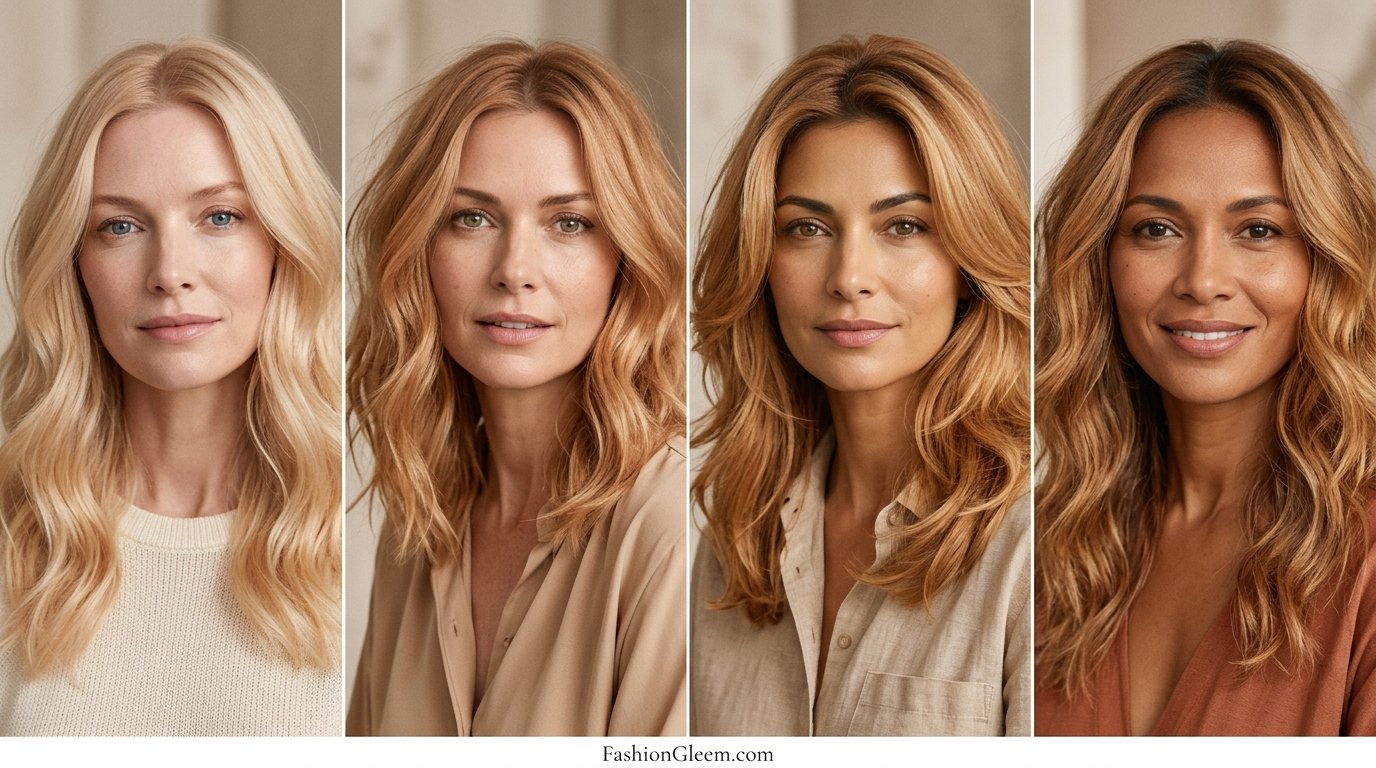
The one answer: a level 8 blonde with a copper wash over it: the Nestrique soft copper blonde guide defines it the same way, a light warm blonde base washed through with gentle copper and golden tones, glowing rather than orange.
Soft describes saturation, not application. The copper is dialed down on purpose, so blonde lightness stays the dominant read and the warmth sits on top of it like late sunlight rather than a new penny.
Manufacturers land in the same place. In the Wella Professionals copper color ideas, copper blonde is profiled as warm and golden-peach, a brighter twist on strawberry blonde built from golden and peachy tones rather than red pigment.
The Copper Family Table: Seven Shades, Placed Precisely
The family separates cleanly once level and direction are named: the GK Hair copper shade guide charts the family by level, copper blonde at level 8, light copper at 7, true copper at levels 5 to 6 and dark copper deeper still.
|
Shade |
Level |
Dominant reflect |
Saturation |
Base it needs |
Commitment |
|---|---|---|---|---|---|
|
Strawberry blonde |
8 to 9 |
Gold-rose, pink-leaning |
Low |
Light blonde base |
Gloss cadence |
|
Soft copper blonde |
7 to 9, center 8 |
Copper-gold |
Low to medium |
Level 7 to 9 base |
Gloss every 4 to 6 weeks |
|
Copper blonde |
7 to 8 |
Orange-copper |
Medium to high |
Level 7 to 8 base |
Faster visible fade |
|
Ginger |
7 to 8 |
Bright orange-gold |
High |
Level 7 to 8 base |
Strong indoor read |
|
Apricot blonde |
8 to 9 |
Peach and gold |
Low to medium |
Light blonde base |
Pastel-leaning fade |
|
Cowboy copper |
5 to 7 |
Rust, leather, caramel |
Medium to high |
Brunette base works |
Fades toward warm brown |
|
Dark copper |
3 to 6 |
Copper over brown |
Medium |
Brunette base |
Lowest lift bill |
Direction is the second separator: the LooksMeter strawberry blonde guide separates the three light reds by which way the red leans, strawberry toward gold-rose, rose gold toward pink and light copper toward orange, with soft copper holding the golden center.
Dominant feature is the third: the AI Change Color copper versus strawberry comparison separates the neighbors by what dominates, lightness in strawberry, warmth in copper, soft copper between them as the bridge.
Family charts agree on the ordering: the Luxe Hairstyles red hair color chart places the same seven shades on one chart, and winter roundups such as the PureGro Essence winter copper roundup place soft copper blonde as the family’s lightest, softest entry.
The Copper Dial: Level Crossed With Saturation
The dial is this page’s organizing idea. Pick a level, 7, 8 or 9, then a saturation, barely copper, true soft copper or full copper blonde, and the shade is specified more precisely than any name.
|
Level |
Barely copper |
True soft copper |
Full copper blonde |
|---|---|---|---|
|
Level 7 |
Warm dark blonde glow |
Deep soft copper, richest read |
Ginger-adjacent, boldest blonde copper |
|
Level 8 |
Copper-kissed blonde |
The center of the keyword |
True copper blonde, red-family read |
|
Level 9 |
Palest warm blonde |
Strawberry-leaning soft copper |
Bright copper over pale blonde |
Galleries prove how wide the dial really is: the Kosspa copper blonde gallery names more than fifteen copper blonde variations, and they look like different shades only because each one is a different level and saturation combination wearing one label.
Setting One: Barely Copper, the Copper-Kissed Wash
Barely copper is the trial setting. A whisper of copper gloss over an existing blonde warms the face, photographs golden and fades away almost completely, which makes it the honest first step for the copper-curious.
It suits the cautious and the cool-skinned. Readers with pink-leaning skin, ash blonde loyalists testing warmth and anyone unsure about red should start here, because the exit cost is one fade cycle, not a correction.
Setting Two: True Soft Copper, the Center of the Keyword
True soft copper is the shade the keyword actually means. At level 8 with medium-low saturation, the blonde still leads, the copper reads clearly in daylight and the whole effect stays muted rather than vivid.
This is the setting most reference photos show. When a saved image reads warm, sunlit and soft rather than orange, it is almost always this center setting, whatever caption the image carries.
Setting Three: Full Copper Blonde, the Saturation Turned Up
Full copper blonde turns the same level into a red-family shade. The orange reflect takes over, the blonde becomes the base rather than the read, and the fade shows sooner because there is more pigment to lose.
Who Soft Copper Blonde Suits
Warm and neutral undertones are the shade’s home ground. Wella’s profile places copper blonde on fair to medium warm or neutral skin, and the shade adjusts outward from that center rather than excluding anyone.
The Undertone Tests: Veins and Jewelry
Two daylight tests sort most readers in a minute. Check your wrist veins: blue or purple suggests cool, green suggests warm, hard to tell suggests neutral. Then check which jewelry flatters you, gold for warm, silver for cool.
Where the tests disagree, treat yourself as neutral. Neutral readers take the center setting, the most forgiving place on the dial, and a gloss-first trial settles any remaining doubt cheaply.
Eye Color Pairings: Green and Hazel Amplify Copper
Green and hazel eyes are the classic copper amplifiers. Copper sits across from green on the warm side of the color wheel, so green eyes read greener against it, and hazel’s gold flecks pick up the shade’s golden reflect.
Skin Depth Adjustments: Fair, Olive, Tan and Deep
Fair cool skin takes the softest setting. Keep the copper more golden than red and stay at the barely-copper to true soft settings, because full saturation against pale cool skin reads brassy and washes the face out.
Olive skin takes the golden center and glows. Ash blondes often read gray against olive, while golden copper warms it. Keep the direction golden rather than pink, since pink-leaning copper fights the green in olive skin.
Tan and deep skin take the richer, deeper setting: the HairstyleWave tan skin gallery works this exact territory, showing a level 7 to 9 blonde with copper-gold reflect reading brighter on tan skin than stark platinum or cool beige ever does.
The governing rule comes from the neighbor shade: the LooksMeter strawberry blonde guide warns that strawberry-depth shades are too light for medium or deeper skin, and the same logic pushes deeper skin toward the level 7 end of this dial with strong golden warmth.
The Base Test: Your Starting Level Decides Your Route
Your starting level matters more than your target photo. The same dial setting is a one-process gloss on one head and a two-session lightening plan on another, and the table below sorts starting points honestly before any money is spent.
|
Starting base |
Route |
Sessions |
Upkeep shape |
|---|---|---|---|
|
Natural level 8 to 9 |
Gloss or demi only |
One |
Gloss every 4 to 6 weeks |
|
Natural level 7 |
Permanent lift and deposit, or strong gloss |
One |
Gloss cadence, root watch |
|
Platinum, level 10 to 11 |
Copper-gold fill, then target color |
One, longer |
Tone refresh every 6 to 8 weeks |
|
Level 6 and below |
Lighten first, then tone |
One to two |
Gloss cadence after lift |
|
Previous dark dye or box black |
Lightening plan after strand test |
Often two |
Correction risk priced in |
|
Brunette testing the water |
Copper balayage entry |
One |
Lowest yearly upkeep |
One-Process Bases: Natural Level 7 and Up, or Already Lightened Hair
At level 8 or 9, the job is deposit, not lift. A soft copper gloss or demi-permanent can often reach the shade alone, because the lightness already exists and only the warm wash is missing.
Lift-First Bases: Level 6 and Below, Previous Dark Dye, Box Black
Level 6 and below need lightening before copper is honest. A gloss cannot lift, and copper deposited over a dark base reads as a faint warm tint in sunlight rather than a blonde shade at any dial setting.
Previous dark dye and box black slow the lift further. Old pigment lifts unevenly, sessions multiply, and a strand test stops being optional. One session promised from box black to level 8 is selling, not advising.
The Brunette Path: Lift Then Tone, or Balayage as the Entry
The full brunette route is lift, then tone. Lighten into the 7 to 9 band, which can take more than one session from dark or previously dyed bases, then apply the copper gloss at your chosen dial setting.
The Blonde Path: Coming Down From Platinum and the Fill Rule
The platinum route has the best-documented rule in this field: the AboutSuperstars platinum route guide states it plainly, fill first, because direct copper on bare platinum grabs pink and fades patchy within two weeks without a copper-gold fill underneath it.
The fill replaces the warmth platinum removed. Hair lifted to level 10 or 11 was carried past the gold and copper stages under a level 8 shade, so the fill rebuilds that layer first.
The Technique Chooser: Six Ways to Wear It
Technique decides grow-out, upkeep and how uniform the shade reads. The same dial setting delivered six ways produces six different maintenance lives, so choose the delivery before you choose the exact tone.
|
Technique |
Commitment |
Grow-out |
Upkeep |
Best base |
|---|---|---|---|---|
|
All-over gloss or demi |
Lowest |
Fades, no root line |
Gloss every 4 to 6 weeks |
Level 8 to 9 already |
|
All-over permanent |
High |
Visible root line |
Root touch-ups plus gloss |
Natural level 7 needing lift |
|
Balayage |
Medium |
Softest of the set |
Gloss between rare sessions |
Brunette and dark blonde bases |
|
Money piece |
Lowest per area |
Pieces fade in place |
Refresh with any gloss visit |
Any base wanting a fast change |
|
Shadow root |
Medium |
Root camouflaged by design |
Longest root interval |
Darker naturals going lighter |
|
Ombre |
Medium |
Grows out downward |
Ends need tone care |
Longer hair, level gradient wanted |
Balayage is the low-maintenance champion of the set. Hand-painted through mids and ends, it reads as dimension rather than a uniform shade, and our mocha balayage guide demonstrates how painted warmth grows out softly on a deeper base.
The Salon Process, Step by Step
The appointment follows the same order on every honest route. Knowing it lets you hear where a consultation goes wrong, because skipped steps announce themselves early.
- Consultation first: your base level, dye history and porosity are assessed, and your dial setting is named in level language before any mixing happens.
- Strand test next on porous or previously colored hair, because ends grab copper harder than healthy lengths and the test shows the real saturation.
- Lift only if your base sits below the band, lightening into level 7 to 9 and stopping the moment the band is reached, never beyond it.
- Fill only if you are coming down from platinum, laying the copper-gold warmth back in before the target shade is allowed anywhere near the hair.
- Tone or gloss at your dial setting, watched rather than timed blindly, because porous light hair can overshoot toward orange in minutes.
- Bond treatment where lightening was heavy, then a finish that shows the shade in daylight before you judge it under salon lighting.
The Exact Ask: Level Language Scripts for Each Dial Setting
Ask in level language, not shade names: the HairstyleWave tan skin gallery coaches exactly this, because a level, a reflect and a technique can be mixed to order, while a shade name means something different in every salon.
For the center setting, say this. Level 8 blonde with copper-gold reflect, muted not vivid, soft root shadow, gloss finish. For barely copper, ask for a copper-kissed gloss over your current blonde.
Bring photos of your setting, not the family’s loud end. A true copper or cowboy copper reference will pull your mix deeper and more saturated than the soft shade you actually want to wear.
Box Dye Reality Check, Graded
The honest grade: plausible on already light hair, a correction risk on anything else. A box can deposit copper on natural or dyed light blonde. It cannot lift dark hair, cannot be set to a dial position and cannot judge whether your hair needs a fill.
The manufacturer itself routes the shade narrowly: the L’Oreal Paris copper hair color guide sends copper blonde at home to its Light Reddish Blonde box shade and frames the salon equivalent as asking for a strawberry blonde hue, which confirms the box version is one fixed setting.
Previously dyed hair is where boxes fail hardest. Old pigment plus new copper builds up in bands, porous ends grab darker than roots, and each extra box widens the patchiness that a correction service then charges properly to undo.
One more limit deserves plain words. A single blog’s formula specifics, named shades mixed with set developer and timing, are one writer’s recipe, not a manufacturer instruction, and this page does not import them as instructions for your hair.
What Soft Copper Blonde Costs: Dated Strands Only
Prices here are strands, each with its source and date attached. No national average exists in the sources fetched for this page, so none is printed, and the ranges below are never blended into one figure.
The gloss economy comes from one shade guide: the Viral Hairstyle copper shade guide, crawled on 2026-11-19, prices a strawberry copper gloss refresh at $60 to $120 every 4 to 5 weeks and a light golden copper first visit at $120 to $250.
One real menu anchors the middle: the Salon M +Suites color menu, fetched live on 2026-11-20, lists natural red all-over color at $160, a refresh gloss at $60 and lived-in blonde at $200, one named Utah salon’s prices, labeled as exactly that.
A seasonal roundup lands in the same territory: the Influencive fall 2026 copper roundup puts copper balayage at $180 to $320 and full-head copper at $90 to $160 in its fall 2026 table, its own mid-market framing rather than a surveyed price.
The Fade Curve, Week by Week
Copper is the fastest-fading member of the warm family. That is the field’s shared observation, and the curve below turns it from a warning into a plan, because a fade you can schedule around is a feature, not a flaw.
|
Week band |
What you see |
What to do |
|---|---|---|
|
Week 1 |
Richest color, full copper read |
Photograph it; this is the reference tone |
|
Weeks 2 to 3 |
Softening begins, blonde shows through |
Start depositing conditioner once or twice weekly |
|
Weeks 4 to 6 |
Noticeably more golden blonde |
The gloss window; book the refresh |
|
Weeks 6 to 8 |
Mostly warm golden blonde without a gloss |
Refresh now, or enjoy the blonde it became |
The curve is the strongest competitor’s best content: the Nestrique soft copper blonde guide prints the same week-by-week timeline, and family charts such as the Luxe Hairstyles red hair color chart confirm the ordering, bright coppers fading fastest while deep auburn and burgundy last longest.
Why it fades is an explanation, graded as one. Colorists standardly explain the speed by red pigment molecules being largest and sitting shallow in the shaft, so they wash out first: the standard colorist explanation, not a laboratory result.
The Keeping Routine: Wash Discipline, Depositing Conditioner, Heat Rules
Wash cooler and less often. Cool or lukewarm water, a sulfate-free color-safe shampoo and washing every second or third day instead of daily are the three habits every serious source in this field agrees on.
Put pigment back between appointments. A copper color-depositing conditioner once or twice a week tops the tone up gently, and the LooksMeter strawberry blonde guide pushes the strawberry end further, every other wash, because copper there rinses out within 3 to 4 weeks.
Retire the purple shampoo. Made for cool blondes, its violet pigment cancels yellow, and on copper it dulls the tone toward muddy. Copper’s care tool is the opposite: warmth put back, not cancelled.
Heat is a fade accelerant, not a styling detail. A flat iron run too hot strips copper tone from the ends within a few uses, so medium settings and heat protectant are upkeep, not extras.
Wearing It: Cuts, Wardrobe and Makeup That Carry the Shade
Dimension is what makes the dial settings read. Layered movement shows copper shifting between light and shadow, and our butterfly haircut guide is built on exactly that principle of movement through the lengths.
Texture carries it further. The choppy, lived-in finish in our wolf cut guide is the cut the social field pairs with copper most, while curls take the same logic through our curly butterfly cut guide, where painted warmth follows the curl pattern.
The gallery record agrees on styling range: the Latest-Hairstyles light copper gallery shows the shade across dozens of lengths and finishes, a reminder that the dial setting, not the haircut, makes the color recognizable.
Wardrobe warmth completes the read. Cream, camel, olive and warm brown deepen copper’s glow, and our capsule wardrobe guide shows how a small, deliberate wardrobe makes those pairings repeatable.
Build the pairing habit once: our step by step guide to creating a capsule wardrobe walks the order for building a wardrobe around anchor colors, and a copper wearer’s anchors are the warm neutrals her hair already votes for.
Makeup follows the same temperature. Warm blush, peach and bronze sit naturally beside copper hair, and our clean girl makeup guide builds its fresh, warm-leaning method on that same side of the color wheel.
Treat the shade as one piece of a seasonal refresh: the broader refresh thinking in our glow up tips makes the same point, and soft copper refreshes without demanding a new everything else.
The Two Corrections
Too Orange: Toning Down a Saturation Overshoot
Too orange is a saturation overshoot, and porous light hair is its usual victim: the GK Hair copper shade guide warns that a formula meant to give soft ginger can turn traffic-cone orange in ten minutes on blonde hair, because porous lengths grab warm pigment hard.
The fix direction is toning down, never adding. A cooler or more golden gloss pulls the read back toward blonde, while adding more copper deepens the problem and ash muddies it.
Grade the severity before acting. A mild overshoot is a gloss fix at the next appointment. A severe one is professional correction territory, and every box layered over it meanwhile makes that correction slower and more expensive.
Too Pink: The Gold Rebalance
Too pink is the missing-fill problem wearing a color. Copper over unfilled platinum, or over very porous very light ends, grabs pink because the warm layer underneath was never replaced, and the pink is the shade developing over nothing.
The fix direction is gold. A copper-gold fill or a gold-leaning gloss rebalances the read from pink back toward copper, rebuilding the warmth in the order the platinum route should have built it in the first place.
Patchy pink means professional hands: the AboutSuperstars platinum route guide built its whole route guide around preventing this failure, and once pink arrives with patchiness, the hair needs its missing warmth rebuilt section by section, not another all-over application.
Frequently Asked Questions
1. What is soft copper blonde hair color?
Blonde first, copper second: a level 8 to 9 warm blonde washed with gentle copper and gold. Wella profiles it as golden-peach, and soft means low saturation, often buildable with a gloss over a light base.
2. What level is soft copper blonde?
Levels 7 to 9, with most versions centered at level 8. GK Hair’s chart puts copper blonde at level 8, sandy and gold-heavy; level 7 is the deeper end, level 9 the palest, closest to strawberry.
3. Is soft copper blonde warm or cool?
Warm, by definition: copper is an orange-based warm reflect and gold is its softener. On cool skin the adjustment is saturation, turned down toward barely copper, because a cool copper does not exist; ash cancels it instead.
4. What is the difference between soft copper blonde and copper blonde?
Saturation, at the same levels. Full copper blonde turns the copper up until the shade reads red-family, while soft copper blonde keeps blonde lightness dominant, so its fade shows later and softer.
5. Is soft copper blonde the same as strawberry blonde?
Neighbors, not twins. Strawberry blonde is paler and pinker, keeping lightness dominant, while soft copper blonde is warmer and more golden: more copper and gold, less pink, and peachy photos mean soft copper while rosy ones mean strawberry.
6. What does soft copper blonde look like as it grows out?
It depends on the technique, because technique is a grow-out decision. A gloss fades evenly instead of lining, balayage and shadow root soften the root by design, and permanent color is the one route that draws a line.
7. Who suits soft copper blonde?
Warm and neutral undertones first, fair to medium skin at the center. Green and hazel eyes pair classically, and beyond the center the shade adjusts: golden for olive, deeper for tan and deep skin, softest for cool.
8. Does soft copper blonde suit cool skin tones?
Yes, at the soft end of the dial. Keep the copper more golden than red at the barely-copper to true soft settings, because full saturation against pale cool skin reads brassy, and only the saturation can change, never the temperature.
9. How do I test my undertone before choosing copper?
Two daylight tests: the wrist vein test and the jewelry test. Blue or purple veins suggest cool, green warm, unclear neutral; gold jewelry flatters warm undertones, silver cool ones, and disagreement means treat yourself as neutral.
10. Does soft copper blonde suit olive skin?
Yes, olive is one of its best fits. The golden-copper center glows against warm olive skin where ash blondes read gray, and the direction matters: keep the copper golden rather than pink, which fights olive’s green.
11. What is the best copper blonde setting for tan or deep skin?
A richer, deeper copper blonde with strong golden warmth, at the level 7 end of the dial. Strawberry-depth shades are too light for medium or deeper skin, and peach, honey, amber and caramel directions personalize tan skin.
12. Which eye colors does copper blonde flatter most?
Green and hazel are the classic copper amplifiers. Green reads greener against copper’s warmth, hazel’s gold flecks pick up the golden reflect, and blue contrasts cleanly, while undertone and starting base still outrank eye color.
13. Can older women wear soft copper blonde?
Yes; the muted end of the red family is its most wearable end at any age. Gloss and shadow root blend gray regrowth instead of lining against it, and level 7 to 8 settings keep face-framing depth.
14. Can I get soft copper blonde without bleach?
Yes if your base is already level 8 or 9, natural or lightened, where a gloss alone can deposit the shade. No from medium brown or darker without lightening first, because a gloss cannot lift.
15. What starting colors reach soft copper blonde in one process?
Natural level 7 and up, plus hair already lightened into the 7 to 9 band. At level 7 a permanent can lift and deposit in one process; at 8 and 9 a gloss may be the whole job.
16. I am a brunette: what is my route to soft copper blonde?
Two honest routes: lift then tone, or copper balayage as the entry. The full route lightens into the 7 to 9 band, sometimes over two sessions, then tones; a gloss over dark hair is not a route.
17. Can I go from platinum to soft copper blonde?
Yes, with the copper-gold fill first, never direct copper on bare platinum. Unfilled platinum grabs pink and fades patchy within two weeks; the fill adds about thirty minutes, and refreshes run every 6 to 8 weeks.
18. Why does copper turn pink on platinum hair?
Because the warm pigment underneath is missing. Platinum was lifted past the gold and copper stages that sit under a level 8 shade, so direct copper has nothing warm to anchor to and reads pink.
19. What is a fill and do I need one?
A fill is a warm copper-gold pre-pigment applied before the target shade, for hair going darker or warmer from a very light, porous start. You need one coming down from platinum, not at a 7 to 9 base.
20. Should I choose balayage or all-over color for soft copper blonde?
Grow-out and upkeep decide. Balayage has the softest grow-out and lowest maintenance but costs most per session; all-over gloss is the lowest commitment, and permanent suits readers needing lift plus deposit in one process.
21. What should I ask my colorist for?
Ask in level language, not shade names. Say level 8 blonde with copper-gold reflect and a soft root shadow, name your dial setting and technique, and bring photos of your setting, not the family’s loud end.
22. Do I need a strand test?
Yes, if your hair is porous or previously colored. Porous ends grab copper harder and less evenly, and the test shows the saturation your hair will actually take, the difference between your setting and a traffic-cone outcome.
23. How long does a soft copper blonde appointment take?
Route dependent, and no single figure is honest. A gloss refresh is the short visit, under an hour in the price strands; the platinum route adds thirty minutes for the fill, and brunette lifts take hours across visits.
24. Can I get soft copper blonde from a box dye at home?
Plausible on already light hair, a correction risk on anything darker or previously colored. The manufacturer routes the shade to a light reddish blonde box, but no box lifts to level 8, matches a dial setting or judges a fill.
25. Why can a box dye not take dark hair to soft copper blonde?
Level math: box dye deposits color but cannot lighten a level 4 or 5 base up to level 8. Copper over darkness reads as a warm tint in sunlight, and repeated boxes build up unevenly.
26. What goes wrong with box copper on previously dyed hair?
Build-up, banding and uneven grab. Old pigment takes new copper unpredictably, porous ends grab darker than roots, and each extra box layers another band, so consultation and a strand test come first, not the box.
27. How much does soft copper blonde cost at a salon?
Only as dated strands, never one figure. A November 2026 shade guide prices gloss refreshes at $60 to $120 and balayage at $200 to $400; one Utah menu lists all-over natural red at $160.
28. How much is the upkeep per month?
One shade guide’s own summary budgets roughly $100 a month for a bright copper and $60 for a dark one. Soft copper blonde sits nearer the bright end, driven by the gloss every 4 to 6 weeks.
29. Is balayage or all-over cheaper to maintain?
Balayage costs more first and less often; all-over gloss costs less per visit and more often. First sessions run $180 to $400 across the strands, against $60 to $120 gloss refreshes, so a year narrows the gap.
30. How long does soft copper blonde last?
On the fade curve: week 1 richest, weeks 2 to 3 softening, weeks 4 to 6 more golden, weeks 6 to 8 mostly warm golden blonde. Copper fades fastest in the family; the shade is a cadence, not an event.
31. Why does copper blonde fade so fast?
The consensus is that copper and the bright reds fade fastest in the family, while deep auburn lasts longest. Colorists standardly explain it by red pigment molecules being largest and sitting shallow; that is their explanation, not laboratory fact.
32. How often do I need a gloss refresh?
Every 4 to 6 weeks is the band the field converges on. The strongest guide’s routine, a fall roundup’s cost table and a shade guide’s 4 to 5 week entry all land there; the platinum route runs 6 to 8.
33. What does soft copper blonde fade to?
A warm golden blonde, when the base was clean, because blonde dominates the read and the copper leaves without exposing anything harsh. The fade goes wrong only from a wrong start: patchy over unfilled platinum, orange over brass.
34. How do I keep copper blonde from fading?
Wash cooler and less often, with pigment put back between appointments. Cool water, sulfate-free shampoo, washing every second or third day, a copper depositing conditioner once or twice weekly, a weekly mask and heat protectant: that is the agreed routine.
35. Can I use purple shampoo on copper blonde?
No: purple shampoo is made for cool blondes and dulls copper toward muddy. Its violet pigment cancels yellow, the opposite of what copper needs; copper’s tool puts warm pigment back, a copper color-depositing conditioner.
36. What is a copper color-depositing conditioner and how often do I use it?
A conditioner carrying copper pigment that tops up the tone at every use, slowing the fade between glosses. Once or twice a week is the standard cadence, every other wash at the strawberry end; it maintains, never creates.
37. My copper blonde came out too orange. What fixes it?
Too orange is a saturation overshoot, and porous light hair is its usual victim. The correction direction is toning down with a cooler or more golden gloss, never adding copper or reaching for ash; severe cases are professional correction.
38. My copper went pink. Why, and what fixes it?
Almost always the missing-fill problem: copper over unfilled platinum or very porous light hair grabs pink because the warm layer underneath was never replaced. The fix is gold, a copper-gold fill or gold-leaning gloss; patchy pink needs professional rebuilding.
39. My copper grabbed unevenly and looks patchy. What now?
Patchiness is a porosity map made visible: the driest lengths grabbed the most pigment. Repair first with bond treatment and moisture, then let a professional even the base; never layer more box dye, which deepens the darkest patches fastest.
40. Can I go back to blonde from soft copper blonde?
Yes, and your route decides how easy it is. Gloss-kept copper is the easy case: stop refreshing and it fades to warm golden blonde alone, while permanent all-over copper is a removal process, stubborn in proportion to saturation.
41. Will soft copper blonde cover gray hair?
It depends on the formula, and the distinction is the answer. A demi gloss blends and sheers gray into translucent copper dimension that grows out without a line, while full opaque coverage needs a permanent route.
42. Soft copper blonde vs cowboy copper: what is the real difference?
They are roughly opposite decisions wearing one family name. Soft copper blonde is level 7 to 9 and blonde-based, fading toward golden blonde; cowboy copper is levels 5 to 7, brunette-based, workable without heavy lifting, fading toward brown.
Conclusion
Soft copper blonde rewards the reader who sets the dial before booking. Level first, saturation second, route third: that order turns a saved photo into a shade your own hair can actually hold.
The upkeep is a cadence, not a surprise. Copper fades fastest in its family, and the gloss every 4 to 6 weeks is simply the rent on the softest, most wearable end of red.
Start at the setting you can leave. A barely-copper gloss or a painted balayage lets you test the warmth for one season, and if it earns its place, your colorist can turn the dial up at the next visit.
The wider site keeps the same honesty standard: the FashionGleem home page gathers the color, cut and care guides this page draws on, each one built to be checked the way this shade guide was.

Dilawar is a contributing writer at Fashiongleem.com, focusing on beauty, hairstyles, skincare, fashion accessories, and personal grooming. He creates informative, easy-to-follow articles that help readers explore new looks, understand popular beauty trends, and improve their everyday styling routines. His writing emphasizes practical advice, useful product information, and accessible fashion inspiration for modern readers.