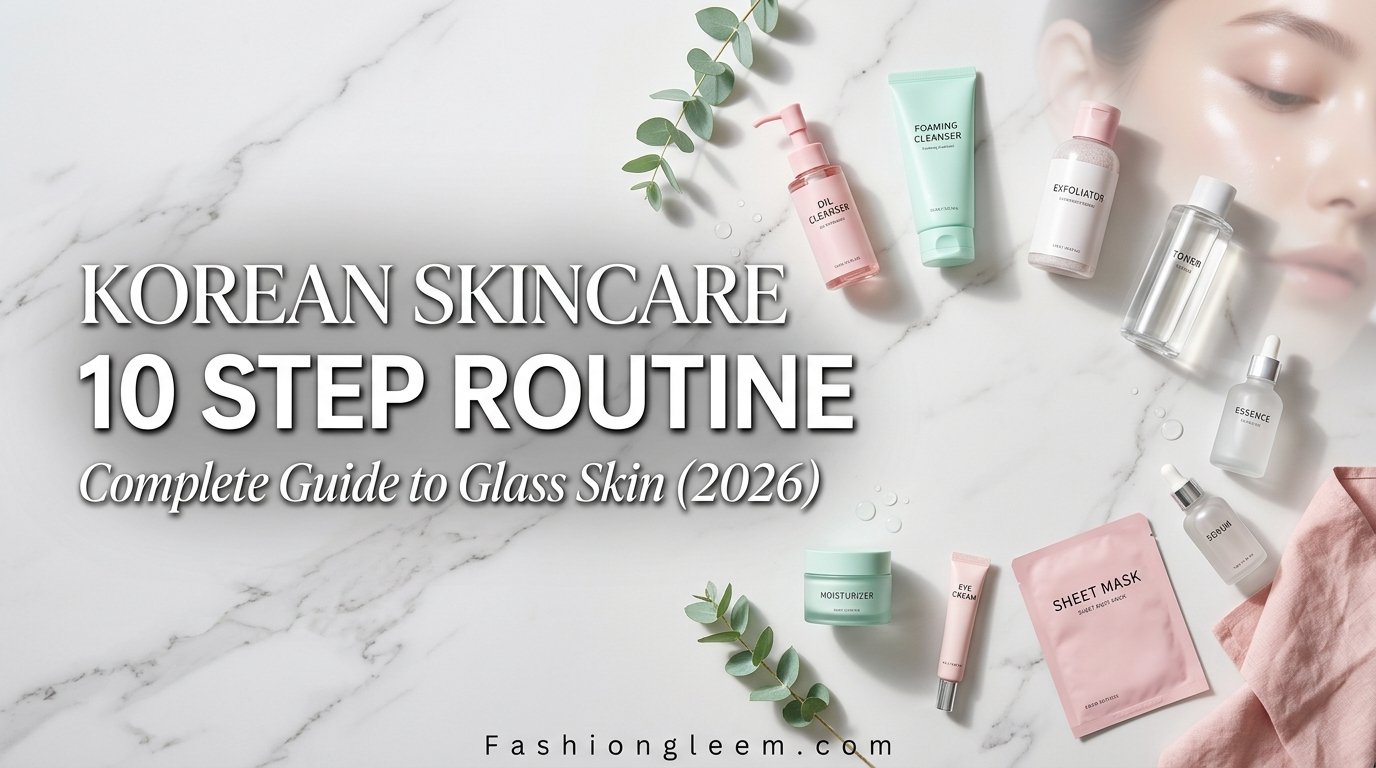
Korean Skincare 10 Step Routine: The Complete Guide to Glass Skin, Step by Step (2026)
Open any beauty feed and you will see the same thing: skin that looks smooth, bouncy, and lit from within. Many of those faces share one secret, and it comes from Seoul.
The Korean skincare 10 step routine is one of the most talked-about habits in modern beauty. It layers gentle cleansing, light hydration, and targeted care into a ritual that aims for healthy, dewy, “glass-like” skin.
It also looks like a lot. Ten steps, morning and night, can sound like a part-time job.
Here is the good news. The routine is less rigid than it appears, and you do not need to follow all ten steps every day to see results.
Korean Skincare 10 Step Routine

The Korean skincare 10 step routine is a layered sequence that goes from cleansing to protection. The usual order is oil cleanser, water-based cleanser, exfoliator, toner, essence, serum or ampoule, sheet mask, eye cream, moisturizer, and sunscreen in the morning.
Most people do not use every step daily. A sensible core is cleanser, toner, serum, moisturizer, and sunscreen, with the extra steps added gradually.
Short formula: Cleanse twice, hydrate in light layers, treat your concerns, seal with moisturizer, and protect with sunscreen.
Key Takeaways
- The routine moves from the thinnest, lightest products to the thickest.
- Double cleansing is the foundation, especially if you wear makeup or sunscreen.
- Exfoliation is only needed once or twice a week.
- Essences, serums, and ampoules add hydration and target specific concerns.
- Sheet masks are an occasional boost, not a daily need.
- Sunscreen is the most important morning step.
- You can start with four or five steps and add more over time.
- Patch test new products and introduce them one at a time.
What Is the Korean Skincare Routine?
Korean skincare is a philosophy as much as a product list. It focuses on prevention, hydration, and gentle care rather than harsh fixes.
Instead of treating skin only when problems appear, the routine builds a healthy base every day. Skin that is well hydrated and protected tends to look calmer, smoother, and more even.
The “Glass Skin” Goal
Glass skin describes a complexion that looks clear, even, and softly reflective. It comes from hydration, a healthy barrier, and consistent sun protection rather than heavy makeup.
Why Ten Steps?
The routine splits skincare into small stages. Each stage does one job and prepares the skin for the next. This layering approach lets lightweight products absorb well and reduces the need for one harsh, do-everything product.
It Is a Guide, Not a Rule
Dermatology experts and beauty writers often stress that you do not need all ten steps. Treat the full list as a menu. Pick what your skin needs.
The Core Principles Behind the Routine
Before the steps, understand the ideas that make the routine work.
Double Cleansing
Using an oil cleanser first and a water-based cleanser second removes both oil-based and water-based impurities.
Layering From Thin to Thick
Apply lighter, water-like products first and richer creams last. This helps each layer absorb.
Hydration First
Hydration comes before heavy actives. Skin that holds water looks plumper and feels more comfortable.
Gentle Exfoliation
Mild exfoliation done occasionally is preferred over aggressive scrubbing.
Sun Protection Every Day
Daily sunscreen helps prevent dark spots, uneven tone, and early signs of ageing.
Consistency Over Intensity
Steady habits beat occasional intense treatments.
The Full Korean Skincare 10 Step Routine at a Glance
Here is the whole routine in one table.
| Step | Product | Main job | When |
|---|---|---|---|
| 1 | Oil cleanser | Dissolves makeup, sunscreen, oil | Night (and morning if needed) |
| 2 | Water-based cleanser | Removes sweat and residue | Morning and night |
| 3 | Exfoliator | Removes dead skin cells | 1 to 2 times a week |
| 4 | Toner | Hydrates and preps skin | Morning and night |
| 5 | Essence | Light hydration, glow | Morning and night |
| 6 | Serum or ampoule | Targets concerns | Morning and night |
| 7 | Sheet mask | Hydration boost | 1 to 3 times a week |
| 8 | Eye cream | Cares for the eye area | Morning and night |
| 9 | Moisturizer | Locks in hydration | Morning and night |
| 10 | Sunscreen | Protects from UV | Morning only |
Different brands and writers group the steps slightly differently. Some count makeup removal or a night cream as separate steps, and some add a sleeping mask. The order and the idea stay the same.
Step 1: Oil Cleanser
The routine begins with an oil-based cleanser. It removes makeup, sunscreen, and excess sebum that water alone cannot lift.
What It Does
Oil dissolves oil. Waterproof makeup and sunscreen break down easily in a cleansing oil or balm.
How to Use It
- Start with dry hands and a dry face.
- Massage the oil gently for about a minute.
- Add a little water to emulsify it into a milky texture.
- Rinse thoroughly.
Who Needs It
Anyone who wears makeup or sunscreen should use it at night. If you wear neither, you can skip it on some days.
Oily Skin Myth
Many people with oily skin avoid oil cleansers. In practice, a good cleansing oil can help remove excess oil without leaving skin tight.
Step 2: Water-Based Cleanser

The second cleanse removes sweat, dirt, and any leftover residue from the oil cleanser.
What to Look For
Choose a gentle gel or low-foam cleanser. Skin should feel clean, not squeaky or tight.
How to Use It
Lather in your hands and massage over damp skin for 30 to 60 seconds. Rinse with lukewarm water, not hot.
Morning Cleansing
In the morning, many people only use the water-based cleanser or even just water if their skin is dry.
Cleanser Comparison
| Skin type | Cleanser style | Notes |
|---|---|---|
| Dry | Creamy or milky | Avoid strong foams |
| Oily | Gel or light foam | Avoid over-washing |
| Combination | Gentle gel | Balanced formula |
| Sensitive | Fragrance-free, low foam | Patch test first |
| Acne-prone | Gentle gel with mild actives | Avoid harsh scrubs |
If your skin is easily irritated, follow this skincare routine for sensitive skin for a gentler approach.
Step 3: Exfoliator
Exfoliation removes dead skin cells so skin looks smoother and products absorb better.
Chemical vs Physical Exfoliants
| Type | Examples | Good for | Caution |
|---|---|---|---|
| Chemical (AHA) | Glycolic, lactic acid | Dullness, texture | Can irritate sensitive skin |
| Chemical (BHA) | Salicylic acid | Oily, clog-prone skin | Can dry out skin |
| Gentle enzyme | Fruit enzymes | Sensitive skin | Usually mild |
| Physical scrub | Fine sugar, grains | Occasional use | Avoid harsh scrubbing |
How Often?
Once or twice a week is plenty for most people. Start slowly and watch how your skin reacts.
Signs You Are Overdoing It
- Redness or stinging.
- Tight, shiny skin.
- Flaking and sensitivity.
- Breakouts.
If you notice these, stop and rebuild your barrier with simple moisturizer.
Step 4: Toner
In Korean routines, toner is a hydrating step, not a harsh astringent.
What It Does
Toners prep skin for the next layers. Modern toners also add light hydration and may help balance the skin’s surface after cleansing.
Ingredients to Look For
- Hyaluronic acid for hydration.
- Glycerin for comfort.
- Centella asiatica for soothing.
- Rice or herbal extracts for a gentle feel.
Ingredients to Avoid
If your skin is sensitive, avoid strong alcohol and heavy fragrance.
How to Apply
Pat it in with clean hands or a cotton pad. Let it absorb before the next step.
Some people do not use toner daily, and that is fine. Use it when your skin needs it.
Step 5: Essence
Essence is the heart of the Korean routine. It is lighter than a serum but more nourishing than a toner.
What It Does
Essence delivers lightweight hydration and prepares the skin for the next products. It is closely tied to the dewy look many people want.
Key Ingredients
- Hyaluronic acid.
- Fermented extracts.
- Snail mucin (if it suits you).
- Niacinamide.
- Peptides.
How to Use It
Dispense into your palm, warm it between your hands, and press it into your face. Layer a second thin coat if your skin is dry.
Essence vs Toner vs Serum
| Product | Texture | Main job |
|---|---|---|
| Toner | Watery | Preps and hydrates |
| Essence | Light, slightly silky | Hydration and glow |
| Serum | Thicker, concentrated | Targeted treatment |
Step 6: Serum or Ampoule
This is the treatment step. It delivers concentrated ingredients for specific concerns.
Serum vs Ampoule
A serum is a lightweight concentrated treatment. An ampoule is usually even more concentrated and used in smaller amounts.
Common Actives by Concern
| Concern | Ingredient to look for |
|---|---|
| Dullness, dark spots | Vitamin C, niacinamide |
| Fine lines | Retinol, peptides |
| Dryness | Hyaluronic acid, ceramides |
| Acne marks | Niacinamide, azelaic acid |
| Redness | Centella, panthenol |
| Texture | Mild acids |
Layering Rules
- Introduce one active at a time.
- Use stronger actives at night.
- Do not mix too many strong actives at once.
- If you use retinol, start slowly.
Dry vs Oily Skin
Dry skin can handle multiple hydrating layers. Oily skin does better with one lighter layer.
Step 7: Sheet Mask

A sheet mask is a cloth or hydrogel sheet soaked in serum. It adds an intense hydration boost.
How to Use It
- Cleanse and tone.
- Place the mask on your face.
- Leave it on for about 15 to 20 minutes.
- Remove the mask and pat in the leftover serum.
- Follow with moisturizer.
How Often?
One to three times a week works for most people. It is a treat, not a daily need.
Types of Sheet Masks
| Type | Best for |
|---|---|
| Hydrating | Dry or dull skin |
| Soothing | Sensitive or red skin |
| Brightening | Uneven tone |
| Firming | Tired skin |
| Clay or wash-off | Oily skin |
Common Mistake
Do not leave a sheet mask on until it dries out. A dry mask can pull moisture back out.
Step 8: Eye Cream
The skin around the eyes is thin and prone to dryness and fine lines. An eye cream gives it extra care.
What to Look For
- Peptides for a smoother look.
- Hyaluronic acid for hydration.
- Caffeine to help with puffiness.
- Gentle, fragrance-free formulas.
How to Apply
Use a small amount, about the size of a grain of rice for both eyes. Tap gently with your ring finger. Do not pull the skin.
Is It Necessary?
It is optional. A good moisturizer can work around the eyes for many people. Eye cream is more of a targeted extra.
Step 9: Moisturizer
Moisturizer seals in everything you have applied. It also supports the skin barrier.
Choosing a Texture
| Skin type | Moisturizer type |
|---|---|
| Oily | Light gel |
| Combination | Gel-cream or lotion |
| Dry | Rich cream |
| Sensitive | Fragrance-free barrier cream |
| Mature | Cream with peptides or ceramides |
Key Ingredients
- Ceramides to support the barrier.
- Squalane for softness.
- Glycerin for water retention.
- Panthenol for comfort.
Do Oily Skin Types Need It?
Yes. Even oily skin needs moisture. A lightweight gel can hydrate without feeling heavy.
Optional Sleeping Pack
Some routines add a sleeping mask at night. It acts like a thick final layer that seals everything in.
Step 10: Sunscreen
Sunscreen is the last step in the morning. Many experts treat it as the most important part of the entire routine.
Why It Matters
UV rays contribute to dark spots, uneven tone, early ageing, and skin damage. Daily use helps protect the results of everything else you do.
What to Choose
- Broad-spectrum protection.
- SPF 30 or higher.
- A texture you enjoy wearing every day.
Types of Sunscreen
| Type | Feel | Best for |
|---|---|---|
| Chemical | Light, invisible | Everyday wear |
| Mineral | Slightly thicker | Sensitive skin |
| Hybrid | Balanced | Most skin types |
| Tinted | Light coverage | Natural looks |
How to Apply
Use enough to cover your face and neck. Reapply every two hours when outdoors.
Sample Morning Korean Skincare Routine

A morning routine is usually shorter than a night routine.
Simple Morning Version
- Rinse with water or a gentle cleanser.
- Apply toner.
- Apply essence or serum.
- Apply moisturizer.
- Apply sunscreen.
Full Morning Version
- Gentle cleanser.
- Toner.
- Essence.
- Vitamin C or niacinamide serum.
- Eye cream.
- Moisturizer.
- Sunscreen.
Sample Night Korean Skincare Routine
Night is when you do the deeper work.
Simple Night Version
- Oil cleanser.
- Water-based cleanser.
- Toner.
- Serum.
- Moisturizer.
Full Night Version
- Oil cleanser.
- Water-based cleanser.
- Exfoliator (once or twice a week).
- Toner.
- Essence.
- Serum or ampoule.
- Sheet mask (a few nights a week).
- Eye cream.
- Moisturizer.
- Optional sleeping pack.
Weekly Schedule Example
| Day | Night focus |
|---|---|
| Monday | Full routine with serum |
| Tuesday | Simple routine |
| Wednesday | Exfoliation night |
| Thursday | Simple routine |
| Friday | Sheet mask night |
| Saturday | Rest night with moisturizer only |
| Sunday | Hydrating routine with essence |
Korean Skincare 10 Step Routine by Skin Type
The routine works best when you adapt it.
For Dry Skin
- Use a creamy cleanser.
- Layer hydrating essence and serum.
- Choose a rich moisturizer.
- Use sheet masks more often.
For Oily Skin
- Keep the routine light.
- Use one hydrating layer instead of three.
- Choose a gel moisturizer.
- Exfoliate gently once a week.
For Combination Skin
- Use a gentle gel cleanser.
- Apply lighter layers on the T-zone.
- Use richer creams on dry areas.
For Sensitive Skin
- Choose fragrance-free products.
- Introduce one product at a time.
- Skip strong acids and scrubs.
- Patch test everything.
For Acne-Prone Skin
- Use non-comedogenic products.
- Choose gentle exfoliants.
- Avoid heavy oils on breakout areas.
- See a dermatologist for persistent acne.
For Mature Skin
- Add peptides and ceramides.
- Use gentle retinoids as advised.
- Protect with daily sunscreen.
Skin Type Table
| Skin type | Steps to focus on | Steps to limit |
|---|---|---|
| Dry | Essence, serum, moisturizer, masks | Strong foaming cleansers |
| Oily | Cleanse, light hydration, sunscreen | Heavy layers, too many masks |
| Combination | Balanced layering | Rich creams on oily zones |
| Sensitive | Gentle cleanse, barrier cream | Acids, scrubs, fragrance |
| Acne-prone | Gentle cleanse, treat, sunscreen | Heavy oils |
| Mature | Serum, eye cream, moisturizer | Harsh exfoliation |
Do You Really Need All 10 Steps?
No. This is the most important point in the guide.
The Core Five
If you want a minimal version, start with these five.
- Cleanser.
- Toner or essence.
- Serum.
- Moisturizer.
- Sunscreen.
The Starter Plan
Begin with four or five steps for a few weeks. Add one new step at a time.
When to Add More
Add steps when you have a clear reason. For example, add an exfoliant if your skin feels rough, or an eye cream if the area feels dry.
When to Cut Back
If your skin feels irritated, sticky, or congested, remove steps. Less can be more.
How to Build the Routine Without Irritating Your Skin
Adding many products at once is the fastest way to cause a reaction.
Introduce One Product at a Time
Wait at least a week before adding another new product. This makes it easy to find the cause if something irritates you.
Patch Test
Apply a small amount behind your ear or on your jaw for a day or two before using a product on your face.
Watch for Signs of Irritation
- Redness.
- Stinging or burning.
- Itching.
- Sudden breakouts.
Support Your Barrier
If your skin feels irritated, simplify to a gentle cleanser, moisturizer, and sunscreen until it calms.
Korean Skincare Ingredients Worth Knowing
You will see these names often on Korean products.
| Ingredient | Common use | Why people like it |
|---|---|---|
| Centella asiatica | Soothing | Calming feel |
| Hyaluronic acid | Hydration | Plumping, lightweight |
| Niacinamide | Tone and texture | Supports a smooth look |
| Ceramides | Barrier care | Helps skin hold moisture |
| Snail mucin | Hydration | Bouncy, dewy feel |
| Rice extract | Brightening feel | Gentle and soft |
| Green tea | Soothing | Light antioxidant care |
| Propolis | Nourishing | Rich, glowy feel |
| Peptides | Firming | Smooth look for mature skin |
Ingredients affect people differently, so always check the label and patch test.
Order Rules: What Goes Where
Getting the order right helps each product work properly.
The Thin-to-Thick Rule
Apply the thinnest, most watery product first and the thickest last.
Actives Before Moisturizer
Serums and treatments go before moisturizer so they sit closer to the skin.
Sunscreen Last in the Morning
Sunscreen is the final skincare step, before makeup.
Wait Between Layers
Give each layer a moment to absorb. This prevents pilling.
Order Cheat Table
| Order | Product type |
|---|---|
| First | Cleansers |
| Second | Toner, essence |
| Third | Serums, ampoules, treatments |
| Fourth | Eye cream |
| Fifth | Moisturizer |
| Last (morning) | Sunscreen |
Common Mistakes in the Korean Skincare Routine
Avoid these errors to get the best results.
Mistake 1: Using Too Many Products at Once
Start small and build gradually.
Mistake 2: Over-Exfoliating
Exfoliating daily can damage the barrier.
Mistake 3: Skipping Sunscreen
Without sunscreen, other steps lose much of their value.
Mistake 4: Applying Products on Dry Skin
Hydrating layers work best on slightly damp skin.
Mistake 5: Using Hot Water
Hot water can strip and irritate skin. Use lukewarm water.
Mistake 6: Ignoring Patch Tests
A new product can cause a reaction, even if it looks gentle.
Mistake 7: Expecting Overnight Results
Skin takes weeks to change. Stay consistent.
Mistake 8: Mixing Too Many Actives
Using strong acids, retinol, and vitamin C together can irritate skin.
Budget Tips for the Korean Skincare Routine
You do not need to spend a lot.
- Start with the core five steps.
- Invest in sunscreen and a good cleanser first.
- Choose multi-use products.
- Buy minis to test before full sizes.
- Use sheet masks as an occasional treat.
- Skip steps you do not need.
Budget Table
| Budget | Priority steps |
|---|---|
| Low | Cleanser, moisturizer, sunscreen |
| Mid | Add toner or essence, one serum |
| Higher | Add eye cream, masks, ampoule |
Korean Skincare Routine by Season
Your skin changes through the year.
Winter
Use richer creams, more hydrating essence, and a sleeping pack.
Spring
Switch to lighter layers and add gentle exfoliation.
Summer
Use gel textures and reapply sunscreen often.
Autumn
Rebuild the barrier with ceramides and hydration.
Pair Your Routine With Makeup and Daily Habits
Skincare is the base for everything else. Healthy skin makes makeup look better.
Simple Makeup After Skincare
Once your routine is done, a light base is enough. The clean girl makeup guide shows how to build a fresh, glowy look that suits glass skin.
Daily Habits That Support Results
- Drink enough water.
- Sleep well.
- Eat a balanced diet.
- Manage stress.
- Change pillowcases regularly.
- Avoid touching your face.
Build a Full Self-Care Plan
If you want a full plan that covers skin, hair, and style, follow this glow up routine. For more practical ideas, see these glow up tips.
For a simple at-home plan that fits into a busy day, read this beauty routine at home.
Healthy Skin Looks Better With a Fresh Haircut
Glowing skin is even more noticeable with a clean, well-chosen haircut. Short styles in particular frame the face and show off your complexion.
Clean Short Cuts
Try a 4 guard buzz cut, a 6 guard buzz cut, or a 10 guard buzz cut.
A buzz cut fade adds a sharper edge.
Fades and Tapers
Browse mid fade haircuts, a burst fade taper, or a low taper fade with a middle part.
Longer Styles
If you prefer length, see layered haircuts or medium length hairstyles.
Korean Skincare 10 Step Routine Checklist
Use this checklist to start.
- Identify your skin type.
- Choose a gentle oil cleanser and water-based cleanser.
- Pick a hydrating toner or essence.
- Choose one serum for your main concern.
- Choose a moisturizer that suits your skin.
- Choose a daily sunscreen.
- Patch test each new product.
- Add one new product at a time.
- Exfoliate once or twice a week.
- Be consistent for at least a few weeks.
Korean Skincare 10 Step Routine Cheat Sheet
Save this table for quick reference.
| Goal | What to do |
|---|---|
| Remove makeup | Oil cleanser, then water-based cleanser |
| Hydrate | Toner, essence, moisturizer |
| Brighten | Vitamin C or niacinamide serum |
| Smooth texture | Gentle exfoliation once or twice a week |
| Soothe | Centella products, barrier cream |
| Protect | Sunscreen every morning |
| Save time | Use the core five steps |
| Avoid irritation | Patch test, add one product at a time |
Quick Reference for Beginners
If you are new to skincare, start simple.
- Week one: cleanser, moisturizer, sunscreen.
- Week two: add a hydrating toner or essence.
- Week three: add one serum.
- Week four: add an occasional sheet mask or exfoliant.
- Keep everything gentle and consistent.
Also Read:
- Glow Up Routine: The Complete Step-by-Step Guide to Build Yours in 2026
- Clean Girl Makeup: The Complete Guide to a Fresh, Glowy, Effortless Look in 2026
- Glow Up Tips: The Complete Guide to Looking and Feeling Your Best in 2026
- Beauty Routine at Home: The Secret to Glowing Skin & Hair 2026
- Skincare Routine for Sensitive Skin
- Popular Layered Haircuts For Men: 22 Attractive Hairstyles
- 4 Guard Buzz Cut: A Classic Short Hairstyle for a Clean Look
- 6 Guard Buzz Cut for a Clean and Natural Look
- 10 Guard Buzz Cut Styles for Every Face Shape
- Buzz Cut Fade: A Modern Haircut That Never Goes Out of Style
- Attractive Medium Length Hairstyles For Men
- The Quiff Hairstyle: 28 Stylish Variations For Modern Men
- Burst Fade Taper Haircut: 23 Best Styles for Men in 2026
- Curly Burst Fade Haircut: 35 Styles for Every Curl Type (2026)
- 37+ Mid Fade Haircuts Men Love for a Sharp, Modern Look
- Low Taper Fade Middle Part: Top 26 Powerful Hairstyles for Men in 2026
- Low Taper Fade Fluffy Hair: Top 21 Best Hairstyles for Men in 2026
- Low Taper Fade Straight Hair: 31 Best Hairstyles for Men in 2026
- Low Taper Fade Curly Hair: 17 Stylish Curly Hairstyles for Men 2026
- Burst Fade Slick Back Haircut: 22 Ideas for Men in 2026
- Permed Hair Mullet: 10 Timeless Variations for 2026
- Top 10 Mohawk Mullet Variations 2026
- Modern Mullet: Learn It. Style It. Shop It.
- 8 Guard Buzz Cut: A Classic Short Hairstyle That Never Goes Out of Style
Frequently Asked Questions (FAQs)
What is the Korean skincare 10 step routine?
It is a layered routine that goes from cleansing to hydration, treatment, moisturizing, and sun protection. The usual steps are oil cleanser, water cleanser, exfoliator, toner, essence, serum, sheet mask, eye cream, moisturizer, and sunscreen.
What is the correct order of the Korean skincare routine?
Start with oil cleanser, then water-based cleanser, exfoliator, toner, essence, serum or ampoule, sheet mask, eye cream, moisturizer, and finish with sunscreen in the morning.
Do I need to do all 10 steps every day?
No. Most people do a shorter version daily and use steps like exfoliation and sheet masks only once or a few times a week.
What is the minimum Korean skincare routine?
A simple core is cleanser, toner or essence, serum, moisturizer, and sunscreen.
What is double cleansing?
It means cleansing with an oil-based cleanser first and a water-based cleanser second. It removes both oil-based and water-based impurities.
Do I need to double cleanse in the morning?
Usually not. A gentle cleanse or just water is enough for most people in the morning.
How often should I exfoliate?
Once or twice a week is enough for most skin types. Start slowly and stop if skin feels irritated.
What is the difference between toner, essence, and serum?
Toner is watery and preps skin. Essence is a light hydrating liquid. Serum is more concentrated and targets specific concerns.
What is an ampoule?
An ampoule is a very concentrated treatment, usually used in smaller amounts than a serum.
How often should I use a sheet mask?
One to three times a week is enough for most people. Leave it on for about 15 to 20 minutes.
Is eye cream necessary?
It is optional. Many people can use their regular moisturizer around the eyes.
Do I need sunscreen every day?
Yes. Daily sunscreen is widely considered the most important step for protecting skin.
Which SPF should I use?
Choose broad-spectrum protection with SPF 30 or higher, and reapply when outdoors.
Can I use the Korean routine on oily skin?
Yes. Keep layers light, use gel textures, and avoid heavy creams.
Can I use the Korean routine on dry skin?
Yes. Layer hydrating essence and serum, and finish with a rich moisturizer.
Is the Korean routine good for sensitive skin?
It can be, if you choose gentle, fragrance-free products and introduce them slowly with patch tests.
Can I mix Korean skincare with Western brands?
Yes. Any product that suits your skin and fits the order can be part of your routine.
How long does it take to see results?
Skin changes gradually. Give a new routine at least a few weeks before judging it.
Can I use vitamin C and retinol together?
Many people use vitamin C in the morning and retinol at night to avoid irritation. If unsure, ask a dermatologist.
What is glass skin?
Glass skin is a clear, even, and softly reflective complexion that comes from hydration, barrier care, and sun protection.
Is snail mucin safe?
It is popular in Korean skincare, but it does not suit everyone. Patch test first, and avoid it if you have a related allergy.
Can teens use the Korean skincare routine?
Teens usually benefit from a simple version with cleanser, moisturizer, and sunscreen. For persistent acne, see a dermatologist.
Do I need expensive products?
No. Gentle, well-formulated products at any price can work. Prioritise sunscreen and cleanser.
Should I see a dermatologist before starting?
If you have acne, rosacea, eczema, or very sensitive skin, a dermatologist can recommend products that suit you.
Conclusion
The Korean skincare 10 step routine is best understood as a flexible menu rather than a strict rulebook. Cleanse twice, hydrate in light layers, treat your concerns, seal with moisturizer, and protect with sunscreen.
Begin with the core five steps, introduce new products one at a time, and patch test everything. Add steps like exfoliation, essence, masks, and eye cream only when your skin genuinely benefits.
Stay consistent, be gentle, and give your skin a few weeks to respond. With patience and a routine that fits your life, you can build the calm, hydrated, glowing skin this approach is known for.