Wolf Cut for Men: Styles, Barber Phrases & Complete Styling Guide
The History Files: Three Decades of the Wolf
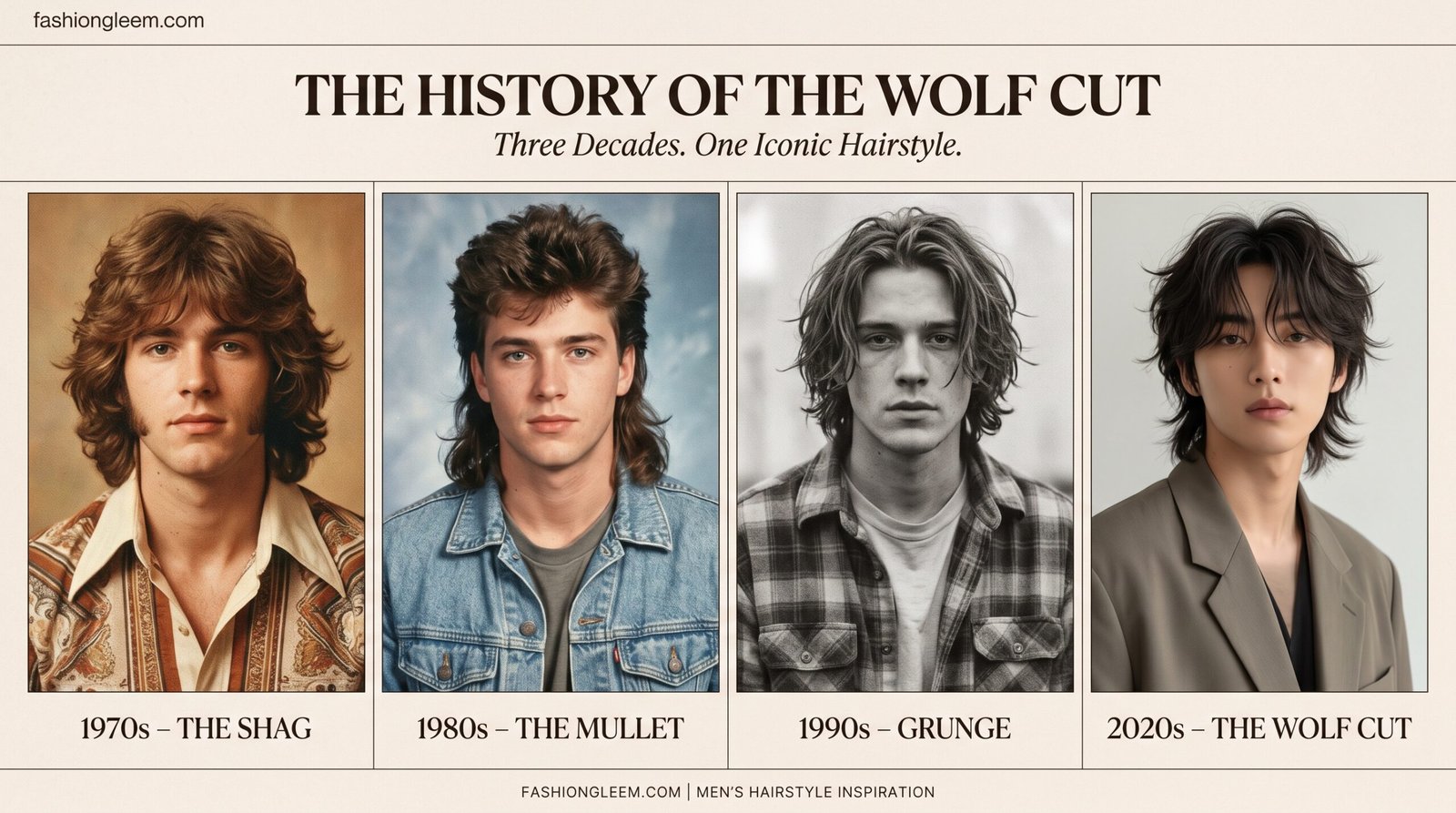
The wolf cut did not appear from nowhere. Its three ingredients each had a decade.
The 1970s gave the shag: Paul McGregor’s layered cut for Jane Fonda in Klute, then David Bowie and Stevie Nicks made it rock royalty. The shag’s contribution is the crown volume and face-framing.
The 1980s gave the mullet: business in front, party in back, worn by athletes and rockers alike. The mullet’s contribution is the length contrast, short up top and long at the nape.
The 1990s gave the grunge attitude: messy, unwashed-looking texture worn as rebellion. The 90s contribution is the deliberate dishevelment, the “I don’t care” that requires care.
The 2020s fused them. Korean salons softened the shag, TikTok spread the mullet revival, and K-pop idols modeled the polished middle ground. The wolf cut is not a new idea; it is three old ideas finally combined correctly.
Finding Your Reference Photos
Reference photos are the most important thing you bring to the appointment. But not all photos work equally well.
Match the hair type. A photo of a wavy-haired model will not translate to stick-straight hair without serious styling. Find references with your texture.
Match the length. Photos of shoulder-length wolves will not help if you have four inches. Filter by your current length.
Show the back. Most photos show the front. The wolf cut’s character lives in the back length and nape, so find at least one rear view.
Show the version, not the vibe. “Edgy” is not a haircut. Pick the specific variation: Korean, shullet, curtain, professional. Name it out loud with the photo.
Wolf Cut on the Move: Travel and Gym
At the gym, the wolf cut is gloriously low-maintenance. Sweat through the workout, rinse or don’t, scrunch with a little product, and the post-gym mess reads as intentional texture. It is the rare cut that improves with sweat.
Traveling, pack one product: sea salt spray. It handles the refresh, the restyle, and the second-day revival. The cut was made for carry-on grooming.
Swimming needs care. Chlorine and salt dry the ends, and dry ends frizz instead of feathering. Rinse after swimming and use a light leave-in on the lengths.
The wolf cut rewards active lives. It is not a cut that punishes you for moving. The messier your day, the better it looks.
What Is a Wolf Cut? The 10-Second Answer
A wolf cut for men is a layered haircut that combines the mullet’s length with the shag’s choppy texture. Short, voluminous layers at the crown. Longer, feathered ends at the back. Face-framing pieces in front. No hard line between them. Straight, wavy, or curly hair all work because the layers adapt to the texture.
Introduction
The wolf cut for men is the rare haircut that looks effortless and deliberate at the same time. It borrows the wild crown of the 1970s shag, the long back of the 1980s mullet, and the polish of K-pop styling, then blends them into something that works in 2026. This guide covers every angle: what it is, how it differs from its cousins, which version suits your face and hair, exactly what to say in the barber’s chair, how to style it in under five minutes, and what the grow-out really looks like.
Where the Wolf Cut Came From
The wolf cut sits structurally between two iconic retro styles. The 1970s shag, cut famously on Jane Fonda for Klute by stylist Paul McGregor around 1969, added face-framing layers and crown lift. The 1980s mullet contributed the short-to-long length contrast and the elongated nape.
The modern version started in Korea, where softer layering and curtain bangs made it polished rather than shaggy. K-pop idols and TikTok carried it worldwide, and it has been a major men’s trend since 2022. L’Oréal Paris describes it as an update of the ’80s and early ’90s mullet, which captures the lineage precisely.
What keeps it alive is adaptability. The same architecture scales from a conservative textured crop to full punk rock. The cut is a system, not a single look.
Wolf Cut vs Shag vs Mullet: The Real Difference
These three get mixed up constantly, and the wrong word at the barber can give you the wrong cut. All share layers and texture, but they distribute weight and length differently.
| Feature | Shag | Wolf Cut | Mullet |
|---|---|---|---|
| Layer distribution | Even all around | Crown-heavy, long back | Short front, long back |
| Silhouette | Rounded, soft | Wild, top-heavy | Front-to-back contrast |
| Crown volume | Moderate, even | High, lifted, chunky | Low to moderate |
| Texture | Blended, flowing | Choppy, piecey, disconnected | Smooth or blunt |
| Best hair type | All types | Thick, wavy | Straight, wavy |
| Trim frequency | 6-8 weeks | 6-8 weeks | 6-8 weeks |
The short version from men’s style guides: the mullet creates contrast through length, while the wolf cut creates contrast through layers. The shag blends everything smoothly; the wolf cut keeps the crown chunky and disconnected. Style guides like Style X Magazine’s shag comparison lay out the same three-way split.
Will a Wolf Cut Suit You? Face Shapes
The wolf cut is surprisingly democratic, but face shape decides which version flatters. The cut draws the eye vertically through crown volume, which balances some shapes better than others.
| Face shape | Verdict | Best version |
|---|---|---|
| Oval | Ideal | Any version; the balanced shape takes the full silhouette |
| Square | Excellent | Softer layers and curtain bangs to ease strong angles |
| Heart | Excellent | Volume at the crown balances a wider forehead |
| Diamond | Very good | Face-framing pieces soften cheekbones |
| Round | Needs adaptation | Height on top, longer back; avoid extra width at the cheeks |
| Oblong | Needs adaptation | Fringe to shorten the visual length; moderate crown height |
Will a Wolf Cut Suit You? Hair Types
Hair type decides how much daily work the cut needs. The architecture is the same; the styling effort is not.
Thick, wavy hair is the easiest canvas. The natural texture does half the styling, and the layers fall into place with minimal product. This is the hair the trend was built on.
Straight hair needs structural support. Without help it can fall flat, so plan on mousse or texture spray plus rough-drying for lift. The result is excellent; the routine is simply less optional.
Curly hair works beautifully when the layers are cut to respect the curl pattern. The wolf cut turns volume into shape instead of a triangle. Ask for dry-cutting or curl-aware layering.
Fine or thin hair needs a softer version. Heavy layering can expose scalp, so the stylist should remove less weight and keep the perimeter fuller. Be honest about density in the consultation; a good barber will adapt the cut rather than force the trend.
Before You Book: Length, Commitment, Cost
Three practical facts decide whether now is the right time. Check them before the appointment, not in the chair.
Minimum Length
Barbering guides put the floor at about 4 inches on top and 5-6 inches at the back. Below that, there is not enough hair to build the crown-to-back graduation that defines the cut. If you are growing out from short, wait until the top reaches that length.
The Grow-Out Commitment
A wolf cut is a big change from one-length hair, and the short crown layers take months to grow out. Be honest with yourself about two things: do you like wearing your hair with some mess in it, and does your hair hold volume at the roots or fall flat by lunchtime? If it falls flat, you will need daily styling or a softer version.
What It Costs
Prices vary by city and barber, but expect a men’s textured cut to run in the standard range for your area’s quality barbershops, with maintenance trims every 6-8 weeks. The cut itself is the investment; the daily products (sea salt spray, matte clay) are inexpensive and last months. Budget for the trim cadence, not just the first appointment.
The Styles: Which Wolf Cut to Ask For
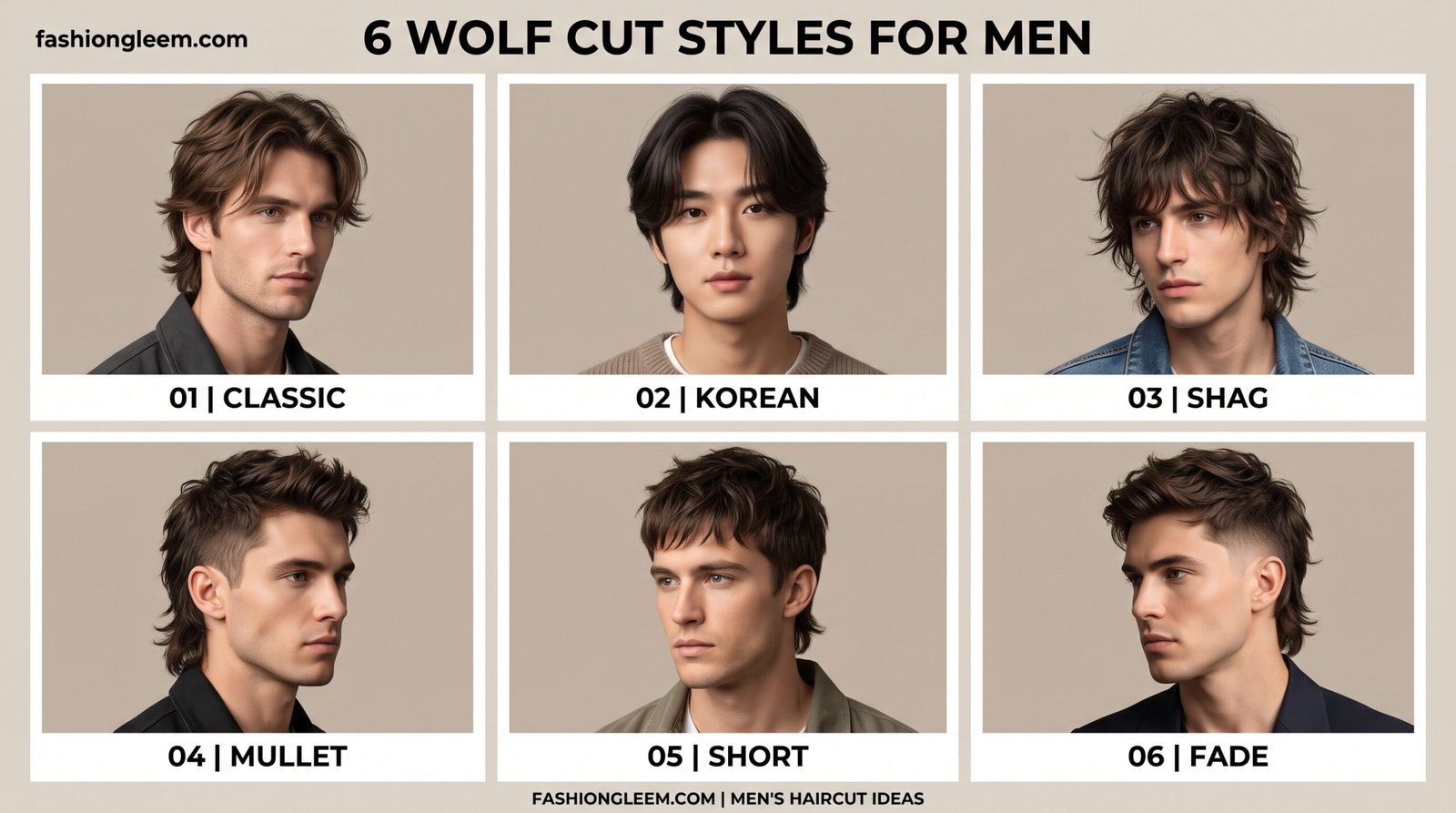
Every version below follows the same architecture. Pick the one that matches your hair type, workplace, and appetite for edge. Each includes the exact phrasing to use with your barber.
1. Classic Wolf Cut
The baseline everyone else riffs on. Layers stack around the crown and cheekbones, the back sits at the collar, and the sides taper softly with no hard break. Ask for: “Classic wolf cut, three inches through the crown with internal layers, back to the collar, face-framing at the cheekbone, tapered sides, no fade line.”
2. Korean Wolf Cut
Where the modern cut started. Softer layering than Western versions, curtain-style bangs sweeping to either side of a middle part, polished rather than shaggy. Ask for: “Korean wolf cut, soft layers through the top, curtain bangs to the cheekbone, tapered sides, back three inches with wispy ends.”
3. Shag Wolf Cut
Maximum texture. Aggressive internal layers throughout, wispy point-cut ends, and a wilder perimeter. Ask for: “Shag wolf cut, aggressive internal layers throughout, wispy point-cut ends, blended sides, back four inches with heavy texture at the perimeter.”
4. Mullet Wolf Cut (Shullet)
The wolf cut pushed toward a mullet: tighter sides, longer layered tail at the back. Ask for: “Mullet wolf cut, three inches through the crown, back five inches with layered texture, low fade or tight taper on the sides, keep the perimeter feathered.”
5. Curtain Wolf Cut
Curtain bangs are the focal point: two symmetrical fringes from a middle part framing the face. Ask for: “Curtain wolf cut, center-parted bangs to the cheekbones, three-inch crown layers, tapered sides, four-inch back with soft internal texture.”
6. Wolf Cut with Fringe
A heavier textured fringe to the eyebrows gives a stronger, rock-influenced look and shortens longer faces. Ask for: “Wolf cut with a textured fringe to the eyebrows, three-inch crown, tapered sides, four-inch back with layered movement.” Note: fringes need trims every 4-6 weeks.
7. Short Wolf Cut
The conservative interpretation: layered top, feathered edges, soft texture just above the neckline. Movement without the length. Ask for: “Short wolf cut, textured layers on top, tight around the ears, nape left a little longer, choppy fringe above the brows.”
8. Long Wolf Cut
Past the shoulders, layers starting at the cheekbone, dramatic curtain effect into flowing back lengths. Ask for: “Long wolf cut, layers starting at the cheekbone, length past the shoulders, wispy ends, keep the crown lifted.”
9. Wavy Wolf Cut
Medium waves parted in the middle, curling out at the temples and down to the collar. The natural texture does the work. Ask for: “Wavy wolf cut, layers that follow the wave pattern, length over the ears, collar-length back.”
10. Curly Wolf Cut
Defined, shapely curls with face-framing layers and crown volume. Ask for: “Curly wolf cut, curl-aware layering, volume at the crown, tapered softly around the neck. Please cut it dry or diffused so the curl pattern reads correctly.”
11. Wolf Cut with Fade
Choppy textured crown meets a taper fade around the ears, with the long piecey back left at the nape. Ask for: “Textured top with choppy fringe, taper fade above the ears, back left long and piecey to the collar.”
12. Professional Wolf Cut
The boardroom-safe version: cleaner cutting, softer texture, controlled length. All the architecture, none of the rebellion. Ask for: “Professional wolf cut, soft blended layers, conservative length at the back, tidy perimeter. Keep it clean enough for the office.”
More Styles Worth Considering
Twelve styles only scratch the surface. These eight cover the rest of the family, from heritage versions to statement looks.
13. Japanese Wolf Cut
Choppy layers on top with longer hair at the sides and back, ends flipping outward for natural movement. Sharper than the Korean version, more flowing than the Western. Ask for: “Japanese wolf cut, choppy crown layers, longer sides and back, ends flipped outward, soft pieces around the face.”
14. Asian Wolf Cut
Adapted for straight, thick hair: razor-cut layers that move naturally without excessive bulk. Ask for: “Asian wolf cut, razor-cut layers for thick straight hair, reduced bulk through the interior, wispy ends.”
15. 90s Wolf Cut
The retro revival: messy layers on top, longer hair flowing at the back, straight off the MTV era. Ask for: “90s wolf cut, messy layered top, longer back, grunge texture, keep it lived-in.”
16. Messy Bedhead Wolf
Intentional dishevelment through strategic texturizing. The “I woke up like this” version, engineered. Ask for: “Messy bedhead wolf, maximum texture, uneven ends, teach me the sea-salt-and-scrunch routine.”
17. Middle Part Wolf Cut
Symmetrical and clean: the wolf silhouette with a defined center part. Ask for: “Middle part wolf cut, symmetrical layers, center parting, moderate back length.”
18. Undercut Wolf Cut
The sides go tight underneath while the wolf layers flow over the top. Edge with structure. Ask for: “Undercut wolf cut, disconnected undercut on the sides, long textured layers over the top, piecey back.”
19. Wolf Cut with Highlights
Color amplifies the layering: highlights catch the texture and make the separation visible. Ask for: “Wolf cut with dimension, highlights placed to emphasize the layers, keep the base natural.”
20. Punk Rock Wolf
The full statement: bold color, asymmetrical elements, shaved sections, extreme texture. Ask for: “Punk rock wolf, extreme texture, asymmetrical fringe, let’s discuss the color separately.” This is the version that needs the most upkeep and the most confidence.
Wolf Cut at Every Age
Teens and early 20s: The full range is open. This is the demographic the trend was built for, and experimentation is the point. Try the bolder versions now.
Late 20s to 30s: The classic, curtain, and textured versions balance edge with professional life. The workplace spectrum section above is written for this decade.
40s and beyond: The professional and Korean versions read modern without reading young. Texture is ageless; the only thing to retire is the most extreme disconnection. A good barber will calibrate the wildness to the wearer.
Seasonal Styling Notes
Summer: Humidity is the wolf cut’s friend and enemy. Waves get wilder, but frizz can take over. A light anti-frizz cream on the ends (never roots) keeps the texture defined.
Winter: Dry air flattens the crown. A touch more mousse at the roots compensates, and a humidifier at night helps more than any product.
Hat season: Beanies crush crown volume. On hat days, lean into the mess: shake it out, add texture spray, and wear the flattening as intention.
The Consultation: Questions to Ask Your Barber
Use the appointment as an interview, not just a transaction. These questions reveal whether the barber understands the cut.
“Have you cut wolf cuts before?” Experience with the architecture matters more than general skill. Ask to see photos of their work.
“How would you adapt it for my hair type?” The right answer references your specific texture and density. A generic “sure, no problem” is a warning sign.
“What length do I need, honestly?” If you are short of the 4-inch/5-6-inch minimum, a good barber says so and books you for later.
“How should I style it at home?” The barber should demo the routine on your head, with your products or their recommendations. Leave knowing the 3-5 minute version.
What to Tell Your Barber: The 3-Part Formula
Walk in with 2-3 reference photos and describe the cut in three parts. This is the formula working barbers recommend.
Part 1: The top. Describe the crown: “choppy layers with volume on top” or “soft textured layers, about three inches.” This sets the wolf character.
Part 2: The back. State the length: “back to the collar” or “leave it long and piecey at the nape.” This sets the mullet influence.
Part 3: The texture. Choose the finish: “textured, piecey ends” or “soft and blended.” This sets the shag influence.
Then add the sides: tapered, faded, or natural. Photos beat adjectives; bring pictures of the exact variation you want, not just “a wolf cut,” since the family is so broad.
How to Style a Wolf Cut: The Daily Routine
The whole point is texture, so aim to define the layers, not smooth them. The standard routine takes 3-5 minutes.
Step 1: Start with damp hair. Apply a small amount of sea salt spray or light mousse, mostly at the roots and through the mid-lengths. This builds the grit the layers need.
Step 2: Rough-dry with your head tipped forward. Lift the crown with your fingers; skip the brush entirely. Air-drying works for wavy and curly hair.
Step 3: Twist a few face-framing pieces around a finger while they dry. This defines the front without helmet hair.
Step 4: Finish with a small amount of matte clay or paste on the ends only. Keep heavy oils and smoothing creams away from the roots; they flatten the crown, which removes the feature that makes the cut work.
Styling by Hair Type
Straight hair: Mousse at the roots plus rough-drying is non-negotiable. Without lift, the crown falls flat by midday. A light texture powder at the roots adds insurance.
Wavy hair: Sea salt spray, scrunch, air dry. The waves supply the texture; your job is just to organize it. This is the lowest-effort version.
Curly hair: Leave-in conditioner for definition, then scrunch with a light cream. Diffuse on low heat if needed. Never brush dry curls.
Fine hair: Less product, more technique. A pea-sized amount of mousse and upside-down drying gives lift without weight. Heavy products are the enemy.
Maintenance: Trims, Washing, Second-Day Hair
Trims: Every 6-8 weeks keeps the layers defined; the cut is meant to look a little messy, so some guides stretch it to 8-12 weeks. Fringes need attention sooner, around 4-6 weeks. Barbering guides like Book of Barbering and Hairover’s wolf cut guide converge on the same cadence.
Washing: Two to three times per week is the sweet spot. Daily washing strips the natural oils that give the cut its lived-in texture. Use lightweight products; heavy conditioners at the roots flatten the crown.
Second-day hair is where the wolf cut shines. The slight oil and collapsed volume actually improve the piecey texture. Refresh with a spritz of sea salt spray and a quick finger-twist of the front pieces. No full restyle needed.
Sleeping: A loose pineapple (high loose ponytail) or a silk pillowcase preserves the crown volume overnight. In the morning, shake it out and go.
Growing It Out: The Honest Timeline
Short crown layers take months to grow out, so plan the exit before you commit. The grow-out passes through predictable stages.
Months 1-2: The cut still reads as a wolf cut. Keep the 6-8 week trims to maintain the shape while the crown gains length.
Months 3-4: The long shag stage. The crown layers catch up to the mid-lengths, and the silhouette softens into a shag. Most people actually enjoy this phase.
Months 5-6: Light trims that shorten the back let the layers catch up evenly. Tell your barber you are growing out the wolf cut; they will balance the lengths rather than re-cut the shape.
The key insight from styling guides: do not just stop trimming. Managed grow-out trims keep every stage wearable. Abandoned grow-outs look accidental; guided ones look intentional.
Fixing a Bad Wolf Cut
Wrong layering happens, usually from vague instructions. The fixes depend on the failure mode.
Too much mullet, not enough wolf: The back overwhelms the crown. Ask for the back shortened and the crown layers chunked up. The fix is rebalancing, not starting over.
Too flat on top: The layers were cut without enough graduation. Internal layers and point-cutting add the missing volume. A skilled barber can rescue this in one appointment.
Fringe disaster: Too short, too blunt, or uneven. The only fix is time plus strategic styling: sweep it to the side, blend it into the face-framing pieces, and trim it into a curtain while it grows.
Too thinned out: Over-texturizing on fine hair. Grow it out with dusting trims that remove only the wispiest ends. This is the slowest fix, which is why the consultation matters.
Prevention beats repair: reference photos and the 3-part formula from the barber section above. Most bad wolf cuts trace back to “just give me a wolf cut” with no further detail.
The Workplace Spectrum: From Boardroom to Punk
Not every wolf cut reads the same at work. Rank the versions before you book.
| Setting | Safe versions | Avoid |
|---|---|---|
| Conservative office | Professional wolf cut, short wolf cut, Korean wolf cut | Shullet, punk rock, extreme texture |
| Creative office | Classic, curtain, textured, long wolf cut | Shaved sections, bold color |
| Anything goes | Mullet wolf, punk rock, undercut wolf | Nothing; commit fully |
The professional version keeps the architecture (crown layers, longer back) while softening the texture and controlling the length. Colleagues read it as a modern textured cut, not a statement. When in doubt, start conservative; texture can always be amplified later.
Mistakes to Avoid
Mistake 1: No reference photos. “Wolf cut” covers a dozen looks. Without pictures, you and the barber may be imagining different cuts.
Mistake 2: Heavy products at the roots. Oils and smoothing creams flatten the crown, deleting the cut’s signature volume. Keep heavy product on the ends only.
Mistake 3: Brushing it smooth. The wolf cut wants finger styling. A brush turns piecey texture into a helmet.
Mistake 4: Skipping trims. The layers lose definition without 6-8 week maintenance. The “messy on purpose” look still needs structure underneath.
Mistake 5: Wrong version for your hair. Fine hair with aggressive thinning, or stick-straight hair with no styling plan, sets the cut up to fail. Match the version to the canvas.
Mistake 6: Ignoring the grow-out. Booking the cut without a plan for months 3-6 leads to the awkward stage. Know the timeline going in.
Wolf Cut and Your Existing Routine
The wolf cut simplifies most routines. Men coming from pompadours or slick-backs find the 3-5 minute routine liberating: no precise parting, no high-shine product, no daily blow-dry marathon.
It pairs well with minimal skincare-style grooming: the effortless hair reads intentional when the rest of the grooming is clean. Readers building a full routine can start with a beginner skincare routine alongside the new cut.
For younger readers, the wolf cut also appears in boys’ short haircut guides as the edgier older-brother option. The family resemblance is real: same layering logic, shorter execution.
If you are between cuts, the layered haircut guide covers the broader family this style belongs to, and the buzz cut guide sits at the opposite end of the maintenance spectrum. Fine-haired readers weighing texture against scalp visibility should check haircuts for scanty hair before committing to heavy layering.
The Wolf Cut Dictionary
Barbers speak a dialect. These are the terms you will hear in the chair.
Crown: The top of the head where the wolf cut’s volume lives. “More crown” means more lift up top.
Nape: The back of the neck. The wolf cut’s longer pieces hang over the nape.
Perimeter: The outer edge of the haircut. A “feathered perimeter” means soft, textured ends rather than a blunt line.
Point-cutting: Cutting into the ends vertically with the scissor tips. Creates the wispy, textured finish.
Internal layers: Shorter layers hidden inside the cut that create volume without visible steps.
Disconnection: An intentional break between lengths, like the jump from crown to back. The wolf cut uses controlled disconnection.
Graduation: The smooth progression from short to long. The wolf cut graduates from crown to nape.
Knowing these terms turns the consultation from charades into conversation. You describe; the barber executes; nothing gets lost.
Quick Decision Checklist
Answer these five questions before you book. Five yeses mean go.
1. Is my top at least 4 inches? Without the length, the cut cannot form. Measure honestly.
2. Do I like a little mess? The wolf cut is texture-first. If you need everything in place, choose something cleaner.
3. Will I style it 3-5 minutes daily? The cut is low-effort, not no-effort. Commit to the routine.
4. Can I trim every 6-8 weeks? The shape needs maintenance. Budget the cadence.
5. Do I have reference photos? The family is too broad for words alone. Bring pictures.
Five yeses: book the appointment. Any no: address it first, then book with confidence.
Key Takeaways
A wolf cut for men blends mullet length with shag texture: voluminous choppy crown, longer feathered back, face-framing pieces, no hard lines. It suits oval, square, heart, and diamond faces best and works on straight, wavy, curly, and thick hair, with adaptations for fine hair.
Book it with reference photos and the 3-part formula (top, back, texture), a minimum of 4 inches on top and 5-6 at the back. Style it in 3-5 minutes with sea salt spray and matte clay, trim every 6-8 weeks, and plan the grow-out through the long-shag stage. Men’s guides like Men’s Minimal’s wolf cut guide confirm the same maintenance cadence and comparison logic.
Frequently Asked Questions
What is a wolf cut for men?
A layered haircut combining the mullet’s length with the shag’s choppy texture: short voluminous crown layers, longer feathered back, face-framing pieces.
Is the wolf cut good for men?
Yes, for men who want texture with low daily effort. It suits most face shapes and hair types, with the version matched to the individual.
How do I ask for a wolf cut?
Use the 3-part formula: describe the crown (“choppy layers with volume”), the back length (“to the collar”), and the texture (“piecey ends”). Bring 2-3 reference photos.
What face shape suits a wolf cut?
Oval, square, heart, and diamond faces suit it best. Round and oblong faces need adaptations: height on top for round, fringe for oblong.
Can I get a wolf cut with straight hair?
Yes, with a styling commitment. Mousse or texture spray plus rough-drying gives straight hair the lift the cut needs.
Can I get a wolf cut with curly hair?
Yes. Curl-aware layering turns volume into shape. Ask for dry-cutting so the curl pattern reads correctly.
Can I get a wolf cut with thin hair?
Yes, with a softer version. The stylist should remove less weight and keep the perimeter fuller. Aggressive thinning on fine hair exposes scalp.
How long does hair need to be for a wolf cut?
About 4 inches on top and 5-6 inches at the back, per barbering guides. Below that the graduation cannot be built.
What is the difference between a wolf cut and a mullet?
The mullet creates contrast through length (short front, long back). The wolf cut creates contrast through layers, with a voluminous crown and blended transition.
What is the difference between a wolf cut and a shag?
The shag has even, blended layers all around. The wolf cut has a chunkier, more voluminous crown with sharper layer separation.
What is a shullet?
A shag-mullet hybrid: essentially the mullet-leaning end of the wolf cut family, with tighter sides and a longer layered tail.
How often should I trim a wolf cut?
Every 6-8 weeks for the shape; fringes need 4-6 weeks. The messy aesthetic stretches the window, but structure still needs upkeep.
How do I style a wolf cut?
Sea salt spray or mousse on damp hair, rough-dry head tipped forward, twist face-framing pieces, finish with matte clay on the ends. Three to five minutes.
What products do I need?
Sea salt spray or mousse for texture, matte clay or paste for definition. Keep heavy oils away from the roots.
Is a wolf cut low maintenance?
Daily, yes (3-5 minutes). Structurally, it needs trims every 6-8 weeks. Low effort, not no effort.
How much does a wolf cut cost?
Expect standard textured-cut pricing for your area’s quality barbershops, plus trim cadence every 6-8 weeks. Products are inexpensive and last months.
How long does it take to grow out a wolf cut?
Five to six months to fully normalize, passing through a long-shag stage around months 3-4. Managed trims keep every stage wearable.
How do I fix a bad wolf cut?
Rebalance, don’t restart. Too much back: shorten it and chunk the crown. Flat top: add internal layers. Bad fringe: sweep aside and grow into a curtain.
Is a wolf cut appropriate for work?
The professional, short, and Korean versions are office-safe. The shullet and punk versions are not. Match the version to the dress code.
Can I get a wolf cut with a fade?
Yes. A taper or mid fade around the ears with the long piecey back kept at the nape is a popular hybrid.
What is a Korean wolf cut?
The original modern version: softer layering, curtain bangs, polished rather than shaggy. The most wearable entry point.
Will a wolf cut work with a receding hairline?
Carefully. A textured fringe can camouflage early recession, but heavy crown layering draws the eye upward. Discuss it honestly with your barber.
Can I get a wolf cut with short hair?
The mini/short wolf cut works at shorter lengths, but below ~4 inches on top the signature graduation cannot form. Grow first, then cut.
Is the wolf cut still trendy in 2026?
Yes. Style guides are still publishing 20-35 variation roundups for 2026, and the cut’s adaptability keeps it renewing.
Who made the wolf cut popular?
K-pop idols and TikTok drove the modern wave from ~2022, building on the 1970s shag and 1980s mullet lineage.
Can older men wear a wolf cut?
Yes, in the softer versions. The professional or Korean wolf cut reads modern without reading young. Texture is ageless; edge is optional.
What should I bring to my barber appointment?
2-3 reference photos of the exact variation you want, plus the 3-part description (top, back, texture). Photos beat adjectives.
Can I cut a wolf cut at home?
Not recommended. The internal layering and crown graduation need professional sectioning. DIY attempts usually produce the “bad wolf cut” this guide fixes.
How often should I wash a wolf cut?
Two to three times per week. Daily washing strips the oils that give the cut its lived-in texture.
Does the wolf cut work for Black men’s hair textures?
Yes, with adaptation. Coily and tight-curled textures need a barber experienced in cutting them dry or stretched, with layering that respects shrinkage. The silhouette translates; the technique must adapt.
What is the awkward stage of growing out a wolf cut?
Months 3-4, when the crown layers catch up unevenly and the shape reads as an unintentional shag. Managed trims that shorten the back keep it intentional.
Can I wear a hat with a wolf cut?
Yes. Beanies flatten the crown, so refresh afterward with texture spray and finger styling. On hat days, lean into the mess.
Does a wolf cut need blow-drying?
Straight hair benefits from rough-drying for lift. Wavy and curly hair can air-dry. Nobody needs a round brush; fingers do the work.
How long does a wolf cut appointment take?
45-75 minutes typically, longer for the first cut with consultation. Textured layering takes more sectioning than a clipper cut.
Will layers damage my hair?
Proper layering does not damage hair. Damage comes from over-thinning, razor burn from dull blades, or excessive heat styling. Choose the barber carefully.
What is a wolf cut with curtain bangs?
The curtain wolf cut: center-parted bangs framing the face, blended into the wolf silhouette. The most flattering version for square and heart faces.
What is the difference between a wolf cut and a butterfly cut?
The butterfly cut uses soft, blended long layers for volume without edge. The wolf cut uses choppy, disconnected layers for deliberate texture. Soft versus wild.
Conclusion
The wolf cut for men endures because it is a system, not a single look. The same architecture: choppy crown, longer back, face-framing texture, scales from the boardroom to the pit. Choose the version that fits your face shape and hair type, book it with photos and the 3-part formula, and maintain it with 3-5 minute styling and 6-8 week trims.
Respect the grow-out timeline, keep heavy product off the roots, and let the mess be intentional. Do that, and the wolf cut delivers exactly what made it famous: effortless texture that looks like you never tried, from a cut you chose very deliberately.
The last word belongs to confidence. The wolf cut is a commitment to texture in a world of clean fades. Wear it like you mean it, maintain the structure underneath the mess, and the cut does the talking. Book the consultation, bring the photos, and enjoy the best hair decision you will make this year.

Dilawar is a contributing writer at Fashiongleem.com, focusing on beauty, hairstyles, skincare, fashion accessories, and personal grooming. He creates informative, easy-to-follow articles that help readers explore new looks, understand popular beauty trends, and improve their everyday styling routines. His writing emphasizes practical advice, useful product information, and accessible fashion inspiration for modern readers.