
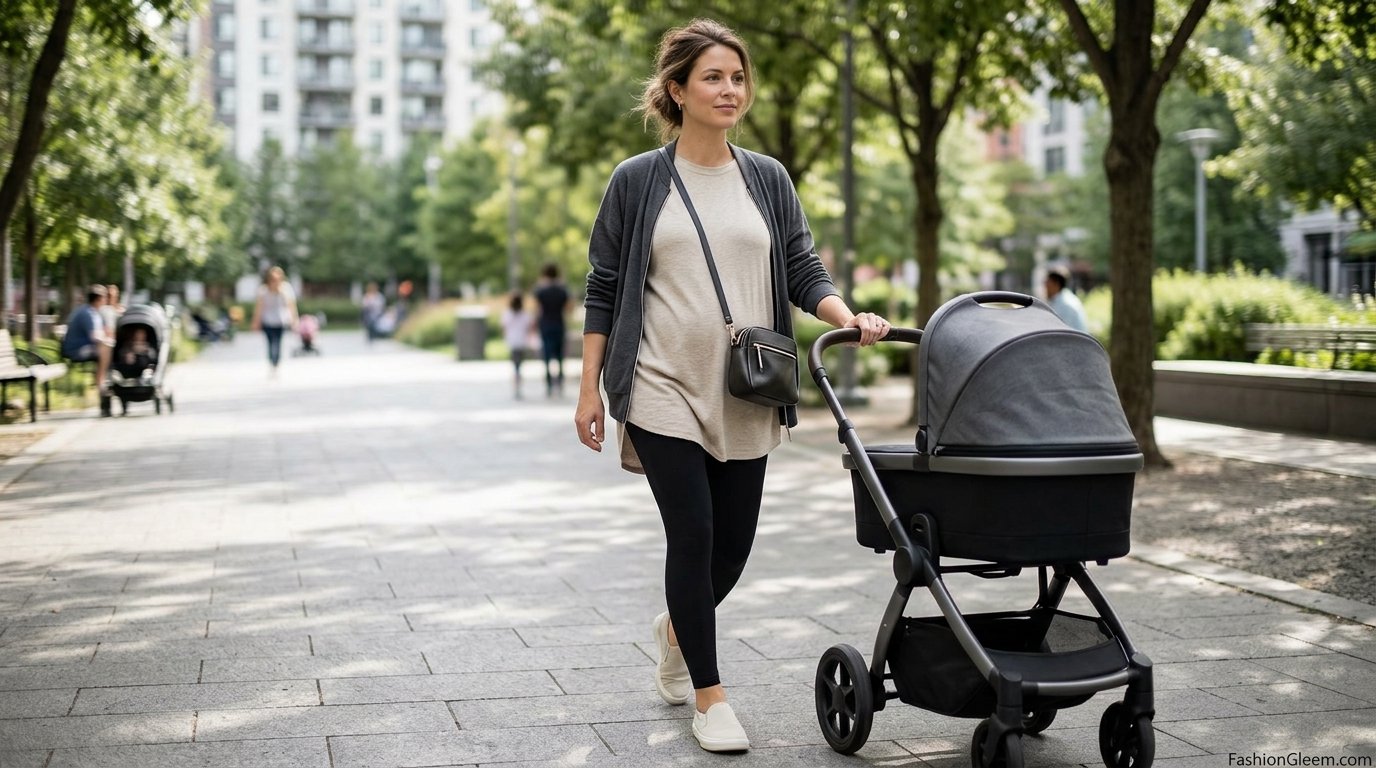
Easy Outfits for New Moms: A Stage-First System for the First Year
Easy outfits for new moms are not a shopping list. They are a small system that matches your postpartum stage, your feeding method, and the five minutes you actually have to get dressed.
Most outfit lists ignore the two things that decide your day. A waistband that felt fine last week can press exactly where you are tender today, and a beautiful dress is useless if it cannot open one-handed at feeding time.
So this page works in a fixed order. Stage first, because week 1 and month 4 need different clothes. Feeding access second, because nursing, pumping, and bottle feeding follow different rules.
Formula third, so you rotate named outfits instead of deciding from zero.
FashionGleem readers will recognize the approach from our capsule wardrobe system: fewer pieces, clear rules, no daily negotiation. Everything here is general comfort information, never medical advice, and your own care team stays the authority on recovery questions.
Four readers use this page differently. Pregnant planners need the week 1 drawer and permission to buy very little. New mothers in the first six weeks need waistband and night-feed rules.
Settling mothers need the capsule. Returning and weaning mothers need the work system and the exit path.
The season itself has a name: the fourth trimester, the framing ACOG uses for postpartum care as an ongoing process rather than a single checkup.
Dressing belongs in that frame: a changing situation you manage weekly, not a problem you solve once.
The Five Tests Every Outfit Has to Pass
Before any formula, run the test. The framing grows out of the outfit checks used by Sew Mama Sew and the stage guides in the research, expanded here into five tests you can apply to clothes you already own.
|
Test |
The question it asks |
What passes |
|---|---|---|
|
Feed |
Can you feed or pump in it, one-handed, in under a minute? |
Front openings, lift-up layers, wrap fronts |
|
Floor |
Can you sit on the floor, kneel, and get up holding a baby? |
Stretch bottoms, no stiff waistbands, secure necklines |
|
Waistband |
Does the band avoid every tender spot, all day? |
High soft bands, fold-over bands, or no band at all |
|
Wash |
Does it survive machine washing and hide leaks and spit-up? |
Dark colors, small prints, washable knits |
|
One-Hand |
Can you put it on and open it while holding the baby? |
Pull-on pieces, slip-on shoes, no back closures |
The feed test, by feeding method
Nursing needs fast, discreet access. Pumping needs a front that opens wide enough for flanges. Bottle feeding needs no access at all, which quietly brings back necklines and closures that nursing guides rule out.
The waistband test, including C-section comfort rules
Comfort guidance collected by Mothers and More gives the waistband three safe positions after a C-section.
The band sits well above the low incision line, it folds down softly below it, or the outfit skips a waistband entirely, like a dress.
Skip low-rise bands, zips, buttons, and belt hardware that rest on the incision line in the early weeks.
Choose breathable, loose pieces and high-waisted underwear, and treat any pain, opening, or discharge question as one for your care team, not a clothing problem.
The same test protects a tender midsection after any birth. If a band digs, rolls, or needs adjusting every time you sit down to feed, it fails, whatever the mirror says.
The wash test and the spare-shirt system
Early motherhood is a laundry sport. Machine wash and tumble dry is the standard; dry-clean only fails on sight. Dark colors and small prints camouflage milk leaks and spit-up between washes.
Build the spare-shirt system: one clean top in the diaper bag, one in the car, and one in your work drawer if you pump. A leak then costs you two minutes, not the whole outfit.
A note on labels: read the care label before the size label
The FTC Care Labeling Rule is why every garment carries wash instructions, and the federal fiber content rules are why the fabric percentages sit on the same tag.
Check both before buying: machine wash, tumble dry, and a high share of cotton, modal, or bamboo is the combination that survives the first year.
The floor and one-hand tests
You will dress, feed, and play at floor level daily. Leggings and pull-on pants pass; a pencil skirt does not. Then test every new piece one-handed at home, holding something baby-sized, before it joins the rotation.
Start With Your Stage: Postpartum Outfits by Week and Month
Postpartum outfits change because your day changes, not because a calendar says so. Use the stage that matches your life this week, and move on when the description stops fitting.
|
Stage |
Your day looks like |
The outfit job |
|---|---|---|
|
Week 1 |
Feeding around the clock, resting, healing |
Soft sets, front openings, zero waistband pressure |
|
Weeks 2 to 6 |
First outings, pediatrician visits, visitors |
Lounge sets that read as outfits, easy layers |
|
Months 2 to 6 |
Daily walks, photos, errands, social life returns |
Capsule formulas, real shoes, one dress that works |
|
Months 6 to 12 |
Routines settle, size shifts slow down |
Wider closet, some pre-pregnancy pieces return |
|
Return to work |
Pumping sessions, meetings, commute |
Two-piece front-opening outfits, spare shirt on site |
Week 1: the soft recovery uniform
Live in soft pajama or lounge sets with front openings, a robe, and high-waisted underwear. Dark, washable bottoms handle the early days best, and waistbands sit high and soft or fold away.
Pack the going-home outfit in the hospital bag ahead of time: a soft dress with no waistband, or maternity leggings with an oversized button-down, in a size that fits late pregnancy.
Weeks 2 to 6: leaving the house again
The matching lounge set becomes the visitor uniform: it reads as an outfit, opens for feeding, and asks nothing of a healing body. Add an open cardigan and slip-on shoes for the first pediatrician runs.
Months 2 to 6: the in-between body
This is capsule season. Your size may shift a size or two across these months, at different rates for chest, waist, and hip, so size-flex pieces (wrap ties, drawstrings, elastic waists, stretch knits) do the heavy lifting.
Months 6 to 12: stabilizing, with no deadline
Re-try stored pre-pregnancy clothes at intervals, without a deadline and without a verdict. Some pieces return, some get donated, and both outcomes are normal.
One capsule source describes stabilization commonly arriving somewhere in the 10 to 14 month window, printed here as that source’s strand, not a promise.
Return to work: the fifth stage
Work is a stage of its own, with pumping logistics layered on top. Its full system sits in the occasions section below, because the rules (two pieces, front openings, no back zips) are strict enough to plan separately.
Then Your Feeding Access: Nursing Friendly Outfits by Method
Nursing friendly outfits start with access, and access types are not equal. Guides list them everywhere and compare them nowhere, so here is the comparison in one table.
|
Access type |
How it opens |
Speed |
Discretion |
Pumping fit |
Durability |
|---|---|---|---|---|---|
|
Two-layer lift-up |
Top layer lifts, underlayer pulls aside |
Fastest |
High, midsection stays covered |
Good with a pumping tank under |
High, nothing stretches out |
|
Wrap or cross-front |
Tie or overlap opens at the front |
Fast |
High when the wrap is deep |
Good |
High on true wraps, lower on faux wraps |
|
Button or snap front |
Buttons or snaps down the front |
Fast |
Medium, gaps possible |
Excellent, opens fully |
High |
|
Hidden side zip |
Invisible zip at the side seam |
Slower |
Highest, looks like regular clothing |
Fair, opening can be narrow |
Medium, zips tire over time |
|
Pull-down neckline |
Stretchy scoop or V pulls down |
Fast |
Lower, more exposure |
Fair |
Low, elastic gives out over months |
|
Clip-down tank |
Bra-style clips at the straps |
Fast |
Medium, needs a layer over it |
Excellent, built for it |
High |
Speed rankings here are editorial judgement from the guide consensus, not measured tests.
The pattern underneath them is solid: layers and true wraps stay fast and covered for months, while a bare pull-down neckline is the first access type to wear out.
Nursing outfits
Start with the two-shirt method and one good wrap or button-front dress. The lactation-informed guide from Milky Mama ranks layered and wrap access at the top for the same reason: one hand, full coverage, no special wardrobe required.
Pumping outfits
Pumping wants two pieces and a wide front opening: a button-down, wrap top, or lift-up top over a pumping tank, with pull-on trousers or a stretch skirt.
A back-zip dress is disqualified entirely, and a one-piece jumpsuit makes every session a project.
Bottle feeding outfits: the rules nobody prints
Bottle feeding removes the access requirement, and that changes the whole closet. Back-button dresses, plain crew necklines, fixed high-neck tops, and regular jumpsuits all come back, because nothing needs to open at the chest.
What still applies: the waistband, wash, floor, and one-hand tests. You still dress holding a baby, still sit on the floor, still get spit-up on your shoulder.
Shop regular clothes freely, keep the comfort rules, and ignore any guide that tells you nursing pieces are mandatory.
Mixed feeding outfits
Mixed feeders shop both columns of the access table. Keep two or three true access pieces for nursing and pump days, and let the rest of the rotation be regular clothes that pass the other four tests.
Weaned: the exit path
Weaning retires pieces, not wardrobes. Move nursing tanks and clip-down bras out of the daily drawer, keep every bottom, layer, and dress that still passes the tests, and let the wrap dresses stay. They were never only nursing clothes.
The two-shirt method, step by step
- Start with the underlayer: a stretchy nursing tank or cami with a neckline that pulls down.
- Add almost any top over it: a pre-pregnancy tee, sweater, or button-down all qualify.
- Lift the top layer up with one hand when the baby is ready.
- Pull the tank neckline down under the breast, so your midsection stays covered.
- Practice at home first, holding the baby, before trusting it in a cafe.
The Formulas: Twelve Easy Mom Outfits on Rotation
A formula is a named outfit you can rebuild without thinking. Rotate four or five of these and the decision fatigue problem mostly solves itself, which matters more than variety in the first year.
|
Formula |
Pieces |
Best stage |
Feeding fit |
|---|---|---|---|
|
Elevated leggings |
High-waisted leggings, long top, zip layer, slip-on sneakers |
Weeks 2 to 6 onward |
Nursing, bottle, mixed |
|
Matching set |
Knit or lounge co-ord, robe or cardigan |
Week 1 onward |
All methods |
|
Wrap dress |
True wrap dress, slip-on flats |
Months 2 to 6 onward |
Nursing, mixed |
|
Button-down uniform |
Oversized button-down, pull-on pants |
Any stage |
Pumping, nursing |
|
Shirt dress |
Button-front shirt dress, sneakers |
Months 2 to 6 onward |
Nursing, pumping |
|
Two-piece work set |
Front-opening top, pull-on trousers |
Return to work |
Pumping |
|
Tank and biker shorts |
Nursing tank, biker shorts, open shirt |
Summer, any stage |
Nursing, bottle |
|
Tee dress |
Scoop-neck knit dress, crossbody bag |
Months 2 to 6 onward |
Bottle, weaned, nursing with stretch |
|
Night feed set |
Crossover pajama top, soft pants, robe |
Week 1 onward |
Nursing, bottle |
|
Photo dress |
Wrap or smocked midi dress, layer |
Occasions |
Nursing, mixed, bottle |
|
Denim bridge |
High-rise stretch jeans, long tee, layer |
Months 6 to 12 |
All methods |
|
Carrier outfit |
Breathable base layers, coat worn over the carrier |
Winter, any stage |
Nursing, bottle |
Formula notes that save money
True wrap beats faux wrap. A real wrap tie adjusts across changing sizes and opens fully; a faux wrap is sewn shut and only borrows the look. Check the tie before you buy, because the difference decides months of use.
Leggings pass or fail on opacity. Do the bend test in bright light, and favor a wide, flat waistband that does not roll or dig.
Maternity leggings stay a valid choice for the first weeks; the over-bump panel is a feature, not a phase to rush out of.
Every formula gets a best-for and a skip-if. The matching set is best for week 1 and visitors, skip it for a pumping day at the office.
The jumpsuit is best for a bottle-feeding date night, skip it entirely on nursing days unless the front zips or wraps.
|
Wrap type |
How it works |
Access |
Fit across sizes |
Verdict |
|---|---|---|---|---|
|
True wrap |
Separate tie wraps and unwraps fully |
Full front opening |
Adjusts across a size or two |
The nursing and photo default |
|
Faux wrap |
Fixed overlap, sewn shut, pulls over |
Limited, depends on stretch |
Fixed size |
Fine for bottle feeding and later stages |
No competitor table in the research compares the two, yet the difference decides whether a dress works for a full season or a single month.
When a listing just says wrap, check for a real tie and a full opening before it joins the capsule.
The Capsule System and What It Really Costs
A postpartum capsule wardrobe is a small, coordinated set of stretch, wrap, and adjustable pieces that mix across a changing body.
Our step-by-step build sits in how to create a capsule wardrobe; this section covers the version tuned for the first year.
The 3-3-3 starting point, printed as strands
One popular capsule formula is 3 tops, 3 bottoms, and 3 layers, combined into weeks of outfits.
Sources disagree on what the third 3 counts and what else belongs, so treat 3-3-3 as a starting sketch, then scale to your laundry rhythm: most guides land between 12 and 20 pieces for the full rotation.
Start from what you own. The shop-your-closet method from Vesta pulls the capsule out of your existing drawers first, and the regular-clothes-first thesis at Mama Renewal makes the same point: buy the gaps, not a new identity.
What a capsule really costs: three strands, one honest table
|
Strand |
Figure |
What it counts |
|---|---|---|
|
One tested capsule, summary claim |
About $850 |
The headline total on the source’s own page |
|
The same capsule, its itemized table |
About $1,808 |
The same pieces summed at full retail |
|
The same capsule, reported spend |
About $1,100 |
What the writer says she actually paid |
All three figures come from the single tested capsule at The Culture Mom, and they contradict each other on that one page.
They are printed as strands, never averaged, because the honest answer is that your total depends on what you already own.
Cost per wear: the math that settles arguments
Cost per wear is the price divided by the number of times you wear the piece. A $58 legging worn 100 times costs 58 cents a wear; a $25 pair worn twice costs $12.50.
Postpartum basics live on heavy rotation, so they earn their price faster than almost anything else you own.
Buy now: nursing or pumping bras and tanks, two or three flexible bottoms, one dress you love. Thrift or borrow: button-downs, cardigans, and maternity pieces with a short season. Store, do not donate yet: pre-pregnancy favorites, until your size settles.
The size-fluctuation strategy, in one place
Buy adjustable, not aspirational: wrap ties, drawstrings, and elastic waists flex across the changes, so they are the only pieces worth buying at full price mid-transition.
Size bras and leggings to this week, because those two categories punish a wrong guess daily.
Keep a holding zone: one box for clothes that are currently too big, one for favorites to re-try monthly.
La Leche League International makes the same practical point about feeding wardrobes in its guidance: the pieces you need change as feeding changes, so a closet that sorts by current fit, not by era, saves the morning argument.
Occasions: The Days That Actually Happen
Pediatrician and first outings
Wear leggings or pull-on pants, a front-opening top, a layer for a cold waiting room, slip-on shoes, and a crossbody bag.
Both hands stay free for the baby and the car seat, and you can feed or soothe without a costume change.
Visitors at home
The matching set plus a robe is the visitor uniform across the guide set, including the stage scaffolding at Rumbie. It looks intentional, opens for feeding, and never requires real pants before you are ready.
Photos and date night
For photos, choose a wrap or smocked dress in a solid mid-tone, and run the outfit test (sit, feed, floor) before the day, not the morning of.
For a date night, the same dress with different shoes is the fastest route out the door, and a budget-friendly styling mindset like our affordable boho style formulas keeps it from becoming a new purchase.
Return to work and pumping days
The work system, drawn from the practitioner tips at Healthy Horizons: two-piece outfits only, front openings only, a spare shirt and spare pads in your desk drawer, and one presentation-day exception you plan in advance rather than improvise.
One return-to-work guide counts at least five front-opening tops, one per workday, as the practical floor.
That figure is printed as one guide’s strand; scale it to your laundry rhythm and pumping schedule, and fold the rest of your routine into the habits on our lifestyle tips for women page.
Seasons: Dressing for the Actual Calendar
Summer heat and carriers
A baby in a carrier is an extra layer of warmth, so dress one layer lighter than the weather suggests.
Think a nursing tank with biker shorts and an open shirt, a breathable shirt dress, or a scoop-neck tee dress in cotton, linen blends, or modal.
The same breathable fibers handle night sweats, the clothing problem most guides name and few solve. Keep a spare pajama top by the bed and choose layers that come off without waking the baby.
Winter layering while babywearing
Wear the carrier over base layers and under an oversized open coat, or use a coat designed to close over both of you where the carrier allows.
Pick tops that lift or open without disturbing the carrier, keep bulky scarves away from the baby’s face, and test the whole arrangement at home before a cold pediatrician run.
Holiday photo outfits
Choose a wrap midi dress or a knit co-ord set in a deep solid color, with a layer for cold houses and shoes you can hold a baby in safely.
Deep solids photograph kindly, hide the day’s evidence, and feed between shots without a change.
Spring and fall transitions
Transitional months reward the layering system: a base that feeds, a mid layer that opens, and a coat that fits over the carrier or the bump of a carried toddler.
A two-minute stroller-walk version of the same system pairs well with the walking habits in our healthy lifestyle tips.
What to Skip in the Early Weeks
On comfort grounds only, skip low-rise or rigid waistbands, zips and buttons that press a tender midsection, back-zip dresses while feeding, dry-clean-only fabrics, and anything that needs two hands or an iron. This is dressing practicality, not medical guidance.
Also skip the shopping spree. The guides agree that a small rotation, washed often, beats a full new wardrobe bought for a body and a routine that are both still changing.
A rested ten minutes, the kind our self care routine page is built around, does more for how you feel in clothes than another parcel does.
Frequently Asked Questions
What are the easiest outfits for new moms?
The easiest outfits are repeatable formulas, not new looks: high-waisted leggings or pull-on pants, a nursing-friendly or loose top, an open layer, and slip-on shoes. A matching lounge set and a wrap or shirt dress cover most other days.
What should I wear in the first week postpartum?
In week one, comfort rules decide: soft pajama sets or gowns with front openings, high-waisted underwear, a robe, and waistbands that sit well above a low C-section incision or fold down softly. Dark, washable bottoms handle the early days best.
What do I wear home from the hospital after birth?
A soft dress with no waistband, or maternity leggings with an oversized button-down and slip-on shoes. Pack the outfit in the hospital bag before birth, in a size that fits late pregnancy, not pre-pregnancy.
What are the best outfits for breastfeeding in public?
The two-shirt method, a button front, or a wrap top over a nursing tank. Each opens with one hand and keeps the midsection covered. Practice the opening at home first, holding the baby, before relying on it in a cafe.
Do I need special nursing clothes, or can regular clothes work?
Mostly regular clothes work: button-downs, wraps, stretchy V-necks and scoop necks, and layered tanks. The pieces worth buying nursing-specific are bras, tanks, and one dress you love. That split is the consensus across the top-ranking guides.
What is the two-shirt method for breastfeeding?
Wear a stretchy nursing tank or cami under a looser top. Lift the top layer up and pull the tank neckline down, so the stomach stays covered while the baby feeds. It makes almost any pre-pregnancy top nursing-friendly.
Which nursing access type is fastest?
For most readers, a lift-up layer over a clip-down tank or a surplice wrap opens fastest one-handed. Hidden zips are discreet but slower, and elastic pull-down necklines stretch out over months of daily use.
Speed rankings here are editorial judgement, not measured tests.
What should I wear after a C-section?
General comfort information only: loose, breathable pieces whose waistband sits well above the low incision line or skips a waistband entirely, such as maxi dresses, high-waisted soft leggings, and front-opening tops. Follow your own care team’s guidance for your recovery.
Where should a waistband sit after a C-section?
Comfort guidance agrees the band should rise above the incision, fold down below it softly, or be absent, as in a dress.
Low-rise bands, zips, and buttons that rest on the incision line are the pieces every C-section guide says to skip early on.
How long should I wear maternity clothes postpartum?
As long as they are the most comfortable thing you own. Several top guides frame maternity leggings and over-bump panels as first-weeks staples, and capsule guides treat the first month as maternity-and-pajamas territory. There is no deadline.
When will my pre-pregnancy clothes fit again?
There is no standard timeline, and this page prints none. Capsule sources describe size shifts of one to two sizes across months 2 to 12 as common, with chest, waist, and hip changing at different rates.
Dress for the body you have this week.
What is a postpartum capsule wardrobe?
A small, coordinated set, usually 12 to 20 pieces in competitor counts, built around stretch, wrap, and adjustable fits that flex across changing sizes, with nursing-friendly tops and flexible-waist bottoms.
Counts and totals conflict across sources and are printed as strands on this page.
How many outfits do I need in the first month?
Fewer than you think. Multiple guides describe a rotation of about three tops and two bottoms, plus pajamas and a robe, carrying the first weeks, because laundry, not variety, is the binding constraint.
What is the 3-3-3 rule for postpartum dressing?
A capsule formula: 3 tops, 3 bottoms, and 3 layers, combined into many outfits. Sources disagree on what the third 3 counts and what else is included, so this page prints the variants as strands rather than one rule.
What fabrics are best for postpartum outfits?
Soft, breathable, washable knits dominate every guide: cotton, modal, bamboo viscose, ribbed knits, and ponte. They handle night sweats, leaks, and frequent washing better than dry-clean-only or stiff woven fabrics.
How do I hide spit-up and milk leaks with clothing?
Choose dark colors and small prints, keep nursing pads in a supportive bra, layer an open cardigan or shirt over the top, and keep a spare top in the diaper bag or work drawer.
Every top-ranking guide gives some version of this kit.
What colors work best for new mom outfits?
A tight neutral palette, black, navy, gray, camel, or denim, makes every top match every bottom and hides stains best. Add one or two colors you love near your face so the uniform still feels like you.
What should I wear to a pediatrician appointment?
Leggings or pull-on pants, a front-opening top you can feed or soothe in, a layer for a cold waiting room, slip-on shoes, and a crossbody bag so both hands stay free for the baby and the car seat.
What are good stroller walk outfits?
The elevated legging formula: opaque high-waisted leggings, a long nursing-friendly top or tunic, a zip layer for temperature swings, and supportive slip-on sneakers. In summer, swap in biker shorts and a breathable tank.
What should I wear for newborn or family photos as a new mom?
A wrap or smocked dress in a solid mid-tone, or a soft knit set, photographed kindly and feeds easily between shots. Avoid stiff waistbands and dry-clean-only pieces; bring the spare top, because babies spit up on photo day too.
What do I wear when visitors come over in the early weeks?
A matching pajama or lounge set, or a robe over a nursing tank and soft pants. It reads as an outfit, opens for feeding, and asks nothing of a healing body. Several guides call this the visitor uniform.
What are easy summer outfits for new moms?
A nursing tank with biker shorts and an open shirt, a breathable shirt dress, or a scoop-neck tee dress.
Light cotton, linen blends, and modal handle heat and night sweats; a baby in a carrier adds a layer of warmth, so dress one layer lighter.
How do I dress in winter while babywearing?
Put the coat over both of you where the carrier allows, or wear the carrier over base layers and under an oversized open coat.
Choose tops that lift or open without disturbing the carrier, and avoid bulky scarves near the baby’s face.
What should I wear back to work while pumping?
Two-piece outfits with a front opening: a button-down, wrap top, or lift-up top over a nursing or pumping tank, with pull-on trousers or a stretch skirt.
Avoid back zips, sheath dresses with no front opening, and one-piece jumpsuits on pumping days.
How many pumping-friendly tops do I need for work?
One return-to-work guide in the top set counts at least five front-opening tops, one per workday, as the practical floor. Treat that as one guide’s strand, and scale it to your laundry rhythm and pumping schedule.
Can I wear a dress while breastfeeding?
Yes, if the dress opens: wrap, surplice, button-front, smocked stretch bodice, or hidden zip access. A pull-over dress with a high, fixed neckline is the one style every guide flags as impractical for feeding.
Are jumpsuits practical for new moms?
Only the right ones: wrap-front or zip-front jumpsuits with nursing access and a soft waist. A standard jumpsuit forces near-undressing to feed or use the bathroom, which is why most guides rank jumpsuits as an occasional, not core, piece.
What shoes are best for new moms?
Slip-on sneakers, cushioned flats, and low loafers or mules. Bending to tie laces while holding a baby is the problem they solve. Several capsule sources also note feet can change size in pregnancy, so re-check fit before reordering old favorites.
How do I get dressed one-handed while holding a baby?
Choose pull-on bottoms, front openings you can work with one hand, slip-on shoes, and lay the full outfit out the night before.
Test each new piece one-handed at home; a top that needs two hands to open will not get worn.
What should I wear for daycare drop-off?
The five-minute formula: comfortable bottoms, an easy top, a third layer, slip-on shoes, one small detail. Leggings with a long cardigan, or pull-on trousers with a striped tee, both survive the car seat buckle test.
How do I look put together in five minutes as a new mom?
Wear a formula, not a decision: matching set, or bottom plus top plus layer in a fixed palette, hair up, one accessory. The capsule guides agree the system, not effort, is what reads as put together.
What are the best leggings for postpartum?
High-waisted, opaque, with a wide flat waistband that does not roll or dig, in a fabric that passes the bend test. Maternity leggings remain a valid choice for the first weeks. Opacity and waistband behavior matter more than brand.
Should I buy a size up postpartum?
Buy for fit and adjustability, not a number: wrap ties, drawstrings, elastic waists, and stretch knits that flex across a size or two.
Several guides suggest buying a few pieces in your current size and waiting on sized staples like jeans.
How do I dress when my size keeps changing?
Keep a small rotation of size-flex pieces now, store pre-pregnancy clothes out of daily sight if they frustrate you, and re-try them at intervals without a deadline.
Capsule sources describe stabilization commonly arriving somewhere in the 10 to 14 month window, as a strand, not a promise.
What is cost per wear, and why does it matter postpartum?
Total price divided by the number of times you wear the piece. A $58 legging worn 100 times costs less per wear than a $25 pair worn twice.
Postpartum pieces are worn on heavy rotation, so cost per wear, not sticker price, is the honest comparison.
Can I wear jeans postpartum?
Yes, when a waistband feels good again: high-rise with stretch, or jeggings with a wide soft band as the bridge piece.
Most guides keep jeans out of week one and reintroduce them as one option among pull-on pants, not a milestone.
What outfits work for both nursing and bottle feeding?
Every formula on this page. Bottle feeding removes the access requirement, so back-button and plain neckline dresses return, but the comfort, washability, and one-hand dressing rules still apply. Mixed feeding readers can shop both columns of the access table.
What should I wear at night for feeds?
A button-front or crossover pajama top, or a nursing nightgown, with a robe or cardigan for warmth during feeds. Breathable cotton, modal, or bamboo helps with night sweats, and a sleep bra holds nursing pads in place.
How do I handle postpartum night sweats with clothing?
Choose breathable natural and cellulosic fibers next to the skin, keep a spare pajama top by the bed, and pick layers that come off without waking the baby.
Night sweats are named as a clothing problem in most top guides, which is why polyester-heavy sets rank poorly.
What are good holiday photo outfits for new moms?
A wrap midi dress or a knit co-ord set in a deep solid color, with a layer for cold houses and shoes you can hold a baby in safely.
Book the outfit test, sit, feed, floor, before the event, not the morning of.
What should I avoid wearing in the early postpartum weeks?
On comfort grounds only: low-rise or rigid waistbands, zips and buttons that press a tender midsection, back-zip dresses while feeding, dry-clean-only fabrics, and anything that needs two hands or an iron. This is dressing practicality, not medical guidance.
How much should a postpartum capsule wardrobe cost?
Sources conflict and are never merged here. One tested capsule claims roughly $850 in its summary, lists about $1,808 at full retail in its own table, and reports about $1,100 actually spent.
Budget guides build near $100 to $150 in non-US strands that this page excludes from US guidance. In the US, the honest answer is a range set by how much you already own.
Conclusion
Easy outfits for new moms stop being a daily problem the moment the system replaces the decision: pick your stage, pick your feeding access, run the five tests, and rotate the formulas that pass.
Start smaller than feels responsible. A stage-first drawer of flexible, washable, one-hand-friendly pieces will carry the first year further than a wardrobe bought in one hopeful afternoon.
Ready to build yours? Take the five tests to your own closet first, list the gaps, and buy only those, one formula at a time.

Dilawar is a contributing writer at Fashiongleem.com, focusing on beauty, hairstyles, skincare, fashion accessories, and personal grooming. He creates informative, easy-to-follow articles that help readers explore new looks, understand popular beauty trends, and improve their everyday styling routines. His writing emphasizes practical advice, useful product information, and accessible fashion inspiration for modern readers.





One Comment